PART 1
The first contraction hit Clara like lightning while she stood in the kitchen, trembling hands clutching a glass of water.
The glass slipped from her fingers, shattering against the white floor.
—Rodrigo... —she managed to say, doubling over in pain—. Something is wrong.
Her husband didn’t even lift his gaze fully from his phone.
He was in front of the dining room mirror, adjusting the navy blue blazer he’d had pressed for his mother Doña Elvira’s birthday party. She was turning 65, and according to Rodrigo, "all the important family" would be there.
Clara was 38 weeks pregnant.
And this was no ordinary pregnancy.
For the past two months, Dr. Beltrán had repeatedly warned them that her blood pressure was dangerously high. She had looked directly at Rodrigo and said that if Clara felt severe pain, dizziness, bleeding, or shortness of breath, they needed to take her to the hospital immediately.
Not "later." Not "after the cake." Immediately.
Another contraction brought her to her knees.
—Please... I think the baby is coming —Clara whispered, her forehead slick with sweat.
Rodrigo let out a heavy sigh, as if she had just asked him to cancel a vacation in Cancun.
—Oh, Clara, come on, don’t start with your dramas.
She lifted her pale face, eyes filled with fear.
—I’m not acting. I’m in horrible pain. There’s pressure... I’m dizzy.
Rodrigo grabbed the keys to his truck.
—You always find a way to ruin my family’s events.
The words cut deeper than the contraction.
Clara tried to stand, but her legs wouldn’t respond. She crawled to him, clutching the leg of his pants.
—Rodrigo, I’m begging you. Take me to the hospital. Our son needs you.
He looked down at her with annoyance.
—My mom turns 65 only once. You’ve been pregnant for 9 months. You can wait a few hours.
Clara couldn’t believe what she was hearing.
—The doctor said it could be dangerous...
—The doctor exaggerates so she can charge more —he interrupted—. Besides, my mom already suspects you’re doing this to keep me away from her.
Clara gritted her teeth as another wave of pain coursed through her.
—Don’t leave me alone.
Rodrigo opened the door.
—When you return to normal, call me. I’m not going to let you embarrass me in front of my family.
And he left.
The door slammed shut.
Clara was left on the kitchen floor, surrounded by broken glass, breathing as if a stone had been placed on her chest.
She called Rodrigo once.
Then twice.
Then five times.
All calls went to voicemail.
Then she felt something warm trickling down her legs.
She looked at the floor.
Blood.
The world spun.
With trembling hands, she dialed 911 and began to crawl toward the entrance, leaving a red streak on the tiles.
—My husband left... I’m alone... I’m pregnant... please hurry —she said, crying.
The operator was trying to keep her awake.
—Don’t hang up, ma’am. The ambulance is on the way. Breathe with me.
But Clara could no longer breathe properly.
When the paramedics arrived, they found her nearly unconscious, the door ajar, one hand resting on her belly.
—Possible placenta abruption —one of them shouted—. Notify the operating room now.
Clara barely heard those words.
The last thing she saw before sinking into darkness was her phone screen lit up, showing a message from Rodrigo:
“Stop bothering me. I’m toasting with my mom.”
PART 2
As Clara was rushed to the General Hospital of Querétaro, Rodrigo lifted a glass of red wine in the illuminated garden of Doña Elvira’s house.
There was a mariachi band, a dessert table, enormous floral arrangements, and over 80 guests smiling for photos.
—Son, I’m so glad you came —Doña Elvira said, kissing his cheek—. You see how that woman always wants to make you feel guilty.
Rodrigo tucked his phone away without answering Clara’s last call.
—Yeah, Mom. You know how she gets. She wants attention all the time.
Doña Elvira smiled with that cruel calmness of someone who believes they have control.
—When the baby is born, you’ll see she’ll tone down the drama. And if not, your mother is here to help you set things straight.
Rodrigo laughed.
He had no idea that at that very moment, Clara was being wheeled into an operating room with four doctors around her and a nurse squeezing a blood bag.
He also didn’t know that Dr. Beltrán, seeing Clara’s name on the chart, went pale.
—Have you notified her secondary emergency contact? —she asked.
—Only her husband is listed, doctor. He’s not answering.
The doctor looked at a nurse.
—Check the previous file. She left another number months ago. A Colonel Mendoza.
The nurse frowned.
—Colonel?
—Call him now.
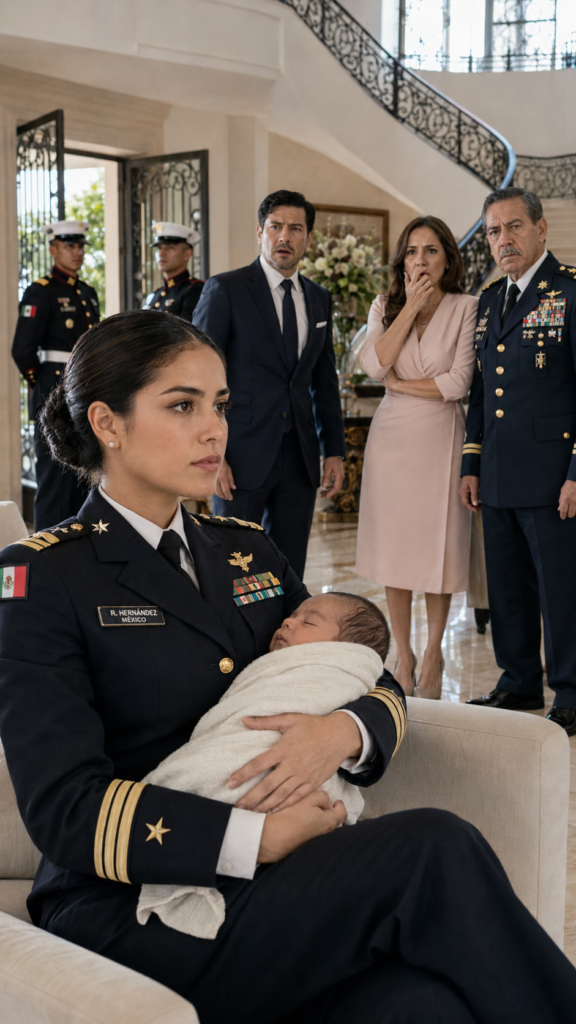
At 3:17 AM, in a military base in Mexico City, retired Colonel Arturo Mendoza received a call that jolted him awake.
It had been four years since he had seen his daughter Clara.
Not because he didn’t love her.
But because Rodrigo had gradually isolated her.
First, he said her family was too intense. Then that her dad wanted to control their marriage. After that, he convinced Clara to change her number, to move, to not answer calls "to avoid fights."
Clara, in love and pregnant, had wanted to believe Rodrigo just wanted peace.
But Arturo never stopped searching for her.
When he heard that his daughter was gravely ill and that the baby could die, he didn’t ask anything else.
—I’m on my way.
He arrived before dawn with two trusted men, his face hardened by fear.
Dr. Beltrán emerged from the operating room nearly an hour later.
—Your daughter is alive —she said—. But she lost a lot of blood. The baby is also alive, though delicate. He needs an incubator and monitoring.
Arturo closed his eyes.
For the first time in years, the ironclad soldier everyone knew broke.
—Where’s the husband?
The doctor lowered her gaze.
—He didn’t respond. According to messages, he was at a party.
That silence was worse than a scream.
Arturo asked to see Clara.
She woke many hours later, weak, her lips cracked, one hand attached to an IV. As she opened her eyes, she saw her father sitting beside her bed.
—Dad... —she whispered, like a little girl.
Arturo took her hand.
—I’m here, daughter. You’re not alone anymore.
Clara cried without strength.
—Rodrigo left me on the floor. I begged him. He told me I could wait.
Arturo took a deep breath, trying not to explode.
—Since when does he treat you like this?
Clara didn’t respond immediately.
Then she began to recount.
That Rodrigo controlled her money.
That he checked her phone.
That her mom entered the house unannounced.
That when Clara wanted to visit her family, he said, "a decent wife doesn’t run to her dad every time she gets upset."
That two weeks earlier, Doña Elvira had told her:
—If that baby is born weak, it’s because you don’t even know how to carry a family.
Arturo listened to it all with clenched fists.
But the real twist came the next day.
A social worker from the hospital asked to speak with him. She showed him something she had received from a neighbor of Clara’s, Doña Lupita, a woman who sold tamales on the corner and had become concerned when she saw the ambulance.
Doña Lupita had a camera pointing towards the entrance of the house.
The video clearly showed Rodrigo leaving while Clara screamed from inside.
But not only that.
The audio captured his voice.
—Even if she’s dying, she’s not ruining my mother’s party today.
Arturo froze.
The social worker swallowed hard.
—There’s more.
They had also recovered voice messages Rodrigo sent to the family group during the party.
In one, he said:
“Clara is putting on a show. If it were really serious, she would have fainted by now.”
In another, Doña Elvira replied:
“Leave her. That’s how women learn not to manipulate with tears.”
Clara listened to those audios from her hospital bed.
She didn’t scream.
She didn’t insult.
She only asked to see her baby.
When they brought her a picture of the boy inside the incubator, small, connected to tubes, with a blue hat covering his little head, Clara caressed the image with a finger.
—His name will be Mateo —she said—. And Rodrigo won’t touch him.
Colonel Mendoza needed no more.
He moved legal contacts, spoke with the Prosecutor’s Office, requested protective measures, and sought support to safeguard Clara when she left the hospital. Not out of cheap revenge, but because he knew that a man capable of abandoning his wife bleeding on the floor was also capable of pretending to be the victim.
And he was right.
For two days, Rodrigo did not appear.
He sent three messages.
The first read:
“Have you calmed down?”
The second:
“My mom says you’re just trying to be interesting.”
The third:
“When the baby is born, let me know. I’m his father.”
Clara didn’t respond to any.
On the afternoon of the second day, Rodrigo arrived home driving his black truck, wearing dark glasses and a smug smile. He was well-groomed, dressed as if he were heading to a photo shoot.
He brought a blue balloon that said “Welcome, champ.”
He expected to find Clara exhausted, crying, ready to forgive him.
He expected to hold his son and post a photo on Facebook with the caption:
“My greatest blessing.”
But as he turned into the neighborhood, he slammed to a stop.
The entrance to his house was filled with military vehicles.
There were two patrol cars, an official truck, and several armed men guarding the area. They weren’t aiming out of whim, but they were ready, alert, their gazes locked on him.
Rodrigo stepped down slowly, trying to smile.
—What’s this? Some kind of operation or what, dude?
No one laughed.
Arturo Mendoza emerged from the door.
Upon seeing him, Rodrigo lost color.
—Mr. Mendoza... what a surprise.
—The surprise was finding out that my daughter almost died while you toasted with your mother.
Rodrigo tried to regain his arrogant tone.
—Look, with all due respect, this is a marital issue. Clara exaggerates a lot. You don’t know how she is.
Arturo raised a folder.
—I know exactly how you are.
Rodrigo looked around.
—Where’s my son?
—In the hospital, fighting for his life —Arturo replied—. Thanks to the fact that his mother had more strength than all of you combined.
Rodrigo swallowed hard.
—I have rights.
—You also have responsibilities. And you abandoned them.
At that moment, a Public Ministry agent approached him with two police officers.
—Rodrigo Salazar, you are hereby notified of a temporary restraining order. You cannot approach Clara Mendoza or the minor Mateo Salazar Mendoza. You will also need to appear for questioning regarding neglect, domestic violence, and whatever else arises.
Rodrigo let out a nervous laugh.
—This is insane. My mom will fix this. She knows people.
As if summoned, Doña Elvira appeared behind a white truck, stepping down in high heels, large glasses, and a face of indignation.
—What are you doing to my son? —she shouted—. That woman was always a manipulator. That baby is our family’s!
Arturo looked at her with a calmness that was frightening.
—that baby belongs to Clara. And as long as she breathes, you will not humiliate her again.
Doña Elvira raised her finger.
—You don’t know who you’re messing with.
Then the agent pulled out another sheet.
—Mrs. Elvira Salazar, there’s also a complaint against you for psychological violence, threats, and participation in the events. Your audios have already been submitted.
The woman froze.
—What audios?
Rodrigo closed his eyes.
Arturo didn’t have to say anything. A neighbor, Doña Lupita, stepped forward from the sidewalk with her apron on and her phone in hand.
—The audios where you said to let her learn, ma’am. The whole neighborhood heard.
Some neighbors watched from their windows.
Others were filming.
The family that cared so much about appearances was being exposed on the street.
Rodrigo lost composure.
—Clara can’t do this to me! She’s my wife!
Arturo took a step toward him.
—No. She was your wife. Because the moment you left her bleeding on the floor to go eat cake, you lost the right to call her that.
Rodrigo tried to advance toward the house, but the officers stopped him.
—I just want to see the baby.
—No —Arturo said—. That baby will not be your trophy for social media.
In the hospital, Clara received the news without smiling.
There was no victory on her face.
Only exhaustion, pain, and a sad peace.
The doctor allowed her to enter for a few minutes to see Mateo. Clara rested her hand on the incubator and watched her son breathe with difficulty.
—I’m sorry for taking so long to understand —she whispered—. I promise no one will leave us behind again.
Days later, the case became a topic on Facebook. A video of Rodrigo arriving with his blue balloon while the military guarded the house went viral within hours.
Some said Clara exaggerated.
Some defended Rodrigo because “men also get tired.”
But thousands of women wrote the same:
“That wasn’t a mistake. That was abandonment.”
Rodrigo lost contracts, friendships, and the image of the perfect husband he flaunted. Doña Elvira stopped going to the club, not out of true shame, but because no one wanted to sit with her anymore.
Clara filed for divorce from the hospital.
She didn’t return to the house where she had begged on the floor.
Her father got her a quiet apartment near her family. Not luxurious, not huge, but filled with something Rodrigo had never given her: safety.
Mateo left intensive care 19 days later.
When Clara held him for the first time, she wept in silence. Her baby fit entirely in her arms, fragile yet strong at the same time.
Arturo watched them from the door.
—Your mom would be proud of you —he said.
Clara kissed Mateo’s forehead.
—I’m starting to be proud of myself too.
Months later, Rodrigo apologized in a hearing. He said he was confused, that his mother pressured him, that he didn’t think it was that serious.
Clara listened without looking down.
—I didn’t need you to think —she said—. I needed you to act. I begged you on my knees, and you chose a party.
The judge granted Clara provisional full custody and supervised visits only after psychological evaluations. He also ordered protective measures and a formal investigation for abandonment.
When Clara exited the courthouse, local press wanted to ask her questions.
She didn’t create a scandal.
She didn’t cry for the cameras.
She simply said a phrase that was shared thousands of times:
—A pregnant woman shouldn’t have to beg for her life. And a man who abandons his family at the worst moment doesn’t deserve to pose as a father when the danger has passed.
That night, Clara returned home, laid Mateo down in his crib, and turned off her phone.
For the first time in a long while, no one yelled at her, blamed her, or called her dramatic.
Only the calm breathing of her son filled the air.
And in that silence, Clara understood something that many people take years to accept: sometimes justice doesn’t begin when someone pays, but when a woman stops asking for permission to save herself.





