PART 1
—We don’t serve food from a woman who still doesn't understand her place.
Doña Beatriz said this without raising her voice, but everyone in the kitchen heard her.
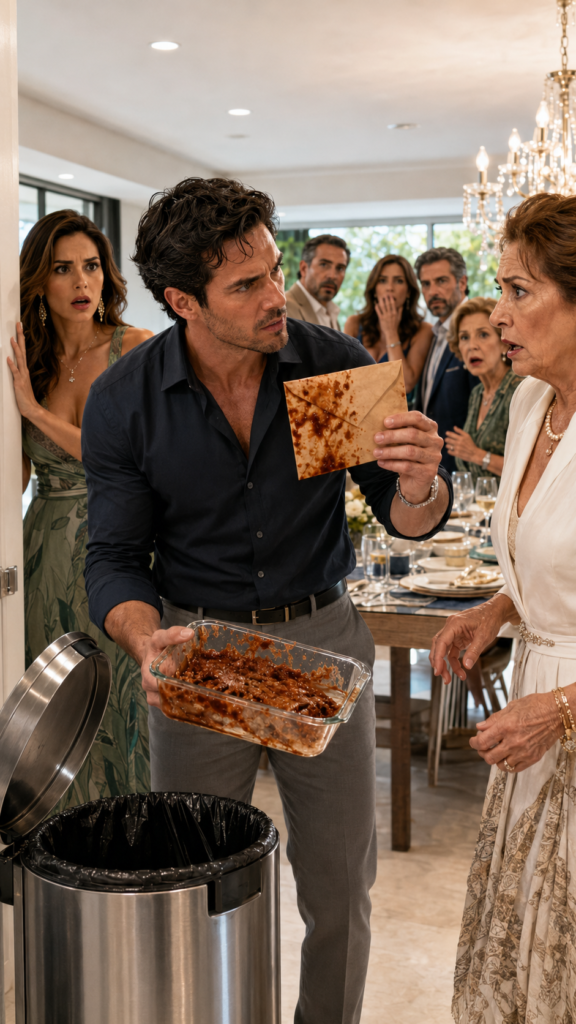
She took the glass dish with both hands, walked to the trash can, and dropped it atop used napkins, chicken bones, and lemon peels.
The sound was a harsh thud.
As if she hadn’t thrown away a capirotada.
As if she’d thrown away 7 years of patience.
Sofía Ledesma stood frozen in the doorway. She was 33 years old, worked as a supervisor at a private clinic in Mexico City, and had been married to Diego Arriaga, Doña Beatriz's eldest son, for 7 years.
During those 7 years, Sofía had learned to smile when her mother-in-law called her "delicate."
She had learned to stay silent when Doña Beatriz criticized how she dressed her daughter Valentina, who was 5.
She had learned to swallow her anger when at every family gathering she was compared to Jimena, Diego's ex-girlfriend, “a girl from a good family.”
But that afternoon, at the Arriaga family's annual meal, something broke.
The gathering was at Doña Beatriz's house, a large home in the Narvarte neighborhood, with a spacious living room, old tiles, and family portraits hanging like certificates of authority.
Every November, she hosted this meal as if it were a mandatory mass.
No one could miss it.
No one could express an opinion.
No one could bring something she hadn’t approved.
Sofía had been asked to bring red rice. Something simple. Nothing dangerous.
But three days earlier, Aunt Mercedes, Doña Beatriz's older sister, had called her from Puebla.
—Sofi, dear, I need a big favor. Tomorrow I’m going in for surgery and can’t make it to the meal. I want you to bring my piloncillo capirotada. You know, the one everyone expects.
Sofía hesitated.
—What if Doña Beatriz gets upset?
Aunt Mercedes let out a sad laugh.
—She’ll be upset even if you breathe, dear. But this time I need you to do exactly as I say.
She dictated the recipe in detail: golden bolillo, plantain, nuts, fresh cheese, cinnamon, piloncillo, and a hint of orange peel.
At the end, she asked for something strange.
—Put the dish in a bag and don’t open it until you get there. Underneath is an envelope. Don’t lose it.
Sofía didn’t ask.
She thought it would be recipes, medical documents, or some family message.
That morning she prepared the capirotada while Valentina slept with a slight fever and Diego washed dishes in silence.
—My mom’s going to make a scene —he said.
—Then tell her something.
Diego looked down.
—This time, yes.
Sofía didn’t fully believe him.
Because for years, every “this time, yes” ended in a “don’t mind her, love.”
When they arrived at the house, Doña Beatriz inspected the dish as if she were examining defective merchandise.
—Where’s the rice?
—Aunt Mercedes asked me to bring this.
Doña Beatriz smiled wryly.
—How convenient. Always looking for a way to show off.
Sofía tried to explain, but her mother-in-law snatched the dish from her hands.
Minutes later, Diego entered the kitchen and saw his mother crushing the lid of the trash can.
—Mom… what did you do?
Doña Beatriz wiped her fingers with a napkin.
—Putting order in my house.
Then, from the bottom of the trash can, a sticky yellow envelope slid out, stained with piloncillo honey.
Diego saw it.
So did Doña Beatriz.
And for the first time that afternoon, the queen of that house lost all color in her face.
No one could believe what was about to happen…
PART 2
Diego reached into the trash can before his mother could react.
He carefully pulled out the envelope. It was sticky, stained, but sealed inside a transparent bag.
On the front, it read:
“For Beatriz. If you humiliate another woman in this house again, let everyone know why this house was never solely yours.”
The dining room fell silent.
Even the cousins who had been arguing over the game stopped talking.
Doña Beatriz extended her hand.
—Give that to me, Diego.
He didn’t obey.
Sofía noticed something different in her husband. He wasn’t the Diego who avoided problems. He wasn’t the domesticated son who bowed his head to avoid upsetting his mother.
He was a man filled with shame.
And shame, when it arrives late, sometimes arrives with rage.
—What is this? —he asked.
—An old piece of paper from Mercedes. Just intrigues. You know how your aunt is.
From the living room, Aunt Rosa murmured:
—Mercedes has never been scheming.
Doña Beatriz shot her a deadly glare.
—You shut up, Rosa.
But no one moved.
That was the first blow against her power.
Diego opened the envelope. Inside was a letter, three old photographs, a notarized copy, and several stapled receipts.
Sofía felt her legs tremble.
Valentina appeared behind her, in her pink dress with a lollipop in hand.
—Mom, why did Grandma throw your cake away?
No one knew how to respond.
Sofía crouched down to hug her.
—Because sometimes adults behave badly when they don’t know how to express what hurts them.
Valentina looked at the trash can.
—But you made it with love.
The words landed on everyone like a clean slap.
Diego began to read the letter aloud.
“Beatriz: if this is in Diego's hands, it means you did exactly what I knew you would do. You threw away Sofía's food not because it was bad, but because it came from her. You’ve treated her like an intruder from day one, just like you treated Carmen, Rosa, me, and every woman who didn’t kneel before your ways.”
Doña Beatriz pressed her lips together.
—Diego, stop.
—No, Mom. Not this time.
He continued reading.
“For years, you’ve used this house as your throne. You said it was your inheritance, your sacrifice, your reward for taking care of our mother. But you forgot to mention that this house was purchased with money from three siblings: you, me, and Ernesto.”
A murmur swept across the table.
Ernesto was Doña Beatriz's younger brother. He had been living in Tijuana for 12 years and rarely came to gatherings because, according to Beatriz, “he had forgotten about the family.”
Diego lowered the letter and checked the notarized copy.
—Here it says the property was divided equally among Beatriz Arriaga, Mercedes Arriaga, and Ernesto Arriaga.
Doña Beatriz went rigid.
—That was my mother’s intention. But I paid for everything.
Aunt Rosa stood up slowly.
—No, Beatriz. That’s not true.
Everyone turned to look.
Rosa was one of those women who hardly ever spoke loudly. She always arrived with gelatin, greeted with a kiss, and sat near the door to leave early.
But that afternoon she spoke like someone tired of carrying another's burden.
—Mercedes sent money every month from Puebla. Ernesto paid for the roof when the house flooded in 2006. And I personally accompanied your mother to the notary when she signed that none of her children could sell or claim the house without the others’ consent.
Doña Beatriz slammed her palm on the table.
—I cared for my mother when everyone was busy!
—No one is taking that away from you —Rosa said—. But caring doesn’t give you the right to erase your siblings.
Diego checked the receipts.
There were deposits from Mercedes for 3,500 pesos monthly for years.
There were transfers from Ernesto for 18,000, 27,000, and 41,000 pesos for repairs.
There were printed messages where Doña Beatriz promised to “keep the papers” to avoid disputes.
And then there was a photograph.
In it, Beatriz was much younger, smiling in front of the notary with a blue folder in her hands. Next to her were Mercedes and Ernesto.
The same woman who had said for years “my house, my rules” was standing in proof that her rules had been born from a lie.
Renata, Beatriz's youngest daughter, put her glass down on the table.
—Mom… is that why you always said Aunt Mercedes was envious?
Doña Beatriz didn’t answer.
—Is that why you kicked Ernesto out when he asked to have a gathering here for Grandma’s anniversary?
The silence was worse than a confession.
Sofía felt something settle in her chest.
For years, she had believed the problem was her: her clothes, her food, her way of speaking, her origin from Ecatepec, her job, her way of raising Valentina.
But no.
She had only been the new threat in a house where Doña Beatriz needed to decide who was worthy and who wasn’t.
Diego laid the papers on the table.
—Mom, you owe Sofía an apology.
Doña Beatriz let out a bitter laugh.
—For a dessert? Are you really going to humiliate your mother for a dessert?
Diego looked at her, his eyes filled with tears.
—It’s not about a dessert. It’s about 7 years of making her feel less while I stayed silent like a coward.
Sofía closed her eyes.
That word hurt more because it was true.
Doña Beatriz pointed at Sofía.
—She’s putting ideas in your head.
—No —Diego said—. She has endured too much.
Renata wiped away a tear.
—Mom, I also saw her cry in the bathroom last birthday when you said Valentina looked like a "slum child" with how she came styled.
Sofía’s eyes flew open.
She didn’t know anyone had seen her.
Renata continued:
—And I didn’t say anything. I’m sorry, Sofi. I was afraid it would be my turn next.
Aunt Rosa lowered her head.
—We all let it happen.
Martín, a cousin who always laughed at Beatriz's comments, murmured:
—Honestly, yeah. We all did.
That was what finally shattered the gathering.
Not the shouting.
Not the documents.
But hearing several admit they had been witnesses and yet preferred the comfort of silence.
Doña Beatriz looked around as if the house were slipping from her hands.
—After everything I’ve done for you all…
Diego replied with a hard calm.
—you did good things. But good things don’t buy permission to mistreat.
Sofía took Valentina's hand.
—We’re leaving.
Doña Beatriz scoffed.
—Of course. Run away. That’s what women like you do when they can’t handle a decent family.
Sofía stopped.
This time, she didn’t look down.
—No, Doña Beatriz. Women like me leave when we understand that decency doesn’t live in a pretty house, but in how you treat people when you think no one will confront you.
No one applauded.
It wasn’t necessary.
Diego picked up Valentina, took Sofía's hand, and walked towards the door.
Renata grabbed her bag.
—I’m leaving too.
—Renata, don’t you dare.
—I just did, Mom.
Aunt Rosa followed them out.
Then Martín.
Then two cousins.
Then a couple of neighbors who always came out of obligation.
In less than 15 minutes, the great annual Arriaga meal turned into cold plates, empty chairs, and a queen sitting alone in front of a table that no longer obeyed.
Outside, the November afternoon smelled of rain and gasoline.
Valentina asked if there would still be dessert.
Diego kissed her forehead.
—Yes, little one. Let’s get some sweet bread.
Sofía didn’t cry until they reached the car.
She didn’t cry for the capirotada.
She cried for all the times she had pretended it didn’t hurt.
Diego didn’t try to justify himself. He only said:
—I’m sorry for taking 7 years.
Sofía looked out the window.
—I don’t want you to defend me only when there are witnesses.
He swallowed hard.
—I know.
—I want you to understand that a family isn’t protected by covering up abuses.
Diego nodded.
That night, when Valentina fell asleep with crumbs from concha on her pajamas, Diego called Aunt Mercedes.
She answered from the hospital.
—So she really threw it away?
Diego was frozen.
—you knew.
—I know my sister, son. The truth needed to come through the one door Beatriz never watches: her pride.
Mercedes explained that for years she had tried to talk about the papers, but Beatriz accused her of being ambitious.
Ernesto had also wanted to settle things peacefully, but his sister blocked him from all sides and started saying he was ungrateful.
The envelope wasn’t revenge.
It was a trap for the lie.
And Doña Beatriz fell into it because she couldn’t resist the opportunity to humiliate Sofía.
The following weeks were heavy.
Beatriz called Diego five times.
The first to say Sofía had bewitched him.
The second to demand they return “the family unit.”
The third to cry.
The fourth to insult.
The fifth to ask about Valentina.
Diego set a condition:
—You can see your granddaughter when you can speak respectfully about her mother.
Beatriz hung up.
Mercedes and Ernesto began legal proceedings to formally recognize their shares of the house. They didn’t want to sell it or throw Beatriz out. But they did want to strip her of the power to use it as a crown.
The house ceased to be the center of the family.
Gatherings began to take place in neutral places: a diner in Portales, a park in Coyoacán, Renata’s apartment, Sofía and Diego’s small house in Iztapalapa.
The first time Beatriz appeared, she arrived with a bag of churros and swollen eyes.
She didn’t fully apologize.
She only approached Sofía and said:
—I brought this for the girl.
Sofía didn’t smile.
—Thank you.
Valentina took a churro, broke it in two, and gave half to her grandmother.
—Here we share food, Grandma. We don’t throw it away.
Beatriz lowered her eyes.
For the first time, she had no cutting remark to defend herself.
She only whispered:
—No. Not here.
Sofía understood then that justice doesn’t always arrive as spectacular punishment.
Sometimes it arrives when a woman stops asking for permission to exist.
Sometimes it arrives when a husband finally understands that love isn’t asking for silence, but standing up.
And sometimes it arrives inside a sticky piloncillo-stained envelope, hidden beneath a dish someone tossed in the trash thinking that there they could also bury another woman’s dignity.
But the truth, when it is ready to come out, can’t be hidden even in the trash.





