PART 1
—If you love hiding things so much, stay out there until you learn to respect this house.
That’s what Santiago told Mariana before he shut the glass door to the balcony and turned the lock.
They lived in a third-floor apartment in Santa Tere, Guadalajara. It wasn’t luxurious, but Mariana had turned it into a home with pots of basil, light curtains, and a small table always set with coffee.
That night, a strange chill filled the air for November. A sharp wind seeped through the cracks, making the glass tremble as if it too were afraid.
Everything began with the visit from Rebeca, Santiago's older sister.
Rebeca arrived from Tepatitlán with fresh cheese, cajeta, and that hard look of a woman who believed no one was good enough for her brother. Ever since their father died, she felt entitled to make Santiago’s decisions.
Mariana spent the entire afternoon cooking. She prepared chicken in pasilla chili sauce, red rice, fresh beans, and hot tortillas. She wanted to impress, even though she knew Rebeca always found something to criticize.
—Oh, Mariana —Rebeca said as she tasted the sauce—. This is a bit bland, honestly. My mom knew how to cook for a man.
Mariana barely smiled.
Santiago heard it but said nothing. He thought it was better not to stir up trouble. That was his first mistake.
After dinner, Mariana cleared the plates and went to wash them. The sound of water in the sink began to flow, and Rebeca approached her brother.
—Santi, open your eyes. Your wife is stealing from you.
He let out an awkward laugh.
—Don’t be ridiculous, Rebe.
—I’m not being ridiculous. I heard her talking on the phone. She said: “Mom, I’ve saved up a bit more. I’ll send you the rest tomorrow.” Where do you think that money is coming from?
Santiago felt a punch in the gut.
That night, while Mariana slept, he checked the banking app. He found three transfers: two for 2,500 pesos and one for 3,000. All to an account he didn’t recognize.
The next morning, he tried to ask her.
—Mariana, who did you send 8,000 pesos to?
She turned pale.
—Santi, please, let me explain.
But that phrase, instead of calming him, sounded like a confession.
Rebeca appeared in the living room as if she had been waiting behind the door.
—See? I told you. They play the victim, but first, they squeeze their husband dry.
Mariana broke into tears.
—That’s not it. I swear it’s not.
—Then tell me who you sent it to —Santiago demanded.
Mariana lowered her gaze. Her hands trembled.
—I couldn’t tell you like that.
The rage, pride, and poison from Rebeca completely blinded him.
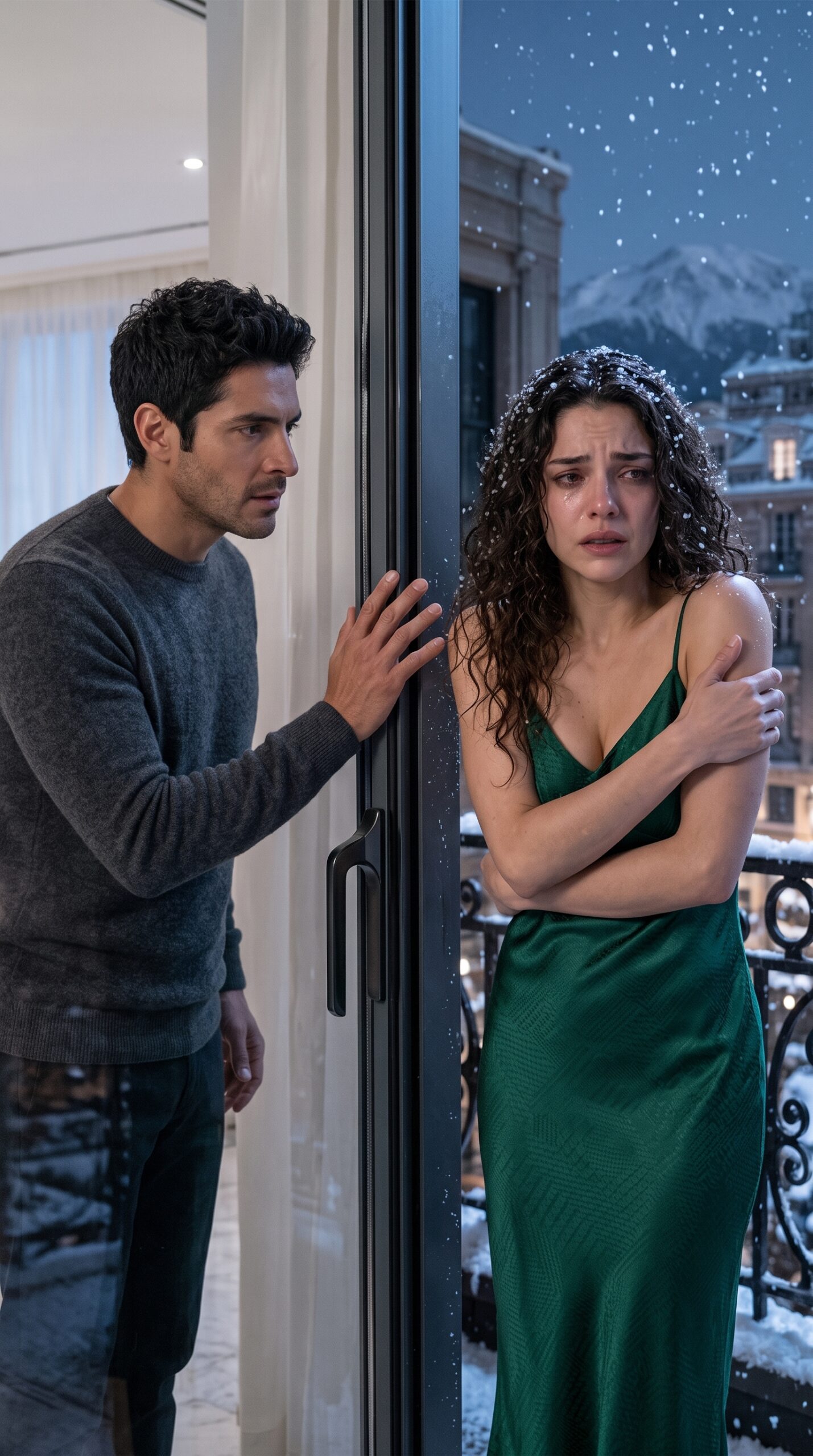
—Go out to the balcony —he ordered—. When you’re ready to tell the truth, you can come back in.
Mariana looked at him as if she had just discovered a stranger wearing her husband’s face.
—Santiago, it’s cold.
—You froze my trust as well.
She stepped out slowly, hugging her arms.
Santiago closed the door.
And turned the lock.
Rebeca didn’t stop him. On the contrary, she murmured:
—That’s how they learn.
At 3 AM, Santiago woke with a tight chest. The bed was cold on Mariana’s side. He got up, filled with regret, and walked to the living room.
But before he opened the door, he saw something that froze his blood.
On the floor was a wet trail, as if someone had entered soaked and walked to the balcony.
Next to the glass door lay Mariana’s ring.
And beneath it, a folded note in her handwriting.
Santiago opened the lock with shaking hands.
The balcony was empty.
Only a mark remained on the railing… and below, next to the sidewalk, a white figure that didn’t move.
PART 2
Santiago descended the stairs barefoot, stumbling on the steps as he shouted Mariana’s name.
Rebeca followed him, but she no longer sounded bossy. She sounded scared.
In the street, two neighbors stood by the entrance tree. A woman held a blanket. A delivery man had his phone pressed to his ear, calling for an ambulance.
Santiago pushed his way through and fell to his knees.
Mariana was there, in a white nightgown soaked with dew, her lips purple, and one hand clutching a crumpled paper.
But she was breathing.
Barely, but she was breathing.
—Mariana! My love, I’m sorry! —he shouted, touching her cold face.
She didn’t respond.
At the Civil Hospital of Guadalajara, they admitted her as an emergency. Santiago spent hours sitting in a plastic chair, his hands dirty, his pants wet, and his head pounding with guilt.
Rebeca paced back and forth.
—I didn’t want this —she repeated—. I just wanted to protect you.
Santiago didn’t respond.
At 7 AM, a doctor emerged from the emergency area.
—Family of Mariana López?
Santiago stood up.
—I’m her husband.
The doctor looked at him with a seriousness that dried his mouth.
—We managed to stabilize her. She has hypothermia, injuries from the fall, and significant intoxication.
—Intoxication? —Santiago asked—. What do you mean?
—We found sedatives in her blood. Also traces of a substance used in agrochemicals. It wasn’t a single dose. It seems it was entering her system over several days.
Rebeca stopped pacing.
Santiago turned to look at her.
—Agrochemicals?
The doctor lowered her voice.
—Someone could have been poisoning her little by little.
The world fell silent around him.
Santiago then recalled the teas Rebeca had brought during the week. She said they were “country remedies” for stress and stomach issues. Mariana took them to avoid being rude.
Rebeca never drank them.
When Santiago returned to the apartment, he was no longer looking for money. He was looking for answers.
In the kitchen, he found the jar of herbs. In the sink, a cup with a bitter smell. On the balcony, he found something else: a cigarette butt hidden behind a pot and a short, copper-colored hair.
Neither he nor Mariana smoked.
Rebeca claimed she didn’t either.
Santiago collected everything in a bag and called Tomás, a friend who worked as an expert at the prosecutor's office.
—I’m not asking for favors —he said—. I’m asking you to tell me if I’m crazy.
Tomás arrived that afternoon. He inspected the balcony, the cup, the butt, and the jar. He didn’t say much, but his face hardened.
—This is no longer a couple’s fight, man —he murmured—. This smells like a crime.
While they waited for results, Santiago finally read the note Mariana had left next to her ring.
“Forgive me for hiding the money. My mom needs urgent surgery in Colima. I didn’t want to worry you because you already have the car debt and apartment payments. I’m not a thief. I was just afraid of being another burden for you.”
Santiago felt something inside him shatter.
The 8,000 pesos weren’t for a lover.
They weren’t for a lie.
They were to save doña Teresa, Mariana’s mother, who had been waiting for a tumor operation for weeks.
He didn’t ask.
He accused.
He shut the door.
That night, Tomás called.
—The cup has traces of the same substance found in her blood. And the cigarette butt has DNA from a woman named Irma Salcedo.
Santiago frowned.
—I don’t know any Irma.
Tomás paused.
—But your sister does. There are photos of them together. Irma works in a fertilizer warehouse in El Salto.
Santiago felt his blood rush to his face.
Rebeca was sitting in the living room, clutching her bag like a scolded child. When he mentioned Irma’s name, she turned pale.
—What does Irma have to do with Mariana? —Santiago asked.
Rebeca opened her mouth, but nothing came out.
—Answer me.
She began to cry.
—I didn’t know this would happen.
That phrase was worse than a confession.
Santiago approached slowly.
—What did you do?
—Irma told me that Mariana wasn’t a good woman. She said she had known her before, that she was dangerous, that she had already destroyed a family.
—And you believed her?
—I saw the transfers. I saw how nervous she got. I thought you were blind.
Santiago slammed his palm on the table.
—My wife was gathering money to operate on her mother!
Rebeca covered her mouth.
—I didn’t know.
—Because you never asked. Because you didn’t want the truth. You wanted to be right.
Silence fell heavily.
Hours later, the prosecutor's office summoned Rebeca. They didn’t handcuff her in front of the neighbors, but everyone saw her leave with a destroyed face, as if she finally understood that suspicion could also kill.
Irma was arrested the following day at the warehouse where she worked. At her home, they found a jar with the same substance, deleted messages, and a notebook with dates.
The dates matched the days when Rebeca had brought “natural teas” to the apartment.
But the hardest blow came afterward.
Irma confessed that she had known Mariana for four years.
They had both worked in a packing plant in Tlajomulco. An old machine, which the company refused to repair, trapped a worker during the night shift. His name was Julián Salcedo.
He was Irma’s brother.
Mariana tried to help him. She cut her arm, screamed for help, ran to turn off the machine. But when the paramedics arrived, Julián was already dead.
The company blamed “a personnel oversight” to avoid paying compensation. Irma needed to hate someone, and she chose Mariana.
For four years, she carried that rage.
When Rebeca told her that her sister-in-law was secretly sending money, Irma saw the perfect opportunity.
—That woman has already ruined a household —she said—. Now she’s ruining yours.
Rebeca believed her.
At first, there were comments.
Then teas.
Then visits to the building with a key Rebeca left her “for emergencies.”
On the night of the balcony, Irma entered when Santiago had already locked Mariana out. She wanted to scare her, force her to confess a guilt that never existed.
But she found Mariana half-unconscious.
Mariana had taken sedatives, not to die, but to sleep. To not feel the cold, the shame, or her husband’s voice telling her she was a thief.
Irma panicked. She tried to lift her. Mariana slipped, hit the railing, and fell toward the tree. Irma spilled water when she entered, left the butt behind while hiding, and fled without calling for help.
A neighbor who went out for medicine for her son found her.
That neighbor saved her life.
When Mariana woke three days later, Santiago entered the room with red eyes. He didn’t bring flowers. He understood that no bouquet could cover a closed door.
Mariana looked at him without hatred.
That hurt him more.
She had a tired look, like someone who had cried everything inside.
—I know the truth —he said—. About your mom. About Irma. About Rebeca.
Mariana turned her face toward the window.
—I tried to save Irma’s brother.
—I know.
—No one believed me.
Santiago lowered his head.
—Neither did I.
A tear ran down Mariana’s temple.
—That’s what broke me the most.
He sat next to the bed, but he didn’t dare touch her.
—I didn’t come to ask for forgiveness to feel better —he said—. I came to tell you that I’m going to testify to everything. What Irma did, what Rebeca did, and what I did. Because even if the law doesn’t punish me the same, I hurt you too.
Mariana closed her eyes.
—My mom needs the surgery.
—It’s already paid for —Santiago replied—. Not to buy you anything. Just because I should have been with you from the start.
Mariana cried in silence.
He did too.
There was no embrace.
There was no beautiful reconciliation like in a novel.
Just two broken people understanding that an apology doesn’t erase a cold night.
Irma was processed for attempted poisoning and injuries. Her lawyer spoke of pain, trauma, and loss. But the judge was clear: suffering doesn’t give the right to destroy another life.
Rebeca didn’t step into prison, but she lost something that meant more to her: the place she thought she had in Santiago’s life.
Before returning to Tepatitlán, she went to the hospital. She stood at the door, with swollen eyes.
—Mariana —she said—. I’m ashamed of myself.
Mariana looked at her from the bed.
—Shame doesn’t return the night I thought my husband hated me.
Rebeca lowered her gaze.
—I know.
—Then live with that. I’m going to try to live with mine.
When Mariana left the hospital, she didn’t want to return to the apartment.
She stood frozen in front of the glass door of the balcony. Santiago watched her from the kitchen.
—I can’t live here —she said—. Every time I see that lock, I hear how you closed it.
Santiago swallowed hard.
—We’re leaving.
—Don’t do it out of guilt.
—It’s not out of guilt. It’s because this house has stopped being a home for you.
They moved to a little house in Tlaquepaque, near a street that smelled of wet clay, coffee, and sweet bread in the mornings. Mariana brought her plants. Santiago sold almost everything else.
For months, they lived slowly.
There were good days: doña Teresa’s successful surgery, walks through the Parián, afternoons without shouting.
And there were bad days: Mariana would stay silent for hours. Santiago would wake up at 3 AM to check if she was still by his side.
One rainy night, Mariana made chamomile tea. They sat in the patio, without touching.
—I don’t know if I’ll ever forgive you like before —she said.
—I understand.
—But I don’t want to live hating you either.
Santiago felt a knot in his throat.
Mariana watched the rain fall on the pots.
—The worst part wasn’t the balcony. It was realizing that a woman can sleep next to her husband and still feel alone.
He closed his eyes.
—I never want you to feel alone with me again.
—That can’t be promised, Santiago. It has to be shown.
From then on, he learned to ask before imagining. He learned that family doesn’t always protect; sometimes they invade, accuse, and destroy in the name of love.
He also understood that a woman’s silence isn’t always guilt.
Sometimes it’s fear.
Sometimes it’s exhaustion.
Sometimes it’s a desperate way of not worrying anyone while she’s crumbling inside.
A year later, Rebeca sent a handwritten letter.
“I’m not asking you to come back. I just want to say that every Sunday I light a candle for Mariana. I learned late that loving someone doesn’t mean deciding for them.”
Santiago showed it to Mariana.
She read it, folded it, and put it in a drawer.
—Not yet —she said.
Santiago didn’t insist.
That was another lesson: forgiveness doesn’t have a calendar.
It’s not demanded.
It’s not used to cleanse the conscience of the one who hurt.
The last time they passed by the old building, Santiago looked up at the third floor. The balcony had new plants and different curtains. Another family lived there, perhaps laughing without knowing that in that place a woman felt the world expelling her.
Mariana, from the car, asked him:
—Are you okay?
He raised up and took the wheel.
—Yeah. I was just remembering how fragile a house can be when we fill it with suspicion.
Mariana said nothing.
But she placed her hand on his.
It wasn’t complete forgiveness.
It was something more honest: to keep walking without denying the wound.
Because Santiago almost lost Mariana over a closed door. Rebeca lost her brother for believing that love was control. Irma lost her humanity for a misunderstood revenge.
And Mariana, the only one trying to save everyone in silence, was the one who ended up carrying the biggest wound.
Sometimes tragedy doesn’t start with a blow.
It starts with a poisonous phrase at the table.
With a doubt sown by a family member.
With a question no one dares to ask.
And when the truth arrives, often it’s too late to return what was broken.