PART 1
Andrés Mendoza returned to Querétaro after six months of security service abroad, carrying a backpack, two discreet medals, and a hope that sustained him through the darkest nights: to embrace Valeria, his wife, once more.
He had imagined a thousand times the door opening, her running towards him, crying tears of joy, wrapping her arms around his neck as she used to.
But when he crossed the threshold of his home in Juriquilla, Valeria did not run.
She didn’t even smile.
She stood by the living room, thinner, paler, wearing a huge sweater despite the heat. Her hands trembled around a cup she didn’t drink from.
“Welcome back,” she said, her voice so soft it seemed borrowed.
Andrés dropped his backpack and moved closer, but Valeria stepped back.
That small movement hurt more than any blow he had endured in service.
Doña Socorro, his mother, appeared from the kitchen with an exaggerated smile.
“Oh, son, don’t pressure her. The poor thing is sensitive. Taking care of the house alone is no small feat.”
Ricardo, his younger brother, leaned against the doorframe, wearing a new shirt, an expensive watch, and a confidence he hadn’t had before.
“Yeah, bro. Give her a break. She’s been a bit intense these months.”
Andrés looked at Valeria.
She lowered her head.
In the following days, the house felt like a hotel where everyone pretended to know each other. Valeria avoided being alone with him. She slept on her side, changed in the bathroom with the door locked, and jumped every time Socorro raised her voice.
Ricardo entered without knocking.
“I need Valeria to sign some papers tomorrow,” he said as casually as if he were discussing buying tortillas.
Andrés asked what papers.
“Just some things for the family business. Administrative stuff. Don’t worry about it, you’re tired from your trip.”
The business wasn’t family.
It was Andrés and Valeria’s.
They had built it from scratch: small warehouses, refrigerated transport, contracts with producers from Tequisquiapan and clients at the Central de Abasto. It wasn’t an empire, but it was theirs.
One night, Andrés entered the study and reviewed the account statements.
He found strange transfers.
Moved shares.
Power of attorney.
Assets appearing linked to a new corporate name: Grupo Rivas Mendoza, managed by Ricardo.
His chest tightened.
He searched for Valeria in the bedroom.
She sat on the bed, staring into space.
“Did you sign this?” he asked, trying to keep calm.
Valeria looked at the documents and went pale.
“Andrés, I… I didn’t really know what it was.”
He felt the rage rise like fire.
“Who forced you?”
Valeria began to cry silently.
“Your mom said that if I didn’t sign, when you came back, you’d find the business ruined because of me. Ricardo said I didn’t understand anything, that I was just a burden.”
Andrés wanted to take her hand.
She flinched.
In that instant, the ugliest suspicion pierced his mind.
What if it wasn’t fear? What if it was guilt? What if during those six months she had been with someone else?
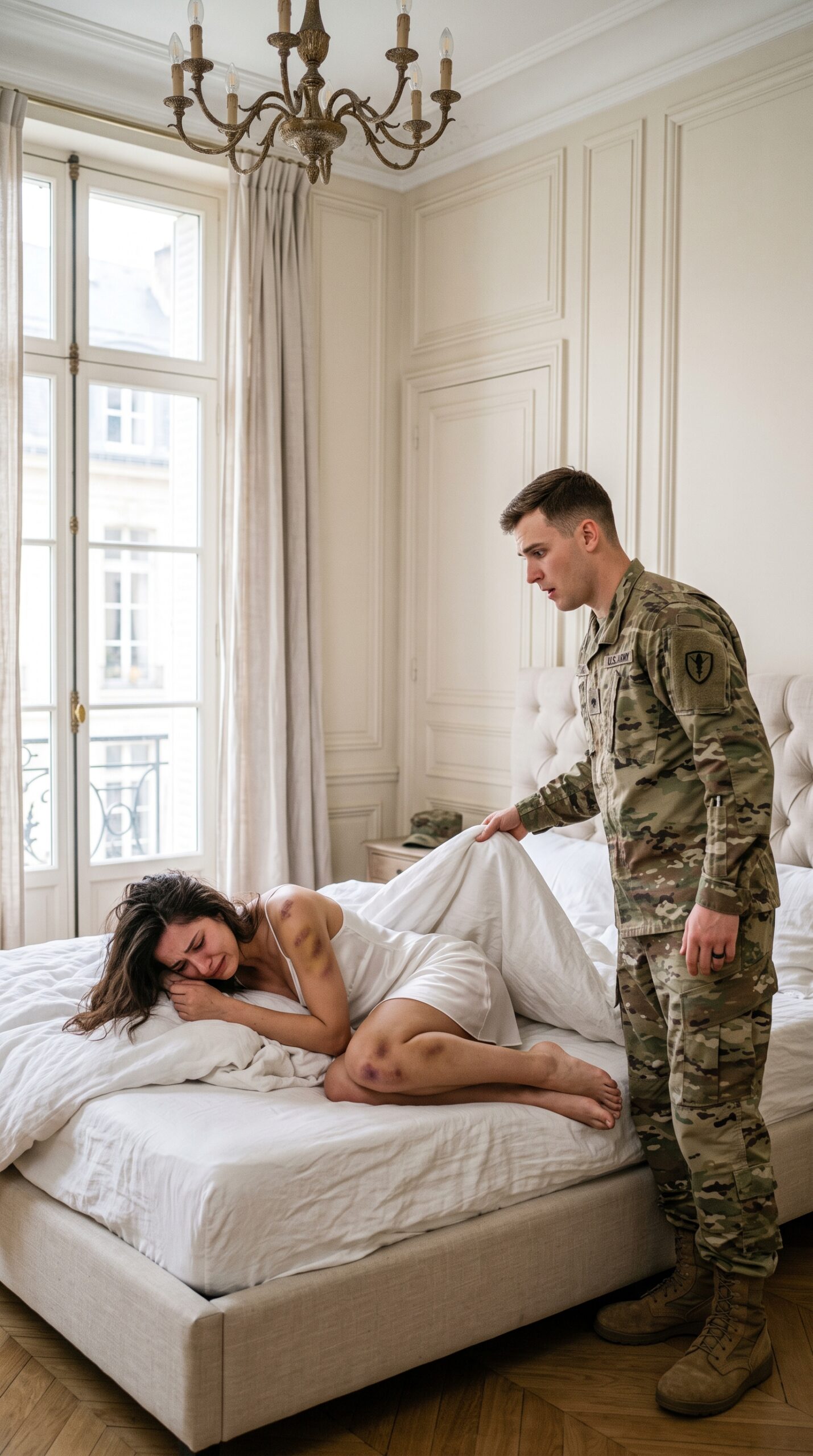
That night, while Valeria slept restlessly, Andrés noticed her sweater had ridden up slightly.
There was a dark bruise near her side.
With his heart pounding against his ribs, he lifted the blanket, searching for proof of a betrayal.
But what he saw froze his blood.
Valeria had bruises on her arms, her legs, and around her ribs, as if someone had tried to break her silently.
PART 2
Andrés didn’t scream.
He didn’t wake the whole house.
He didn’t go to confront Ricardo, although every muscle in his body screamed for it.
He sat on the edge of the bed, staring at the marks his wife had hidden beneath oversized clothes, false smiles, and silences that no one wanted to hear.
Valeria opened her eyes and saw him.
For a moment, she looked like a child trapped in a stranger’s home.
“I’m sorry,” she whispered.
Andrés felt that word shatter him.
“You don’t have to apologize to me.”
Valeria quickly covered herself, embarrassed, as if the marks were her fault.
He knelt in front of her.
“Tell me who did this.”
She shook her head.
“If I talk, your mom will say I’m crazy. Ricardo has everyone on his side. Even the notary came to the house like he was their buddy.”
Andrés clenched his jaw.
“Then we won’t talk. We’ll prove it.”
The next morning, he feigned normalcy.
He had breakfast with Socorro and Ricardo as if nothing had happened.
“Mom, Ricardo, I’ve thought a lot,” he said while pouring himself coffee. “Maybe it’s best if Ricardo takes more control. I’m tired, and Valeria needs to rest.”
Ricardo’s eyes sparkled.
“Finally, you’re getting it, bro.”
Socorro smiled like a lady leaving mass.
“I always told you that family knows how to take care of its own.”
Valeria looked at him from the table, confused and scared.
Andrés barely moved his head, asking for her trust.
That same day he contacted three people: a criminal lawyer in Mexico City, a financial auditor who had worked with insurance companies, and an old service buddy who now collaborated with a property investigation unit.
He didn’t start a fight.
He built a case.
First, they took Valeria to a private doctor. The medical certificate was clear: injuries consistent with repeated blows, some recent and others weeks old.
Then they reviewed the signed documents.
There were signatures made on days when Valeria had registered medical appointments. There were changed pages. There were powers of attorney that didn’t match the original version. There were transfers authorized from a computer connected to Socorro’s home network.
Then the first audio appeared.
Valeria had recorded it out of fear, not knowing if it would ever be useful.
Ricardo’s voice sounded mocking:
“Sign, Val. Andrés won’t even find out. And if he does, my mom will tell him you were having an affair with half of Querétaro.”
Then Socorro’s voice, cold as a knife:
“A woman alone doesn’t run a Mendoza household. Know your place.”
Andrés listened to that audio four times.
On the fifth, he got up, went to the bathroom, and vomited.
Not from weakness.
But from guilt.
Because while he thought Valeria was rejecting him for betrayal, she had been surviving.
The following days were a theatrical performance.
Ricardo spoke on the phone on the terrace, saying they would soon close new contracts with the “rearranged” assets.
Socorro began organizing a big dinner to celebrate “Andrés’s return” and “the new phase of the business.”
She invited uncles, cousins, partners, suppliers, a couple of lawyer friends, and even the notary who had certified several signatures.
“It’s going to be something beautiful,” Socorro said. “So everyone can see this family is more united than ever.”
Andrés accepted.
He even paid for the banquet.
Ricardo mocked him in private.
“I thought you’d be tougher, bro. But good for you for maturing.”
Andrés patted him on the shoulder.
“I’m seeing things more clearly.”
And it was true.
The night of the dinner, the house looked like an event hall. Warm lights, flower arrangements, waiters coming in and out, modern bolero music playing, and glasses clinking as if nothing was rotten underneath.
Valeria came down in a dark blue long-sleeved dress.
She still covered herself.
But that night, she no longer walked alone.
Andrés took her hand in front of everyone.
Socorro noticed and pressed her lips together.
Ricardo, on the other hand, was too busy bragging.
“The business needed fresh blood,” he said, glass in hand. “Andrés did his part serving the country, of course, but someone here had to make real decisions.”
Some guests clapped.
Others looked uncomfortable.
Socorro raised her glass.
“To my children, to unity, and to the sacrifices mothers make to protect what belongs to the family.”
Andrés smiled slightly.
Then he stood up.
The room fell silent.
“Thank you for coming,” he began. “My mom wanted this dinner to celebrate trust. And she’s right. Tonight we’re going to talk about trust.”
Ricardo raised his glass.
“Yeah, bro.”
Andrés looked at Valeria.
She took a deep breath.
“Six months ago, I left thinking I was leaving my home in my family’s hands. I believed my wife would be protected. I believed my mother and brother would understand that loving someone also means respecting what they built.”
Socorro set her glass down on the table.
“Andrés, don’t start with the drama.”
He didn’t reply.
At that moment, two court clerks, a lawyer, and two police agents entered.
The music stopped.
The notary jumped up suddenly.
Ricardo let out a nervous laugh.
“What is this nonsense?”
The lawyer opened a folder.
“Cautionary measures are being imposed on the property transfers made in favor of Grupo Rivas Mendoza. It is also reported that there is a complaint for forgery, fraud, dispossession, threats, and injuries.”
The entire dining room froze.
An aunt murmured:
“Oh, holy Virgin…”
Socorro turned red.
“This is an embarrassment. Andrés, tell these people to leave.”
Andrés pulled out his phone and connected the audio to a speaker.
Ricardo’s voice filled the room:
“Sign, Val. Andrés won’t even find out.”
Then came Socorro’s voice:
“A woman alone doesn’t run a Mendoza household.”
No one clapped.
No one toasted.
The silence weighed more than a tombstone.
Ricardo lunged at Andrés.
“That’s edited, dude!”
One of the agents stopped him.
Valeria, trembling, stepped forward.
“It’s not edited. And there’s more.”
Then she revealed the detail that changed everything.
For months, Socorro had been giving her pills “for nerves,” supposedly prescribed by a doctor friend. Valeria felt dizzy, confused, and weak when she signed documents.
The doctor had found traces of sedatives in her tests.
The notary paled.
“I didn’t know anything about that.”
Andrés looked at him.
“But you knew she couldn’t read a deed fully when you hid the pages with the folder.”
The lawyer presented copies, dates, internal camera videos, and call logs.
The dinner turned into a social interrogation.
The partners who had congratulated Ricardo distanced themselves from him as if he were on fire.
One of the suppliers said quietly:
“No wonder he wanted to change the accounts so fast.”
Socorro tried to approach Andrés.
“Son, I just wanted to protect what was yours. That woman was taking away your authority. You were going to end up with nothing.”
Andrés looked at her as if he were finally seeing a stranger.
“What they almost took from me was my wife, my peace, and the embarrassment of calling you mother.”
Socorro cried, but her tears no longer commanded.
Ricardo shouted that it was all a trap.
But when the agents asked him to hand over his phone, they found messages with the notary, account statements, and a conversation where he boasted:
“When Andrés comes back, there won’t be anything to claim. Valeria signs even in fear.”
That phrase sunk him.
Valeria didn’t celebrate.
She didn’t smile in victory.
She just sat down, as if her body finally understood that it no longer had to defend itself.
Andrés sat beside her and held her hand gently, without squeezing it.
“I’m sorry for doubting you,” he said softly.
She took time to respond.
“I doubted myself too. That was the worst.”
Months later, the business recovered its assets. The transfers were provisionally annulled while the process moved forward. Ricardo faced charges for fraud and injuries. The notary lost his license while his involvement was investigated. Socorro was out of the house, out of the business, and out of her son’s daily life.
The family divided.
Some said Andrés had exaggerated by exposing them in front of everyone.
Others said that finally, someone had put a stop to it.
On Facebook, if the story had come out in full, surely half of Mexico would have commented the same: “family can also be the place where you get hurt the most.”
Andrés and Valeria moved to a smaller house in San Miguel de Allende. It wasn’t luxurious, but it had big windows, bougainvillea at the entrance, and one simple rule: no one entered without permission.
Valeria started therapy.
Andrés did too.
Because justice can recover documents, accounts, and properties, but it doesn’t immediately return the nights without fear.
One afternoon, while watering the plants, Valeria let Andrés hug her from behind.
It was a small hug.
Almost timid.
But for them, it was worth more than any business.
Socorro sent letters, audios, messages with phrases of a regretful mother.
Andrés never replied with insults.
He just sent a copy of the complaint and a line:
“Blood doesn’t justify cruelty.”
And perhaps that was the hardest lesson.
Sometimes the enemy doesn’t break in through the door, shattering locks.
Sometimes they have keys to the house, sit at your table, call you “son,” and expect that familial love will be enough to forgive everything.





