PART 1
At 19, Mariana Salgado learned that a door can slam shut harder than a punch.
She lived in a simple house in León, Guanajuato, with cream-colored walls, a Virgin of Guadalupe at the entrance, and a dining room where her mother served coffee every afternoon. Her father, Rogelio Salgado, was a straight-laced man, dry, proud of his name, and of never owing anything to anyone.
That afternoon, Mariana sat in front of them, hands trembling. On the table lay a pregnancy test.
Her mother, Teresa, clutched her chest.
Rogelio said nothing at first. He just stared at the white plastic as if it were a death sentence.
—Who is it from? —he finally asked.
Mariana looked down.
—I can't say.
Silence filled the room.
—What do you mean you can't? —Teresa whispered—. Honey, don’t play with this.
Rogelio clenched his jaw.
—Is he married? Is he a criminal? Who got you into this mess?
Mariana swallowed hard. She had rehearsed that conversation a thousand times, but none stung as much as the real one.
—It’s not that simple, Dad.
—Of course, it’s simple —he replied, slamming his palm on the table—. You either tell me who the father is or you fix this before the whole neighborhood finds out.
Teresa was crying silently.
Mariana lifted her face.
—I can’t end this pregnancy.
—Can’t or won’t? —Rogelio spat.
—If I do, it won’t just affect me. It will affect our whole family.
Rogelio let out a bitter laugh.
—Look at you. Now it turns out your misfortune is about protecting us.
—One day you will understand —Mariana said, her voice breaking—. And that day, you will wish you had listened to me.
That phrase ignited her father’s fury.
Rogelio stood up.
—You have two options. You get rid of that pregnancy… or you leave this house.
Teresa's eyes widened.
—Rogelio, please…
—No! —he shouted—. This house will not bear a shame that you can’t even explain.
Mariana froze.
—Dad, I’m begging you. Trust me.
He pointed to the door.
—Trust is earned. And you lost it.
Less than an hour later, Mariana was on the sidewalk with an old suitcase, 380 pesos in her pocket, and her heart shattered.
Teresa watched her from the window, crying as if something had been ripped from her soul.
But she didn’t come out.
She didn’t hug her.
She didn’t stop her.
That night, Mariana took a bus to Mexico City. She changed her number, looked for work in a diner, washed dishes, cleaned tables, and for months slept in a borrowed room behind a stationery store.
When her son was born, she named him Gabriel.
It wasn’t easy.
There were nights when Mariana ate tortillas with salt to save milk and diapers for the baby. There were mornings when she studied nursing with Gabriel sleeping on her lap. There were days when exhaustion knocked her down, but he would open his eyes, smile, and everything would make sense again.
Gabriel grew up different from other children.
He was serious, kind, inquisitive. He had the light eyes of someone Mariana never mentioned and a way of furrowing his brow that broke her heart.
At 10, on his birthday, he asked her the question she had avoided her whole life.
—Mom, do my grandparents know I exist?
Mariana stopped cutting the cake.
—They know… that you were born.
—And don’t they want to meet me?
She couldn’t answer.
Gabriel looked down.
—Did I do something wrong?
That comment destroyed her.
That same night, after watching him sleep, Mariana pulled out a metal box hidden in the closet. Inside was a leather bracelet, a folded photo, and a yellowed letter with a signature she had burned like fire for 10 years.
Damián Escobedo.
The name her parents had never wanted to hear.
The name of the man everyone thought was dead.
The name of Gabriel's true father.
The following Saturday, Mariana boarded a bus with her son. They traveled five hours to León. Each kilometer opened an old wound.
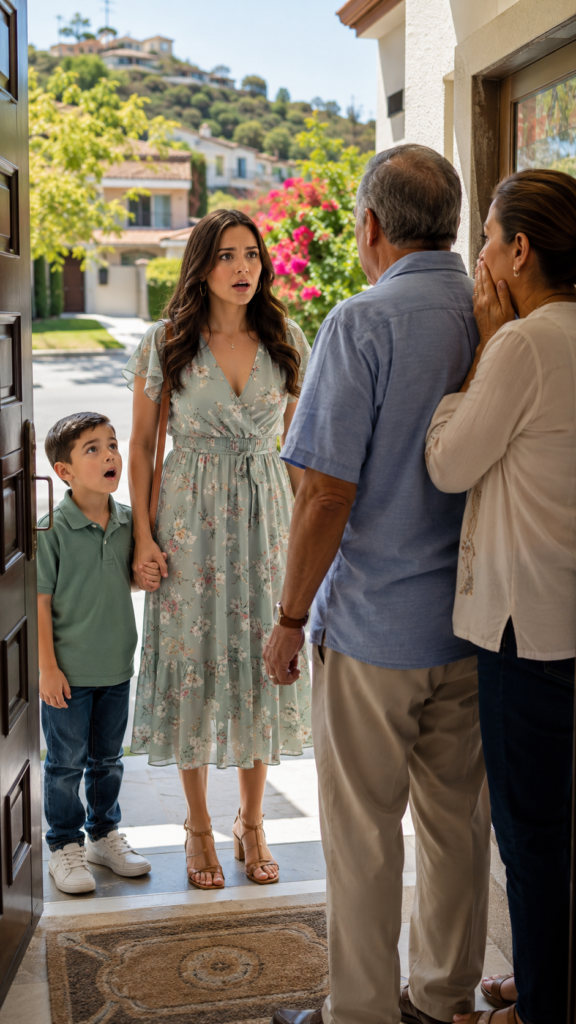
When they arrived, the house looked almost the same. The same green gate. The same pots with bougainvilleas. The same door Rogelio had slammed in her face.
Mariana took a deep breath and knocked.
Seconds passed.
The door opened.
Rogelio appeared with whiter hair and a more hunched back. Upon seeing her, he stood frozen.
—Mariana…
Teresa emerged behind him. When her eyes fell on Gabriel, she covered her mouth with both hands.
No one said a word.
Gabriel squeezed his mother’s hand.
Mariana looked at her parents with a calm she had taken 10 years to build.
—I didn’t come to fight.
Rogelio swallowed hard.
—Then why did you come?
She placed a hand on her son’s shoulder.
—to finally let you know why I couldn’t give him up.
Teresa began to tremble.
—Mariana…
—Gabriel's father was Damián Escobedo.
Rogelio’s face lost all color.
Teresa clutched the door frame.
Mariana stepped forward and delivered the sentence that took their breath away.
—And Damián wasn’t dead when you signed that declaration.
PART 2
Rogelio recoiled as if the floor had caved beneath his feet.
Teresa began to shake her head.
—No… don’t say that.
Mariana didn’t raise her voice. She was no longer the scared girl they had thrown out. She was a woman who had carried a truth too heavy all alone.
—You knew —she said—. You knew that night Damián hadn’t left drunk in his truck, as you declared to the Public Ministry.
Rogelio clenched his fists.
—Shut up. You don’t know what you’re saying.
—I do know, Dad. I’ve known for 10 years.
Gabriel watched them all, not fully understanding, but feeling that something enormous had just shattered.
Teresa started to cry.
—Your father wanted to protect us.
Mariana let out a sad laugh.
—Protect us? You kicked me out pregnant to protect me.
Rogelio ran a hand over his face.
—Damián was a danger to you.
—No. Dangerous was his father.
The name Octavio Escobedo fell in the room like a shadow.
In León, everyone knew Don Octavio. Owner of warehouses, ranches, workshops, and half the world. A man who donated money to churches, posed for photos with politicians, and smiled in public while destroying lives in private.
Damián was his only son.
He was also the young man who had fallen in love with Mariana without asking for permission, without hiding her, and without being ashamed of her.
They met when Mariana helped her father deliver invoices to the mechanic shop where Rogelio worked. Damián would come to review cars for the family business, always dressed simply, always kind to the employees.
At first, Rogelio saw him with respect.
Later, when he noticed how he looked at Mariana, he began to hate him.
Damián had promised Mariana that he would talk to his family. He also told her he had proof of his father’s dirty dealings: money laundering, false invoices, and threats against workers who wanted to sue.
The night Damián disappeared, he was on his way to Mariana’s house.
He wanted to ask for permission to marry her.
He wanted to tell Rogelio that she was pregnant.
But he never arrived.
Hours later, the police reported an accident on the old road to Silao. The official version said Damián was driving drunk, lost control, and died burned alive.
Mariana didn’t believe it.
Because one day before, Damián had left her a letter hidden in the public library.
In that letter, he wrote that if anything happened to him, she should seek a lawyer named Héctor Villalba and never give the baby to the Escobedo family.
—He knew his father wanted to erase him —Mariana said—. And when I told you I couldn’t explain everything, you chose to think I was a nobody.
Teresa sank into the couch.
Rogelio looked out the window, as if he could still escape that truth.
—We were threatened —he finally murmured.
Mariana felt her stomach tighten.
—By whom?
Rogelio didn’t respond.
Teresa did.
—Octavio Escobedo sent two men. They arrived the same night of the accident. They said that if we didn’t sign a declaration stating Damián had left alone and drunk, your father would lose the shop… and you would end up in a ditch.
Gabriel's eyes widened.
Mariana pulled him closer.
—And that’s why you kicked me out?
Rogelio broke down.
—I thought if you stayed, they would find you. I thought if I hated you, you would go far away. I thought… —his voice broke— I thought I was saving you.
Mariana looked at him with a mix of anger and pain.
—You could have told me the truth.
—You were 19.
—I was 19 and pregnant, Dad. I wasn’t stupid. I was your daughter.
The emotional blow was so strong that no one spoke for several seconds.
Then Mariana pulled out Damián's letter from her bag.
She placed it on the table.
—Damián didn’t die that night.
Teresa lifted her face.
Rogelio was frozen.
—What?
—The body they buried wasn’t his. Héctor Villalba discovered it years later. The record had irregularities, the DNA was never compared, and the truck was burned before the forensic experts arrived.
Rogelio slumped into a chair.
—Holy God…
Mariana continued.
—Damián survived. He was taken from the hospital under another name. He spent six years in a clinic in Jalisco, with incomplete memory, no documents, not knowing who he was. Héctor found him through a report from a nurse.
Teresa covered her mouth.
—Is he alive?
Mariana nodded, holding back tears.
—He’s alive. And yesterday he testified before the Prosecutor’s Office.
Rogelio began to cry like a child.
Mariana had imagined that moment many times. She thought she would feel satisfaction seeing them destroyed. She thought justice would taste sweet.
But seeing her aged parents, sunk in guilt, didn’t bring her peace. It only confirmed how much damage fear can cause when disguised as authority.
—I didn’t come just for you to meet Gabriel —she said—. I came because Damián wanted to see you.
Rogelio looked up.
—Us?
—Yes. Because you are the only ones who can testify that Octavio threatened you. You are the only ones who can help close this.
Teresa didn’t hesitate.
—I’ll go.
Rogelio looked at her, surprised.
She wiped her tears.
—We’ve kept silent for 10 years. We lost our daughter for 10 years. I won’t lose my grandson for being a coward.
Gabriel looked at his grandmother for the first time with curiosity.
—So you really are my grandma?
Teresa broke down completely.
She walked toward him slowly, as if fearing the child would disappear.
—Yes, my love. Even though I don’t deserve for you to call me that.
Gabriel watched her for a few seconds and then hugged her.
That embrace shattered Rogelio completely.
The man who one day had pointed to the door fell to his knees in front of Mariana.
—Forgive me, honey. I was a fool. I was a coward. I left you alone when you needed me the most.
Mariana didn’t help him up right away.
She needed him to feel the full weight of those 10 years.
—I sold food while sick with exhaustion. I cleaned bathrooms with a fever. I gave birth without my mother. I saw my child ask why no one wanted him. That can’t be erased with an apology.
Rogelio hung his head.
—I know.
—But I don’t want Gabriel to grow up hating. I’ve carried too much of that.
The next day, the four of them traveled to Guadalajara.
The meeting with Damián took place in a discreet office, far from cameras and gossip. Mariana entered first, holding Gabriel's hand.
Damián was standing by the window. He had a scar near his eyebrow and the face of someone who had survived more than one death.
When he saw the boy, he lost his breath.
Gabriel looked at him warily.
Mariana spoke softly.
—Gabriel, this is your dad.
Damián knelt in front of the boy.
He didn’t try to hug him forcibly. He didn’t demand anything. He just cried.
—I’m sorry for not searching for you sooner —he said—. I didn’t know how to come back from where they buried me alive.
Gabriel, who had always been more mature than a child should be, asked:
—Did you really love me?
Damián placed a hand on his chest.
—Since before I met you.
Rogelio and Teresa entered afterward.
Damián looked at them without hatred, but with a seriousness that hurt.
—Your silence gave my father 10 years.
Rogelio accepted the blow.
—And we’ve come to take them back.
Rogelio and Teresa's declaration changed everything.
Damián's letter, the false records, the hidden payments to the former commander, and the nurse’s testimony opened an investigation that Octavio Escobedo could no longer buy. His contacts pulled away. His partners denied him. His lawyers stopped smiling.
The Escobedo name, once untouchable, began to appear on the news not for their donations, but for their crimes.
Mariana didn’t celebrate their downfall.
She just breathed.
For the first time in 10 years, she felt she didn’t have to run away.
Months later, Damián began to spend time with Gabriel little by little. There were no magical endings or perfect families like in novels. There were wounds, therapy, awkward silences, and difficult conversations.
But there were also Sundays with barbecues, math homework on the table, and a grandmother Teresa learning what cartoons her grandson liked.
Rogelio took longer.
Every time he saw Gabriel running in the yard, he remembered the old suitcase on the sidewalk and the door slamming shut.
One day, while Mariana was picking up dishes after lunch, he approached her.
—I should have never made you choose between your home and your son.
Mariana looked at him.
—No, Dad. You should have never.
He nodded, swallowing his tears.
—Thank you for coming back, even though we didn’t deserve it.
Mariana looked at Gabriel laughing with Damián under the bougainvillea.
—I didn’t come back for you. I came back for him. So he would know his life was never a shame.
Rogelio looked down.
—And it ended up being our salvation.
Mariana didn’t reply.
Maybe one day forgiveness would come fully. Maybe not.
But that afternoon, in the same house where they had thrown her out for being pregnant, her son burst in with hands full of dirt and shouted:
—Grandpa, come see what I found!
Rogelio stood still for a second.
Then he walked toward him.
And Mariana understood something painful: sometimes justice doesn’t return lost years, but it does force everyone to face what they did.
Because a family doesn’t break when a child is born.
It breaks when adults prefer to care for appearances over caring for those they claim to love.





