PART 1
Don Rogelio had spent thirty years among engines, grease, and clients who always swore, "The car wasn't making that noise yesterday."
His shop was on a dusty avenue in Nezahualcóyotl, nestled between a tire repair shop, a taco stand, and a convenience store that extended credit until patience ran out.
He was a man of few words, a hardened soul.
Every Monday, he repeated the same thing to his helpers:
— We’re not a charity here, boys. Good work costs money. Period.
But that morning, at eight o'clock, an ancient, faded Nissan rolled into the shop, its hood spewing white smoke and producing a horrible sound, as if it carried loose stones in the engine.
The woman behind the wheel got out cautiously.
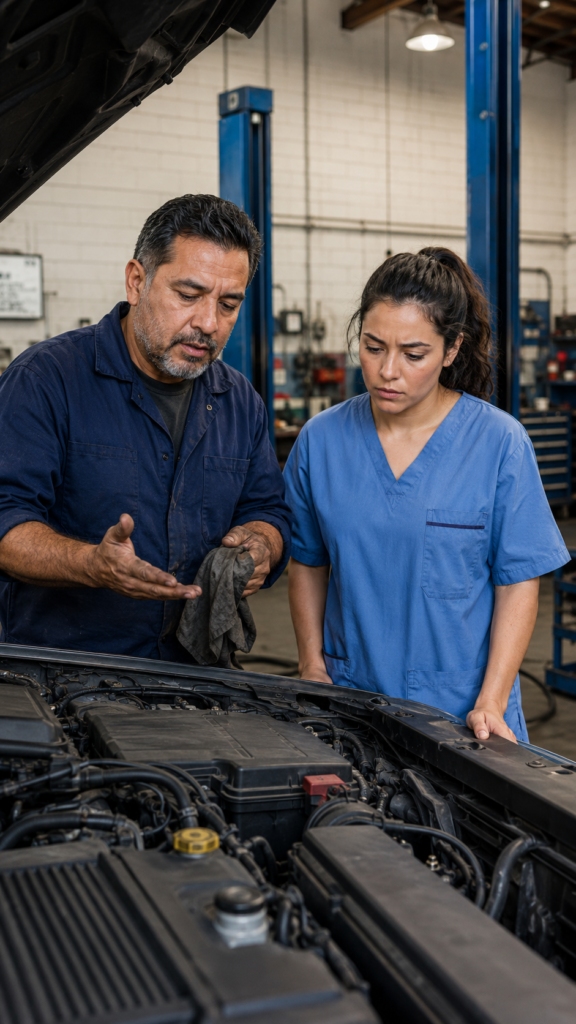
She looked about 22, wearing an oversized blue nursing assistant uniform, worn-out sneakers, and dark circles under her eyes that suggested she hadn’t slept in weeks.
In a used car seat behind her, a baby slept, clutching a stuffed monkey.
— Please, tell me it’s not serious —she whispered—. I start work in one hour.
Don Rogelio opened the hood.
He didn’t need much time to assess the situation.
Burst hose, cracked belt, spilled oil, and the front tires as slick as a hot tortilla.
— Miss, this isn't fit to hit the Periférico —he said, wiping his hands on a rag—. Fixed up, it’ll cost you at least 8000 pesos. Minimum.
The young woman didn’t cry.
That was worse.
She stood frozen, staring at the baby. Then her gaze fell to her trembling hands.
— I’m on probation at a retirement home —she said—. If I’m late, they’ll fire me. I owe rent, need diapers, and my first full paycheck hasn’t come yet.
She grabbed the keys.
— I’ll pour water in it and take my chances. If it blows up, well, that’s that.
Don Rogelio felt an unusual anger.
Not at her.
At life.
Because in that girl, he saw many women who came to the shop begging for miracles with coins in their pockets. But he also saw something more. A way she clenched her jaw that twisted his stomach.
— Leave the keys —he growled.
— I can’t pay you.
— Who said anything about money? —he replied, harsher than necessary—. The part is out of stock. It needs to be ordered from Monterrey. It’ll take two weeks.
Her eyes widened.
— And how am I supposed to work?
Don Rogelio reached into his pocket and pulled out another keychain.
It was for his own car: an old Jetta, spotless, restored by himself, his pride, his favorite.
— Here. Courtesy car from the shop. Full tank. You return it in two weeks.
Iker, his main helper, nearly spat out his coffee.
— Boss, that’s your car! You don’t even let us wash it!
— Shut up, man —Rogelio said—. Install the baby seat.
The young woman took the keys as if they were something forbidden.
— Why are you doing this?
Don Rogelio turned his gaze away.
— Because your son isn’t responsible for the fact that this hunk of metal doesn’t want to live anymore.
For two weeks, the Nissan sat on the lift.
There was no out-of-stock part.
The hose cost 240 pesos.
But Don Rogelio replaced much more.
Front tires, brakes, oil, spark plugs, lights, wipers, he even polished the headlights so it would pass inspection without any trouble.
When she returned, she parked the Jetta at the entrance and came in carrying the baby.
— I’m scared to see the bill —she said.
Don Rogelio placed a sheet on the counter.
At the bottom, it read: 0.00 pesos.
She stared at him, pale.
— It’s factory warranty —he lied—. Internal campaign. The brand takes care of it.
The young woman noticed the new tires. Smelled the fresh oil. Understood everything.
Then she squeezed the baby against her chest, lifted her face, and said a single word:
— Dad.
PART 2
The shop fell silent.
Or at least that’s how it felt to Don Rogelio.
The air guns still fired, the compressor hummed, an old radio played band music, and a clumsy hammering from an apprentice echoed in the background.
But for him, everything went dead.
That word struck him like a rusty key in a door that had been locked for years.
Dad.
Don Rogelio truly looked at her.
Not as a client.
Not as a poor girl.
Not as a desperate mother trying not to let life fire her.
He looked at her like one looks at something lost due to pride that suddenly appears before their eyes.
The nose. The right eyebrow with a small scar.
The way she pressed her lips together to keep from crying.
The tremor in her chin when she held back her pride.
It was Valeria.
His daughter.
The girl who, at eleven, ran down the hall with scraped knees. The teenager who blasted music. The young woman who, four years ago, stood in front of him in that very shop and said:
— I’m pregnant.
Don Rogelio hadn’t hugged her that day.
Hadn’t asked if she was afraid.
Hadn’t asked who the baby’s father was.
Hadn’t asked if she had eaten.
He had just let his pride as an old man win, one of those who confuse authority with love.
— I’m not going to support whims in my house —he told her.
Whims.
That’s what he called a baby.
Valeria left that same night with a backpack, three changes of clothes, and a broken heart.
Don Rogelio searched for her at first.
Or so he told himself.
The truth was uglier.
He asked neighbors, called an aunt, checked social media a few times, and then grew tired of feeling guilty.
Then he turned her room into a locked room.
As if closing a door could erase a daughter.
— It can’t be —he murmured.
Valeria let out a small, bitter laugh.
— Yes, it can. It’s me.
Iker stood frozen in the back. The other guys sensed something heavy was happening and lowered their eyes.
Don Rogelio wanted to walk towards her, but his legs wouldn’t respond.
— Why didn’t you tell me from the first day?
Valeria squeezed the baby.
The boy, awake, observed everything with wide, calm eyes, as if he didn’t know he had just entered a broken story.
— Because I didn’t come to seek you as a daughter —she answered—. I came because my car was dying, and I was too, little by little.
That phrase hit him harder than any insult.
— Valeria…
— No —she cut him off—. Let me speak. Because if I don’t say it now, I’ll regret it.
Don Rogelio closed his mouth.
She left the baby bag on a chair. Took a crumpled envelope from the diaper bag and placed it on the counter.
— Here’s 1200 pesos. It’s not much. But it’s what I could gather.
— I don’t want your money.
— Well, I don’t want your pity.
The blow was direct.
Valeria wasn’t shouting. That hurt more.
— My whole life, I thought that if I came back to you, you’d see me the same way you did that day. Like a shame. Like a burden. Like the dumb daughter who ruined your reputation.
Don Rogelio lowered his gaze.
— I was angry.
— No. You were disappointed. And that hurts more.
The baby made a little noise. Valeria stroked his head.
— His name is Mateo —she said, almost defensively—. He’s ten months old. He doesn’t know who you are. I didn’t know if I wanted you to know.
Don Rogelio felt something inside him sink.
Mateo.
His grandson.
There he was, less than a meter away, with a tiny hand closed over the stuffed animal, unaware that his grandfather had missed his first teeth, his first fevers, his first laughs.
— The dad? —Rogelio asked cautiously.
Valeria smiled without joy.
— He left when he found out I wasn’t going to abort. He blocked me. His family said I wanted to trap him. You know, those things they say when they want to get away.
Don Rogelio clenched his fists.
— You should have come.
— I came.
He lifted his face.
Valeria swallowed.
— I came when Mateo was two months old. One night. I stood outside your house with him wrapped in a blanket. It was cold. I was about to knock.
Don Rogelio felt his chest tighten.
— And why didn’t you knock?
Valeria looked at him with a calmness that frightened him.
— Because I heard you inside.
He frowned.
— What did you hear?
— You were with Iker. They had come to drop off some parts. You said: "My daughter got herself into this problem all by herself. Let her learn."
Iker turned pale.
Don Rogelio slowly turned toward him.
— Boss… I…
— Shut up —Rogelio whispered.
He didn’t raise his voice.
But the whole shop felt it.
Valeria took a deep breath.
— I didn’t come to claim that. It’s over. But that night, I understood I had no home. So I left.
Don Rogelio brought a hand to his face.
The grease stained his cheek, but he didn’t even notice.
He remembered that phrase.
Of course, he remembered.
He had said it with a beer in hand, pretending it didn’t hurt, pretending he was strong, pretending his absent daughter wasn’t tearing his life apart.
And she had listened.
— I didn’t know you were outside —he said.
— That doesn’t change what you said.
— No.
Nothing changed.
Silence fell heavily.
Iker approached slowly, eyes downcast.
— Valeria, I do remember you —he said—. You used to come by in the afternoons and sit on that tire to do homework. I… I’m really sorry. That day I should have told the boss to stop being tough.
Valeria looked at him.
— It wasn’t your obligation.
— Maybe not —Iker said—. But I was scared to get involved. And that’s cowardice too.
Don Rogelio hadn’t expected to hear that.
Especially from Iker, who always seemed more interested in his paycheck than in other people’s dramas.
Valeria turned back to her father.
— Do you know what was the worst part? —she asked—. When I walked in two weeks ago and you didn’t recognize me, it made me angry… but also relieved.
Don Rogelio swallowed hard.
— Relief?
— Yes. Because I could ask for help without feeling like I was returning defeated.
He then understood the full cruelty of the matter.
His lie about the part from Monterrey had given Valeria an excuse to accept help.
And his blind fatherhood had given her a sad protection: not having to confront the shame of returning.
— I did recognize you a little —he confessed, his voice breaking—. Not with my head. With something here.
He touched his chest.
— But I played dumb. Because if it was you, it meant I had lost four years. And a coward prefers to doubt rather than accept that he messed up.
Valeria didn’t say anything.
Don Rogelio walked around the counter.
He didn’t hug her right away.
He had no right to take what he had once let go.
He stood before her, hands open, awkward, full of cracks.
— Forgive me —he said.
It wasn’t a speech.
He didn’t justify himself.
He didn’t mention that he worked a lot, that he was old, that he didn’t know how to show affection, that’s how he was raised.
He just said that.
— Forgive me, daughter.
Valeria closed her eyes.
For a moment, it seemed she was going to fall.
But she didn’t fall.
She had learned to hold herself up too long.
— I don’t know if I can forgive you today —she said.
Don Rogelio nodded.
— I’m not asking you to.
She exhaled, as if that answer lifted a stone from her chest.
— But I do want Mateo to have a family —she added—. Not perfect. Not a storybook. A real family. One that makes mistakes but doesn’t disappear.
Don Rogelio looked at the baby.
Mateo reached out his hand, fascinated by the greasy rag hanging from the mechanic's pocket.
Valeria quickly pulled him away.
— No, my love, that’s dirty.
But Don Rogelio smiled.
A strange, rusty smile.
— He’s curious about tools. Good sign.
— Don’t start —Valeria said, and for the first time, a real smile escaped her.
Small.
But real.
That smile nearly shattered him.
Don Rogelio took the envelope with the 1200 pesos and pushed it back.
— You’re taking this.
— Dad…
— It’s not a gift. It’s an investment.
— An investment in what?
— In making sure there are no missing diapers. In being able to buy gas. In not being late for work. In making sure that boy doesn’t pay for our pride.
Valeria looked at him with teary eyes.
— I don’t want to depend on you.
— I’m not asking you to. I’m asking you not to confuse help with humiliation.
That phrase lingered.
Because both knew he was also talking about himself.
Don Rogelio had confused asking for forgiveness with losing authority.
Had confused toughness with character.
Had confused silence with punishment.
And nearly lost forever the only thing that truly mattered.
— You’re coming over for dinner on Sunday —he said.
Valeria raised an eyebrow.
— Just like that?
— Just like that.
— And what are you going to cook?
Don Rogelio scratched his neck.
— Pasta with tomato. I’m broke for giving away tires.
Iker let out a nervous laugh from the back.
Valeria laughed too.
Her laughter came out mixed with tears, but filled the shop as if someone had opened a window.
— Mateo eats purée —she said.
— There’ll be purée too.
— You don’t know how to make purée.
— I’ll learn. I wasn’t born knowing how to fix transmissions either.
Valeria lowered her gaze to the baby.
Then she did something no one expected.
She leaned in and placed Mateo’s little hand on Don Rogelio’s greasy, black hand.
The baby clutched a finger.
Tightly.
As if he knew him.
As if he were saying not to let go this time.
Don Rogelio broke down.
He didn’t cry pretty.
He cried like men who have spent years swallowing everything: with a hard face, a twisted mouth, and pride in tatters.
Valeria didn’t hug him right away.
First, she let him cry.
Maybe because he needed to feel the full weight of what he had lost.
Then, slowly, she rested her forehead on his shoulder.
— I can’t promise it will be easy —she whispered.
— I don’t want easy —he replied—. I want to be there.
That was the true arrangement of the day.
Not the engine.
Not the tires.
Not the bill at 0.00 pesos.
What began to repair was something else: an empty house, a wounded daughter, a grandfather who didn’t know he already was one, and a boy who came into the world carrying a distance that didn’t belong to him.
That afternoon, when Valeria left the shop in her now-secure Nissan, Don Rogelio didn’t hide behind the counter.
He walked her to the door.
Adjusted Mateo’s seat properly.
Checked the seatbelt twice.
Then he stood watching as the car merged into the traffic of Neza, amidst buses, motorcycles, and corn vendors.
Iker stood beside him.
— Boss —he said quietly—, so you really lost a good amount of money.
Don Rogelio wiped his face with the back of his hand.
— No, man.
Iker looked confused.
Don Rogelio kept watching the street.
— Today, I regained a Sunday.
That night, he opened Valeria’s room.
Dust floated in the yellow light of the hallway.
The bed was still there.
Also, an old poster, a middle school notebook, and a photo of her at eleven, with crooked teeth and a huge smile.
Don Rogelio sat on the bed.
He didn’t ask for the past to disappear.
He didn’t ask for Valeria to forget.
He just looked at the photo and said:
— You’re coming back on Sunday, daughter.
And for the first time in four years, the silence of that house didn’t sound like punishment.
It sounded like waiting.
Because there are lies that destroy.
But there are also small lies, told with shame and love, that serve as a bridge when the truth still hurts too much.
Don Rogelio lied about an out-of-stock part.
He lied about a warranty.
He lied so a mother wouldn’t feel shattered for accepting help.
But in the end, that lie tore away the biggest truth of his life:
that no car, no workshop, no pride, and no amount of money is worth more than a daughter knocking on the door again.
And sometimes justice doesn’t come with screams or punishments.
Sometimes it comes on a Sunday.
With pasta and tomato.
With a baby seat at the table.
And with a small hand holding a worn finger to remind someone they still have time not to lose themselves again.





