PART 1
Rosario walked out of the Santa Martha prison with a black bag, two changes of clothes, and an apology signed by people who didn’t even have the courage to look her in the eye.
They also gave her a check.
"Compensation for judicial error," the paper said.
She didn’t cash it.
She tucked it away in a box, alongside newspaper clippings that called her monster, murderer, and "the woman who let a child die."
Then she rented a small space in an Iztapalapa neighborhood, painted the walls white, and hung a handmade sign:
COMMUNITY DINER.
Rosario didn’t want to get rich.
She just wanted no kid to go to bed hungry if she could put a plate on the table.
But for three weeks, no one came in.
Not even for a glass of water.
The neighbors crossed the street when they saw her. The women lowered their voices. The children stopped playing when she came out to sweep.
Everyone knew who she was.
The big one.
The ex-con.
The one with the dead child.
Rosario was nearly 6’3”, with strong arms from lifting pots and a serious face that scared even when she tried to smile.
So she cooked beans, rice, noodle soup, chicken stew… and in the end, it all went to waste.
Until one Tuesday, just as she was about to turn off the stove, a little girl appeared at the door.
Skinny, with her hair tied back with an old elastic, torn sneakers, and a gaze that showed no fear.
"Are you Doña Chayo?" she asked.
Rosario froze.
"That’s what they call me."
"My mom says you’re not bad. That if I’m hungry, I can come here. That you’d never close the door on a child."
Rosario’s heart clenched.
"What’s your name, sweetie?"
"Lucía."
She served her a big plate, with rice, beans, and an egg in sauce. The girl ate quickly, as if it might be taken from her.
"Slow down, little one."
Lucía looked down.
"It’s just that we haven’t had a hot meal since yesterday."
The next day, she returned with a 4-year-old brother.
On the third day, their mother came.
Her name was Graciela, but everyone called her Chela.
She walked in with her bag pressed against her chest and her eyes fixed on the floor.
"Forgive me," she murmured. "Truly, forgive me."
Rosario thought she was embarrassed to ask for food.
"You don’t need to apologize for being hungry. Sit down and eat."
Chela obeyed.
From that day on, the diner began to fill up.
First, five kids came.
Then twelve.
Then twenty.
The butcher sent bones for broth on Fridays. The woman from the tortilla shop left two kilos every afternoon. A retired man offered to wash dishes.
And Chela was the one who helped the most.
She arrived early, swept, chopped vegetables, peeled potatoes, and stayed until the last plate was clean.
But something didn’t add up.
Every time someone mentioned Rosario’s case, Chela turned pale and slipped into the kitchen.
One afternoon, Lucía hugged Rosario around the waist and said:
"You remind me of my brother. He was big too. But he’s with God now."
Rosario dropped the ladle.
She didn’t know why.
That same week, a neighbor brought old newspapers to wrap bread. One had a picture of Rosario handcuffed, leaving the courthouse.
Chela saw it.
The plate she held shattered on the floor.
Rosario looked at her face.
That face.
That tremor.
That fear.
And suddenly she remembered.
Chela had been at the trial.
Sitting in front of the judge.
Pointing at her with a finger.
Saying that Rosario was dangerous, that she had seen her near the child, that she was capable of anything.
That night, Rosario opened the box she swore she would never touch again.
She searched for the trial papers.
She read the list of witnesses.
Graciela Martínez.
Chela.
The only key witness.
Then she read the name of the dead child.
Mateo Martínez.
Chela’s son.
Lucía’s older brother.
The next day, when Chela came in as if nothing had happened, wearing her apron, Rosario took her to the back of the diner and laid the newspaper on the table.
"Why?" she asked, her voice broken.
Chela didn’t cry.
She just stared at the floor.
"Because someone had to pay."
Rosario felt the world crashing down on her.
"And it had to be me?"
Chela pressed her lips together.
"Because people already hated you. Because it was easy to believe them."
Rosario had to grip the table.
Six years.
Six years locked up.
Six years marked.
And the woman who had buried her had been eating from her hands for weeks.
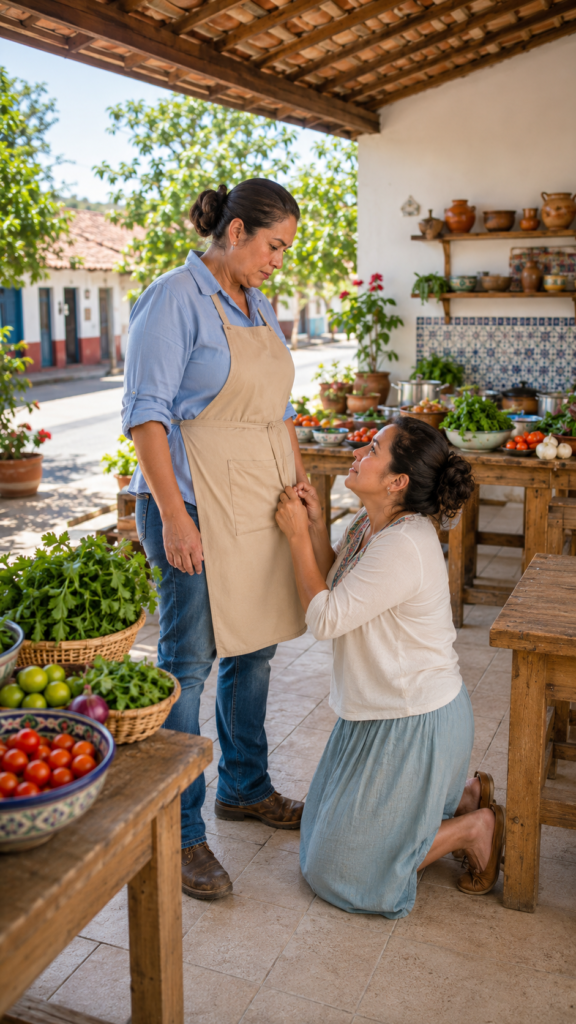
Then Chela fell to her knees, grabbing Rosario’s apron and said something that left Rosario breathless:
"Do whatever you want to me. But don’t run my kids off. You’re the only person in this neighborhood who would never let a child die of hunger."
PART 2
Rosario raised her hand.
Chela closed her eyes.
But the blow never came.
Rosario’s hand hovered in the air, trembling, because just then Chela doubled over on the floor and let out a horrible cough.
A dry, deep cough, as if something inside her was being torn away.
When she covered her mouth with her sleeve, Rosario saw the stain.
Blood.
The anger that had been stuck in her throat for six years froze.
"What’s wrong with you?" she asked.
Chela tried to hide her sleeve.
"Nothing."
"Don’t lie to me again."
The phrase fell heavy between them.
Chela sat in a chair, weak, shoulders slumped.
Rosario brought her a glass of water, not understanding why she did it.
She was the woman who had destroyed her life.
And yet, her body acted before her resentment.
"For the past nine months," Chela said, barely audible. "Stomach cancer. There’s not much that can be done now."
Rosario didn’t answer.
Outside, Lucía was laughing with her little brother because a man had given them sweet bread.
Inside, the air smelled of broth, bleach, and rotten truth.
"That’s why I came," Chela continued. "I didn’t come for you to forgive me. I don’t deserve that even in my dreams."
"Then why did you come?"
Chela looked toward the door.
She looked at Lucía.
She looked at her with that sadness that only mothers have when they know they’re saying goodbye.
"When I die, my kids won’t have anyone. Their dad left for Monterrey with another woman. My mom is sick. My brothers don’t want to take care of someone else’s kids."
Rosario swallowed.
She already knew what was coming.
"And in this whole neighborhood," Chela said, "the only person who feeds a child without asking whose it is… is you."
Rosario felt disgust, rage, pity, and an old pain mixing in her chest.
"First, you used me to save yourself. Now you want to use me to save them."
Chela lowered her head.
"Yes."
That sincerity hurt more than any lie.
"But not because I don’t care about what I did," she added. "But because Lucía is innocent. Mateo was too. None of them are to blame."
Hearing that name, Rosario froze.
Mateo.
For six years, that name had been a stone in her throat.
They accused her of letting him die.
The press said she did it out of anger.
Neighbors invented that Rosario hated children because she could never have any.
But no one told the whole truth.
No one told that Mateo was not a stranger to her.
Before prison, Rosario had a small eatery with three tables, a griddle, and an old TV that always malfunctioned.
Mateo came every afternoon after school.
He was a huge kid for his ten years, clumsy, cheerful, with big hands and always scraped knees.
They called him “El Güero,” even though he was anything but.
He would sit next to the kitchen and steal hot tortillas from Rosario.
"You’re going to burn yourself, stubborn kid."
"But they taste better this way, Doña Chayo."
Mateo had epilepsy.
Sometimes he’d have seizures out of nowhere. He’d go stiff, his eyes would glaze over, and he’d fall to the floor.
The first time it happened in the eatery, everyone screamed.
Not Rosario.
She laid him on his side, cleared the chairs, and spoke softly to him until the seizure ended.
From then on, when Chela was busy cleaning houses, she left Mateo with Rosario.
It wasn’t official.
There were no papers.
But everyone in the neighborhood knew Rosario took care of him.
She served him first, even if there were customers waiting.
She folded his tortillas.
She kept a piece of chicken for him.
And Mateo, with his mouth full, would always say:
"You really take good care of me."
Rosario never had children.
But Mateo was the closest thing.
Only no one warned her that borrowed love could also be lost as if it were her own.
One afternoon, a week before the tragedy, Rosario saw Chela hurriedly pulling Mateo by the arm.
"I’m going to take him to bathe quickly and then I’ll be back," Chela said.
Rosario grew serious.
"Chela, that boy can’t be left alone in water. Not for a minute. If he has a seizure, he’ll drown."
"Yeah, yeah, I know."
"No, it’s not just ‘yeah, yeah.’ I’m telling you seriously. Don’t leave him alone."
Chela nodded without really listening.
And seven days later, Mateo drowned in a bathtub.
When the police arrived, Chela was hysterical.
She said Rosario had gone to look for the boy.
That she saw her leave the yard.
That it scared her.
That Rosario always cared too much for him, in a strange way.
The neighborhood believed her.
Because Rosario was big, serious, and poor.
Because she didn’t have a husband to defend her.
Because people prefer an easy monster over an uncomfortable truth.
The judge believed it too.
And Rosario went to Santa Martha for six years.
In the diner’s kitchen, facing Chela, all of that returned like a slap.
"Why did you point at me?" Rosario asked. "Tell me the whole truth."
Chela gripped the glass with both hands.
"Because Mateo did die in the bathtub, but not because someone harmed him. He had a seizure."
Rosario closed her eyes.
"I went to the store," Chela said. "It would be five minutes. I left him sitting in the tub. When I came back, he was face down."
The silence was brutal.
Outside, a spoon fell to the floor and someone laughed.
Inside, neither of them was breathing well.
"You knew," Rosario whispered. "I warned you."
Chela began to cry, but silently.
"Yes. And when I pulled him out, the first thing I thought was not of my son. God punish me for that. The first thing I thought was: 'They’re going to take Lucía from me too.'"
Rosario felt her legs give way.
"So you blamed me."
"People were already looking at you wrong. You intimidated them. They said you were strange, that you got too attached to Mateo. I just… I just wanted them to stop looking at me."
"You stole six years from me."
"I know."
"You stole my name."
"I know."
"You stole Mateo from me too."
Chela lifted her face, devastated.
"I stole Mateo from both of us."
That phrase broke something inside Rosario.
She wanted to hate her.
Really wanted to.
But the woman in front of her didn’t seem like a villain. She looked like a human wreckage. A mother who lost her child for five minutes of negligence and then lost her soul trying to cover it up.
That didn’t make her innocent.
But it made her human.
And sometimes that’s the hardest thing to forgive.
That night, Rosario didn’t sleep.
She took the trial box out again.
She laid the newspapers, the sentence, the copies of statements, the intact check, and the official apology on the table.
She thought about calling the police.
She thought about standing in front of the diner and telling everyone the truth.
She thought about looking Lucía in the eyes and telling her that her mom had lied.
But then she remembered the girl eating as if the world had denied her everything.
She remembered Mateo stealing tortillas from the griddle.
She remembered her own cell, the nights when she swore that, if she ever got out, she would never resemble those who condemned her without listening.
She turned on the stove.
Not to cook.
To burn the papers.
One by one, she began bringing them to the flame.
Not because the truth didn’t matter.
But because she didn’t want Lucía to inherit a guilt that wasn’t hers.
Rosario decided something that no one in the neighborhood would understand:
Lucía would stay in the diner.
So would her little brother.
They would eat there.
They would do homework there.
They would sleep there if necessary.
And Chela would die without her children knowing that their mother had destroyed the woman who was saving them.
But just as Rosario was about to burn the last packet, a thick envelope fell to the floor.
It was yellow, sealed, with her name typed on it.
It was the envelope they had given her when she was released.
The one she had never wanted to open.
Rosario hesitated.
She almost tossed it into the fire.
But something stopped her.
She opened it.
Inside was the check.
And beneath the check were letters.
Many.
More than thirty.
All written in the same crooked handwriting, with spelling mistakes, stains from tears, and dates from different years.
Rosario read the first one.
It was from Chela.
Addressed to the judge.
It said she had lied.
That Rosario was innocent.
That Mateo had died from a seizure in the tub.
That she, Graciela Martínez, had testified out of fear.
That she accepted going to prison, but that Rosario should be released.
The date was four months after the sentence.
Rosario kept reading.
Another letter to the prosecution.
Another to human rights.
Another to a public defender.
Another to a newspaper.
Another to a government office.
For six years, Chela had written.
Again and again.
With fear.
With shame.
With guilt eating her away before cancer could.
No one listened at first.
They closed doors on her.
Called her crazy.
Told her the case was already judged.
But she kept going.
Until someone reviewed it.
Until someone compared.
Until someone found the "judicial error" that freed Rosario.
Rosario dropped the letters on the table and covered her mouth.
The woman who had put her in prison had also spent six years trying to get her out.
That didn’t fix everything.
It didn’t return the nights in Santa Martha.
It didn’t erase the insults, the blows, the loneliness, the fear.
But it changed the weight of the story.
Chela hadn’t come to the diner just out of hunger.
She had come because she was dying.
And because before leaving, she wanted to leave her children with the only person who, deep down, she had always known was innocent.
Rosario ran to the Seguro hospital the next morning.
But she arrived too late for big words.
Chela was in a bed, pale, thin, with Lucía asleep in a chair beside her.
She opened her eyes when she saw Rosario.
She couldn’t speak.
Rosario approached, took her hand, and laid one of the letters on the sheet.
Chela looked at it.
Understood.
Her eyes filled with tears.
Rosario didn’t say "I forgive you" like in the novels.
It wasn’t necessary.
She merely tucked the blanket around her and whispered:
"Your kids will eat. Every day."
Chela closed her eyes.
And for the first time in years, her face seemed to rest.
She died that Saturday afternoon.
The neighborhood attended the funeral.
Some cried.
Others murmured.
Because in the barrios, people always want to know everything, but they rarely can handle the entire truth.
Rosario didn’t say anything.
She didn’t mention that Chela lied.
She didn’t say that Chela confessed.
She didn’t say that justice didn’t correct its mistake on its own, but thanks to a broken woman who wrote letters until someone listened.
She simply took Lucía by the hand.
The little boy clung to her skirt.
After the funeral, Rosario opened the diner as usual.
She put beans in the pot.
Heated tortillas.
Served hibiscus water.
And when the line began to form, she called Lucía first.
"You first, sweetie."
"Why do I always go first?" the girl asked.
Rosario looked over at the table by the stove, the same one where Mateo used to sit and steal tortillas.
She barely smiled.
"Because your brother was just as pushy and always got in line ahead of everyone."
Lucía burst out laughing.
She had the same laugh.
The same way of biting into a tortilla.
The same light shining in her eyes.
Rosario turned back toward the pots so no one would see her cry.
From then on, the diner never closed early again.
At the door, there was a new sign, painted in red letters:
ANY CHILD EATS HERE. NO QUESTIONS.
Some neighbors said Rosario was foolish.
That she should have reported it.
That she should have sought revenge.
That six years couldn’t be paid back with letters or tears.
Maybe they were right.
But Rosario learned something in prison and in the kitchen:
Justice punishes.
Truth liberates.
But only compassion prevents a child from paying for the sins of adults.
And every night, when Lucía falls asleep in a chair with a full belly, Rosario looks at the open door of the diner and feels that, this time, if Mateo sent someone of his blood to knock, she was indeed on the other side.
On time.





