PART 1
—Your wife ran off with another man, son. She didn’t wait a single week.
That was the first thing Andrés Villaseñor heard when he opened his eyes after seven months in a coma.
The hospital light in Monterrey hurt his eyes. His mouth was dry, his skin clung to his bones, and a new scar crossed his temple. He remembered almost nothing of the accident, just a suitcase full of documents, the smell of freshly baked bread in his kitchen in Mexico City, and the voice of his wife telling him:
—Come back soon, my love.
In front of the bed stood Doña Leonor, his mother, elegant even in suffering. She held a rosary between her fingers and wore a face of sorrow that seemed rehearsed. Beside her, Camila, Andrés’s younger sister, wiped tears that never seemed to fall.
—Where is Marisol? —he asked, barely above a whisper.
Doña Leonor sighed.
—Andrés, you have to accept the truth. Marisol thought you were dead. She sold jewelry, withdrew money from the account, and left with a man. She was seen in Puebla, completely unbothered.
Andrés shut his eyes.
Not because he believed it.
But because he knew, from the very first second, that they were lying to him.
Marisol Ortega wasn’t like that. The woman who had pushed a coffee cart with him for years outside the Portales market wouldn’t abandon anyone. The woman who got up at four in the morning to bake conchas, cinnamon rolls, and orange bread didn’t disappear out of ambition.
Before Andrés had a construction company, trucks, and big contracts, it was just the two of them in a small apartment, counting coins to pay the rent.
She kneaded bread with flour-covered hands while he reviewed plans that no one wanted to fund.
—One day you’ll build huge towers —Marisol would tell him.
—And you’ll have a bakery with beautiful displays.
—No, dude. I just want a kitchen that fits a big table and where no one kicks us out.
In nine years of marriage, Marisol was his home.
The only thing that hurt them was their inability to have children. Doctors said they were healthy, but pregnancy never came. For them, it was an intimate sadness. For Doña Leonor, it was a condemnation.
—A wife who doesn’t produce heirs can’t hold a family together —she repeated at every meal.
Andrés always confronted her.
—My family begins with Marisol. With or without children, she is my home.
But everything shattered the day Andrés traveled to Monterrey for the most important contract of his life.
That morning, Marisol turned on the oven before dawn. She prepared his favorite bread: vanilla concha with a hint of orange and toasted almond.
—I’ll be back in three days —he promised, kissing her on the forehead—. And when I return, we’ll go to the clinic again. Together.
Hours later, the private plane he was traveling in vanished from the radar. There was fire, confused bodies, and a passenger list that turned Andrés Villaseñor into an official dead man.
Doña Leonor didn’t wait for the death certificate.
The next day she entered the house in Las Lomas with Camila, two lawyers, and a coldness that froze more than any condolences.
Marisol hadn’t slept for twenty-four hours.
—Pack your things —Leonor ordered.
—This is my home too.
—It was my son’s home. And you didn’t give him a single heir.
They took keys, cards, phone, documents, and even the car. Camila rifled through drawers as if Marisol were a thief. Only Petra, the longtime employee, tried to defend her.
—She can’t be left on the street.
Leonor fired her on the spot.
Marisol left with one suitcase, a recipe notebook, and the old apron she wore when they were poor. She didn’t cry in front of them.
She cried in a taxi, heading to a rooftop room in Narvarte.
Weeks later, she was back selling bread outside the Coyoacán market. With a used coffee maker and a repaired cart, she started from scratch.
One day, she felt dizzy while serving coffee.
The doctor at the health center looked at the tests and smiled.
—Marisol, you’re pregnant.
She covered her mouth.
—After nine years?
—And it’s not just one baby. You’re having three.
Marisol cried silently, hands on her belly.
The miracle had come when everyone had taken everything from her.
Meanwhile, Andrés woke up in Monterrey without knowing that his wife was alive, pregnant, and alone.
And when he finally managed to get out of bed, he decided to seek the truth that his own blood was trying to bury.
PART 2
Andrés returned to Mexico City thinner, with scars on his face and a silent rage he didn’t show in front of his mother.
Doña Leonor settled him into the house in Las Lomas as if nothing had happened. She prepared broths, arranged pillows, and repeated the same story every day.
—Marisol didn’t deserve your last name. She saw you dead and showed what she really was.
Camila added details.
—I saw her take bags. Seriously, Andrés, she even took Mom’s jewelry. What a piece of work.
Andrés listened without arguing.
But every false word confirmed something: they were both too eager for him to hate his wife.
That night he called Ernesto Padilla, his lifelong partner and friend.
—I need you to find Marisol.
—Did your mom say she left with someone?
—My mom also said that Marisol was barren as a punishment from God. I don’t believe anything she says.
Ernesto started looking without telling the family. He checked accounts, spoke to neighbors, asked former employees. Four days later, he found Petra, the dismissed employee.
They met at a café in Del Valle.
When Petra saw Andrés walk in alive, she almost dropped her cup.
—Mr. Andrés… thank God.
—Tell me what happened to my wife.
Petra broke down in tears.
—They kicked her out. Your mom came with lawyers. They took everything from her. Even her papers. Mrs. Marisol didn’t leave with anyone. She left because she was left without a home.
Andrés felt the air clogging in his chest.
—Where is she?
—I don’t know exactly. But I heard she went back to selling bread in Coyoacán.
That piece of information hit him like a bell.
Bread.
Coyoacán.
Marisol.
The next day, Andrés pretended to go to a meeting. In reality, he went with Ernesto to walk around the market. They wandered through streets, stalls, sidewalks filled with fruit, flowers, and noise.
Nothing.
Until Ernesto bought two conchas from a wooden cart.
—They say they’re amazing —he said.
Andrés took a bite out of obligation.
And the world stopped.
Butter. Orange. Cinnamon. Toasted almond.
The same taste of their poor mornings. The same bread Marisol had made him on the day of the trip. The exact flavor of a promise.
—Where did you buy this? —he asked, pale.
Ernesto pointed to the corner.
Andrés crossed the street as if walking inside a dream.
And then he saw her.
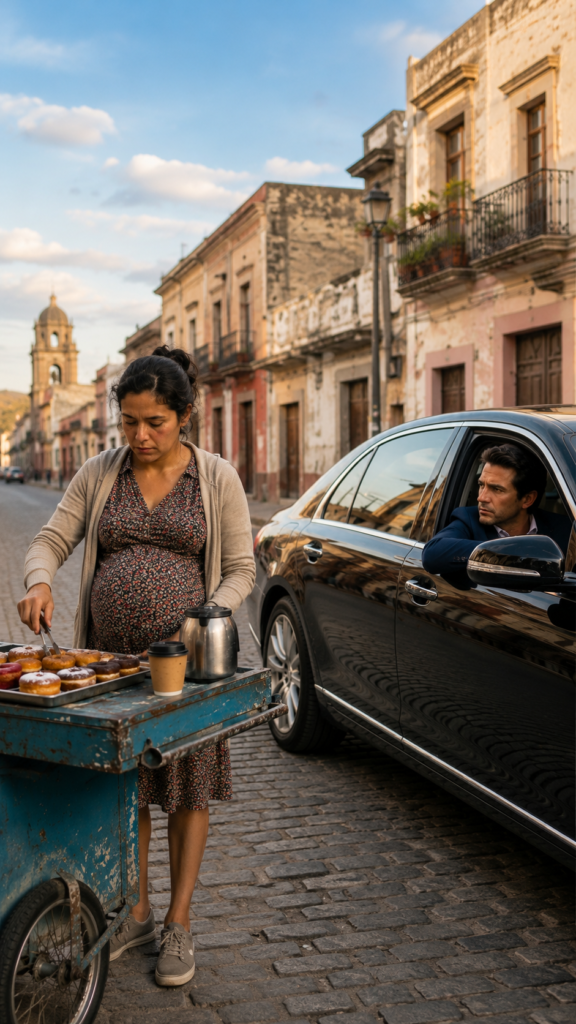
Marisol was behind the cart, with her hair up, a simple dress, and her round belly under the apron. She was serving coffee to an older woman and smiling wearily, as if she had been holding the world alone for months.
Andrés couldn’t move.
His wife wasn’t with another man.
She wasn’t enjoying stolen money.
She wasn’t betraying him.
She was pregnant, working on the street, and surviving with dignity.
—Let’s go to her —Ernesto whispered.
Andrés shook his head, tears filling his eyes.
—Not yet. First, I’ll make sure no one humiliates her again.
For a week, he gathered evidence. Petra wrote a statement. The former guard from Las Lomas confirmed that Marisol had been expelled. A family lawyer, pressured by Andrés, admitted that Doña Leonor and Camila blocked the accounts, withdrew documents, and forged authorization to move assets during his absence.
But the hardest blow came when Ernesto obtained a copy of a conversation between Leonor and Camila.
In the audio, Camila said:
—If Marisol turns out to be pregnant, we’re done for.
And Leonor replied:
—That’s why we got rid of her before she got tested. Without Andrés, without papers, and without money, no one will believe her.
Andrés listened to that phrase three times.
Each time it hurt more.
The family hadn’t just lied.
They had suspected the pregnancy and decided to erase Marisol before the miracle had a name.
That afternoon, Andrés returned to the market.
Marisol was putting away trays when she felt someone stop in front of her cart.
—What can I get you, young man? I only have two conchas left.
There was no response.
She looked up.
The paper bag fell to the ground.
—No… it can’t be.
Andrés was there, his face marked by the accident and his eyes broken with regret.
—Marisol.
She recoiled, trembling.
—You’re dead.
—I was declared dead. But I woke up.
Marisol brought both hands to her belly.
—I waited for you. I looked for you. They took my phone, my cards, everything. Your mom threw me out as if I were trash.
—I know.
She began to cry, but didn’t move closer.
—And you only came now?
Andrés lowered his head.
—I woke up not long ago. They told me you left with another man. I didn’t believe them, but I needed proof. Forgive me for not coming sooner.
Marisol breathed with difficulty.
—I didn’t want money. I just wanted to stay in our home to mourn you in peace.
Andrés took a slow step, asking for permission with his gaze.
She didn’t move.
So he knelt right there on the sidewalk.
—Forgive me for not protecting you from my own family.
People began to look. Some customers who knew Marisol fell silent.
She cried silently.
—I’m pregnant —she finally said—. They’re yours.
Andrés looked up.
—Is it true?
—They’re three.
He covered his mouth with one hand. Then carefully rested his forehead against Marisol’s belly and cried like a child.
—My children… our children.
Marisol, who had been strong for months, broke at that moment. She placed a hand on his head and closed her eyes.
It wasn’t a happy ending yet.
It was merely the first breath after a brutal injustice.
That same night, Andrés took Marisol to a safe apartment, not to the house in Las Lomas. She didn’t want to return to where they had humiliated her unprepared.
—I don’t want to see them —she said.
—You’re not going to face them alone —he replied.
Two days later, Andrés called a family meeting. Doña Leonor arrived dressed in black, as if still playing the role of the grieving mother. Camila came in wearing dark glasses and a look of annoyance.
In the room were Andrés, Marisol, Ernesto, Petra, the guard, two lawyers, and a notary.
Leonor froze upon seeing Marisol pregnant.
—What is she doing here?
Andrés didn’t raise his voice.
—The owner of this house can be wherever she wants.
Camila let out a nervous laugh.
—Owner? Come on, Andrés. She has nothing.
The notary opened a folder.
Here came the turn no one expected.
Before the trip, Andrés had signed a property update. If something happened to him, fifty percent of his assets would go directly to Marisol. And if there were children, born or unborn, the other half would be protected for them.
Marisol didn’t know this.
Doña Leonor did.
That’s why she had thrown her out.
That’s why she took documents away.
That’s why she tried to destroy her reputation before the pregnancy was known.
Andrés placed the audio on the table.
Leonor's voice filled the room:
—Without Andrés, without papers, and without money, no one will believe her.
Camila started to cry.
—Mom forced me.
Leonor glared at her in fury.
—Shut up.
But it was too late.
Andrés placed another folder in front of them: complaints for dispossession, forgery, abuse of trust, and domestic violence. Camila was removed from the company that same afternoon. Doña Leonor lost any access to accounts, properties, and decisions regarding the construction company.
—I won’t leave you on the street —Andrés said to his mother—, because I’m not like you. You’ll have what you need to live. But you will never again decide about my wife or my children.
Leonor tried to approach.
—Son, I was just protecting your name.
Marisol spoke for the first time.
—A name isn’t worth anything if it’s used to crush a lone woman.
The silence was tremendous.
Camila lowered her head. Leonor didn’t apologize. She only cried for what she had lost, not for what she had done.
Months later, Marisol gave birth to two girls and one boy: Valentina, Lucía, and Mateo.
Andrés was there for every appointment, every ultrasound, every night of fear. He learned to make coffee without burning it and to keep his mouth shut when Marisol needed to cry without hearing sweet phrases.
She began to bake again, but not because she needed to survive.
She baked because the bread reminded her that her hands could still create life after so much humiliation.
One Sunday morning, the kitchen smelled of orange, cinnamon, and almond again. On a shelf was the old recipe notebook, the worn apron, and a photo of the cart from Coyoacán.
Andrés tasted a concha and closed his eyes.
—This flavor found me when everyone wanted to lose you.
Marisol smiled, tired but at peace.
—It wasn’t the bread. It was that, deep down, you never stopped believing me.
He looked at their three babies sleeping in the living room and understood something no fortune teaches.
A house can have marble, gates, and a last name.
But a home only exists where they don’t let you go when the whole world decides to lie about you.
And maybe that’s why Marisol’s story hurt so much: because sometimes the worst enemies don’t come from outside.
Sometimes they sit at your table, pray for you, and then take away the keys when you need love the most.





