PART 1
At the dining table, as the rain beat against the windows of an apartment in the Narvarte neighborhood, Doña Graciela dropped the phrase like she was collecting a bill.
—Starting next month, you’re going to send us 18,000 pesos, Valeria. Enough of begging.
Valeria Montes lifted her gaze from her plate.
This wasn’t just any visit. She had prepared cochinita, red rice, and hibiscus water because it was Sunday and because for five years, she had tried to earn the love of her husband’s family.
At the head of the table sat her father-in-law, Don Eusebio, looking weary with his hand over his chest. Next to him, Sergio, her brother-in-law, scrolled through TikTok while boasting about his plans to open a parts store in Iztapalapa.
His wife, Brenda, flaunted a new cream-colored purse and long nails adorned with jewels. Valeria remembered the purchase perfectly because that purse had come from an additional card in her name.
Tomás Rivas, her husband, ate without glancing at her.
Valeria was 36 years old and worked as an administrative director at a logistics company in Santa Fe. She made a good salary, yes. But no one acknowledged that each month, she paid for Don Eusebio’s medications, Doña Graciela’s overdue bills, Tomás’s car insurance, Sergio’s loans, and even Brenda’s whims.
They all called it “family.”
But it always landed on Valeria’s tab.
—If it’s for medical treatment, let’s review the prescriptions — she said, her voice firm—. But I’m not going to raise the fixed deposit. Not anymore.
Doña Graciela dropped her fork with a sharp clatter.
—Not anymore? Is that how you speak to the mother of the man who gave you a place?
Brenda let out a giggle.
—Oh, V Vale, come on, that’s nothing for you. You move millions at your job.
—Precisely because of that, I know when an account doesn’t add up — Valeria replied.
Tomás finally lifted his head.
—Don’t make a scene. My mom is just asking for support.
Valeria took a deep breath.
—It’s not support if it’s demanded like rent. I’m not your ATM.
The silence shattered like a plate.
Doña Graciela stood up, red with rage.
—Listen to the little lawyer. She thinks she’s so fancy just because she wears heels and has an office.
Tomás pushed back his chair.
—Apologize to my mom.
—I’m not going to apologize for setting a boundary.
The first slap twisted her face.
Everyone froze.
Don Eusebio murmured something, but he didn’t stand up. Sergio lowered his phone. Brenda clutched her purse to her chest. Doña Graciela didn’t look shocked.
She smiled.
—That’s how you correct an uppity woman.
Valeria touched her burning cheek.
—You hit me in front of everyone?
Tomás was breathing heavily.
—And you still respond.
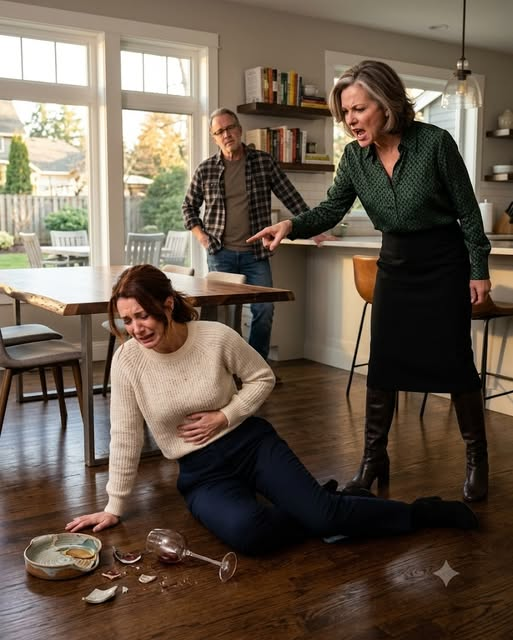
The second slap knocked her back against the chair. Her glass fell to the floor, and the hibiscus water spread like blood over the tiles.
From below, Valeria saw five faces staring at her. None helped her.
So instead of crying, she let out a cold laugh.
—Good thing this happened today — she said, wiping her lip—. Because you just lost your ATM.
Tomás didn’t understand.
But that very night, Valeria blocked all the cards.
And the next morning, an email arrived that no one in that family expected…
PART 2
The email came in at 7:42 in the morning, just as Valeria was leaving the emergency room with a medical certificate in hand and dark glasses covering half her face.
The sender was unknown.
The subject line read:
“If you really plan to leave there, you need to see this.”
Valeria froze on the sidewalk, with the sounds of cars passing on Cuauhtémoc Avenue and the smell of tamales from the corner mixing with the humid air.
She opened the message.
It had four attachments.
The first was a photo of an IOU for 520,000 pesos. Her name appeared as the guarantor.
Her signature was there.
Or that’s what they wanted it to look like.
The second file was a screenshot of
“Your wife signed without looking. Just tell her it’s for the car insurance.”
Tomás replied:
“Valeria is easy to deal with. She gets mad for two days and then pays.”
Valeria felt a chill stronger than the pain in her cheek.
The third file was worse.
It was an audio recording of Doña Graciela.
“That woman has money to spare. If she doesn’t want to help willingly, we’ll make her feel guilty. And if she gets tough, Tomás knows how to take her down a notch.”
Valeria closed her eyes.
For five years, she had thought they used her out of convenience.
No.
They had studied her.
They had learned her fears, her guilt, her need to be accepted. And with that, they had built a cage.
The fourth file was a short message:
“I’m Brenda. I’m sorry. I can’t carry this anymore. You didn’t sign anything. Sergio forged documents. Graciela knows. Tomás does too.”
Valeria put her phone back in her purse.
She didn’t cry.
She called her lawyer, Licenciado Emilio Barragán, a serious man who had worked with her father before he died.
—Emilio, I need a divorce, a report of violence, and a review for signature forgery.
He didn’t ask useless questions.
—Go to your apartment safe. Don’t return alone. Send everything you have. And Valeria, listen to me carefully: you don’t discuss with those people. You document.
That phrase pierced her.
At 9:00, Valeria arrived at her office in Santa Fe. She walked straight, with makeup covering the bruises and a black folder under her arm.
Her assistant, Paola, stood up as soon as she saw her.
—Licensed, are you okay?
—No. But I will be.
Valeria locked herself in her office and started organizing everything.
Monthly transfers to Doña Graciela: 10,000 pesos for 60 months.
Pharmacy payments for Don Eusebio.
Tomás’s car insurance.
Overdue tuition for a nephew who didn’t even say good morning.
Brenda’s purchases.
Deposits to Sergio for businesses he never opened.
The total was brutal: 890,000 pesos in five years.
It wasn’t love.
It was extraction.
At 10:30, she blocked all the additional cards. Tomás’s. Doña Graciela’s. Sergio’s. Brenda’s.
At 10:41, she received the first message from Brenda:
“What did you do? I’m at Plaza Satélite and the card isn’t going through.”
Valeria didn’t respond.
At 10:46, Sergio wrote:
“Sister-in-law, come on, you’re burning me with a supplier.”
She didn’t respond either.
At 11:02, Tomás called 13 times in a row.
Valeria silenced her phone.
At 12:15, Tomás showed up in the company lobby shouting as if he owned the building.
—Tell Valeria to come down! She’s my wife! She’s stealing my own money!
The guards recorded him.
Paola warned Valeria from reception.
—He’s saying you’re crazy, licensed.
—Let him keep talking — she replied—. The cameras have audio.
Tomás tried to go up, but security stopped him. Before they took him away, he shouted a phrase that later became key:
—My mom was right! Women like you need to be put in their place!
At 2:00 in the afternoon, Licenciado Emilio had the report ready.
At 4:30, the expert confirmed that the signature on the IOU didn’t match Valeria’s. It had been traced from an old document: a bank application that Tomás kept at home.
But the final blow came at 6:00.
Paola entered with a pale face.
—Licensed, there’s another email. It’s from internal audit.
Valeria opened it.
The company where she worked had been reviewing contracts with a parts supplier called Suministros Rivas del Bajío for months. It was a small company that, curiously, had started receiving contracts after Tomás insisted on “helping a family member.”
The email stated that Suministros Rivas del Bajío was in Sergio’s name.
And that several payments had been authorized with altered documents.
Valeria read the last paragraph twice.
“Communication from Mr. Tomás Rivas was detected suggesting using the marital relationship with the administrative director to expedite approvals.”
Below was a screenshot.
Tomás had written:
“Valeria signs whatever I put in front of her. She’s my wife, dude. She won’t make it difficult.”
For the first time all day, Valeria’s hands trembled.
Not from fear.
From disgust.
The marriage hadn’t just been emotional and economic abuse.
They had also used her as a bridge to steal.
That night, Doña Graciela posted a video on Facebook. She appeared crying outside a public hospital, with a shawl over her shoulders and a broken voice.
“My wealthy daughter-in-law took away our support. My husband is sick. My son is desperate. She has money, but she has no heart.”
The video exploded.
Within hours, hundreds of people insulted Valeria.
“Mean old woman.”
“No wonder the husband got fed up.”
“A woman who abandons a sick person is worth nothing.”
Valeria read some comments. Then she closed the computer.
Before, she would have wanted to explain everything immediately.
This time, she waited.
The next day, at 3:00 in the afternoon, she posted a brief statement. No shouting. No insults. No victimhood.
She attached the medical certificate showing the injuries from two slaps.
She attached screenshots where Tomás admitted:
“Yes, I hit you, but you provoked my mom.”
She attached a table with the 890,000 pesos given to the Rivas family over five years.
She attached medical confirmation from Don Eusebio stating he continued to receive attention and treatment through the proper channels. The only payments suspended were private ones, premium consultations, and personal purchases charged to Valeria.
And finally, she added a phrase:
“Refusing to keep paying for luxuries is not abandoning a family. Hitting a woman to force her to pay is violence.”
The internet turned in less than an hour.
“Did he really hit her?”
“890,000 pesos and they’re still burning her.”
“Mother-in-law didn’t want medicine, she wanted an ATM.”
“How scary to marry someone who sees you as a credit card.”
Doña Graciela deleted the video, but it was too late.
The screenshots were everywhere.
Tomás called 22 times. On the 23rd call, Valeria answered with the recorder on.
—Delete that — he said—. You’re destroying my family.
—Your family was destroyed when they decided to forge my signature.
There was silence.
—Who told you that?
Valeria smiled without joy.
—That’s what concerns you. Not that it’s true.
Tomás changed his tone.
—Look, love, it got out of control. My mom is sick with nerves. Sergio did foolish things, but he’s my brother. We can fix this at home.
—Don’t ever call me love again.
—Valeria…
—I’m going to say something to make it clear: there’s no more home. There’s no more card. There’s no more useful wife. There’s a report.
Tomás hung up.
Two days later, Doña Graciela arrived at Valeria’s building with Sergio and an aunt who kept repeating “oh, dear, don’t be mean.” They sat at the entrance as if staging a sit-in.
—This woman wants to send her own family to jail! — Doña Graciela shouted—. No stranger would do that!
Valeria went down with her lawyer and two guards.
She didn’t hide.
—Mrs. Graciela, if you have something legal to say, speak to my lawyer.
—I’m your mother-in-law!
—No. You’re the mother of the man who hit me while you celebrated it.
The aunt crossed herself.
Sergio tried to get closer.
—Come on, sister-in-law, don’t play dumb. You always paid to avoid trouble. Let’s fix this.
Valeria looked at him with a calmness that made him back away.
—That was before. Before I was embarrassed that you made scenes. Now I’m embarrassed I was afraid of you.
The patrol arrived ten minutes later.
Doña Graciela tried to play the victim, but the lawyer showed the report, the audio, and the threats. The officer asked them to leave and warned that insisting could worsen the case for harassment.
The aunt left first.
Sergio followed.
Doña Graciela remained standing, trembling with rage.
—You’re going to end up alone, Valeria.
—No, ma’am. I was alone when I was with you.
The divorce hearing came three months later.
Tomás showed up with an unkempt beard, a cheap suit, and the eyes of a man who hadn’t slept. He tried to look remorseful.
—I love my wife — he said in front of the judge—. It was a moment of rage. We all make mistakes. She humiliated me in front of my family too.
Licenciado Emilio arranged the documents on the table.
Medical certificate.
Messages.
Audios.
Lobby video.
Bank reports.
Forgery expert report.
Company emails.
Investigation of contracts linked to Sergio.
And then came the twist no one expected.
Brenda entered as a witness.
She no longer wore long nails or an expensive purse. She looked plain, with a tired face and a folder in her hands.
Sergio stood up furiously.
—What are you doing here?
Brenda didn’t look at him.
—I’m here to tell the truth.
She testified that Doña Graciela ordered them to pressure Valeria because “a woman without children has an obligation to serve her husband’s family.” She testified that Sergio forged the signature. She testified that Tomás knew everything. And she provided the full audio of the night of the slaps.
In the recording, Valeria could be heard saying:
“I’m not your ATM.”
Then the slap.
Then Doña Graciela’s voice:
“Hit her again, so she understands.”
The courtroom turned cold.
Tomás lowered his head.
For the first time, no one could say Valeria was exaggerating.
The divorce was granted. The apartment was put in Valeria’s name because she had bought it before the marriage. Tomás lost access to accounts, cards, and benefits. The company fired him after confirming his involvement in irregular contracts. Sergio was charged with forgery and fraud. Doña Graciela received a restraining order and had to issue a public apology in the same groups where she had called Valeria a monster.
Don Eusebio called her one night.
—My daughter… I saw many things and stayed silent. I’m sorry.
It hurt Valeria.
Not because she wanted to go back.
But because she understood that silence can also hit.
—I wish you health, Don Eusebio — she replied—. But my life will no longer pay for anyone’s comfort.
They never spoke again.
Months later, Valeria reclaimed her home.
She changed the lock, threw away the broken dishes, and bought a smaller table. She invited her mother over for green pozole and sweet bread. There were no shouts, no demands, no hands banging on the table.
Just peace.
Her story began to circulate on Facebook as “the woman who turned off the ATM.” Some said she was too cold. Others called her brave. Many women wrote to her privately, sharing that they too were supporting families that despised them.
Valeria rarely gave long advice.
She only replied:
“Save evidence. Set boundaries. Don’t confuse love with debt.”
Because she understood that a family isn’t proven when everyone eats off your table.
It’s proven when you fall to the floor and someone bends down to lift you.
For five years, Valeria believed that being a good wife meant enduring.
That night, she understood that enduring can also be a slow way to disappear.
And if her story made those who believe a woman should pay, stay silent, and smile uncomfortable, so be it.
Because an ATM can run out of cash.
But a woman who regains her voice never gives change again.