PART 1
—Your wife ran off with another man, Sebastián. She didn’t wait even a week for you.
That was the first thing Sebastián Arriaga heard upon waking after seven months in a coma.
The hospital light in Monterrey burned his eyes. His throat was dry, his skin clung to his bones, and his memory shattered like glass.
He could recall the Mexico City airport, a black briefcase, his wife’s kiss in the kitchen, and the smell of conchas fresh from the oven.
After that, nothing.
Just darkness.
In front of his bed stood Doña Leonor, his mother, dressed in black as if she were still at a funeral. Beside her, Patricia, his younger sister, pretended to wipe away tears with an expensive handkerchief.
—Where is Mariana? —Sebastián asked weakly.
Doña Leonor sighed, as if the question bored her.
—Son, you need to accept the truth. Mariana wasn’t the woman you thought she was. She sold things from the house, took out money, and left. They say she’s with a guy in Puebla.
Sebastián closed his eyes.
Not because he believed it.
But because that lie hurt more than the wounds.
Mariana Salcedo wouldn’t have left like that. She wasn’t the type of person to abandon when life got tough.
Before the construction company, before the million-dollar contracts and the house in Lomas Verdes, they had lived in a tiny apartment in Portales.
She would wake up at four in the morning to bake bread and sell coffee outside the Coyoacán market.
He would review blueprints over a rickety table while she told him:
—One day, you’re going to build enormous buildings, Sebas.
—And you’re going to have a bakery with beautiful display cases.
—Nope. I just want a kitchen big enough for a large table.
For nine years of marriage, Mariana believed in him even when no one else did.
The only thing that pained them was not having children. The doctors said they were both fine, but the pregnancy never came.
For them, it was a quiet sadness.
For Doña Leonor, it was a weapon.
—A wife who doesn’t bear heirs secures nothing —she would say at every meal.
Sebastián always defended Mariana.
—My family starts with her. With kids or without.
But Doña Leonor never accepted her. Patricia didn’t either. They both saw Mariana as a bread vendor who had intruded where she didn’t belong.
On the morning of the accident, Sebastián was heading to Monterrey to close the biggest contract of his life.
Mariana baked his favorite concha: butter, orange, cinnamon, and almond.
—This flavor I’ll never forget —he said.
She grew serious.
—Don’t say that, dude. Come back whole.
He promised to return in three days.
The plane never arrived.
There was fire, unidentified bodies, and a passenger list that declared Sebastián dead.
Doña Leonor didn’t wait for the final report.
The next day, she entered the house with Patricia, two lawyers, and several relatives.
Mariana had gone twenty-four hours without sleep.
—Pack your things —Leonor ordered.
—This is my house too.
—It was my son’s house. And you didn’t give him a single heir.
They took cards, keys, phone, documents, and even the old recipes from the kitchen.
Only Lupita, the maid, tried to defend her.
—She has rights.
—You’re fired too —said Patricia.
Mariana left with a suitcase, a flour-stained apron, and a heart shattered into pieces.
Weeks later, she returned to selling bread in Coyoacán, unaware that three babies were growing inside her.
And while she kneaded alone, Sebastián awoke hearing everyone call her a traitor.
PART 2
Sebastián didn’t shout when he heard his mother’s story.
He didn’t contradict her either.
He just looked at her in silence, with that rare calm that men have when they are no longer confused but dangerously certain.
Doña Leonor thought her son was weak.
Patricia believed the coma had broken his will.
But Sebastián knew Mariana from before the money. He had seen her break a concha in two so he could eat first. He had seen her lie, saying she had already eaten breakfast when there wasn’t even enough for eggs.
A woman like that didn’t disappear out of ambition.
Much less with another man.
That night, when everyone thought he was asleep, Sebastián called Esteban Rivas, his lifelong partner and friend.
—I need you to find Mariana —he said hoarsely—. Without my mother knowing.
—You don’t believe what they told you?
Sebastián looked at an old photo on the nightstand: him and Mariana next to a coffee cart, laughing in the rain.
—I mean it, Esteban, if everyone tells me the sky is red, but Mariana taught me it’s blue, I believe her.
Esteban began to move contacts.
He sought former employees, neighbors, drivers, guards, bank statements. In two days, he found Lupita, the dismissed worker.
The woman agreed to meet in a discreet café in Narvarte. When she saw Sebastián alive, she dropped her glass of water.
—Oh, sir… thank God.
Sebastián wasted no time.
—Tell me what happened to my wife.
Lupita cried.
—They kicked her out like she was nothing. Her mother came with lawyers. They took everything from her. Mrs. Mariana didn’t sell anything, didn’t steal anything. They threw her out.
Sebastián clenched his jaw.
—Where is she?
—I don’t know where she lives, but I heard she went back to selling bread around Coyoacán. Near the market. Just like before.
The next day, Sebastián went with Esteban to check a job site near Miguel Ángel de Quevedo. His body was still weak, but his mind was locked on one name.
When they finished, Esteban returned with two coffees and a paper bag.
—I was told these conchas are amazing. Try them, let’s see if they’re exaggerating.
Sebastián took one bite.
The world stopped.
Butter.
Orange.
Cinnamon.
Toasted almond.
The same softness. The same perfume. The same flavor of the early mornings when they had nothing yet felt rich because they had each other.
—Where did you buy this? —he asked pale.
Esteban pointed to the corner.
Sebastián crossed the street, nearly staggering. Among flower stalls, honking taxis, and women buying vegetables, he saw the cart.
And behind the cart was Mariana.
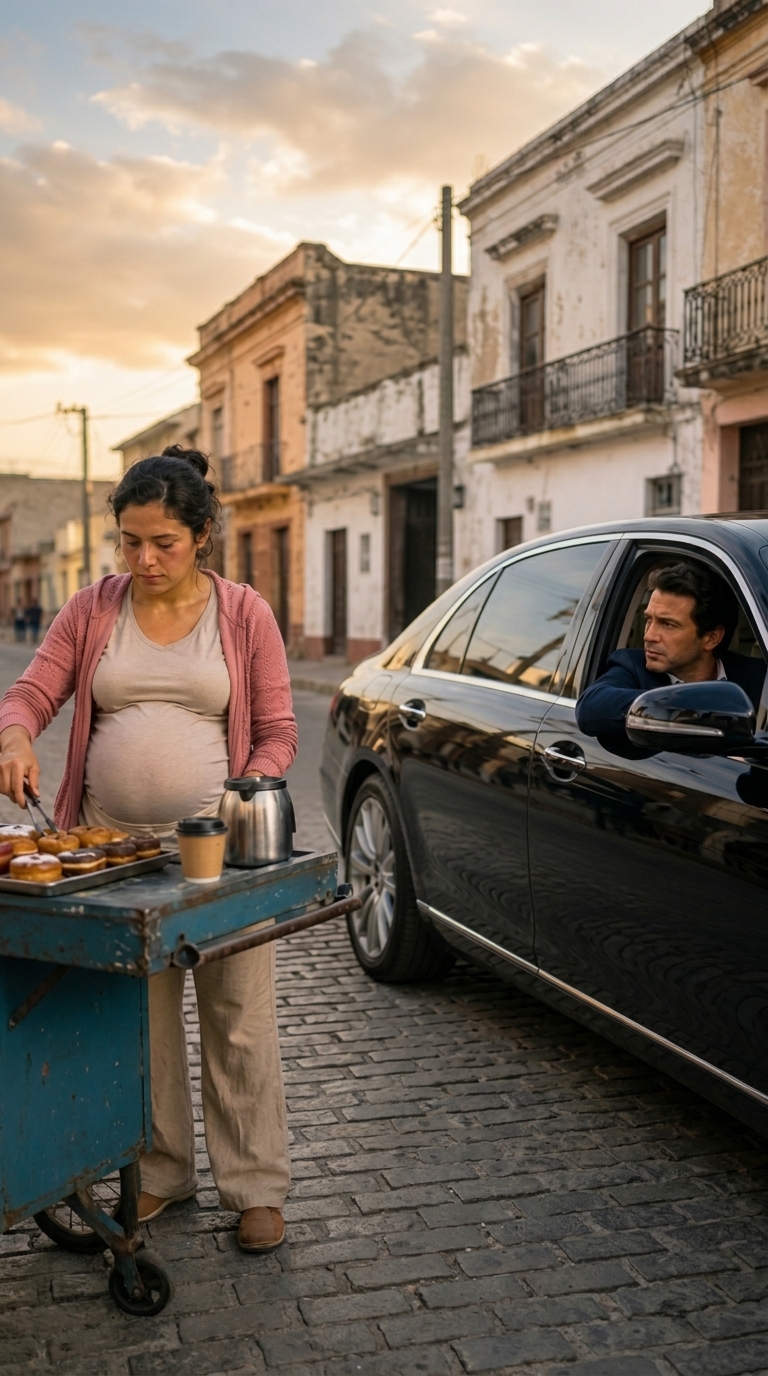
Thinner, with her hair tied back, a simple dress, and a light apron. Her hands were full of flour.
And her belly round.
Very round.
Sebastián stood frozen on the sidewalk.
Mariana smiled at a customer, tired but dignified. She didn’t look like a defeated woman. She looked like a woman who had cried all she could cry and then forced herself to keep living.
Esteban whispered:
—Let’s go.
Sebastián shook his head.
—Not yet.
It hurt him every second without holding her, but he knew that if he appeared without proof, his mother would twist everything again.
That same day, he gathered statements.
Lupita signed.
The guard at the house confirmed that Mariana was expelled.
A family lawyer, pressured by Sebastián, admitted that Doña Leonor and Patricia blocked accounts, manipulated documents, and presented Mariana as a “widow without rights” to gain temporary control of properties and stocks.
But the evidence that changed everything came from where no one expected.
Esteban found a security recording from the entrance of the house.
The video showed Mariana crying with her suitcase while Patricia took a folder of documents from her.
Then Doña Leonor’s voice could be heard:
—Without children, you’re nobody in this family. And if my son is dead, you disappear too.
Sebastián watched the video three times.
On the third, he no longer cried.
He just said:
—Now it’s time.
He returned to the market at dusk.
Mariana was putting away trays when someone stopped in front of the cart.
—Good afternoon, what can I get you?
No one answered.
She lifted her gaze.
The bread tongs fell to the ground.
—No… it can’t be.
Sebastián stood before her, thinner, with discreet scars on his face and eyes full of guilt.
—Mariana.
She recoiled as if she had seen a ghost.
—You were dead.
—That’s what they told me too.
Mariana covered her mouth.
—They kicked me out of your house. They took everything from me. I waited for you until they wouldn’t even let me in.
Sebastián took a step forward, but he didn’t touch her.
—I was told you ran off with another man.
Mariana let out a broken, bitter laugh.
—With another? Sebastián, I was pregnant and selling bread because your family left me on the street.
He looked down at her belly.
—Pregnant?
She cried.
—There are three. After nine years, three came. And you weren’t there.
Sebastián broke right there, in the middle of the sidewalk.
He knelt before her and pressed his forehead against her belly so gently that several customers stopped talking.
—Forgive me —he whispered—. Forgive me for not finding you sooner.
Mariana placed a trembling hand on his hair.
—I just wanted you to come back.
That night, they didn’t return alone to the house in Lomas Verdes.
They entered together.
Sebastián held Mariana’s hand. Behind them came Esteban, Lupita, the guard, and the family lawyer.
Doña Leonor was in the dining room with Patricia, reviewing company papers as if they were already absolute owners.
Upon seeing Mariana, Patricia stood up, furious.
—What is she doing here?
Sebastián threw a folder on the table.
—She’s here to reclaim what you stole from her.
Doña Leonor paled.
—Son, be careful with what you say.
—I was careful for nine years, Mom. Careful not to offend them. Careful not to inconvenience them. Careful for them to accept my wife. That’s over.
Patricia tried to smile.
—That woman abandoned you.
Sebastián turned on the living room television.
The video appeared on the screen.
Doña Leonor’s voice filled the house:
“Without children, you’re nobody in this family.”
Patricia turned white.
Mariana said nothing. She just held her belly.
Then came the twist that finished destroying the lie.
The lawyer, sweaty hands, confessed that Patricia had prepared a request to declare Sebastián legally incompetent if he woke up confused, thus controlling the company for longer.
—They didn’t just want to erase Mariana —Sebastián said—. They also wanted to use me.
Doña Leonor began to cry.
—I just wanted to protect your legacy.
Sebastián pointed at Mariana.
—My legacy is there. The woman you threw out. The three children you despised before they were born. The only person who waited for me when everyone else was already dividing me.
Patricia shouted that it was unfair, that Mariana always wanted to keep everything.
Mariana finally spoke.
—When he and I had nothing, I already had everything. I never needed to steal a dime from him.
The silence was brutal.
Sebastián removed Patricia from the company and ordered a full audit. She faced charges for forgery and breach of trust.
He assured Doña Leonor of financial support, but away from her house, from his wife, and from his children.
—I won’t leave you on the street —he said—, because I’m not like you. But you will no longer decide about my family.
Mariana didn’t celebrate.
She just took a deep breath.
—I don’t want revenge. I want peace. But peace also needs boundaries.
The following months were slow and difficult.
Sebastián accompanied Mariana to every medical appointment. He learned to carry shopping bags, to make coffee without burning it, and to listen when she was scared.
Sometimes Mariana would wake up crying, remembering the suitcase, the closed door, the humiliation.
He didn’t ask her to forget.
He would just sit beside her and say:
—I’m here. This time I truly am.
In spring, two boys and a girl were born: Emiliano, Gael, and Lucía.
When the nurse placed the three babies in Mariana's arms, Sebastián cried without shame.
—We asked for one miracle for nine years —he said—. And three came all at once.
Some time later, one Sunday morning, the kitchen smelled once again of orange, cinnamon, and butter.
On a shelf were the old apron, the recipe notebook, and a photo of the cart in Coyoacán.
Mariana pulled out a tray of conchas.
Sebastián tasted one and closed his eyes.
—This flavor brought me back.
She smiled with beautiful exhaustion.
—No. You came back because you never stopped searching.
He looked at their three children sleeping in the living room and understood that a home is not built with last names, contracts, or expensive walls.
It is built with the one who waits for you even when everyone lies.
And there remained the question that many dared not answer:
Does blood really make a family, or is family made up of those who don’t let you go when the whole world tries to tear you apart?





