PART 1
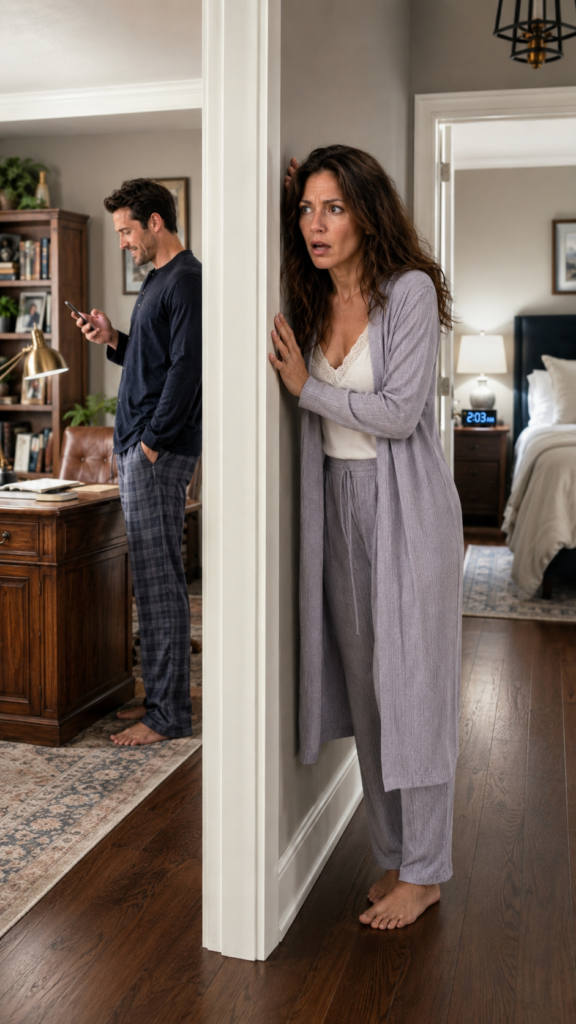
At 2:00 AM, Inés Valderrama opened her eyes at the sound of her husband’s voice behind the study door.
"She won’t notice. Inés signs everything without asking."
The words hit her chest like a bucket of ice-cold water.
She was in her home in San Ángel, an old mansion adorned with bougainvillea in the yard, with cantera floors and family photos perfectly aligned in the living room. For 29 years, Inés believed that this house was her refuge.
That night, she realized it could also be her cage.
Her husband, Rodrigo Armenta, was on the phone with someone. He wasn’t shouting. He didn’t sound nervous. He was calm, almost mocking, like when he closed a deal in his Polanco office.
"She just needs to sign on Friday," he said. "After that, the publisher, the royalties, and the properties will be protected. She has no idea what any of it is worth."
Inés froze.
She was a writer. Not a scandalous celebrity, but respected. Her novels about women from the neighborhood, single mothers, and broken families had sold well for years.
Rodrigo always said he managed the money so she wouldn’t get stressed.
And she believed him.
She slowly got up, wearing a gray robe over her nightgown. She walked barefoot down the hall, careful that the old wood wouldn’t creak. Through the crack in the door, she saw Rodrigo with his back to her, a phone pressed to his ear and a glass of whiskey in his hand.
"My wife lives in her little books," he said. "All I have to say is 'sign here, love,' and she’ll do it. That’s how it’s always been."
Inés felt her knees buckle.
It didn’t hurt like infidelity. It hurt worse. It hurt like discovering that the person sleeping beside her had been laughing at her trust for decades.
When Rodrigo returned to the bedroom, she was already lying down, pretending to sleep.
He slipped under the covers, tucked a strand of hair behind her ear, and whispered,
"Rest, my life."
Inés kept her eyes closed.
For the first time, those words didn’t sound loving. They sounded like poison.
The next morning, Rodrigo went downstairs as if nothing had happened. Gray suit, expensive watch, the smile of an important man. He asked Cata, the maid, for eggs with green sauce and coffee without sugar.
Then he kissed Inés on the forehead.
"On Friday, we’ll go to the notary, okay? Just routine paperwork. Family planning, nothing complicated."
Inés barely smiled.
"Sure."
But as soon as he left for Reforma, she entered the study.
She never did that. Rodrigo insisted there were delicate documents for the company, tax contracts, boring matters.
Inés rummaged through drawers, folders, hollow books, and even a box of cigars. Under a shelf, she found a key taped with black tape.
The key opened a lateral filing cabinet.
Inside were bank statements, powers of attorney, contracts with seals, documents for a new partnership, and receipts for transfers she had never authorized.
She also found records of her royalties.
Money from her books, conferences, and adaptation rights that she thought were in shared accounts, but which had ended up in companies where her name didn’t appear.
At the back, inside a metal box, she found the worst.
A modified will.
A property separation agreement.
And several pages marked with yellow arrows where she was to sign.
Inés turned the pages with trembling hands.
In an older version, she was listed as the primary beneficiary of the family assets.
In the new one, her name was crossed out in red ink.
And in the space where it used to say "Inés Valderrama," now there was only a blank line waiting for her signature.
Then she found a handwritten note from Rodrigo:
"After this, she will be out with no claim."
Inés felt the air disappear.
This wasn’t a mistake. This wasn’t a misunderstanding. Her husband had prepared the exact place where he would erase her.
PART 2
Inés didn’t scream.
That was what scared her most about herself.
She sat on the floor of the study, surrounded by papers, listening to the city begin to wake outside. A garbage truck passed, a dog barked, someone opened a curtain in the house next door.
The world continued normally.
But her life had just shattered in two.
For almost 30 years, she had allowed Rodrigo to manage everything. He paid taxes, spoke with accountants, negotiated contracts, and checked accounts.
She wrote.
He repeated that he was protecting her.
Now she understood he wasn’t protecting her. He was keeping her away.
Inés took pictures of every document. She saved screenshots, folded copies, stuffed everything in a canvas bag, and put the box back where it belonged.
Before noon, she called someone she hadn’t seen since college.
Marina Gálvez.
They had studied together at UNAM. Inés became a writer. Marina became a tough lawyer, one of those who appeared in newspapers for cases of family fraud, contested inheritances, and entrepreneurs hiding fortunes behind shell companies.
Marina answered with a dry voice.
"Inés, tell me."
Inés could hardly speak.
"I think Rodrigo is stealing from me."
There was a short silence.
"Come to my office today. Don’t tell anyone. And bring even the most insignificant paper."
Marina’s office was in the Roma neighborhood, in an old building on the outside and modern inside. It smelled of strong coffee, freshly printed paper, and rain.
Inés arrived wearing dark glasses, a tightly held bag against her chest, and the face of someone who had just discovered they were living with a stranger.
Marina read everything without interruption.
When she reached the property agreement, she looked up.
"This isn’t just a simple scam, Inés."
"Then what is it?"
"A theft crafted with patience."
Inés swallowed.
Marina continued flipping through pages.
"There are suspicious powers of attorney, companies created months ago, movements of royalties, and an attempt to make you sign documents that leave you without real access to assets that are also yours."
"But I never signed this."
"That’s exactly what we’re going to prove."
In less than 48 hours, Marina gathered a forensic accountant, a handwriting expert, and a commercial lawyer. They reviewed contracts, accounts, transfers, and emails.
The first finding was brutal.
A company called Valle Editorial Consultores had been receiving money from Inés’s royalties for the last four years. The name was similar to that of her real publisher, as if Rodrigo had wanted everything to appear normal in a quick review.
The second finding hurt more.
Several signatures supposedly from Inés appeared on documents dated when she was out of the country presenting a novel in Bogotá.
There were photos. Tickets. Videos. Interviews.
She couldn’t have signed.
Someone did it for her.
"Inés," said Marina carefully, "this could imply forgery, fraudulent administration, and simulation of legal acts."
Inés looked down.
"He always said I was bad with numbers."
Marina closed the folder.
"You weren’t bad. He convinced you not to look."
That night, Inés returned home.
Rodrigo was in the kitchen, pouring tequila into a shot glass. When he saw her, he smiled as if nothing was wrong.
"Where were you, my love?"
"I went to get some fabric in Coyoacán. I want to change the curtains."
"Good. The house needs life."
Inés looked at him.
The house had life.
What it didn’t have was truth.
Friday arrived.
Rodrigo took her to a private club in Polanco. He said they could eat there afterward, "to celebrate that everything was in order."
In the lounge were two of his partners, a well-known notary, and a thick folder with colored dividers.
Rodrigo pulled out her chair.
"We sign quickly and then go eat, okay?"
Inés sat down.
She took the first page and read it slowly.
Rodrigo clenched his jaw.
"You don’t need to read everything, love. They’re just forms."
She raised her gaze.
"How curious. It says here that I authorized a transfer of 8 million pesos in March."
The notary froze.
One of the partners stopped smiling.
Rodrigo cleared his throat.
"You probably don’t remember. It was something we talked about."
Inés turned to the next page.
"That day I was in Monterrey giving a conference. There are videos, plane tickets, and over 300 people who can confirm it."
The silence became heavy.
Rodrigo changed his tone.
"Inés, don’t make a scene."
She took a deep breath.
"I’m not making a scene. I’m reading what you wanted me to sign without reading."
Rodrigo reached out to take the page from her.
At that moment, the door to the lounge opened.
Marina Gálvez entered with two lawyers, a court clerk, and a man in a blue suit, holding a sealed folder.
She didn’t raise her voice. She didn’t need to.
"Good afternoon. Urgent measures are being notified to suspend the signing of these documents, preserve the related documentation, and request preventive immobilization of assets subject to investigation."
Rodrigo stood up.
"This is nonsense. My wife is confused."
Inés looked him in the eye.
"No, Rodrigo. What’s happening is that I’ve finally stopped being obedient."
The notary closed the folder.
"Under these circumstances, I cannot proceed with the act."
That phrase drained the color from Rodrigo’s face.
One of his partners murmured something. The other began checking his phone with trembling hands.
Marina placed copies of transfers, preliminary reports, printed messages, and documents with questioned signatures on the table.
"There are indications that income from Mrs. Valderrama was diverted, property dispositions were modified without informed consent, and an attempt was made to use an agreement to leave her without the possibility of claiming."
Rodrigo let out a dry laugh.
"My lawyers will destroy this."
Marina remained unfazed.
"Perfect. Then they can also explain why your wife appears to be signing in Mexico City while she was in front of cameras in Monterrey."
Rodrigo looked at Inés.
"Inés, let’s go home. We’ll talk there."
For years, that phrase would have sufficed.
At home.
In private.
Without witnesses.
Where he could lower his voice, touch her hand, and make her feel exaggerated, ungrateful, dramatic.
But that woman was no longer sitting there.
"Inés is not going home with you," said Marina.
Rodrigo laughed.
"Now you decide for my wife?"
Inés stood up.
"No. Now I decide."
The case exploded weeks later.
Not on television, because Inés refused to sell her pain as a spectacle. But yes in courts, in offices, in banks, in the publishing house, and among friends who had seen Rodrigo as a respectable gentleman, an exemplary husband, a family man for years.
The investigation revealed more than Inés imagined.
Rodrigo had used friends' companies to move money. He had changed beneficiaries on insurance policies. He prepared a new will where a partner had absurd rights. He had sold inherited jewelry from Inés’s mother and told her the money was used to pay a medical debt.
A lie.
The money went into a business account she didn’t know.
But the cruelest twist appeared in an email.
Rodrigo wrote to his partner:
"As long as Inés thinks I’m indispensable, she’ll never check anything. Her talent is useful, but her trust is even more so."
When Inés read that sentence in Marina’s office, she finally cried.
She didn’t cry for the money.
She cried for all the times she felt foolish, when in reality, she was being manipulated.
She cried for the years she confused tranquility with control.
She cried for the young woman who once signed her marriage certificate believing she was entering a family, not a trap.
At the hearing, Rodrigo’s lawyers tried to paint her as a resentful wife, influenced by a lawyer friend and confused by financial matters.
But Inés was no longer the woman who asked for permission to understand.
She responded with dates, bank statements, contracts, emails, flight tickets, interviews, and expert reports.
When the judge asked her why she had taken so long to review her own assets, she held his gaze.
"Because for years, I was told that trust was love. And I didn’t know it could also be a way to surrender without defense."
The judge ordered several assets to be immobilized, all questioned signatures reviewed, Inés’s royalties protected, and operations related to the companies suspended until the investigation was complete.
The expert reports confirmed forgeries.
The partners began to blame each other.
One testified that Rodrigo always said:
"Inés never gets involved. She just signs."
That phrase sealed his fate.
Months later, Inés regained control of her royalties, protected her author rights, and achieved acknowledgment of her involvement in the assets built during the marriage.
Rodrigo lost partners, reputation, and the mask of the perfect husband.
The house in San Ángel remained part of the proceedings, but Inés didn’t want to live there.
"I won’t sleep in a place where my name was quietly erased," she told Marina.
She moved to a smaller apartment in Del Valle, filled with plants, books, and morning light.
At first, she couldn’t write.
Every time she opened her laptop, she heard Rodrigo’s voice saying "her little books."
But one day, she wrote one page.
Then five.
Then a whole chapter.
Her next novel became the most read of her career. Not because it told exactly her story, but because many women recognized something of their own within its pages: that habit of shrinking themselves so someone else could feel enormous.
At a presentation at the FIL in Guadalajara, a reader asked her:
"How did you know it was time to leave?"
Inés paused for a few seconds.
She thought of the early morning at 2:00, the metal box, the blank line where her name had been erased.
Then she answered:
"One doesn’t always leave when they stop loving. Sometimes they leave when they understand that loving should never mean disappearing."
The entire room applauded.
Inés looked at her hands.
The same hands that Rodrigo thought were meant to sign without reading.
Now those hands were writing.
And each new page was a way to place her name right back where someone thought they could erase her forever.





