PART 1
Just one phrase from his sister turned Gabriel's home into hell.
—That woman is playing you, brother. She’s using you, draining your money, and still pretending to be the victim.
Dinner had grown cold on the table of the apartment where Gabriel lived with Mariela, in a quiet neighborhood of Zapopan. Outside, a rare cold wind whipped through Guadalajara, making even the windows seem to groan.
Mariela had prepared chicken soup, rice, freshly warmed tortillas, and a spicy chili sauce that Beatriz, Gabriel's sister, had loved since childhood.
But Beatriz hadn't come over for dinner.
She had come to sow doubt.
From the moment she arrived, she scrutinized every corner as if the house belonged to her. She criticized the curtains, the food, the smell of the freshly mopped floor, and even the way Mariela served the dishes.
Gabriel said nothing.
He always claimed Beatriz was intense but good. After their father’s death, she had become protective, forced to grow up too fast.
Mariela listened in silence, though it pained her inside that her husband defended his sister more than her.
That night, while Mariela washed the dishes, Beatriz approached Gabriel with her phone in hand.
—Check your account. Seriously, do it if you still have any dignity.
Gabriel frowned.
—What are you talking about?
—I overheard her on the phone. She said, “I’ve saved up a little more, I’ll send the rest tomorrow.” Do you really think she’s talking about the savings club? That woman is supporting someone.
Gabriel felt a knot in his stomach.
Hours later, when Mariela fell asleep, he grabbed his phone and logged into his banking app. There they were: 2 transfers of 2,500 pesos and 1 of 3,000.
In total, 8,000 pesos.
To an account he didn’t recognize.
The next day, he tried to ask calmly, but the moment he mentioned the money, Mariela turned pale.
—Gabriel, please, let me explain.
Beatriz appeared in the living room as if she had been waiting behind the door.
—See? When a person has nothing to hide, they don’t tremble like that.
Mariela cried.
—It’s not what you think.
But Gabriel was already blinded.
Shame, pride, and Beatriz's words filled his head.
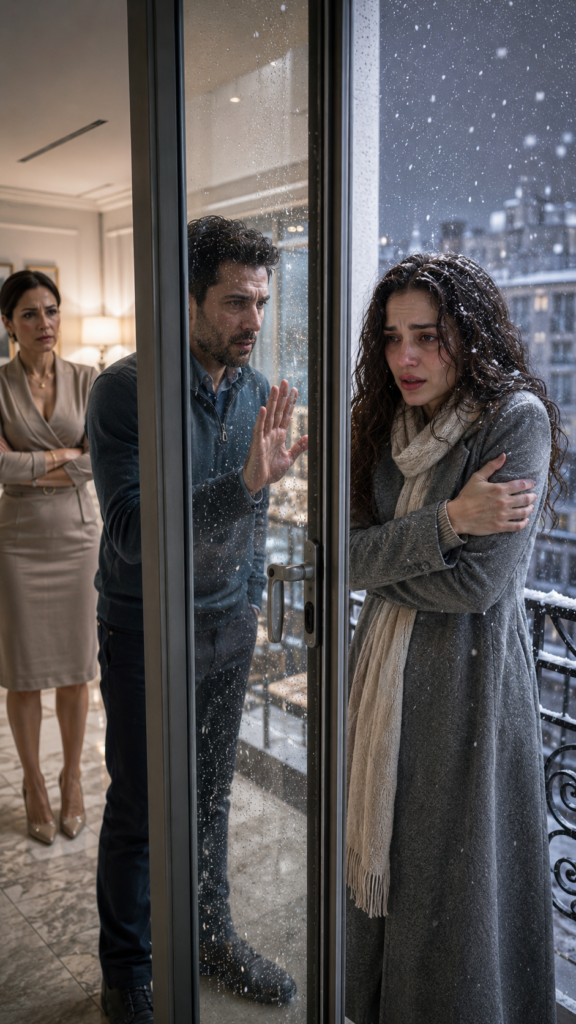
—Then go out to the balcony —he said with a coldness he didn’t even recognize—. When you find the courage to tell the truth, you can come back in.
Mariela looked at him as if she had just lost him forever.
Then she stepped outside.
Gabriel slammed the glass door shut.
And locked it.
At 3:17 AM, he woke with a jolt in his chest. The bed was empty. The cold seeped in under the door.
He ran to the balcony.
But Mariela was gone.
Only a wet footprint remained on the floor, a cigarette butt hidden next to a flowerpot, and a crumpled letter that read: “Forgive me for not telling you who those 8,000 pesos were really for…”
PART 2
Gabriel burst through the door.
The cold air slapped his face like a punch. He looked down and felt his legs turn to jelly.
On the sidewalk, next to the entrance tree, was a figure wrapped in a light robe.
—Mariela! —he shouted.
He dashed down barefoot, without a jacket, stumbling down the steps. Beatriz followed him, but she wasn’t screaming in fear; she was nervous.
Neighbors were already peeking out. A woman from 2B brought a blanket. A guy was recording with his phone until Gabriel swatted the air at him.
Mariela was alive.
She was breathing slowly, her lips purple, fingers clenched around the letter.
The ambulance arrived 12 minutes later.
At the Civil Hospital, Gabriel walked the hallway for hours, smelling bleach, burnt coffee, and guilt. Beatriz sat far away, clutching her purse, saying nothing.
When the doctor came out, Gabriel stood as if his soul had been yanked away.
—Your wife is stable, but she arrived in serious condition.
—Did she fall? Did she jump? Tell me the truth.
The doctor looked at him with seriousness.
—She has hypothermia, bruises, and traces of sedatives. But that’s not all. We found signs of poisoning from a substance used in agrochemicals. It wasn’t a single dose. It’s been in her system for days.
Gabriel felt the world go silent.
—Was she being poisoned?
The doctor didn’t respond immediately.
But her silence was worse than any words.
That morning, Gabriel returned to the apartment with Javier, an old friend who worked as a municipal police officer. Javier couldn’t open a formal investigation without a report, but he could see what Gabriel wasn’t in a condition to.
They found the cigarette butt behind the flowerpot.
Neither Gabriel nor Mariela smoked.
Beatriz claimed she didn’t either, though her yellowed fingers told another story.
They also found a cup with remnants of “herbs from the ranch,” the kind Beatriz had brought days earlier, saying it was good for nerves, for the stomach, and to “clean bad energies.”
—Who else was here last night? —Javier asked.
Gabriel shook his head.
—Nobody.
Then Javier pointed to the front door lock.
—Well, someone came in. Nothing was forced. They used a key.
Gabriel remembered something that tightened his throat: Beatriz had a copy “for emergencies.”
He found her in the kitchen, washing a cup with trembling hands.
—Did you give the key to anyone?
Beatriz turned white.
—What?
—I asked if you gave the key to anyone.
She swallowed hard.
—Don’t start with your ideas. Mariela is to blame. Can’t you see what she did? She wanted to play the victim.
Gabriel slammed his palm on the table.
—She almost died!
Beatriz started to cry, but not like someone in pain. She cried like someone running out of options.
Javier received a call that same afternoon. They had reviewed the building’s cameras. At 2:41 AM, a woman in a cap and black jacket entered through the parking lot.
Beatriz closed her eyes when she saw the image.
Gabriel understood before hearing the name.
—Who is it?
Javier answered:
—Her name is Norma Salcedo. She works at a fertilizer company in Tlajomulco. And according to her social media, she’s been friends with Beatriz since high school.
Silence fell heavy.
Beatriz sank into a chair.
—I didn’t know this would happen.
Gabriel looked at her as if she were a stranger.
—What didn’t you know?
—Norma told me Mariela was dangerous. She said she had already destroyed a family, that she was using you, that those transfers were proof she was taking care of a man.
—And you believed her?
—I just wanted to protect you.
Gabriel let out a dry, broken laugh.
—Protect me? You humiliated my wife at her own table. You filled my head with poison. You left her outside in the cold.
Beatriz covered her face.
—She gave me the herbs. She said they would only cause dizziness, fatigue, that this way Mariela would get nervous and confess. I swear I didn’t know it was strong poison.
Gabriel felt like vomiting.
—And did Norma come in last night?
Beatriz took too long to answer.
—I hid the key in the flowerpot in the hallway. She said she only wanted to talk to her, scare her a little.
Javier put a hand to his forehead.
—This is already a crime, Beatriz. A serious one.
But the hardest blow was still inside the letter.
Gabriel had read it in the hospital, his hands trembling.
“Forgive me for not telling you about my mom. They found a tumor and needed to save for the surgery. I didn’t want to worry you because you’ve been paying off your workshop debts for months. The 8,000 pesos were for her. I wasn’t deceiving you. I was just afraid of being another burden in your life.”
Gabriel broke down in the hallway.
He didn’t cry beautifully.
He cried like men do when they finally understand that their pride has just shattered the one person they should have protected the most.
Norma's arrest occurred that same night. They found her at an aunt’s house, trying to delete messages. In her room, they found jars, gloves, a notebook with dates, and an old photo of Mariela in a factory uniform.
That’s when the twist that changed everything came out.
Norma didn’t hate Mariela for Gabriel.
She hated her for her brother.
Years ago, Mariela had worked at a vegetable packing plant in Tlajomulco. A machine malfunctioned during the night shift. A worker named Iván Salcedo got trapped.
Mariela was the only one who ran to help.
She cut her hands trying to pull a lever. She screamed until her voice was gone. She asked for the current to be turned off.
But the company took too long.
Iván died before the paramedics arrived.
The family needed a scapegoat. The company washed its hands of it. The bosses said Mariela had “distracted” Iván, that because of her he hadn’t followed protocol.
It was a lie.
But Norma believed it for 3 years.
When Beatriz told her suspicions about the transfers, Norma found the perfect opportunity.
—That woman has killed once —she told her—. Now she’s going to destroy your brother.
Beatriz, with her sickly love of control, believed her.
The night on the balcony, Norma entered the apartment while everyone slept. She found Mariela trembling, half-asleep from the sedatives she had taken to calm her anxiety. She didn’t want to die. She wanted to stop feeling.
Norma tried to force her to confess to something she had never done.
They argued.
Mariela lost her balance near the railing. Norma pulled her too late, leaving a wet footprint on the floor. Then she smoked a cigarette while deciding whether to call for help.
In the end, she fled.
It was a neighbor who went out early to buy bread rolls who saw Mariela lying there and called for help.
That call saved her life.
When Mariela woke up 3 days later, Gabriel entered the room without flowers, without excuses, and without theatrics.
He had learned that a bouquet doesn’t cover a closed door.
—I know everything —he said, his voice breaking—. About your mom, about Norma, about the factory… and what I did.
Mariela looked at him from the bed.
Her eyes held no anger.
They held exhaustion.
And that hurt more.
—You left me outside —she whispered.
Gabriel lowered his head.
—Yes.
—I asked you to listen to me.
—Yes.
—And you preferred to believe your sister.
Gabriel found no defense.
—I’m going to declare everything. Against Norma, against Beatriz, and against myself if necessary. I’m not here to ask for your forgiveness to feel less garbage. I’m here to tell you that what I did has no justification.
Mariela turned her gaze to the window.
—My mom needs the surgery.
—It’s already paid for —he replied—. Not for you to forgive me. But because it was the right thing to do all along.
Mariela cried in silence.
She didn’t hug him.
She didn’t take his hand.
There was no novel-like reconciliation.
Just two broken people in a white room, understanding that sometimes love doesn’t end abruptly, but trust does.
Norma was charged with attempted poisoning and injury. During her hearing, she said the pain of her brother had driven her insane.
The judge was clear:
—Pain explains a wound, but it doesn’t authorize you to destroy someone else’s life.
Beatriz didn’t step foot in jail, but she lost the place she thought she had in Gabriel’s life. Before leaving for Tapalpa, she went to the hospital and stood at the door, unable to enter.
—Mariela… I’m ashamed.
Mariela looked at her without blinking.
—Your shame doesn’t return the night I thought my husband hated me.
Beatriz placed a hand on her chest.
—I know.
—Then live with it.
Gabriel accompanied her to the bus station. They didn’t argue. They didn’t yell. They just embraced with the sadness of siblings who don’t know if they’re saying goodbye for months or for a lifetime.
—Take care of her —Beatriz said.
Gabriel gritted his teeth.
—I should have done that from the beginning.
When Mariela left the hospital, she didn’t want to return to the apartment.
She stood in front of the balcony, staring at the glass as if she could still hear the lock clicking shut.
—I can’t live here —she said.
Gabriel didn’t argue.
They sold furniture, gave away things, and rented a small house in Tlaquepaque, near a bakery where the mornings smelled of freshly baked conchas and coffee from the pot.
Mariela brought her plants.
Gabriel brought few belongings.
They left the rest behind, though guilt wouldn’t fit in any box.
Months passed painfully.
There were good days, with slow walks, calls from Mariela’s mom after the successful surgery, and breakfasts where they could finally talk without shouting.
And there were bad days.
Days when Mariela would sit silently staring out the window.
Days when Gabriel would wake up at midnight just to confirm she was still by his side.
One rainy night, Mariela prepared chamomile tea. They sat on the patio, watching the water fall over the pots.
—I don’t know if I’ll ever forgive you like before —she said.
Gabriel nodded.
—I understand.
—But I also don’t want to live hating you.
He closed his eyes.
—I’ll prove it to you, not promise it.
Mariela took a deep breath.
—That. Because a woman can be married and still feel alone. And that, Gabriel, also kills.
From then on, Gabriel learned to ask before accusing. He learned that family doesn’t always protect; sometimes it invades, manipulates, and destroys in the name of love.
Beatriz learned too late that loving a brother doesn’t mean ruling his life.
Norma lost her freedom for confusing justice with revenge.
And Mariela, who was only trying to silently save her mother, ended up being the only one who bore the deepest wound.
A year later, Gabriel passed by the old building. He looked up at the balcony where everything had shattered.
Mariela waited for him in the car.
—Are you okay? —she asked.
He got in, took a deep breath, and replied:
—Yeah. I just remembered that a home can be destroyed with a suspicion.
Mariela said nothing.
But she placed her hand over his.
It wasn’t a complete forgiveness.
It was something harder.
It was continuing to walk without pretending nothing had happened.
Because sometimes tragedy doesn’t begin with a blow.
It begins with a venomous phrase at the table.
With 8,000 pesos that no one dares to explain.
With a sister who believes she has the right to meddle.
And with a husband who closes a door without imagining that, on the other side, he is forever losing the trust of the woman he claimed to love.





