PART 1
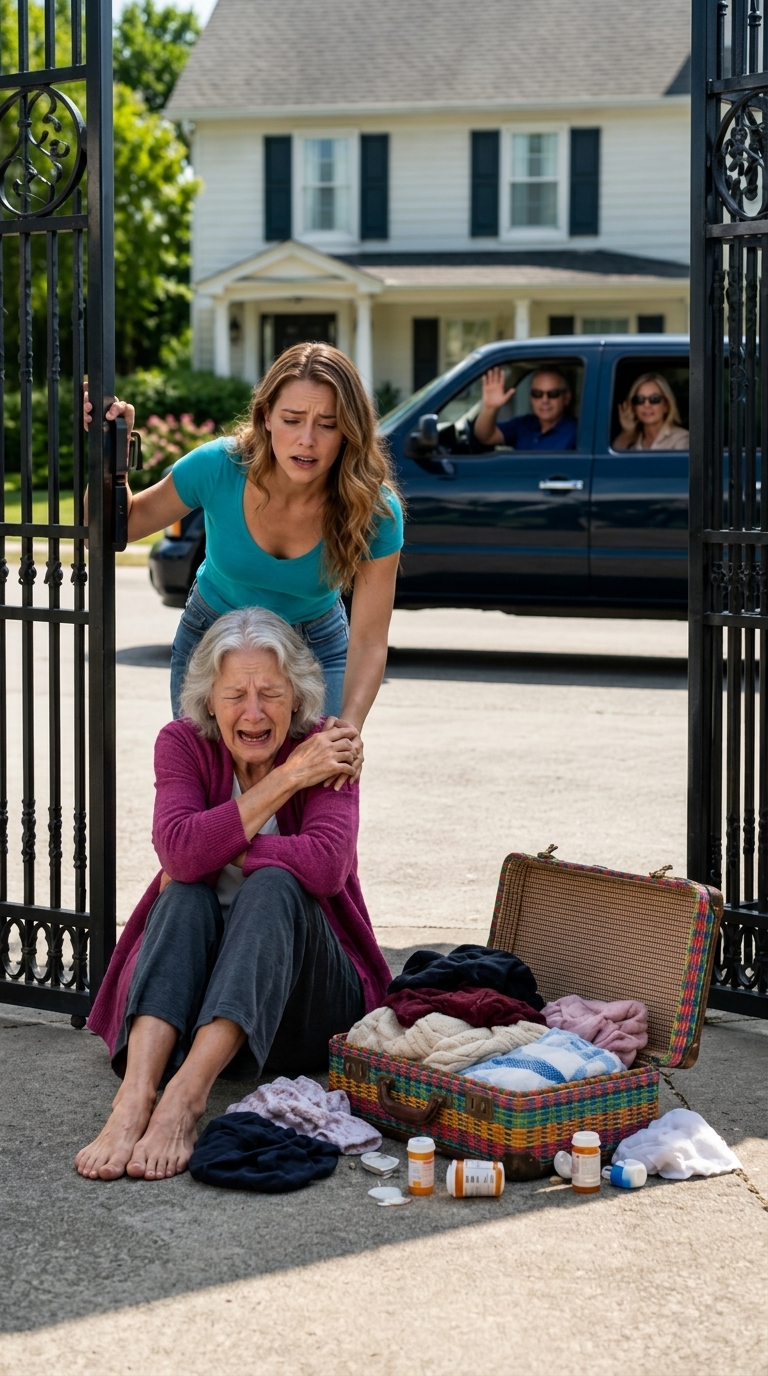
Camila was left with her grandmother at the entrance as if she were an old sack.
It was 7:13 in the morning in a quiet neighborhood of Narvarte, in Mexico City. Camila had just stepped out of the bathroom, her hair wet and her robe loosely tied, when she heard loud knocks at the door.
When she opened it, she froze.
There was Doña Genoveva, her grandmother, sitting in a folding chair, wearing a gray sweater covered in lint, a coffee-stained skirt, and two mismatched slippers.
Beside her, an old suitcase lay half-open, filled with dirty clothes, diapers, mixed-up medicines, and a folded photo of a young Genoveva.
Behind her, her uncle Joel hadn’t even turned off the van.
His wife, Maritza, stared at her phone with dark glasses on, as if that made her ashamed, but not for the elderly woman, just for wasting her time.
“Here’s your grandmother,” Joel said flatly. “We’re tired of her. Now do something useful for once in your life.”
Camila felt her throat tighten.
“What did you do to her?”
“Nothing, don’t start with your dramas,” Joel replied. “She’s old, she gets lost, screams, breaks things. We can’t handle her anymore.”
Doña Genoveva looked up, confused.
“Sweetheart… did we arrive at home?”
Camila lowered her gaze to her trembling hands. She had purple bruises on her wrists.
“Why does she have marks?”
Maritza let out a giggle.
“Oh, please. She hits herself. That’s how sick people are. Besides, we sold her house because it was impossible to maintain.”
Camila’s eyes widened.
“You sold my grandmother’s house?”
“She signed,” Joel said. “That’s all that matters.”
“With Alzheimer’s?”
Joel stepped one pace closer, his jaw clenched.
“Listen, kid. Don’t get into troubles you don’t understand. You always were her favorite, right? Well, there’s your prize.”
Camila wanted to scream, call the police, block their way.
But her grandmother started to cry softly, like a scolded child.
“I don’t want to go back to the dark room…”
A heavy silence fell.
Joel looked at Maritza. Maritza put away her phone.
“Let’s go,” she said.
“You can’t leave her like this,” Camila pleaded.
Joel was already getting into the van.
“Of course we can. You don’t have a husband, you don’t have kids, you work from home making little cakes. You have all the time in the world.”
The van roared to life before Camila could respond.
Doña Genoveva stared at the street, lost.
The first few days were a silent nightmare.
The grandmother would wake up at 3:00 AM screaming that someone wanted to steal her earrings. Then she would cry because she couldn’t find her husband, dead for twelve years.
Sometimes she recognized Camila and would squeeze her hand.
Other times she would push her away, terrified, asking who had brought her to that place.
Camila sold custom cakes from her apartment. It barely covered her rent, utilities, and food. But she started buying diapers, supplements, medicines, and a notebook where she noted every strange phrase her grandmother said.
One afternoon, while feeding her chicken soup with rice, Genoveva stared at her intently.
For the first time in days, her eyes seemed clear.
“You never locked me in that room,” she whispered.
Camila set down the spoon.
“Who locked you in, Grandma?”
The elderly woman swallowed hard.
“Those who smile sweetly also steal… The key sleeps with the broken Virgin… 5… 8… 2… 1…”
Then she looked back at the wall, empty.
That same night, Camila received a message from Joel.
“Don’t involve lawyers. You have no idea what you’re waking up.”
Camila then understood that they hadn’t just abandoned her grandmother.
They feared what she might remember.
And when Genoveva, trembling under the blanket, whispered, “Box 5821… where the bell sings,” Camila knew she was about to uncover something that no one in the family wanted to come to light.
PART 2
Camila didn’t sleep that night.
She sat by the bed, listening to her grandmother’s weary breathing and staring at the old suitcase as if it contained a bomb.
At 5:40 AM, when the city was just beginning to stir, she carefully opened the suitcase.
There were stained blouses, expired medical prescriptions, a bag with three loose pills, and the folded photo of young Genoveva smiling in front of a yellow house in Coyoacán.
Camila recognized that house.
It was the house where she had spent her childhood vacations. The house where her grandmother taught her how to beat egg whites to make meringue. The house that Joel had just sold “because she signed.”
Beneath the clothes, she found a small, broken Virgin of Guadalupe figurine. The base was loose.
Camila recalled the phrase.
“The key sleeps with the broken Virgin…”
Her hands trembling, she opened the base.
Inside was a small, golden key with an old label: “Banco La Campana.”
Camila felt a chill.
It wasn’t a nonsensical phrase.
Her grandmother was remembering.
The next day, she took Genoveva to a geriatrician at the General Hospital. The doctor examined the bruises, dehydration, and the status of her medications.
“This isn’t just Alzheimer’s,” she said quietly. “There’s been negligence here. And those marks don’t look accidental.”
Camila bit her lips to hold back tears.
“Can you give me a report?”
“Of course. But I also recommend legal advice. Quickly.”
Camila didn’t have money for expensive lawyers, but a neighbor told her about Attorney Renata Solís, a lawyer for seniors who worked on cases of financial abuse.
Renata listened to everything without interrupting.
When Camila showed her Joel’s message, the key, and the phrase about box 5821, the lawyer became serious.
“Your uncle didn’t threaten you for nothing. If that box exists, it could contain evidence.”
“And if they don’t give it to me?”
“We’ll go with documents, medical reports, and a preventive complaint. In Mexico, when there’s possible abuse against a senior, it’s not a game.”
Banco La Campana was in the Historic Center, two blocks from an old church. Every hour, a bell rang so loudly that the glass vibrated.
“Where the bell sings.”
Camila entered with Genoveva on her arm. The grandmother looked around as if she were in a dream.
At the counter, the manager checked the key, Genoveva’s ID, and the medical documents.
“Mrs. Genoveva Rivas registered a secondary authorization eight years ago,” he said.
Camila held her breath.
“Under whose name?”
The manager looked at her.
“Under Camila Torres Rivas.”
Camila felt her legs weaken.
Her grandmother, in a moment of ancient clarity, had given her permission without saying anything.
They went down to a private room.
Box 5821 was at the back, cold, metallic, untouched.
When they opened it, Camila found four envelopes, a gold watch, pearl earrings, and a USB drive wrapped in an embroidered handkerchief.
The first envelope read: “For when they try to say I’m crazy.”
Inside were copies of deeds, bank statements, and a will signed before a notary.
The house in Coyoacán wasn’t for Joel.
It was for Camila.
But there was something stronger.
A document indicated that Genoveva had created a trust to pay for her medical care for the rest of her life. She had enough money for nurses, medicines, and a dignified residence if it ever became necessary.
Camila covered her mouth with a hand.
Joel hadn’t grown tired of taking care of her.
He had grown tired of waiting for her to die.
The second envelope contained receipts for bank withdrawals made by Joel over two years, using a power of attorney that apparently bore Genoveva’s signature.
Renata examined the papers and frowned.
“These signatures don’t match.”
The third envelope had photographs.
In one, Genoveva was seen sitting on a bed, with the door closed from the outside. In another, Maritza was seen wearing the grandmother’s pearl earrings at a family party.
The last photo left Camila speechless.
It was Joel inside a notary’s office, accompanied by Maritza and a young man. On the table was Genoveva, but her face looked strange, absent, as if she didn’t understand anything.
The fourth envelope contained a note written in trembling handwriting:
“If I ever say nonsensical things, don’t ignore me. Sometimes my head shuts down, but my heart knows who loves me. Joel wants my house. Maritza wants my jewelry. They give me sleeping pills and make me sign. If I go with Camila, believe her.”
Camila broke down in tears.
Genoveva looked at her, confused, and stroked her hair.
“Don’t cry, sweetheart. You’re cutting the milk from the soul.”
It was an old, absurd, and tender phrase, one she only said.
The USB drive was what finally sank the family.
Renata connected it in her office. There were several audio recordings made by Genoveva herself before her condition worsened.
In one, Joel’s voice could be heard:
“Sign, Mom. It’s to sort out the property tax.”
And then Maritza’s voice:
“If you don’t sign, we’ll leave you alone. Let’s see who can put up with your screaming.”
Then Genoveva was heard crying.
“But that house was for Camila…”
Joel responded with a cold laugh.
“Camila is worthless. She makes cakes in a tiny kitchen. We know how to move money.”
The lawyer stopped the audio.
“With this, we can fight for the annulment of the sale, report abuse, dispossession, and family violence. But you have to be ready. Your uncle is going to come at you with everything.”
And he came.
That same afternoon, Joel appeared at the building with Maritza and two cousins, banging on the door as if he owned the place.
“Open up, Camila!” he shouted. “We know you went to the bank.”
The neighbors stepped out into the hallway.
Camila opened up with her phone recording.
Joel tried to break in forcefully.
“Give me what you took, kid. You don’t know who you’re messing with.”
Genoveva was sitting on the couch. Upon seeing Joel, she began to tremble.
“The dark room…” she murmured. “Don’t lock me up again.”
The neighbors listened.
Maritza pretended to be concerned.
“Oh, poor thing, she’s delirious. Look how Camila has her, all agitated.”
Then the grandmother raised her hand and pointed at Maritza.
“You took my pearls.”
Maritza paled.
“What?”
“And you, Joel… you gave me the blue pill so I would sign.”
The hallway fell silent.
Joel laughed, nervous.
“She’s crazy. What she says isn’t worth anything.”
Then Camila played the audio.
“If you don’t sign, we’ll leave you alone…”
Maritza’s voice echoed in the hallway.
The cousins stopped looking at Camila and looked at Joel.
One of them, Sergio, lowered his head.
“No way… was that true?”
Joel tried to snatch the phone from her, but a neighbor stopped him.
In less than twenty minutes, a patrol car arrived. Renata also came with printed copies of the medical report, the box documents, and the complaint ready.
For the first time, Joel didn’t seem arrogant.
He seemed scared.
The case wasn’t resolved in one day. That only happens in novels.
There were hearings, expert opinions, notarial reviews, and medical confirmations that Genoveva wasn’t in a condition to sign the sale of the house.
It was also discovered that the twist no one expected had come.
The buyer of the house was a shell company created by Maritza’s brother.
They had “legally” sold it to themselves for a ridiculous amount, only to resell it at the real price.
And worst of all: the money from the trust had started to disappear months ago.
Joel cried in front of the judge.
He said he was tired, that taking care of a person with Alzheimer’s was a burden, that no one helped him.
But Renata wouldn’t let him hide behind exhaustion.
“Caring is tiring,” she said. “Stealing is another thing. Locking someone up is another thing. Abandoning a sick woman at her granddaughter’s door as if she were trash is another thing.”
Camila didn’t say much.
She just held her grandmother’s hand.
Genoveva stared at the floor, lost again, not fully understanding why everyone was talking about her.
Months later, the sale of the house was annulled.
Joel and Maritza faced charges for financial abuse, forgery, and mistreatment. Several relatives who had stayed silent had to testify.
Some apologized.
Others said it was “better not to air dirty laundry.”
Camila blocked them all.
With legal help, she recovered the house in Coyoacán and used the trust to hire a day nurse. She didn’t put Genoveva in a cold place or treat her like a burden.
She adapted a room with old photos, Agustin Lara’s music, and a window overlooking the patio where bougainvilleas grew.
Sometimes the grandmother would wake up not recognizing her.
“Who are you?” she would ask.
Camila would smile, even if it hurt.
“I’m someone who loves you very much, Grandma.”
And some afternoons, when the sun fell orange over the pots, Genoveva would return for a few seconds.
“Camila…” she would whisper. “My little girl with the cakes.”
Then Camila understood that justice doesn’t always return memory, nor erase the damage, nor make a broken family become family again.
But it could put everything in its place.
One Sunday, Sergio, the cousin who had seen everything in the hallway, came to visit them. He brought sweet bread and apologized for not having asked earlier.
“We all knew something was wrong,” he admitted. “But it was easier to say that Joel was taking care of it.”
Camila looked at him without anger, but without softening the truth.
“That was also abandoning her.”
Sergio didn’t respond.
Because there are silences that also hurt.
That night, Camila found Genoveva awake, looking at the broken Virgin on the nightstand.
“Are we home yet?” the elderly woman asked.
Camila tucked the blanket around her.
“Yes, Grandma. We are home now.”
Genoveva closed her eyes and smiled.
“Don’t let them take the bell.”
Camila didn’t know if she was talking about the bank, the church, or that little piece of memory that still rang inside her.
But she understood something that many families prefer to ignore: a sick person may forget names, dates, and paths, but that doesn’t make their life the property of others.
And when someone abandons an elderly adult saying, “it’s your problem now,” perhaps the real problem isn’t aging or illness.
Perhaps the problem is a family that only shows up when there’s a house, jewelry, or money involved.





