PART 1
At 8 in the morning, when the shop barely smelled of reheated coffee, gasoline, and tortillas from the corner stand, an old Tsuru rattled down the avenue.
The hood was emitting white smoke.
The engine sounded like it had stones rattling inside.
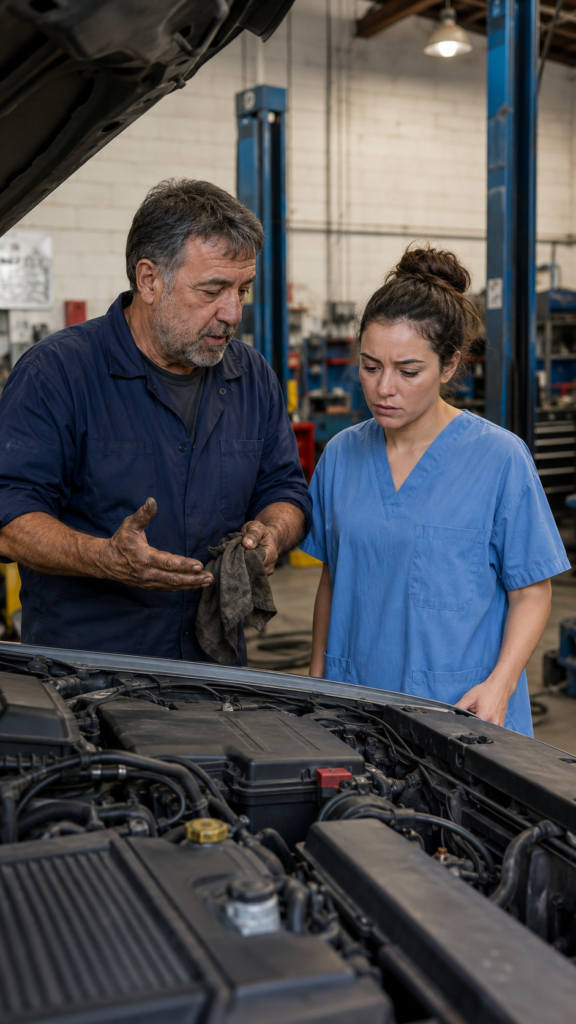
Don Ernesto, owner of the workshop "El Pistón Norteño" in Guadalajara, lifted his gaze with an unfriendly expression. He had spent 30 years fixing cars and repeating the same phrase:
—Here, quality comes at a price. This isn’t charity.
His apprentices knew it by heart.
He was a tough man, with hands blackened by grease, a weary back, and a dry voice. He wasn’t rude for no reason, but life had turned him into a rusty screw: if anyone wanted to move him, they had to put in some serious effort.
A young woman, around 22, stepped out of the Tsuru.
She wore a white nursing assistant uniform, too big for her thin frame. Her hair was hastily tied back, her eyes sunken, and dark circles under her eyes that spoke of not just one bad night, but many.
In the back seat, a sleeping baby reclined in a used car seat, clutching a stuffed monkey.
—Sir… it’s making a really awful noise —she said, gripping the keys tightly—. Please tell me it’s not serious.
Don Ernesto popped open the hood.
It took him less than a minute to see the disaster.
A blown hose, a frayed belt, oil leaking where it shouldn't, front tires slick, and brakes that, with a bit of rain, could send that car directly into a pole.
He sighed.
—Kid, this is delicate. If done right, it’ll be about 800 pesos… minimum. And that doesn’t count whatever else comes up.
The girl didn’t cry.
That was worse.
She stood still, as if someone had turned off her body. She looked at the baby. Then glanced at her watch.
—I start my shift at a nursing home in an hour —she murmured—. I’m on probation. If I'm late, I’ll get fired. I don’t have a card, I don’t have savings, I have no one to ask. Honestly, I have nothing.
She grasped the keys with trembling hands.
—I’ll throw some water in and take my chances. If it blows up, well, what can I do?
Don Ernesto looked at her.
And in that tired face, he saw another face he had been trying to forget for years.
His daughter.
The one who left home four years ago, pregnant, after he told her a phrase that still burned when he was alone:
—In this house, we won’t support mistakes.
Mistakes.
As if a baby could be a mistake.
He clenched his jaw.
—Leave the keys —he grunted.
She opened her eyes wide.
—I can’t pay you.
—Who talked about money? —he replied dryly—. The part is… complicated. We have to order it from Monterrey. It takes 2 weeks.
—2 weeks? How am I supposed to work?
Don Ernesto rummaged through his pocket and pulled out another keychain.
It was from his old Jetta, cared for as if it were a collector’s item. Nobody drove it. Not even Iker, his assistant, dared touch it.
—Here —he said, tossing her the keys—. It’s a courtesy car from the shop. Full tank. Drive carefully.
Iker approached, alarmed.
—Boss, that’s your car!
—Shut up, man —Don Ernesto said without looking at him—. Pass the baby seat.
The young woman looked at him as if she couldn’t tell if they were helping her or humiliating her.
—Why are you doing this?
Don Ernesto wiped his hands with a rag.
—Because that Tsuru doesn’t belong on the street like this. And because I don’t want to read tomorrow that a nurse and her baby ended up smashed on the Periférico.
She looked down.
She got into the Jetta with the baby.
Before starting the engine, she turned one last time towards the workshop. Her eyes were filled with something strange: fear, anger, and shame.
In the following days, Don Ernesto worked on the Tsuru after closing.
There wasn’t any complicated part.
The hose cost 80 pesos.
But he replaced the tires, checked the brakes, adjusted the suspension, put in fresh oil, cleaned the headlights, and left the car ready to pass inspection without prayer.
He didn’t tell anyone.
Until, exactly 2 weeks later, the young woman returned.
She had better color in her face.
She left the Jetta keys on the counter and looked at the Tsuru, shiny, whole, and safe.
—I’m scared to see the bill —she whispered.
Don Ernesto slid her a sheet.
At the bottom, it read:
0.00 pesos.
She raised her gaze.
—This can’t be.
—Factory campaign —he lied, without blinking—. Cooling system defect. The brand covered everything.
She saw the new tires.
Smelled the fresh oil.
Touched the newly polished headlights.
She knew it was a lie.
But what took her breath away the most was when Don Ernesto said, without looking at her:
—Go on, leave. And take care of that kid.
Then the girl pressed her lips together, as if she were about to break.
And before leaving, she said a single word that froze the entire workshop:
—Dad.
PART 2
The sound of tools seemed to die suddenly.
Iker, who was at the back adjusting a battery, turned with his mouth agape. The other guys froze, as if someone had turned off the workshop from the light box.
Don Ernesto didn’t respond.
Not because he hadn’t heard.
But because that word fell on him like a whole engine.
Dad.
It had been 4 years since anyone had called him that.
The girl didn’t move. She held the baby close to her chest, her eyes fixed on him, not as a grateful client, but as a daughter waiting for a sentence.
Don Ernesto swallowed hard.
—No —he managed to say—. You don’t…
She let out a small, bitter laugh.
—Yes. I cut my hair. I lost weight. I took my mother’s last name. But it’s me, Dad. I’m Valeria.
The name hit him harder.
Valeria.
His little girl with crooked braids.
The one who, as a child, fell asleep in a chair in the workshop while he closed late.
The one who, at 11, brought him tacos because she said, “A boss has to eat too.”
The one who, at 18, told him she was pregnant, her voice cracking, hands on her belly.
And he, instead of hugging her, told her she had ruined her life.
Don Ernesto leaned against the counter.
His hands, those strong hands that could turn stripped screws, didn’t know where to go.
—Why didn’t you say anything from the first day? —he asked, but his voice no longer sounded tough.
Valeria looked down at the baby.
—Because I didn’t come to ask for your forgiveness. I came because my car was dying and I had no one else.
That phrase hurt more than a blow.
—I…
—No —she interrupted him—. Let me talk. If you recognized me and helped me like a dad, I would’ve felt humiliated. If you didn’t recognize me, it would hurt. There was no good way, understand?
Don Ernesto didn’t answer.
Because he did understand.
And that was the worst part.
Valeria adjusted the baby in her arm. The child woke up and looked at him with big, dark, curious eyes. He had a tiny hand curled around the stuffed monkey.
—His name is Mateo —she said—. He’s 9 months old.
Don Ernesto felt something break inside him.
9 months.
A grandson.
A grandson who had breathed, cried, grown, and learned to smile without him knowing anything.
Or rather, without him daring to look.
—I went to your house once —Valeria said, her voice soft—. When Mateo had a fever. I stayed outside, across the street. I saw the light on in the kitchen.
Don Ernesto raised his gaze, confused.
—Why didn’t you knock?
Valeria pressed her lips together.
—Because I heard you talking to Iker on the phone.
Iker lowered his head immediately.
Don Ernesto frowned.
—What did you hear?
She took a deep breath.
—That you said: “My daughter chose her path. If she comes back, don’t let her in.”
The workshop fell silent once more.
Don Ernesto closed his eyes.
He remembered that call.
He remembered being drunk on pride, not alcohol. He remembered saying that to sound strong, so no one would notice that every night he stared at his daughter’s empty room, sitting on the edge of her bed without turning on the light.
But Valeria didn’t hear the fear.
She heard the rejection.
—That day, I understood I didn’t have a dad —she said—. And I left.
Don Ernesto felt shame.
Not the kind that hides behind anger.
Clean, brutal shame, the kind that leaves you without excuses.
—Valeria…
She shook her head.
—I’m not telling you this to make you feel bad. Well… maybe just a little. Because you deserve it.
Iker let out a nervous breath, but no one laughed.
Valeria continued:
—I worked taking care of old people, cleaning houses, doubling shifts. I fell asleep sitting on the bus with Mateo strapped to my chest. There were days I ate nothing but bread with coffee to buy him diapers. And every time I wanted to look for you, I heard your voice saying that I came with my hand out.
Don Ernesto took off his cap.
He left it on the counter.
It was the first time in years Iker saw him do that in front of someone.
—I said that because I’m an idiot —he murmured.
Valeria looked at him fixedly.
—Yes.
The word fell flat, just.
Don Ernesto nodded.
—Yes —he repeated—. I am.
Mateo made a little noise and reached for the greasy rag on the counter. Valeria snatched it away before he could grab it.
—Not that, my love. It’s dirty.
Don Ernesto let out a brief, broken laugh.
—Like your grandfather.
Valeria didn’t smile.
Not yet.
—I didn’t come for you to play the nice grandpa one day and then disappear when it gets hard —she said—. I didn’t come for money. I didn’t come for pity. I came because when I saw that 0.00 pesos bill, I understood something.
—What?
—That there was still something good in you. Even if you hide it well, like a lost tool.
Iker had to turn away to hide his expression.
Don Ernesto felt his eyes burn.
—I didn’t recognize you —he said, almost in a whisper—. I saw you and something moved inside me, but I didn’t want to look closely. I was scared that it was you.
—Scared of me?
—Scared of confirming that you had been so close to me… and I so far from you.
Valeria fell silent.
For the first time, her anger seemed to ease a bit.
Don Ernesto walked around the counter. He didn’t get too close. He stayed at a respectful distance, like someone who knows they’ve lost the right to invade.
—The day you told me you were pregnant, I thought of everything but you —he confessed—. I thought of what people would say. That you were too young. That family would talk. I thought of my pride, my last name, my rules. I didn’t think that you were scared.
Valeria blinked rapidly.
—I was terrified.
—Now I know.
—No. You don’t know. That night I left without a jacket because I didn’t want you to see me cry. I slept at the bus terminal. I was 18 years old and pregnant. And all I wanted was for my dad to say: “I’m here.”
Don Ernesto covered his face with one hand.
He didn’t cry loudly.
He didn’t make a scene.
But his shoulders dropped as if finally releasing a burden he had been pretending didn’t weigh anything for years.
—I’m sorry —he said.
Valeria hugged Mateo to her chest.
—I don’t know if I can today.
—I’m not asking you to repay me today —he replied—. Or tomorrow. Or ever. I just had to say it.
She looked down.
Then the unexpected twist occurred.
Iker approached slowly with a yellow envelope in hand. He looked pale.
—Boss… I also have to say something.
Don Ernesto looked at him, confused.
—What do you have?
Iker placed the envelope on the counter.
—Four years ago, when Valeria left, I found this stuck under the workshop door. I thought it was a bill or an ad. Then I saw it was for you.
Valeria’s eyes widened.
—What?
Iker swallowed hard.
—I kept it. I didn’t give it to you.
Don Ernesto felt the blood drain from his face.
—Why?
Iker looked down.
—Because that day you were furious. You said that if she came back, you would fire her. I… thought that if I gave you the letter, you would go look for her to yell at her worse. Then days passed and I felt ashamed. After that, I didn’t know how to fix it.
Valeria stopped breathing for a second.
Don Ernesto took the envelope with trembling fingers.
It was old, crumpled, dust-stained.
On the front, it said:
“For my dad. Read it when you’re no longer angry.”
Valeria covered her mouth with one hand.
—I thought you’d read it —she whispered—. I thought you read it and still didn’t look for me.
Don Ernesto opened the envelope.
The handwriting was Valeria’s, younger, rounder, shakier.
He didn’t read it all out loud.
He couldn’t.
He only caught a few lines:
“Dad, I don’t want you to support me. I just want to know if I still have a home. I’m scared, but I also love my baby. If one day you calm down, look for me. I'll be waiting even if I say no.”
The paper trembled in his hands.
There was the truth.
They hadn’t lost each other just because of pride.
Also because of a hidden letter.
Iker’s eyes were red.
—I’m sorry, Valeria. I’m sorry, boss. I messed up badly.
Don Ernesto didn’t shout.
That was more frightening.
He just folded the letter carefully, as if it were something sacred.
Then he looked at Iker.
—You made me lose 4 years.
Iker lowered his head.
—Yes.
—But I had already opened the door to lose them —Don Ernesto said—. You hid a letter. I hid my daughter behind my pride.
Valeria cried then.
Not as a victim.
She cried as someone who finally understands that pain had more than one hand in it, but that no excuse erases the past.
Don Ernesto moved a little closer.
—Valeria, I don’t have the right to ask you to come back as if nothing happened. But I do want to ask you for an opportunity.
She looked at him through tears.
—For what?
—To know Mateo. To help you without making you feel less. To shut my mouth when I need to listen. To learn to be a dad late, if it’s still possible.
Mateo, as if he understood his name in the middle of all this chaos, stretched his hand towards him.
Don Ernesto looked at Valeria, silently asking for permission.
She hesitated.
Then she brought the baby closer.
Mateo’s tiny hand grabbed the thick, cracked finger, full of mechanic’s marks.
He held on tight.
Don Ernesto broke down.
He didn’t cry beautifully. He cried like men who spent their lives swallowing everything: late, clumsily, with shame.
Valeria didn’t hug him right away.
First, she let him cry.
Because sometimes it’s also necessary to see the one who broke you accept that they are broken.
Then, carefully, she put a hand on his shoulder.
—On Sunday, I can come over for lunch —she said.
Don Ernesto raised his face.
—Really?
—But I don’t want you to treat me like a poor thing.
—No.
—Or decide my life.
—No.
—Or say that Mateo was a mistake.
Don Ernesto looked at the baby.
Then he looked at his daughter.
—Mateo is the only thing that came out clean from all this mess.
Valeria let out a laugh through her tears.
A small laugh.
But real.
Iker wiped his face with his sleeve and murmured:
—I’ll bring the tortillas on Sunday, if you let me.
Valeria looked at him.
—you bring the flan. And you’re still not forgiven.
—Right —Iker said, lowering his head—. I earned it.
Don Ernesto took the envelope with the money Valeria had brought to pay.
He returned it to her.
She was going to protest, but he raised his hand.
—It’s not a gift. It’s an investment.
—In what?
—In making sure there are enough diapers. In making sure you arrive at your shift without driving in fear. In making sure my grandson doesn’t learn that asking for help is shameful.
Valeria clutched the envelope against her chest.
—I don’t know how to start over with you.
Don Ernesto looked at the 0.00 pesos bill.
Then he looked at the letter.
—I don’t either. But I know how to fix things slowly.
She took a deep breath.
—Then slowly.
That afternoon, when Valeria left in her Tsuru, it no longer looked like a condemned car. It looked like a bridge on wheels.
Don Ernesto watched as she turned the corner.
Iker approached, saying nothing.
—Boss…
—Tomorrow, you put up a sign —Don Ernesto said.
—About what?
—“Free inspections for single mothers going to work.” But without making a show of it. No Facebook, no videos.
Iker nodded.
—And the workshop?
Don Ernesto tucked the letter into his shirt pocket.
—The workshop will continue charging those who can pay. But the one who comes with a blown engine and a worse life… we’ll help them.
That night, Don Ernesto opened Valeria’s room.
He hadn’t entered in years.
The bed was still there. Also, a photo of her at 11, with crooked bangs, crooked teeth, and a smile that could conquer the world.
He dusted it off.
He placed the letter next to the frame.
And for the first time, he didn’t speak to an absence, but to a waiting.
On Sunday, there was pasta, beans, warm tortillas, and a half-smashed flan that Iker brought.
Valeria arrived with Mateo.
There was no movie-style hug.
There was no immediate forgiveness.
There was something more difficult and more honest: an open chair, a served plate, a grandfather learning to hold a baby, and a daughter who, though still hurt, chose not to close the door.
Because sometimes a lie doesn’t destroy.
Sometimes a humble lie gives truth time to arrive without breaking everything.
And maybe that’s why this story is so uncomfortable.
Because many defend their pride as if it were family.
And when they finally release it, they discover that family had been waiting outside for years, cold, scared, and a letter in hand.





