PART 1
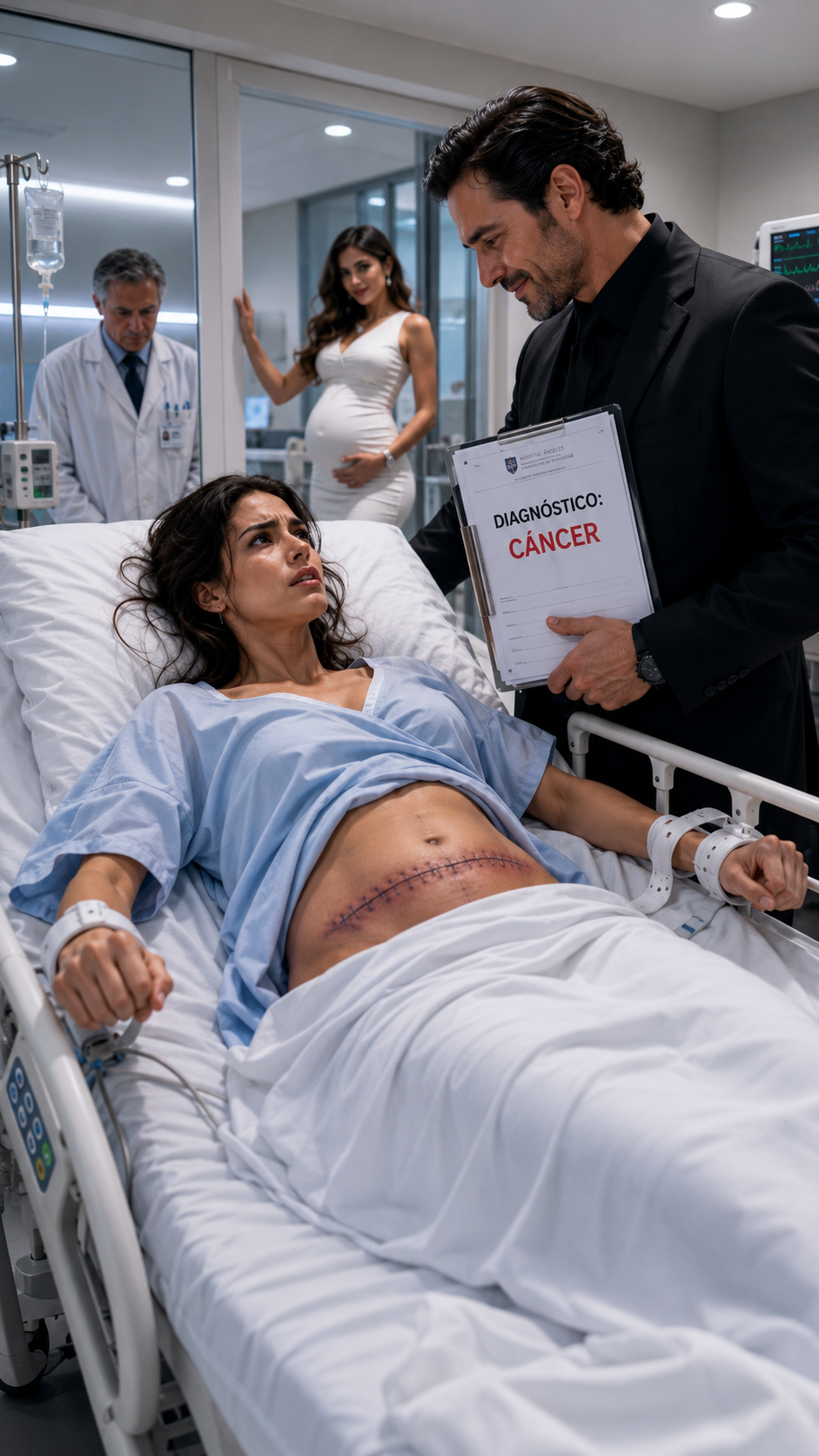
Mariana Villaseñor woke up in a private hospital in Mexico City with her belly bandaged, a dry mouth, and a pain that felt otherworldly.
Hours earlier, she had lost her baby.
Or so they told her.
Her husband, Santiago Ramírez, owner of a media agency in Polanco, cried in front of everyone as if his soul had been shattered. He kissed Mariana's forehead, squeezed her hand, and swore he would do the impossible to save her.
But Mariana had already heard something.
In the early hours, still dizzy from the anesthesia, she stepped into the hallway looking for air. The hospital gown gaped open at the back, her legs trembled. Then she heard Santiago's voice behind a half-open door.
—When she falls asleep again, do it. I don't want Mariana to ever be able to get pregnant again.
The doctor fell silent.
Santiago lowered his tone, but not enough.
—Give her another diagnosis. Cancer, hemorrhage, whatever. I’ll pay. But make sure everything is signed as a medical emergency.
Mariana felt the floor shift beneath her.
She didn't scream.
She didn't cry.
She stood there, cold, staring at the bright light of the hallway as if she had just died standing up.
At that moment, Abril Luján appeared, an influencer who worked for Santiago's company. She wore a cream-colored dress, oversized glasses, and carried a basket of fruit as if she were a Sunday visitor.
But what hurt the most was her hand on Mariana's belly.
A barely rounded belly.
Santiago pulled her close with a tenderness that Mariana had been begging for months.
—Take care of her with the best gynecologist —he ordered—. That baby will be the future of my family.
Mariana dragged her feet back to her room.
On the table were white roses and a card: “You and I against everything, my love.”
She felt like throwing up.
A young nurse entered, smiling.
—Mrs. Mariana, your husband hasn’t left your side. What a beautiful love, honestly. When he found out about the baby, he cried like a child.
Mariana looked out the window.
Outside, the city continued to sound with horns, vendors, and life. Inside, her marriage was rotting in silence.
Minutes later, Santiago entered, agitated.
—Where were you? I was so worried.
He hugged her tightly.
His fear felt real.
That was the cruelest part.
He held a glass with dark medicine.
—Drink it, love. It will help you. Then we can try again.
Mariana looked at him fiercely.
—No.
Santiago clenched his jaw.
—Don’t be stubborn. You always wanted to give me a child.
She took the glass and smashed it against the wall.
The liquid spilled like a black stain on the white floor.
—I said no.
Santiago took a deep breath. He looked at the nurse.
—Leave us alone.
Mariana barely saw the syringe.
She felt a prick in her arm.
Then Santiago's face blurred, and darkness swallowed her whole.
When she woke up, it was morning.
The pain was different. Deeper. More hollow.
She lifted the sheet with trembling hands and saw a new scar crossing her abdomen.
Santiago was sitting beside her, with red eyes.
—Love, there were complications. They detected malignant cells in your uterus. I had to authorize the surgery to save you.
He showed her a sealed file.
Everything seemed legal.
Everything seemed perfect.
But Mariana had heard the truth.
Then the door opened.
Abril entered with her basket of fruit and a brazen smile.
—Sorry to interrupt. I came to say hello to Mrs. Ramírez.
Santiago didn't kick her out.
He just took Mariana's hand.
And beneath the sheet, while pretending to comfort her, his fingers trembled as they looked at Abril.
Mariana smiled silently.
Because under the pillow lay a legal letter that her mother had left her years ago.
And Santiago still didn't know that this letter could bury him alive.
PART 2
That afternoon, Mariana pretended to sleep.
Santiago stayed by the bed, stroking her hair like a model husband. Abril sat across from them, legs crossed, playing with a golden bracelet.
To anyone, it seemed like an awkward visit.
To Mariana, it was a confession without words.
In the reflection of the metallic furniture, she saw Abril brushing Santiago's shoe with hers. First slowly. Then brazenly.
Santiago glanced at Mariana to make sure she remained motionless. Then he placed his hand on Abril's knee.
Not to stop her.
To ask for patience.
When they both stepped into the hallway, Mariana got up as best she could and followed them. She found them near the coffee machines.
—I told you not to do that in front of her —Santiago scolded.
Abril let out a soft laugh.
—Oh, please. You already took away the only thing that could get in the way. What more do you want?
—Lower your voice.
—No. Tomorrow you announce that I’m entering the family. I’m pregnant, and I won’t keep hiding like anyone else.
Santiago didn’t respond.
That silence confirmed everything.
Mariana returned to the room with her body burning. Before she reached the bed, she collapsed onto the floor.
A nurse rushed to lift her.
—Don’t cry, ma’am. Your husband will break if he sees you like this.
Mariana wanted to laugh.
But she just closed her eyes.
By evening, Abril entered alone. She no longer wore the influencer smile or the sweet TikTok voice.
She closed the door.
—You know, right?
Mariana didn’t answer.
Abril approached the bed.
—Santiago loves me. I’m expecting a child from him. And you, with all due respect, don’t matter anymore.
—Since when? —Mariana asked.
Abril held up three fingers.
—Three years. It started at a dinner in Polanco. The day you lost the baby, he wasn’t in a meeting. He was with me, in Santa Fe.
Mariana remembered the blood, the unanswered calls, the fear, the early morning alone.
She remembered Santiago arriving the next day on his knees, swearing he would never forgive himself for not being there.
It had all been theater.
—You’re going to sign the divorce —Abril continued—. Without children, without family, and without a uterus, you can’t compete with me. Honestly, just let go.
Mariana turned her head toward her.
—That’s what you think.
Abril smiled cruelly.
—Don't get confused. You're still alive because Santiago feels guilty. But the guilt will fade away.
When Abril left, Mariana pulled out a folder that her lawyer, Tomás Cárdenas, had prepared months earlier.
Tomás was a friend of her mother. He always suspected the Ramírez family.
Mariana never wanted to listen to him.
Until that day.
Inside was the legal letter from Beatriz Villaseñor, her deceased mother. A letter kept for ten years, notarized.
Mariana opened it with trembling hands.
“If Santiago Ramírez ever tries to decide about your body, your inheritance, or your children, don’t negotiate. Run. His family doesn’t just steal companies. They also buy doctors.”
Mariana stopped breathing.
Further down were copies of records, shares, and a will.
Her mother hadn’t been an employee of Grupo Ramírez, as she had always been told.
She had been a founding partner.
And Mariana was the heir to almost half of the group.
Santiago hadn’t married her for love.
He married to control her.
At dawn, Santiago found the papers on the bed. His face twisted.
—What is this?
—The truth —Mariana said.
—You’re medicated. You don’t know what you’re doing.
—For the first time, I know perfectly.
At that moment, Tomás entered with a notary and two police officers.
Santiago turned pale.
—What the hell is this?
Tomás placed a folder on the table.
—We requested a complete copy of the medical file. The cancer diagnosis was signed by a doctor who wasn’t even in Mexico that day.
Santiago swallowed hard.
Tomás continued:
—We also have payments to Dr. Salcedo, transfers to a private foundation in Querétaro, and a surgical authorization with a forged signature.
Abril entered at that moment.
She came in smiling.
The smile vanished when she heard Tomás say:
—And there’s one more thing. The preliminary genetic test of Miss Abril’s baby does not match the Ramírez line.
The room froze.
Santiago turned to Abril with a fury he could no longer hide.
—What the hell is he talking about?
Abril placed a hand on her belly.
For the first time, she seemed scared.
Mariana understood something terrible: Abril was also being used.
That night, Tomás took Mariana out of the hospital through a service entrance. He took her to Beatriz's old house in Coyoacán, a yellow mansion with dried bougainvillea and floors that creaked as if holding secrets.
There they found a box under a loose tile.
Inside were letters, a diary, a USB drive, and old photos.
In a recording, Beatriz spoke in a broken voice:
—Mariana, if you hear this, forgive me. The Ramírez took my company. If you ever have a child, don’t let them register it. To them, a child is not family. It’s merchandise.
Mariana felt her soul drop to the floor.
Had her baby really died?
The next day, Abril arrived at the Coyoacán house without makeup, in dark glasses, and with a bruise on her neck.
—Santiago knows the baby isn’t his —she said—. He tried to choke me.
Mariana didn’t move.
—And you come to ask for help?
—I came to tell you where your son is.
The silence was brutal.
Abril pulled a USB drive from her bag.
—Your pregnancy didn’t end as they told you. The child survived. Salcedo took him out and sent him to a foundation in Querétaro. Santiago said that someday it could help him claim control of the inheritance.
Mariana gripped the table.
—What’s the name of the foundation?
—Casa Luz.
They traveled that same night.
Tomás obtained a provisional order with the medical evidence. Upon arrival, the director of Casa Luz tried to smile, but her hands trembled.
—We don’t have any minors with that history here.
Tomás lifted the order.
—Then you won’t have a problem opening the files.
The woman broke down in five minutes.
She took them to an interior garden.
There were several children playing under a jacaranda. One of them, in a blue shirt, was building a wooden train on the floor.
He had a small scar above his eyebrow.
And Mariana's eyes.
Not similar.
The same.
Mariana approached as if walking through a dream.
—Hello —she whispered.
The boy looked up.
—Are you Mariana?
Her knees buckled.
—Yes. Who told you my name?
—A lady came to see me. She said my mom's name was Mariana and that someday she would find me.
—What’s your name?
—Mateo.
Mariana hugged him carefully, as if the world could snatch him away from her again.
Mateo didn’t cry.
He just rested his head on her shoulder and said:
—You took a long time.
That phrase broke her heart.
And made her invincible.
Santiago tried to destroy her.
He leaked false notes: “Spurned wife loses her mind after necessary surgery.” He accused her of stealing documents, inventing a child, manipulating Abril.
But this time, Mariana wasn’t alone.
Tomás delivered the audio recordings to the Prosecutor’s Office. A journalist named Carolina Méndez published the report: “Mariana’s Womb Wasn’t an Illness, It Was Evidence.”
In a few hours, all of Mexico was talking about the case.
Women from Guadalajara, Monterrey, Puebla, and Mérida began to share similar stories: false diagnoses, surgeries without consent, husbands deciding for them.
Mariana's pain stopped being private.
It became a scream.
The main hearing was in Mexico City. Mariana entered dressed in white, holding Mateo’s hand. Abril walked behind, pale but ready to testify.
Santiago looked impeccable, in a gray suit with the gaze of a world owner.
Until he saw Mateo.
For one second, he lost the mask.
Everyone noticed.
Tomás presented each piece of evidence: the fake file, the surgery without consent, payments to the doctor, the Casa Luz network, Beatriz’s stolen inheritance, and the messages threatening to disappear Mateo.
Then Abril spoke.
—I wanted to stay with Santiago and his money —she admitted, crying—. I lied, yes. But when I learned that they had stolen a child from Mariana, I understood that man loves no one. He only possesses.
Santiago stood up angrily.
—Everyone is lying!
The judge ordered him to sit.
Then the last audio played.
Santiago’s voice filled the room:
—If Mariana wakes up without a uterus, she won’t be able to fight as a mother. The child will be kept. When he serves us, we’ll use him.
No one said anything.
Not even the reporters moved.
Mariana closed her eyes.
That phrase destroyed her one last time.
But it also set her free.
Dr. Salcedo was arrested that afternoon. The director of Casa Luz confessed to a network of irregular adoptions. Several officials fell. The lawyer who forged Beatriz’s papers tried to flee through Chiapas, but he was arrested before crossing the border.
Santiago was prosecuted for obstetric violence, forgery, child abduction, fraud, and criminal conspiracy.
Months later, he received a historic sentence.
He lost his freedom.
He lost his company.
And he lost the surname as a shield.
Beatriz’s inheritance was restored to Mariana. With that money, she founded an organization for women victims of medical and family abuse.
Abril also paid. She lost contracts, fame, and friends. She testified to everything she knew and agreed to make amends.
Mariana never called her a friend.
But she understood that sometimes justice needs even those who were part of the wound.
Mateo took time to call her mom.
He slept with the light on. He kept cookies under the pillow “just in case there weren’t any tomorrow.” Every gesture reminded Mariana of the four years they stole from her.
One day, in the garden of Coyoacán, Mateo saw her planting a jacaranda.
—Are you really going to stay? —he asked.
Mariana knelt in front of him.
—For my whole life.
The boy looked at her seriously, as if reviewing a contract.
Then he hugged her.
—Then I can call you mom now.
Mariana cried against his hair.
Not out of defeat.
But out of coming back.
Five years passed.
The scar on her abdomen remained. Mariana never hid it. It was the map of a war that others tried to win over her body.
Santiago was serving his sentence in a federal prison. Grupo Ramírez was transformed into a reproductive health foundation with Beatriz Villaseñor's name at the entrance.
Mateo ran around the house with a stray dog named Canelo.
And Mariana learned that peace doesn’t always arrive in silence.
Sometimes it comes with a signed sentence, an open door, a recovered child, and a truth spoken in front of everyone.
Because they took an organ from her, they stole a child, and they wanted to erase her mother.
But they made a huge mistake.
They left alive the woman who could tell the story.





