PART 1
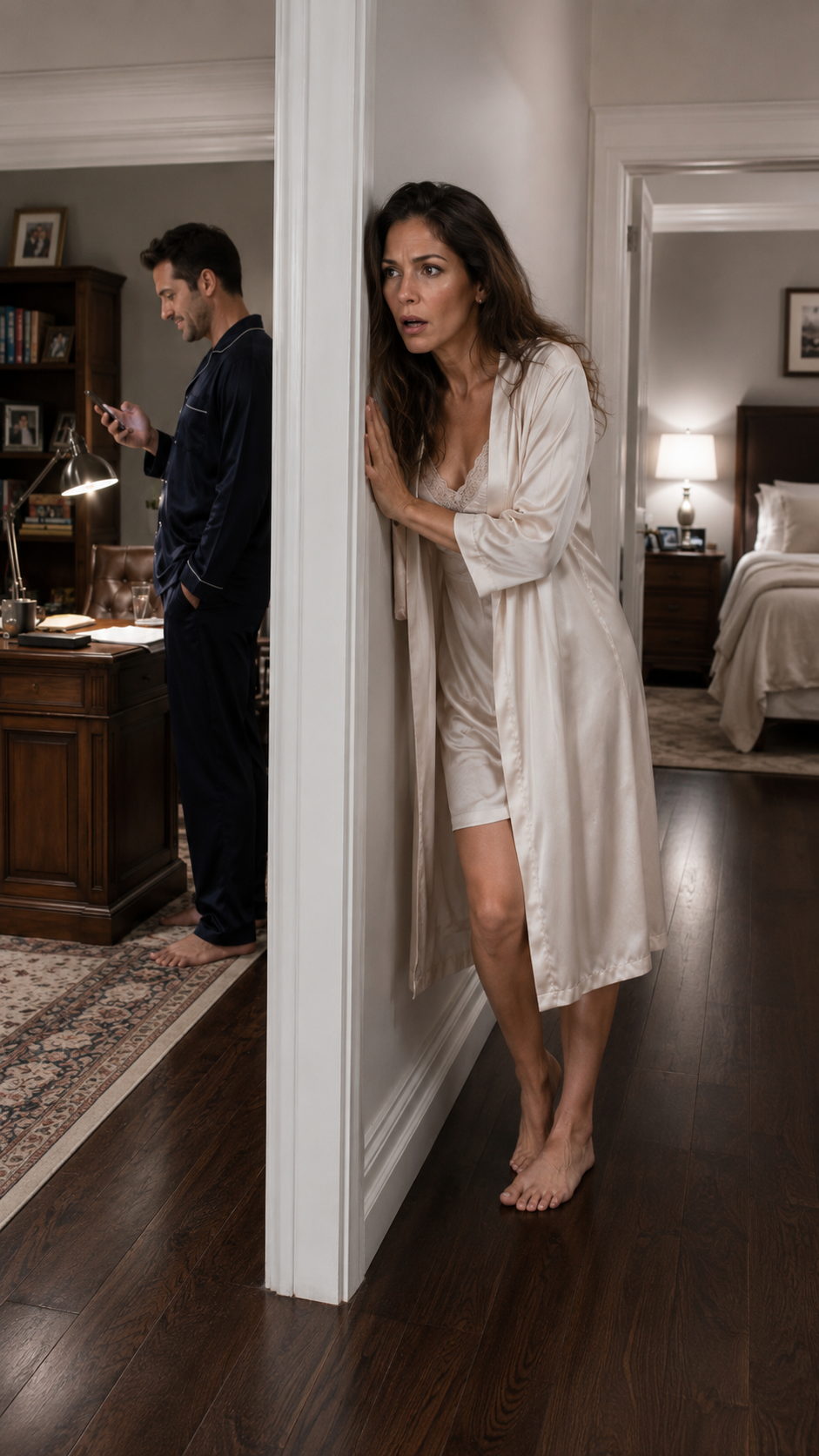
At 2:13 in the morning, Clara Mendoza woke up with a dry throat and a phrase lodged in her chest.
"She has no idea. As soon as I get her to sign, she's out of the picture."
The voice came from the study, at the end of the hallway of their home in Jardines del Pedregal.
It was the voice of her husband, Julián Arriaga, a fine furniture businessman and a respected man in many circles.
For 29 years, Clara had slept beside this man, believing that her tranquility was love.
That night, Julián’s side of the bed was empty and cold.
Clara got up slowly, draping a shawl over her shoulders and walking barefoot to avoid making the floor creak.
The study door was barely open.
Inside, another male voice said:
"What if she starts reading, Julián? It’s not just any paper."
Julián let out a soft laugh.
"Clara doesn’t read that stuff. She gets nervous with contracts. I tell her where to sign and she signs. That’s how it’s always been."
Clara felt the floor drop beneath her.
"Besides," he added, "I keep her busy with her pottery workshops and her garage sales. She thinks that’s independence. Poor thing."
That didn’t sound like a couple’s quarrel.
It sounded like mockery.
A lifetime reduced to a private joke between men.
Clara returned to the bedroom before Julián came out. She slipped under the sheets and pretended to sleep.
Minutes later, he entered, lay down beside her, and caressed her arm as if nothing had happened.
"Go to sleep, my dear," he murmured.
Clara kept her eyes closed.
For the first time, that voice didn’t bring her peace. It disgusted her.
The next morning, Julián came down to breakfast impeccably dressed, in a white shirt, an expensive watch, and smelling of imported cologne.
He ordered green chilaquiles without cream and reminded Clara that they had an appointment with a notary in Santa Fe on Thursday.
"Just routine papers, love. To sort out some properties and avoid future disputes."
Clara watched him as he drank his coffee.
His face was the same.
But he no longer seemed like her husband.
He seemed like a stranger wearing the mask of her life.
When Julián left for the factory, Clara entered the study.
She never did that.
He always said there were "heavy business matters" in there and that he didn’t want to worry her.
She opened drawers, checked folders, moved accounting books, and found a key stuck under a wooden tray.
The key opened a small filing cabinet behind the desk.
Inside, there were bank statements, contracts, sales receipts, and property documents she believed were shared.
She also found transfers from the profits of some ceramic pieces that had sold for outrageous amounts in galleries in San Ángel.
Julián had told her that money was "reinvested" in materials.
A lie.
It had ended up in a partnership where her name didn’t appear.
Then she saw an invoice for her mother’s jewelry.
Clara had believed for years that they had pawned it to pay for a medical debt for their youngest child.
Another lie.
The money had gone into Julián's business account.
That afternoon, Clara made copies, took photos, and pretended everything was normal.
Two nights later, she overheard Julián talking on the phone on the terrace.
"We just need her to sign the transfer. After that, we’ll move the rest before she thinks to ask."
On Wednesday, Julián left his cell phone in the kitchen.
It had no lock.
Clara opened a chat saved as "M. Management."
"All set for Thursday."
"Mark with arrows where her signature goes."
"Don’t give her time. If she hesitates, tell her it’s to protect her children."
Clara felt nauseous.
She went up to Julián’s closet and searched behind the suits.
At the top, she found a tin box, hidden among old jackets.
She opened it with the same key.
There were notarial powers, a deed of transfer, changes in insurance, a new will, and a property separation agreement.
On several pages, her name was crossed out in blue ink.
Where it used to say "Clara Mendoza de Arriaga," there was now a blank space.
And next to that gap, a handwritten note said:
"Have her sign here without reading."
Clara sat frozen, the box open on her lap.
She couldn’t believe that the man who called her "my dear" had calmly prepared the exact spot where he intended to erase her.
PART 2
Clara didn’t scream.
That was the strangest part.
For 29 years, she had imagined that a betrayal like this would shatter her into pieces, make her cry in the kitchen, or call her children in the middle of the night.
But no.
What came was a chilling calm.
A calm that offered no forgiveness.
She pulled an old notebook with handwritten numbers from a drawer.
She found a name she hadn’t uttered in years: Paulina Robles.
Paulina had been her classmate in high school, a serious girl with big glasses who ended up studying law at UNAM.
Now, according to what she had heard in family gatherings, she was a tough lawyer specializing in inheritance cases, fraud, and shell companies.
Clara dialed her number.
Paulina answered with a hoarse voice.
After listening, she didn’t ask silly questions.
"Come today. Bring everything. And please, don’t tell anyone, not even your kids. Especially if Julián thinks they’re on his side."
Paulina’s office was in the Roma neighborhood, in an old building with tiled floors and the smell of freshly brewed coffee.
Clara arrived with a shopping bag full of documents, copies, cell phone photos, and the tin box.
Paulina reviewed everything in silence.
She didn’t make dramatic gestures.
That scared Clara even more.
When she finished reading the transfer, she looked up.
"Do you know how much is here?"
Clara swallowed hard.
"Houses, land, the factory, my pieces, accounts… maybe 35 million pesos. Or more."
Paulina closed the folder.
"This isn’t just about a greedy husband. This reeks of forgery, breach of trust, fraudulent administration, and property dispossession. And it’s all set up to make you look distracted, foolish, or dependent."
The word "foolish" hurt Clara because it sounded exactly like what Julián thought of her.
In less than 48 hours, Paulina called in a forensic accountant, a handwriting expert, and a commercial lawyer.
The documents started to reveal a different story.
A company created 8 months prior was receiving money from family accounts.
The company’s name was almost the same as Clara’s workshop: "Barro Claro."
The real workshop was called "Barro de Clara."
It was such a simple trap that it was infuriating.
If someone reviewed quickly, they would think the money was going to her business.
But no.
It was going to Julián.
Then they found signatures that Clara swore she had never made.
Contracts dated on days when she was in Oaxaca giving a pottery workshop.
Withdrawals from shared accounts.
Insurance policies changed without notice.
And a will that absurdly named a partner of Julián as the administrator of several properties "due to Clara’s emotional incapacity."
Clara read that phrase three times.
"Emotional incapacity."
That was how they planned to bury her alive.
Not with screams.
Not with blows.
With papers.
With stamps.
With stolen signatures.
That night, she returned home.
Julián was in the kitchen, cutting papaya.
"Everything okay, love? You seem quiet."
Clara barely smiled.
"Just tired."
He came closer and kissed her forehead.
Once, that gesture would have softened her.
Now it only confirmed something terrible: Julián wasn’t nervous because he had never considered her a rival.
On Thursday, he took her to a notary in Santa Fe.
He said they could eat at a nice restaurant afterward, "to celebrate getting everything in order."
In the meeting room were the notary, two of Julián’s partners, and a folder with yellow dividers.
Julián adjusted her chair.
"Let’s sign quickly and get out of here, Clarita. Trust me, it’s just a formality."
She took the first page.
She read it slowly.
Julián clenched his jaw.
"Love, you don’t need to read everything. I already reviewed it."
Clara raised her gaze.
"Yes, I do."
The silence turned tense.
One of the partners pretended to respond to messages.
The notary cleared his throat.
Clara moved to the second page and pointed to a signature.
"How curious, Julián. Here it says I authorized a transfer on March 14."
He leaned toward her.
"You probably don’t remember."
Clara reached into her bag and pulled out a printed photo.
"On March 14, I was in Oaxaca, in front of 80 women, giving a workshop. There are videos, hotel receipts, and bus tickets."
Julián lost color.
The notary pulled his hand away from the folder.
Clara continued.
"And here’s another signature of mine, dated May 27. That day, I was hospitalized with my sister in the Mérida hospital. There are records too."
One of the partners stood up.
"Julián, this wasn’t discussed."
Julián shot him a deadly look.
"Sit down, Ramiro."
But Ramiro no longer seemed like a partner.
He seemed like a scared accomplice.
Then the door to the room opened.
Paulina Robles entered with two lawyers, a court clerk, and a thick file under her arm.
She didn’t shout.
She didn’t threaten.
She simply placed the documents on the table.
"This is a notification of a request for precautionary measures to immobilize assets, preserve documents, and examine allegedly false signatures related to Mrs. Clara Mendoza."
Julián jumped up.
"This is nonsense. My wife is upset. She’s being manipulated."
Clara fixed her gaze on him.
"No, Julián. The truth is, for the first time, I didn’t come alone."
The notary closed the folder.
"Under these circumstances, I cannot proceed with this act."
That phrase split the scene in two.
Before her, Julián was still the elegant man who controlled the table.
Afterward, he was a man trapped in his own lies.
"Clara," he said, lowering his voice, "don’t make a scene. Let’s talk about this at home."
The word "home" hit her like a slap.
Because for years, at home, Julián had resolved everything.
At home, he made her doubt.
At home, he told her she was exaggerating, that she didn’t understand, that it was better not to get involved.
Clara took a deep breath.
"No. At home, you taught me to be silent. I came here to speak."
Paulina began to present evidence.
Transfers.
Chats.
Contracts with dubious signatures.
The shell company.
The insurance changes.
The receipts for Clara’s mother’s jewelry.
And then came the first twist nobody expected.
The tin box wasn’t the only hidden thing.
Ramiro, the partner who had tried to get up, asked to speak with his lawyer before this escalated.
Hours later, he delivered emails.
In them, Julián spoke of Clara as "the easy signature" and "the domestic obstacle."
But one email changed everything.
Julián wasn’t just planning to take her assets.
He had also prepared a false psychological report to declare her incapable of managing her wealth if she refused to sign.
The report had already been paid for.
The doctor listed as responsible had never seen Clara.
Clara felt the air leave her.
It wasn’t just about money.
Julián was willing to strip her of her name, her voice, and even her sanity before a judge.
For weeks, the investigation grew.
The expert confirmed that several signatures were not Clara’s.
The accountant traced money to accounts in Querétaro and Houston.
The couple's children, Daniela and Esteban, were called to testify.
Daniela arrived furious with her mother.
"Why are you doing this? Dad says you want to destroy the family."
Clara didn’t defend herself with screams.
She showed her the documents.
She showed her the phrase "emotional incapacity."
She showed her the chat where Julián said:
"With Daniela on my side, Clara will break."
Daniela covered her mouth.
Esteban read in silence.
Then he went out into the hallway and vomited.
That was the greatest pain for Clara.
Not losing the house.
Not uncovering the signatures.
But seeing her children understand that their father had used them as stones against their own mother.
The main hearing took place months later.
Julián arrived in a gray suit, a hard stare, and expensive lawyers.
They tried to paint Clara as a confused, resentful woman, influenced by an ambitious lawyer.
But Clara was no longer the woman who signed where she was told.
She responded with dates.
With accounts.
With receipts.
With names.
With evidence.
When they asked her why it took her so long to realize, Clara clenched her hands on the table.
"Because I was taught that trusting meant obeying. And because he knew how to make me feel guilty every time I asked something."
No one spoke for a few seconds.
Not even Julián.
The judge ordered to keep the assets immobilized, review all notarial acts, and protect the real income from Clara’s workshop.
The false psychological report became one of the most serious pieces of evidence.
The doctor denied having evaluated Clara.
Ramiro testified that Julián insisted that "the lady would never read anything."
That phrase sank him.
Over time, Clara regained royalties, accounts, and rights over her workshop.
Julián lost partners, reputation, and much of the control he had built over the years.
The Pedregal house remained in the settlement.
But Clara didn’t want to live there.
"I don’t want walls that learned to listen to my silences," she said.
She moved to a small, bright apartment in Coyoacán, with bougainvilleas in the window and a large table for working with clay.
On her first morning there, she prepared coffee in a clay pot.
No one asked her why she was taking so long.
No one told her what to sign.
No one treated her like decor.
Months later, Clara opened a workshop for women over 40 who wanted to learn pottery and also review their own papers.
People said she was exaggerating.
She said no.
"Exaggerating is loving someone and discovering they had already prepared the hole where they intended to bury you."
One day, Daniela visited her with red eyes.
"I’m sorry, Mom. I believed him."
Clara hugged her.
Not because everything was healed.
But because some wounds don’t heal with pride, but with truth.
Julián tried to see her one last time.
He sent flowers, letters, messages.
In one note, he wrote:
"After 29 years, we deserve to talk."
Clara read the phrase and smiled sadly.
She took a pen.
On the same sheet, she replied:
"After 29 years, I deserve to read before I sign."
She didn’t send anything else.
That night, while arranging freshly fired clay pieces, Clara looked at her hands.
Those hands that Julián thought were docile.
Those hands he wanted to use to erase her.
Now those hands were shaping something new.
And each piece carried her full name engraved on the base:
Clara Mendoza.
Because sometimes justice doesn’t start when someone pays.
It starts when a woman stops asking for permission to exist.





