PART 1
Mariana's legs buckled in the Banorte branch when the teller, with a pained expression, said:
—Ma'am, your account is empty.
Empty.
The account where she had saved, for five years, every peso from her double shifts at a private clinic in Guadalajara. The account for Nico's speech therapy, her twelve-year-old son, a boy with Down syndrome who laughed with his eyes and called her "maaa" as if he were singing.
Mariana requested the full transactions.
The teller printed page after page. Monthly withdrawals. The same amount. The same day. For eight months.
And below each authorization appeared a signature.
Mariana's.
But she didn’t remember signing anything.
Until she recalled that night when Julián, her husband, laid some papers on the table while she stood, exhausted, having dinner.
—They're for Nico's insurance, love. Just sign here, please. It's a formality.
She signed without reading.
What a fool, she thought now, her chest ablaze.
She arrived home in a rage. Julián was sitting in the living room, watching the TV that was off. He didn't even pretend to be surprised when she threw the papers on the table.
—Where's the money for Nico?
He looked down.
—My mom used it.
Mariana felt her hands freeze.
Doña Elvira, her mother-in-law, had never liked Nico. At family meals, she ignored him. She would say that "God doesn’t send tests that one cannot bear," as if the child were a penance.
—What did she use it for? —Mariana asked.
Julián swallowed hard.
—For Rodrigo's wedding. My mom wanted to help with the venue, the banquet, all that.
Rodrigo was the favorite grandchild. The perfect nephew. The one they proudly posted on Facebook in a suit, cap, and with a blonde bride.
Mariana felt like vomiting.
—Did they take away my son's therapy to pay for a party?
Julián didn't respond.
Then he said the sentence that shattered her:
—Don’t make such a fuss. Nico doesn’t even understand money.
Mariana didn’t scream. She didn’t cry. She simply went upstairs, packed Nico's clothes into a suitcase, gathered his medications, his notebooks, his stuffed dinosaur, and left for her sister's house in Tlaquepaque.
But something didn’t add up.
A wedding couldn’t be paid for in eight monthly installments before an engagement.
So Mariana returned to the bank. She traced the deposits. They weren’t going to a venue. They weren’t going to a caterer. They were going to a place called Casa San Gabriel, on the outskirts of Chapala.
On Saturday, the day of the supposed wedding, she drove there with anger lodged in her throat.
There were no floral arrangements.
There was no music.
There were no guests.
Just a tall fence, a gray gate, and a plaque that read:
"Permanent Care Residence."
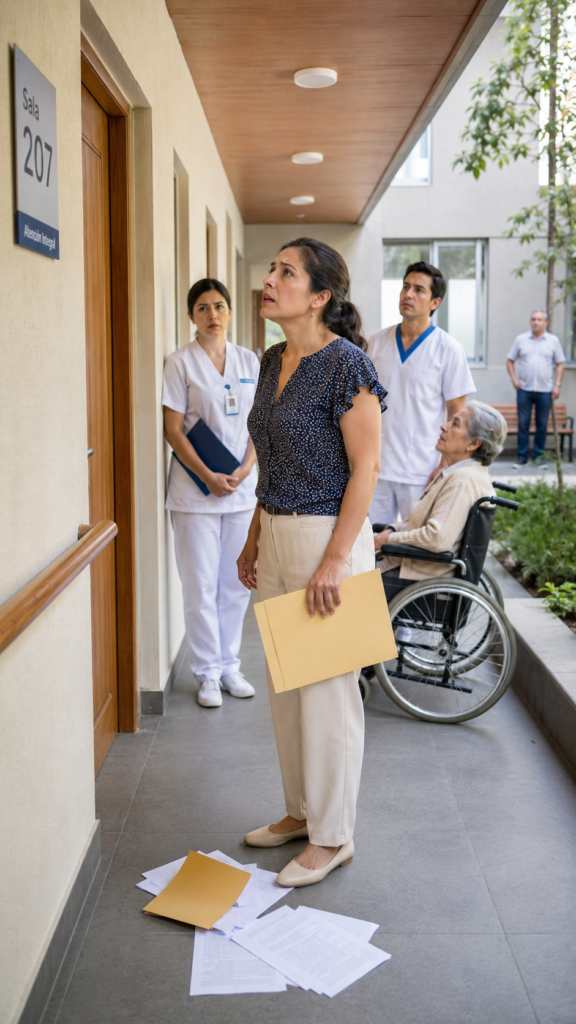
Mariana pushed her way in. She saw white corridors, nurses, elderly people, young ones in wheelchairs, disabled individuals soaking up the sun in a courtyard.
On the wall was a list of rooms.
Mariana read, name by name, until the world dimmed.
Room 7.
Nicolás Rivas Salgado.
Her son.
A staff member approached with a folder and an overly kind smile.
—You must be the mother. Your mother-in-law took care of everything. Admission is scheduled for Monday.
Mariana opened the folder.
There was the authorization.
With her signature.
And then she understood they hadn’t stolen money for a wedding.
They were paying to leave Nico there.
PART 2
Mariana left Casa San Gabriel with the folder pressed against her chest, as if it were a murder weapon.
The staff member followed her to the gate.
—Ma'am, wait. Your husband came many times. He asked for everything to be prepared with great care.
Mariana turned around, her eyes red.
—My husband?
—Yes. He came on Saturdays. With his mom. He measured the bed, checked the bathroom, asked about therapies, meals, schedules. He even brought pictures of the boy so the staff could get to know him.
Mariana's stomach churned.
The lie was bigger than she thought.
It wasn’t just Doña Elvira. It was Julián. Her husband. The man who slept beside her, who knew each of Nico's fears, who knew that the boy covered his ears when the blender sounded.
They had planned it all.
For eight months.
Without her.
She drove back to Guadalajara with her hands tense on the steering wheel. She wanted to get to Doña Elvira’s house and create a scene that would have the neighbors peeking through the windows.
But before hitting the highway, she stopped at a gas station.
She couldn’t breathe.
She opened the folder again.
Among contracts, receipts, and copies of identification, she found a small blue notebook. It didn’t belong to the residence. Nor to the bank.
On the first page was a phrase written in Julián's handwriting:
"For when Nico needs others to care for him and we can no longer do so."
Mariana slammed the notebook shut.
She didn’t want to read more.
Not at that moment.
The anger was easier to carry than the fear.
She arrived at Doña Elvira’s house without knocking. She went straight to the kitchen, where the woman was making red rice, as if the world were not falling apart.
Mariana threw the folder on the table.
—I went to Casa San Gabriel.
Doña Elvira dropped her spoon.
For the first time in twelve years, she didn’t have a bossy face. She didn’t raise her voice. She didn’t say, "this is my house." She simply sat down slowly, as if her knees no longer worked.
—Then you know part of it —she said.
—I know you wanted to abandon my son.
The word "abandon" fell on the table like a broken plate.
Doña Elvira covered her face with her hands.
—Oh, Mariana… I wish it were that simple.
Mariana laughed with rage.
—Simple? You emptied my therapy account! You made me sign like an idiot! You invented a wedding! What else is missing?
Doña Elvira cried silently.
That threw Mariana off. She expected screams, insults, blackmail. Not the clumsy tears of an old woman who suddenly seemed tired of being cruel.
—Julián is sick —Doña Elvira said.
Mariana froze.
—Don’t come to me with that.
—He’s really sick, honey. Cancer. Pancreas. They found it in January at IMSS. It’s already metastasized.
The kitchen fell silent.
Not even the rice oil seemed to move.
Mariana felt the ground beneath her shift.
—No.
—Yes.
—He would have told me.
Doña Elvira lifted her face. Her eyes were swollen.
—He didn’t want to. He said you were already tired, that if he told you, you’d sell even your soul to seek treatments. That you’d spend Nico’s savings on hospitals, doctors, miracles… and that then he would die anyway.
Mariana wanted to respond, but she couldn’t.
Because she knew Julián.
And she knew that yes. She would have done exactly that.
Doña Elvira opened a drawer and pulled out a coffee-stained envelope. Inside were photos of Nico at Casa San Gabriel.
Nico in the yard, laughing with a therapist.
Nico painting with his fingers.
Nico sitting on a bed with a dinosaur blanket.
Mariana took the photos with trembling hands.
—You took him there?
Doña Elvira nodded.
—On Sundays. When I told you I was taking him for ice cream or to the park. Julián wanted him to know the place gradually, so he wouldn’t be scared if one day he had to stay.
Mariana looked at that woman who had despised her son so many times.
—You called him a punishment from God.
Doña Elvira lowered her head.
—Because I was ignorant. Because I was cruel. Because I was ashamed of something I didn’t understand. And when Julián told me he was dying, he asked me one thing: "Mom, learn to love my son before I’m gone." I learned late, but I learned.
Something inside Mariana broke.
It wasn’t forgiveness.
Not yet.
But the hatred no longer fit the same in her chest.
She left without saying goodbye. She went to her house, the one she had left three weeks earlier with two suitcases and a confused child asking for his dad.
Julián came home at night.
He looked thin. Thinner than Mariana had wanted to see. His skin was yellowish, his shirt loose, and he had the look of someone who had been carrying a stone on his back for months.
Seeing her sitting in the living room, with the folder open, he didn’t ask anything.
—You know —he said.
Mariana stood up slowly.
—Since when?
Julián closed the door and leaned against it.
—January.
—It’s March, Julián.
He nodded.
—Yes.
—And in two months, you couldn’t find a minute to tell me you were dying?
Mariana's voice broke on "dying."
Julián sat down. It seemed even breathing was hard for him.
—I didn’t know how.
—But you knew how to forge my decision. You knew how to use my signature. You knew how to lie to me with a wedding.
—I didn’t forge your signature —he said, in a low voice—. You signed.
Mariana felt an invisible slap.
—You deceived me.
—Yes.
He didn’t try to defend himself. That angered her more.
—It’s my son! You had no right to decide for me!
—I didn’t decide to take him away from you —Julián said—. I did it so he wouldn’t be left unprotected when I’m gone… and when you can no longer manage.
—I will always be able to.
Julián looked at her with a sadness that didn’t feel like reproach, but exhaustion.
—That’s what my dad said about my brother. Until one day he fell in the bathroom and no one could lift him. Mariana, you work double shifts, sleep four hours, carry Nico when he’s scared, fight with schools, doctors, neighbors. You’re strong, but you’re not made of stone.
She clenched her fists.
—Don’t talk to me as if I’m already defeated.
—No. I speak to you as someone who loves you and who is afraid of leaving you alone with a life that was already heavy for two.
Mariana fell silent.
The word "love" hurt her more than any scream.
Because in the last few weeks, she had hated him fiercely. She had called him a coward in her head. Mama’s boy. Not a real man. She had even thought that maybe he had another woman and felt relief, because that gave her a clean reason to leave.
And he, in the meantime, was dying.
—Why the account for Nico? —she asked, almost voiceless.
Julián wiped his face with his sleeve.
—Because there was no other. Casa San Gabriel has a waiting list for years. A place opened up. We had to secure it or lose it. It wasn’t to leave him there this Monday forever.
Mariana raised her gaze.
—But the paper says permanent admission.
—The paper says that because that’s how the contract works. But my plan was for him to start with weekends, then some days, without forcing him. Just… to leave a door open.
—And the wedding?
Julián closed his eyes.
—It was a stupid idea. My mom said that if I told you anything about the residence, you’d rush over to cancel everything. I made up the story about Rodrigo to buy time.
—Buy time for what?
He took a while to respond.
—To reach April.
Mariana understood without wanting to understand.
April wasn’t just any date.
It was the month the doctors had given as a possible limit.
She sat in front of him.
Between them was the folder, the blue notebook, and twelve years of marriage put on trial.
—you left me to hate you —Mariana said.
Julián smiled faintly. A sad, tiny smile.
—I thought it would hurt you less when I was gone.
Mariana broke down in tears.
Not pretty. Not like in the movies.
She cried with rage, guilt, snot, hands on her face, body bent. Julián approached, but he didn’t touch her until she allowed it.
When Mariana lifted her hand, he took it as if it were something sacred.
The next day, she went to pick up Nico from her sister's house.
The boy was in pajamas, eating cereal and watching cartoons. When he saw Mariana, he ran to her and hugged her around the waist.
—Maaa.
That long "a" opened her chest.
Her sister watched her from the kitchen.
—What are you going to do?
Mariana kissed Nico’s hair.
—I’m going back home.
—With Julián?
—with his dad.
It wasn’t a perfect reconciliation. There was no music, no immediate forgiveness, no family hug from a novel.
There was a suitcase unpacked in silence.
There were hidden medications that stopped being hidden.
There were medical appointments where Mariana finally sat next to Julián.
There were nights when Nico would sleep between them, and Julián would stroke his hair until he fell asleep before him.
Doña Elvira began to come to the house with food. Sometimes Nico would call her "maaa" too, and the lady would turn away to cry without being seen.
Mariana didn’t forgive her for the past overnight.
But one Saturday, she saw her kneeling, tying Nico’s shoelaces with patience, speaking softly to him, and she understood that some people don’t change because they are good.
They change because pain forces them to see what they once despised.
Julián died in April.
Nico was by his side, sitting on the bed, singing him an invented song, repeating words that no one fully understood, but that sounded like love.
Mariana didn’t count the last minutes to anyone.
She just kept one image: Julián listening to his son and smiling with his eyes closed, as if he could finally rest.
After the funeral, when the house was filled with wilting flowers and borrowed plates, Mariana opened the blue notebook.
She read it all.
It wasn’t a farewell.
It was a manual for loving Nico.
"When he’s scared, don’t hug him from the front. Put a hand on his back."
"Don’t give him tomatoes. He spits them out, but feels embarrassed."
"If he says 'maaa' don’t correct him. It’s his way of saying he trusts."
"Leave the hallway light on."
"Don’t use the blender near him."
"He likes socks with patterns, even if they don’t match."
"When he misses his mom, show him the picture where she wears a blue blouse. He likes that one."
Mariana had to close the notebook several times because she couldn’t keep reading.
Each page was Julián fighting against death in the only way he could: teaching strangers how to care for the child he loved the most.
The man she had silently called a coward had been brave in a way she hadn’t seen.
Weeks later, Mariana returned to Casa San Gabriel.
This time she didn’t go to scream.
She went with Nico's hand in hers, with the blue notebook in a bag, and with dry eyes.
She requested to review every document. She read every line. She asked everything. Changed what didn’t seem right. Demanded that any future decisions required her direct and written authorization.
And in the end, she signed.
Not because she wanted to leave Nico.
But because she understood something that many mothers dare not say out loud: to love is also to prepare a safe place for when the arms can no longer reach.
Since then, every Saturday, she takes Nico to Casa San Gabriel for a few hours.
He paints, greets the nurses, and sits on the dinosaur bed. Mariana stays close. Always.
Doña Elvira goes too. Sometimes she brings him strawberry jelly, and Nico kisses her on the cheek. The lady closes her eyes as if that kiss weighed on her and saved her at the same time.
Mariana still works. She still gets tired. There are still days when she hates having signed that first time without reading.
But now, every time she adds a new note to Julián's notebook, she feels she is not alone.
The last sentence he wrote is barely legible. The handwriting is crooked, shaky, as if the hand no longer obeyed him.
But Mariana reads it every night.
"If they sing to him slowly, he sleeps peacefully. Nico knows when he is loved."
And perhaps there lies the true question left by this story:
Was it betrayal to secretly decide out of love… or was it love disguised as betrayal because no one knew how to tell the truth in time?





