PART 1
When Damián Robles opened his eyes after seven months in a coma, he did not see his wife crying by the bedside.
He saw his mother sitting like a queen at a wake, dressed in black, lips tight, and a rosary clutched between her fingers.
—I’m so glad you woke up, son —Doña Amparo said, without a smile—. But you need to know right away. Clara is gone. She couldn't wait for you.
Damián tried to speak, but his throat burned as if filled with sand.
The private hospital room in Monterrey smelled of alcohol, old flowers, and lies. His body was skinny, marked with soft scars. Half of his memories seemed shrouded in smoke.
—Clara? —he murmured.
His sister Beatriz, standing by the window, pretended to wipe away a tear.
—She left with a man from Puebla, they told us. Sold your things, took the money, and disappeared. Honestly, Damián, it made us sick.
Damián closed his eyes.
Not because he believed it.
But because Clara's name hurt in a place no doctor could reach.
He remembered her laughter in the kitchen, her hands covered in flour, the scent of sweet bread wafting from an old oven in the Santa María la Ribera neighborhood. He remembered when they both sold conchas and café de olla outside the metro to pay the rent.
Clara had never been the kind of woman to abandon.
During nine years of marriage, she had stood by him when his architecture firm had neither clients nor decent chairs. She would bake in the early morning and then accompany him to deliver proposals that were almost always rejected.
—One day you’re going to build buildings that everyone will look up to —she told him.
—And you’re going to have your bakery, with beautiful displays.
—I’m happy with a big table and people eating joyfully.
Damián always hugged her around the waist, his face hidden in her neck.
The only thing they lacked was a child.
That emptiness, for them, was sadness.
For Doña Amparo, it was poison.
—A woman who doesn’t provide a family shouldn’t feel entitled to anything —she would say at every meal.
Damián would always respond:
—Clara is my family.
But Amparo never accepted her. She said Clara was a baker without a surname, a woman from the neighborhood who had been lucky to marry a Robles.
Everything changed when Damián landed the biggest contract of his life: a luxury residential complex in San Pedro Garza García. Before the trip, Clara woke up at four to bake his favorite bread: orange, butter, and almond.
—So you don’t forget your home —she said.
He bit into the bread and closed his eyes.
—I recognize this flavor even if they erase my memory.
Clara grew serious.
—Don’t say silly things.
He kissed her forehead.
—I’ll be back in three days. And when I return, we’re going to the clinic. Whatever comes, we’ll face it together.
But the small plane never arrived.
There was fire, confused remains, burned documents, and news announcing that Damián Robles had died.
Clara couldn’t mourn him in peace.
The next day, Doña Amparo arrived at the house in Lomas Verdes with Beatriz, two lawyers, and a locksmith.
—Pack your things —she ordered—. This house belonged to my son.
—Damián is not confirmed dead —Clara said, trembling.
—Don’t play the grieving widow. You didn’t give him children. Here, you’re nobody.
They took her keys, cards, cell phone, and even the marriage folders. Beatriz rummaged through drawers as if Clara had been a thief.
Only Martina, the maid, tried to defend her.
—She has the right to stay.
—You’re leaving too —Amparo replied.
Clara left with one suitcase, a recipe notebook, and an old apron, unaware that in her womb, the miracle everyone had blamed her for had just begun.
PART 2
Clara arrived at a rooftop room in Narvarte with eyes dry from crying.
She had no cell phone, no cards, and no home. She barely had a few coins, one half-closed suitcase, and the recipe notebook she had saved by hiding it under her blouse.
For several days, she wandered the city like a ghost. She sold some silver earrings, pawned the watch Damián had given her on their fifth anniversary, and bought a used oven that barely heated evenly.
Then she found a wooden cart abandoned in a workshop in the Obrera neighborhood. She had it repaired with what little she had and returned to the only place she knew how to survive: the street.
Every morning, she set up near the Coyoacán market.
She sold café de olla, vanilla conchas, cuernitos with cajeta, nata bread, and an orange bread with almond that several customers recognized from the very first bite.
—Didn’t you used to sell here years ago with your husband? —an elderly woman with white hair asked her.
Clara smiled, but her eyes filled with tears.
—Yes, ma’am. A long time ago.
She didn’t say that husband was dead to everyone.
She didn’t say that his family had thrown her out like trash.
She didn’t say that every morning she still baked to avoid going crazy.
One Thursday, while serving coffee, she felt the ground shift beneath her. She grabbed hold of the cart, pale, sweating cold. A neighbor took her to the health center.
The doctor looked over the tests twice and then smiled.
—Clara, you’re pregnant.
Clara covered her mouth with her hands.
—It can’t be. We tried for nine years.
—Well, it happened. And there’s something else.
Clara felt her heart stop.
—What thing?
—You’re not having one baby. You’re having three.
The news shattered her inside.
It was the dream that she and Damián had wished for so many nights, but it was coming when he was no longer there and when his family had treated her like a burden.
That night, she placed the ultrasound picture on the recipe notebook. She cried sitting on the mattress, one hand on her belly.
—Your dad would’ve gone crazy with happiness —she whispered.
But Damián was not dead.
He had spent seven months in a Monterrey hospital registered under another name. The accident had damaged his face, his documents burned, and no one identified him until a nurse found an old scar mentioned in a lost file.
When he woke up, Doña Amparo was already there.
And she came with a prepared story.
—Clara didn’t love you, son —she kept repeating—. As soon as she believed you were dead, she took everything she could.
Beatriz added poison with a pained voice.
—She even took mom’s jewelry. What a lowlife.
Damián listened without arguing.
His body was weak, but his memory began to return in pieces.
Clara breaking a bolillo in half when there was no dinner.
Clara selling bread in the rain to pay the office’s rent.
Clara waiting awake until dawn when he returned defeated from a meeting.
None of that fit with a greedy woman.
Five days after leaving the hospital, he called Julián, his trusted partner.
—I need you to find Clara without my mother knowing.
—You don’t believe them?
Damián glanced at an old photo where Clara appeared next to the cart, flour on her nose.
—I know my wife better than my surname.
Julián started with the household employees. He looked for neighbors, guards, drivers, and suppliers. In three days, he found Martina, the dismissed worker.
They met at a café in Del Valle. When Martina saw Damián alive, she dropped the bag and crossed herself.
—Oh, Virgin of Guadalupe… Mr. Damián.
—Tell me the truth —he asked—. Did Clara leave?
Martina cried out of anger.
—No, sir. She was fired. Your mom came with lawyers. They took everything from her. Mrs. Clara didn’t even have money for a taxi. I wanted to help her, and they threw me out too.
Damián felt something break in his chest.
—Where is she?
—I don’t know where she sleeps. But I heard she went back to selling bread in Coyoacán. Like before.
That detail left him frozen.
The next day, Julián took him near the market under the pretense of checking on a construction site. Damián pretended to look at blueprints, but his mind was on every corner, every cart, every woman in an apron.
After a while, Julián returned with two coffees and a paper bag.
—I bought some bread at a stand. There was a line, dude.
Damián took a piece without enthusiasm.
But when he tasted it, he froze.
Orange.
Butter.
Toasted almond.
The exact softness of his home.
The same flavor of the poor dawns, of impossible dreams, of Clara telling him: “You can do it.”
—Where did you buy this? —he asked, pale.
Julián pointed to a corner.
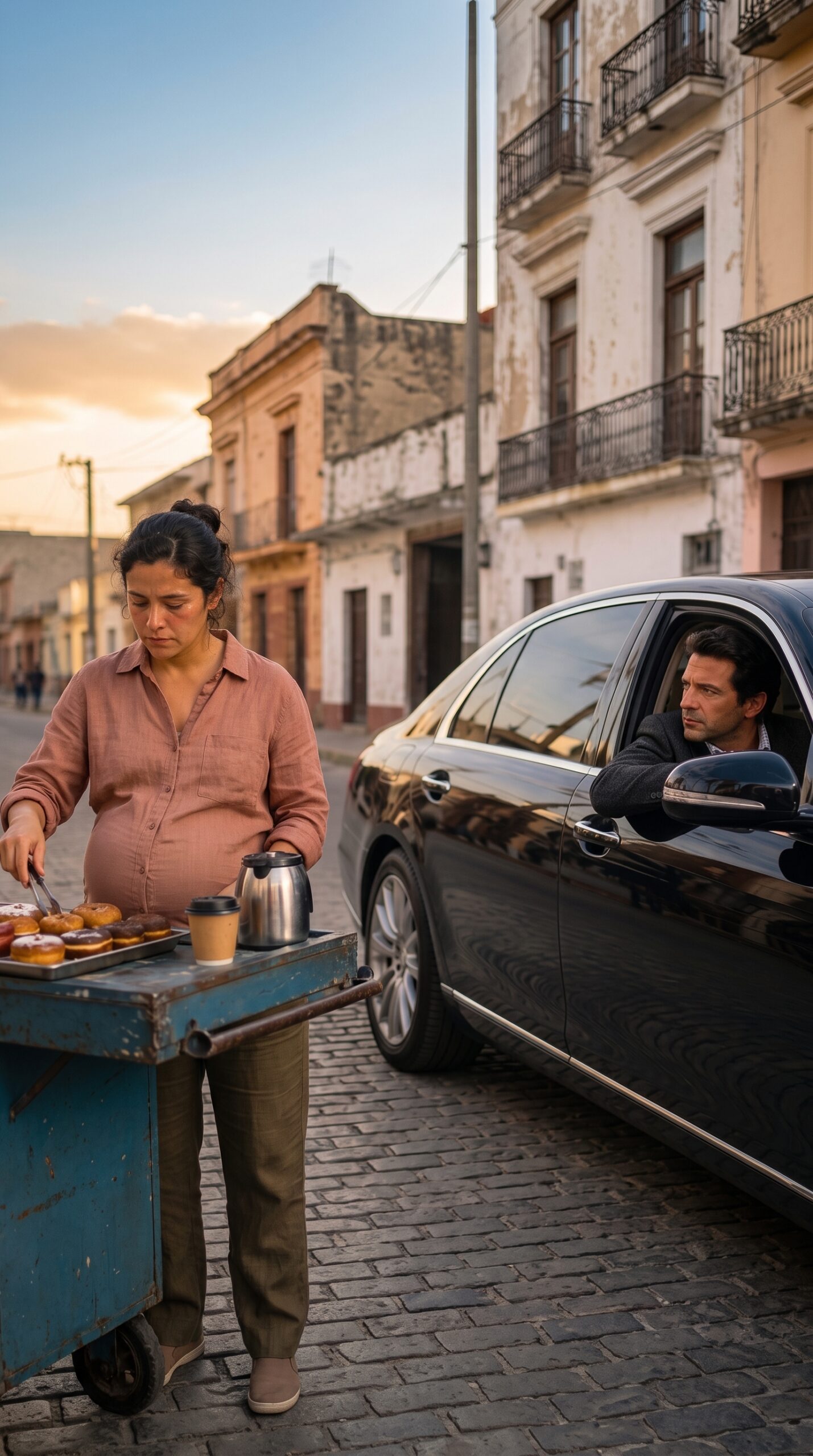
Damián walked as if following an invisible thread. He crossed the street, passed a flower stand, and saw her.
Clara was behind the cart, hair pulled up, deep dark circles under her eyes, and a simple dress that revealed her round belly. She was serving coffee to an elderly man and smiling with that sad strength of someone who doesn’t want to break in front of anyone.
Damián stopped breathing.
She was alive.
She was pregnant.
And she was alone.
Julián approached.
—Are you going to talk to her?
Damián shook his head, tears in his eyes.
—Not yet. First, I’m going to make sure no one touches her life again.
That same day began Doña Amparo’s downfall.
Damián requested account statements, security videos, notarized copies, and access records from the house. Julián obtained the statement from the guard who saw Clara leave crying with one suitcase. Martina signed her testimony.
The family lawyer, pressured by a lawsuit, confessed that Amparo had ordered locks changed, cards blocked, and documents hidden to prevent Clara from claiming assets.
The surprise appeared in a folder Beatriz kept in her apartment.
They had initiated a process to declare Clara “widow without descendants” and leave control of the company in Amparo and Beatriz’s hands.
But there were two problems.
Clara was still the legal wife.
And now she was pregnant with the heirs they had demanded so much.
Damián kept every piece of evidence. He didn’t want an empty scandal. He wanted the truth.
He returned to the market two days later, just as Clara was closing the cart. She was arranging empty trays when she saw a pair of shoes in front of her.
—I have no bread left, young man —she said without looking up—. Tomorrow morning I’ll have...
The tray fell to the ground.
Damián was there, thinner, with scars on his face and red eyes.
—Clara...
She stepped back, bringing a hand to her chest.
—No. It can’t be.
—I’m here.
—Damián is dead.
—No. I got lost, but I came back.
Clara began to tremble. Her face shifted from fear to rage and from rage to a pain so deep that the people around them fell silent.
—I was left alone —she said with a broken voice—. Your mom threw me out of my house. Took my cell phone. Took everything. I wanted to wait for you, Damián. I really wanted to wait for you.
He took a step and stopped, afraid to touch her.
—I know the truth now.
Clara then cried like she hadn’t in months. He hugged her gently, almost afraid to break her. She buried her face in his chest and weakly pounded his shirt with her fist.
—Why didn’t you come back sooner?
—Because I didn’t know who I was —he whispered—. But I tasted your bread and found you.
Clara barely pulled away. Damián looked down at her belly.
—Is it...?
She took a deep breath.
—they’re yours. There are three.
Damián let out a broken sound, half laughter and half crying. He knelt down right there on the sidewalk and rested his forehead on Clara’s belly.
—I’m sorry. I’m sorry for not getting here sooner.
Some filmed with their cell phones. Others cried without knowing them. An elderly woman whispered:
—Now that’s a story for a novel, but one that hurts.
That afternoon, Damián didn’t take her straight home. First, he took her to a private clinic to check on her and the babies. Then he bought her comfortable shoes, vitamins, clothes, and a new cell phone.
—I don’t need luxuries —Clara said.
—They’re not luxuries. It’s the minimum I should have taken care of.
She looked at him sadly.
—I don’t want you to confuse guilt with love.
Damián lowered his head.
—It’s not guilt. It’s shame for having allowed my family to humiliate you for so long.
By evening, they arrived at the house in Lomas Verdes.
Doña Amparo was in the living room with a decorator, deciding which wall to tear down. Beatriz was flipping through catalogs to remodel the master bedroom, as if the house were already hers.
When they saw Damián walking in hand in hand with Clara, they fell silent.
Amparo’s face changed in a second.
—Son, I’m so glad you found her. I knew she would appear sooner or later.
Clara didn’t respond.
Damián placed a thick folder on the table.
—Martina, come in.
Martina entered behind them, followed by Julián, the guard, and the family lawyer. Beatriz stood up.
—What circus is this?
—The truth —Damián said—. The truth that you buried while I was in a coma.
Amparo tightened her grip on the rosary.
—I only protected your assets.
—My assets were selling bread pregnant on the street because you left her without keys.
—We didn’t know she was pregnant.
—Even if she weren’t —he replied—, she was my wife. Not your trash.
Beatriz let out a nervous laugh.
—Oh, Damián, don’t exaggerate. She always played the victim.
Damián looked at her with a coldness he had never shown before.
—You signed false documents. You declared that Clara stole jewelry. You wanted to keep the company using my supposed death.
Beatriz paled.
—Mom told me it was for the best.
—You both will answer for this.
Amparo began to cry, but not out of regret.
She cried because she had been discovered.
—I’m your mother.
—And she is the woman who supported me when you all called me a failure.
Silence fell heavily.
Clara spoke for the first time.
—Doña Amparo, you could have hated me for being poor, for being a baker, for not bearing children when you wanted. But what you did wasn’t disdain. It was cruelty.
Amparo couldn’t hold her gaze.
—I thought you were going to take everything.
Clara smiled sadly.
—I already had everything when I had your son alive. You were the one who never understood that.
That night, Damián made decisions without yelling.
His mother would receive financial support, but would live outside that house and would never again decide about his marriage or the company. Beatriz was separated from the construction firm and reported for forgery, breach of trust, and document manipulation.
Clara didn’t celebrate.
She only asked for one thing:
—I don’t want revenge, Damián. I want peace. If this house starts smelling of disdain again, I’ll leave even if I love you.
He nodded.
—Then let’s build a home, not a trophy for my surname.
The following months were not magical. Clara still woke up afraid someone would take the keys from her. Damián had nightmares about fire, hospitals, and his mother’s voice telling him Clara had betrayed him.
But every medical appointment brought them back together.
He learned to prepare coffee without burning it. She started baking again not out of necessity, but because kneading calmed her soul.
Sometimes Damián would find her in the kitchen, one hand on her belly and a lost look in her eyes.
—What’s wrong? —he would ask.
—Sometimes I feel like they can still take everything from me.
He would approach slowly.
—No one is taking you out of my life again.
In spring, two boys and one girl were born: Mateo, Nicolás, and Abril.
When the nurse placed all three babies next to Clara, Damián cried without hiding.
—We asked for a miracle for nine years —he whispered—. And three arrived.
Clara looked at him, exhausted and beautiful.
—They arrived when no one could use them to humiliate me anymore.
That phrase pierced him forever.
Some time later, on a Sunday morning, the house smelled of orange, cinnamon, and butter again. In the kitchen, there was a big table, just as Clara dreamed when they had no money. On a shelf were the recipe notebook, the old apron, and a photo of the cart from Coyoacán.
The babies slept in the living room.
Damián tried a piece of freshly baked bread and closed his eyes.
—This flavor brought my life back.
Clara shook her head gently.
—No, Damián. You came back because you didn’t believe the lie.
He hugged her from behind.
The house was no longer a trophy for the rich nor a surname hanging on the wall. It was noisy, warm, imperfect, and alive.
And Damián understood that a family isn’t defended with money, lawyers, or surnames.
It’s defended by believing in the right person when everyone wants to make her seem guilty.
Because sometimes betrayal doesn’t come from those who left.
Sometimes it comes from those who stayed close, waiting for love to die so they could take it all.





