PART 1
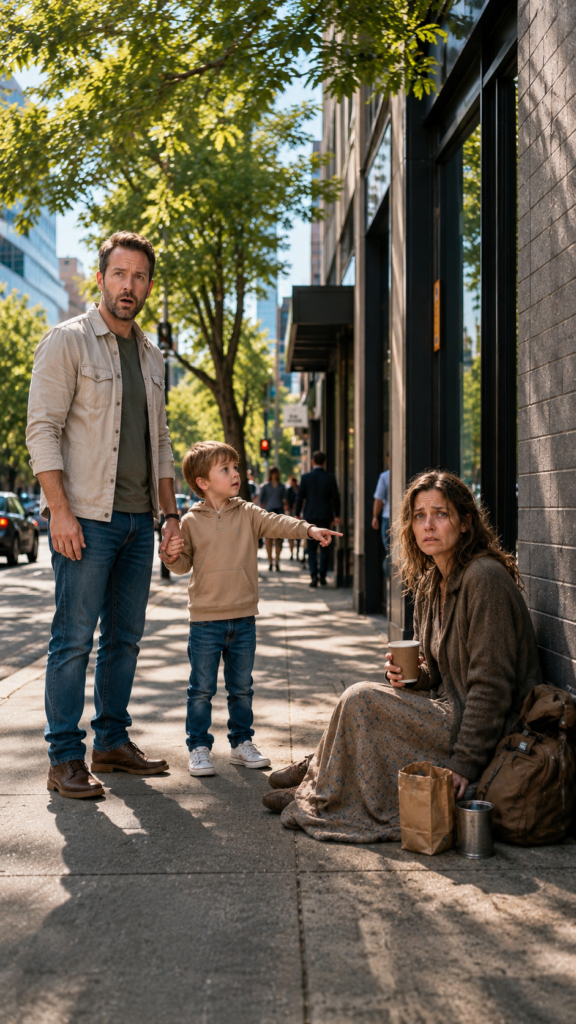
"Dad... that lady is Mom."
Diego said it so quietly that Andrés Robles thought he had misheard.
It was Sunday afternoon outside the Coyoacán Market. Families were eating tostadas, tourists were taking photos, women were haggling over flowers, and a street musician played a sad tune beside the sidewalk.
But Diego, just 8 years old, stopped walking.
His lemon ice cream began to melt between his fingers.
Andrés turned to him and noticed that the boy was pale, his eyes wide as if he had just seen a ghost.
"What did you say, champ?"
Diego didn’t respond immediately.
He just raised a trembling hand and pointed toward the wall of a closed pharmacy. There, sitting on a damp cardboard box, was a woman wearing an old jacket, her hair tangled, nails broken, and a plastic cup at her feet.
She looked like one of the countless invisible people the city learns to dodge.
But Diego couldn’t take his eyes off her.
"It's Mom," he repeated, his voice cracking. "I swear, Dad... it's Mom."
Andrés felt a sharp thud in his chest.
Mariana, his wife, had been dead for 3 years.
Or at least that’s what he had been told.
He had been at the funeral. He had received hugs, flowers, condolences, and terrible phrases like, "God knows why he does things." He had held Diego while the boy cried in front of a closed coffin.
He had learned to be a father all on his own.
To make sandwiches.
To sign homework.
To answer questions no man should have to answer for his son, like: "Does Mom remember my voice?"
That’s why he firmly shook his head.
"No, Diego. Your mom is in heaven."
But the boy let go of his hand.
"No. Look at her closely."
Andrés wanted to take him away, to protect him from this cruel illusion. But then the woman lifted her face.
And the world slipped from his grasp.
She was so thin. Her lips cracked, skin marked by the sun, and deep dark circles under her eyes. Her face seemed broken inside.
But those eyes...
They were the same honey-colored eyes that Mariana had when she woke up late on Sundays.
The same that filled with tears when Diego was born.
The same that Andrés had kissed before believing he lost them forever.
The woman looked at him.
First with fear.
Then with a recognition that pierced through her completely.
Diego ran toward her.
"Mom!"
The cry made several people turn.
The boy fell to his knees in front of the woman and touched her face with both hands.
"It's me. It's Diego."
The woman opened her mouth, but only air escaped.
Then she cried.
"My little moon boy," she whispered.
Andrés felt his legs give way.
Only Mariana called Diego that since he was a baby. No one else. Not his grandmother. Not his aunts. Nobody.
A woman crossed herself. A vendor called an ambulance. Andrés approached slowly, as if touching her could undo her.
"Mariana..."
She tried to get up, but collapsed into his arms.
She weighed almost nothing.
As if for 3 years, life had slowly erased her piece by piece.
In the hospital, the doctors treated her as an emergency case. Diego sat outside the room, hugging his mother's old jacket as if it were a treasure.
Hours later, a doctor emerged.
"She’s stable. Very dehydrated, severely malnourished, and showing signs of prolonged stress. But she is conscious."
Andrés entered alone.
Mariana was in the bed, staring at the ceiling.
He approached with fear.
"I buried you."
She closed her eyes.
"No, Andrés."
Her voice was weak but clear.
"You buried Lucía."
Andrés stopped breathing.
Lucía.
Mariana's twin sister.
The troubled woman who showed up every six months asking for money, forgiveness, or shelter.
"What are you saying?"
Mariana turned her head and looked at him with unbearable sadness.
"Lucía came looking for me that night. She was running from someone."
"From whom?"
Mariana gripped the blanket with trembling fingers.
And then she said the name that made Andrés's blood run cold.
"Rodrigo Valdés."
His partner.
His best friend.
The man who had carried Diego at the funeral and promised never to leave him alone.
And in that instant, Andrés understood that his pain was just beginning.
PART 2
For 11 years, Rodrigo Valdés had been more than a partner to Andrés.
Together they had built Robles & Valdés Construction from a tiny shop in Narvarte into a strong company, with projects in Puebla, Querétaro, and Mexico City.
Rodrigo attended family meals. He sat at the same table as Mariana. He brought expensive toys for Diego on his birthday and always said:
"That kid is like my nephew, man."
After Mariana's supposed death, Rodrigo became indispensable.
He spoke with lawyers.
He reviewed insurance policies.
He accompanied Andrés to the bank.
He organized meetings with investors when Andrés couldn’t even get out of bed.
"You take care of your son," he repeated. "I’ll handle the rest."
Andrés believed him.
He believed because pain makes anyone blind.
Now, standing in front of the hospital bed, he understood he had let the wolf into the living room.
Mariana began to recount everything with long pauses.
Lucía had come to her apartment one rainy night, banging on the door like a madwoman. She had a backpack, bruises on her arms, and a folder full of papers.
She said Rodrigo had used her to move cash, open accounts in the names of fronts, and sign fake receipts.
At first, Lucía wanted to blackmail him.
She thought she could extort money from him and run away to Tijuana.
But when Mariana reviewed the documents, she understood it was much graver.
There were altered contracts.
Forged signatures.
Fake invoices.
Family land used as collateral without authorization.
And a business insurance policy where Mariana's death triggered millions in benefits for the company.
Rodrigo wasn’t just stealing.
He was preparing a perfect trap.
"I told him I would tell you everything the next day," Mariana murmured. "I told him I wouldn’t let him destroy our family."
That same night, Mariana took Lucía to an old house her aunt had near Malinalco. She thought they could hide for a few hours and call a lawyer.
But Rodrigo followed them.
At first he begged.
Then he cried.
Then he threatened them.
Mariana remembered the rain pounding against the windshield. Lucía screaming that she didn’t want to see him again. Rodrigo blocking the path with his truck.
Then came the crash.
A brutal hit against a tree.
Glass.
Blood.
Darkness.
Lucía died almost instantly.
Mariana survived, but woke up in a small hospital, confused, hurt, and without documents.
Rodrigo arrived before Andrés.
"He told me that everyone thought I was dead," Mariana whispered. "He showed me a photo of Diego outside school. He said that if I came back, he would be the next accident."
Andrés felt so much rage he had to grip the chair.
"And that’s why you left?"
Mariana cried silently.
"I didn’t leave. They hid me. They moved me from clinic to clinic, then to a house, then to the street. Rodrigo had people watching me. Every time I tried to ask for help, someone showed up reminding me that Diego was still alive because I obeyed."
Andrés wanted to run out and find Rodrigo.
He wanted to scream.
To hit him.
To drag him in front of everyone who had ever called him a decent man.
But Mariana grabbed his wrist.
"Andrés, don’t let your anger take Diego’s father away from him again."
That phrase stopped him.
Because Diego had already lost too much.
That night, Andrés called Carmen Villaseñor, a retired commander who had been a friend of his father and now advised on financial crime cases.
Carmen arrived at the hospital before midnight with a black notebook and a gaze that wasn’t easily scared.
She listened to Mariana without interrupting.
She wrote down dates, names, license plates, notaries, companies, and addresses.
When she finished, she closed the notebook.
"If Rodrigo thinks Mariana is still lost, we have the advantage. But we have to play clean and with evidence, not with rage."
For several weeks, almost no one knew Mariana was alive.
They registered her under another name in a private clinic. Diego went to see her every afternoon after school. At first, he just sat by the bed, watching her as if he feared she would wake up.
Then he began bringing her drawings.
Then homework.
Then his favorite pillow.
One afternoon, he fell asleep with Mariana’s hand pressed against his chest.
She didn’t move for 2 hours to avoid waking him.
Meanwhile, Carmen and Andrés began piecing the puzzle together.
They found transfers to accounts in Monterrey.
Deleted emails from the company.
Videos from toll booths heading to Malinalco.
Duplicated invoices.
Altered medical records.
And something worse: a voicemail saved on Lucía’s old phone.
Rodrigo’s voice was crystal clear.
"Mariana can’t come back. If she shows up, the kid pays. You already know how things are settled in this country."
Andrés listened to the audio once.
Then again.
The third time, he had to step into the hallway because he felt like he was drowning.
Carmen didn’t flinch.
"This sinks him. But we still need to make him fall where it hurts most."
The opportunity came one month later.
Rodrigo would receive an award during a corporate dinner at a hotel in Polanco. The award was for "leadership, honesty, and commitment to Mexican families."
The irony was so filthy that Andrés almost laughed.
That night, the hall was filled with businessmen, local politicians, architects, journalists, and supposed friends.
Rodrigo stepped onto the stage in a gray suit, perfect smile, and expensive watch.
"Every business should be built on trust," he said into the microphone. "Because without family, nothing is worth it."
Andrés, sitting at a table in front, clenched his jaw.
Rodrigo looked at him from the stage.
"And I want to dedicate this award to my life brother, Andrés Robles, a man who has faced loss with dignity. Mariana would be proud of you."
The hall erupted in applause.
Andrés didn’t move.
Then the doors opened.
First came Carmen, accompanied by three agents and a prosecutor.
Then came Diego.
And behind him, walking slowly, appeared Mariana.
She wore a simple blue dress, her hair tied back, and a light coat over her shoulders. She still looked fragile, but her eyes were no longer filled with fear.
They were real.
The hall fell silent.
A heavy, uncomfortable, brutal silence.
Rodrigo stopped smiling.
The microphone trembled in his hand.
"It can’t be..."
Mariana stepped forward until she stood in front of the stage.
Diego held her hand firmly, as if he were supporting her against the world.
"Rodrigo," she said, her voice clear. "For three years, you let my son believe his mother was dead."
Some guests pulled out their phones.
Others looked down.
Rodrigo tried to regain his composure.
"Mariana, you’re confused. You don’t know what you’re saying. You’ve suffered so much."
She let out a sad smile.
"Yes. I suffered a lot. But I’m not confused."
Carmen signaled.
The screens in the hall changed.
They no longer showed the award's logo.
They displayed documents.
Fake contracts.
Forged signatures.
Transfers.
Toll booth videos.
The manipulated death certificate.
And then the audio played.
"Mariana can’t come back. If she shows up, the kid pays."
Rodrigo’s voice filled the entire hall.
Diego squeezed his mother’s hand.
Andrés felt something break inside him, but it wasn’t weakness. It was the last piece of a lie falling apart.
Rodrigo stepped off the stage looking for a side exit.
The agents stopped him.
"This is a setup," he shouted. "Andrés, tell me you’re not going to believe this madness."
Andrés stood up slowly.
For years, he had seen Rodrigo as a brother.
That night, he only saw a coward in an expensive suit.
"You sat at my table," Andrés said. "You hugged my son. You watched me cry in front of a coffin. And all that time you knew Mariana was alive."
Rodrigo opened his mouth but couldn’t find a phrase to save himself.
Mariana stepped forward.
"My sister died because of your ambition. I lived for three years as a shadow because of your threats. And my son grew up asking for a mother that you stole from him."
For the first time, Rodrigo lowered his gaze.
It wasn’t remorse.
It was defeat.
The agents placed handcuffs on him in front of everyone who had just minutes before applauded him.
Some recorded.
Others cried.
Several pretended not to know him.
As they took him out of the hall, Rodrigo looked at Mariana.
"Please... don’t do this to me."
She hugged Diego against her chest.
"You did this to me. To my son. To Lucía. Now you’re just experiencing the consequence."
The scandal exploded on social media that very night.
The company was intervened.
Rodrigo’s accounts were frozen.
Notaries, experts, and officials ended up being investigated.
The lands returned to their owners.
Robles & Valdés disappeared forever.
But justice didn’t heal everything.
Mariana had to learn to sleep without checking the window five times.
Diego had to learn that his mom could go to the bathroom and come back.
Andrés had to forgive himself for not suspecting sooner, even though Mariana repeated that the culprit wasn’t the one who had been deceived, but the one who used a family’s love to hide a crime.
There were good days.
And horrible days.
Days when Mariana made coffee and suddenly stared at her hands, as if she still couldn’t believe she could touch a clean cup.
Nights when Diego left his door open to hear her breathe.
Mornings when Andrés cried in the shower so no one would see him.
A year later, they moved to a small house in Querétaro.
It had no luxuries.
No marble.
No private security.
It had bougainvilleas at the entrance, a kitchen with plenty of light, and a wall where Diego taped drawings of moons.
One afternoon, the three of them sat in the yard watching the sun set.
Diego leaned his head on Mariana’s shoulder.
"Mom," he said softly, "I knew it was you."
She kissed his hair.
"Yes, my little moon boy. You saw me when everyone else had erased me."
Andrés hugged him from the other side.
"You had more courage than all of us."
Diego smiled slightly.
"I just recognized her."
Mariana took Andrés’s hand.
For three years, the world insisted on burying a living woman.
For three years, a boy talked to a photo believing his mother could hear him from heaven.
But in the end, it wasn’t a lawyer, nor a partner, nor a document that found the truth.
It was an 8-year-old boy who looked twice when everyone else would have just kept walking.
Because sometimes love doesn’t need proof.
Sometimes it trembles, points to a sidewalk, and says:
"That’s Mom."





