PART 1
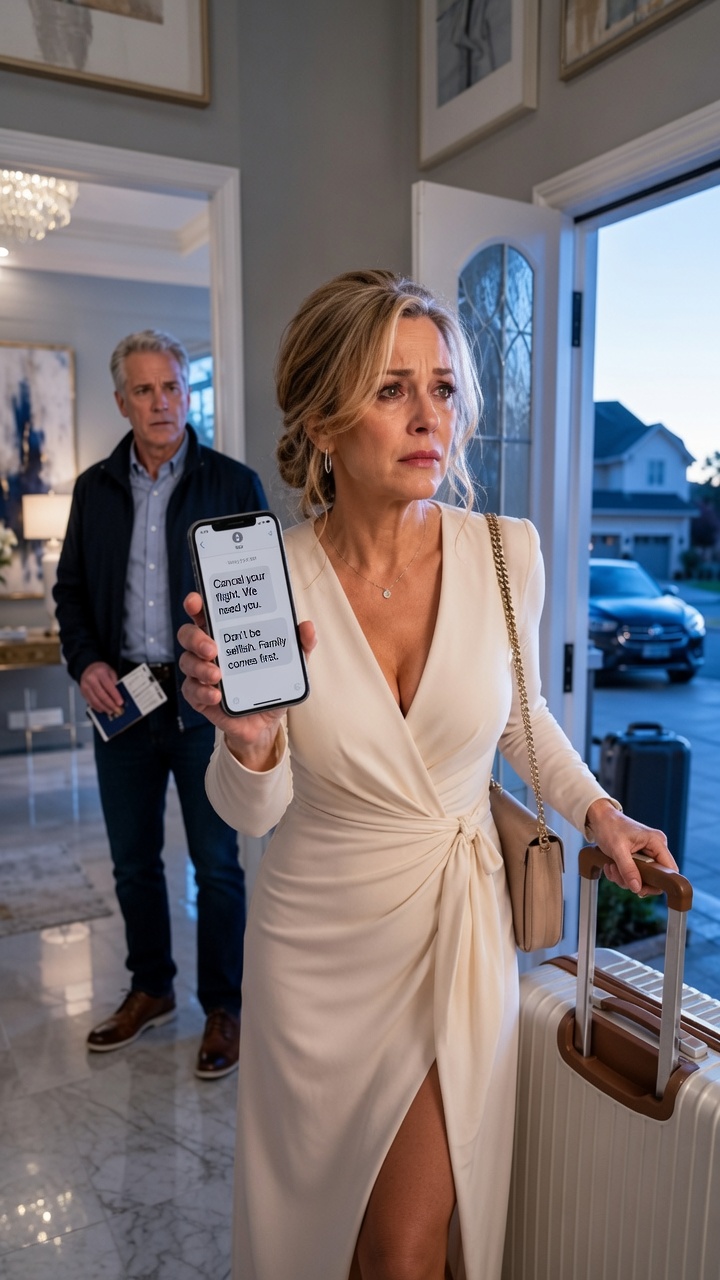
—Cancel the flight, Mom. We need you to stay.
Roberto didn’t ask Carmen.
He ordered her.
It was 9:43 PM in a quiet neighborhood of Querétaro, exactly 11 hours before Carmen and her husband Manuel were set to board a flight to Huatulco.
It wasn’t just any trip.
It was their 32nd wedding anniversary.
A week by the sea, in a simple hotel, with breakfast included, sunset walks, and a room with a balcony that Carmen had seen so many times in photos she could almost smell the breeze.
They had taken 5 years to pay for it.
5 years of saying, “We’ll go later.”
5 years of babysitting grandchildren, lending money, canceling meals, postponing appointments, birthdays, breaks, and even fights that never ended because there was always something more urgent in Roberto’s life.
Carmen was in the bedroom folding two dresses on the bed.
One light yellow.
The other blue, Manuel’s favorite.
He was sitting next to the suitcase, checking the printed tickets as if they were treasure.
Then the cellphone rang.
Roberto.
Carmen answered with a tired smile, thinking her son might just want to wish them a good trip.
—Mom —he said, without greeting—. Jimena starts training on Monday. We need you to take care of the kids all week.
Carmen stopped folding the dress.
—Son, our flight leaves tomorrow at 8:00.
—Yeah, I know.
That hit harder than a shout.
He knew.
Jimena, his wife, had sent the training schedule two weeks earlier, but no one asked for help back then.
They waited until the night before.
They waited until the suitcases were ready.
They waited until Carmen felt ashamed to choose her break over the needs of others.
—Roberto, it’s all paid for.
—Then cancel it. Family comes first.
Before Carmen could respond, a message arrived.
“Don’t be selfish. Family comes first.”
Carmen read it once.
Then again.
She felt something ancient within her, something obedient, something that always said “yes” before thinking, crack without making a sound.
Manuel looked up.
—What happened?
Carmen glanced at the tickets.
Looked at the suitcase.
Looked at the man who had learned to stay silent every time she rushed to solve Roberto’s life for the past 30 years.
—I think I’m tired —she said quietly.
Roberto called again at 10:18.
He talked about the expensive babysitter.
About how the rent had gone up.
About how Jimena couldn’t miss the training because it was her chance to get a promotion.
About how Valeria had an exam.
About how Nico woke up crying.
About how only Carmen could make them the soup “just how they liked it.”
It all sounded real.
That’s why it hurt so much to say no.
Because Carmen loved her grandchildren.
Because Roberto was her son.
Because a part of her still believed that a good mother had to endure, stay silent, and solve things even when she was running out of life.
But that night she couldn’t.
—Roberto —she finally said—, I understand you’re under pressure. But I’m not going to cancel my trip.
There was silence.
Then his voice turned cold.
—Perfect. Then don’t come to us when you need something.
That phrase would have destroyed her before.
Carmen would have cried, apologized, and woken Manuel to tell him they couldn’t go again.
But that night she took a deep breath.
—I’ll remember you said that.
And she hung up.
The phone didn’t stop.
Messages from Jimena.
“It’s just a few days.”
“Roberto is really stressed.”
“The kids are asking for you.”
“I thought I could count on you.”
Carmen turned off the screen.
At 5:26 AM, as the coffee filled the kitchen with a bitter smell, she saw Roberto’s last message.
“If you get on that plane, forget you have a son.”
Manuel looked at her from the table.
—We can still stay.
Carmen’s hands trembled.
Her chest hurt.
It hurt to be a mother and choose herself at the same time.
But she picked up the suitcase.
—No. We’re going.
When they closed the door of the house, the phone rang again.
For the first time in decades, Carmen didn’t answer.
And Roberto was about to discover that his threat no longer held power in that house.
PART 2
The Querétaro airport was nearly empty when they arrived.
Carmen walked alongside Manuel with the absurd feeling of doing something wrong.
It wasn’t a crime.
But for a mother used to being available, having a life of her own felt like betrayal.
The cellphone vibrated inside her bag.
Once.
Again.
One more time.
She didn’t take it out.
Manuel took her hand in the security line.
—You don’t have to prove anything to me, Carmen. If you want to go back, we’ll go back.
She looked at him.
He had dark circles under his eyes.
He had also spent the night awake, but not because of the flight.
Because of her.
For years, Manuel never forbade her from helping Roberto.
He never yelled.
He never said, “Your son is using us.”
He just canceled plans.
Saved the nice shirt.
Returned tickets.
Said, “Don’t worry,” with a quiet sadness that Carmen pretended not to notice.
—I do want to go —she replied—. Even if it scares me.
Before boarding, she made the mistake of checking her cellphone.
23 messages.
Roberto had written:
“Are you really going to abandon your grandchildren?”
Jimena:
“The kids aren’t to blame for your whims.”
Then Roberto again:
“Good to know what kind of mother you are.”
The last message left her frozen.
“Valeria asked why her grandma preferred the beach.”
Carmen felt her body go limp.
Valeria was 7.
Nico, 4.
They shouldn’t be caught in an adult war.
They didn’t deserve to hear venomous phrases.
Carmen stood up.
—I’m going to the bathroom.
She entered, shut the stall door, and cried silently.
She wanted to reply.
Wanted to send an audio saying she loved them, that she wasn’t abandoning them, that a week of rest didn’t erase 7 years of picking them up from school, buying them uniforms, taking them to the doctor, and staying awake when Roberto and Jimena “couldn’t go on anymore.”
But she sent nothing.
Because she understood something that scared her.
If she replied out of guilt, she would return to the cage.
When boarding was announced, Manuel was waiting for her, standing.
—Ready?
Carmen looked at the airplane door.
Then looked at her cellphone.
And put it on airplane mode.
When the plane took off, she waited for guilt to cut her breath.
It didn’t happen.
Silence arrived.
A strange, uncomfortable silence, almost new.
As if her life had stopped sounding for everyone but her.
They landed in Huatulco with the sun high.
The air smelled of salt, coconut, and rest.
But when she turned on her cellphone, Carmen found more messages.
Roberto was no longer begging.
He was attacking.
Jimena was no longer explaining.
She was insinuating.
Among all those texts was one from Lulú, her neighbor.
“Carmencita, I don’t know if it’s right to tell you, but Roberto came to your house a little while ago. He had keys. He went in with Jimena. They left with a folder and a black bag. Did you give them permission?”
Carmen froze.
Manuel read the message over her shoulder.
—What folder?
She knew it instantly.
The green folder.
The one with the bank papers.
The copies of the deeds.
The account statements.
The additional card Roberto had “for any emergency.”
And the envelope where Manuel kept the life insurance receipts.
Carmen felt coldness on her back, even though it was warm outside.
Her son didn’t just want her to cancel the trip.
He had used her absence to get into her house.
And the real emergency was just beginning.
They didn’t go to the hotel first.
They sat in an airport café, with the suitcases beside them and two cups of coffee that no one touched.
Manuel’s jaw was set.
Carmen couldn’t stop looking at Lulú’s message.
For years, it hadn’t seemed serious that Roberto had keys.
He was her son.
He knew the house “out of trust.”
He knew where the papers were “for safety.”
He had access to an account “just in case something happened.”
Everything seemed reasonable when said in parts.
But together, at that moment, it sounded different.
It sounded like abuse disguised as family.
—We need to call the bank —Manuel said.
—Right now —Carmen replied.
And she did.
She blocked the additional card.
Removed Roberto as an authorized user.
Changed passwords.
Requested alerts.
Canceled access.
The bank officer asked her twice if she was sure.
—Yes —Carmen said.
And for the first time in a long time, that word came out whole.
Then she called Lulú.
—Did they force anything?
—No, comadre. They entered normally. But they were in a hurry. Jimena was carrying a big bag, and Roberto looked really flustered.
Carmen closed her eyes.
—Thanks for letting me know.
Lulú lowered her voice.
—You did well to leave. Sorry to butt in, but sometimes children get used to a mother not having a door.
That phrase stuck with her.
A mother without a door.
Manuel was waiting for Carmen to say they would go back.
She was waiting for it too.
But she didn’t say it.
—Let’s go to the hotel —she murmured.
Manuel looked at her in surprise.
—Are you sure?
—If I go back right now, Roberto will understand that he can still pull me with a string.
So they went to the beach.
It wasn’t a perfect trip.
No sea heals 32 years of exhaustion all at once.
Carmen walked on the sand and thought of Valeria.
Had dinner with fish and wondered if Nico had slept well.
Watched Manuel laugh with a waiter and felt pain realizing how much she had taken from her marriage to save problems that weren’t always hers.
But every morning she breathed easier.
They drank coffee by the sea.
Bought sweet bread at a little shop.
Walked through La Crucecita.
Manuel bought Carmen a ridiculous hat that she swore she wouldn’t wear, but put it on all afternoon.
One night, sitting on the balcony, Carmen opened a notebook she had bought at the market.
She wrote short phrases.
“I’m not a bad mother for resting.”
“Helping doesn’t mean obeying.”
“My children can have problems without me disappearing.”
“Loving also means setting limits.”
On the third day, Roberto called nine times.
Carmen didn’t answer.
Then he sent a message.
“I need to talk to you about what happened at the house.”
She didn’t reply.
Later came another.
“You’re acting like a stranger.”
Carmen read it several times.
Maybe it was true.
Maybe Roberto had never known his mother when she said no.
On the fifth day, Jimena wrote.
“We found a lady to take care of the kids. She’s expensive, but oh well.”
Carmen stared at the screen.
Expensive.
That was all.
The supposed family tragedy that was supposed to ruin their anniversary had been resolved with organization and money.
Not with her sacrifice.
Not with her guilt.
Not with her life on pause.
That night she showed the message to Manuel.
He sighed.
—How do you feel?
Carmen thought for a moment.
Sad.
Angry.
Free.
Guilty.
Light.
—Like I had been carrying a bucket that wasn’t even mine.
Manuel smiled faintly.
When they returned to Querétaro, they didn’t enter the house like before.
First, they called a locksmith.
Changed the locks.
Checked the study.
The green folder had been moved.
Copies of account statements were missing, a blocked card, and the insurance envelope.
Manuel found something else.
A folded sheet inside the drawer.
It was a loan application in Roberto’s name, with Carmen as a potential guarantor.
Carmen’s signature was poorly forged.
It wasn’t perfect.
But it was enough for a trusting person not to look twice.
Carmen felt nauseous.
That was the twist that broke her heart.
They hadn’t come to look for papers out of emergency.
They had come to find a way to use her name.
Manuel slammed his fist on the table.
—This isn’t just a tantrum, Carmen. This is serious.
She didn’t cry.
Not then.
She picked up the phone and called Roberto.
He answered on the second ring.
—Finally you deign to answer.
—Tomorrow you’re coming to the house at 5:00. You and Jimena. Without the kids.
—Now you’re giving orders?
—Yes.
There was silence.
—Mom, you’re really overreacting.
—Tomorrow at 5:00.
And hung up.
They arrived at 5:27, late, as if even that was a way to show power.
Jimena entered seriously, arms crossed.
Roberto didn’t greet Manuel.
—What’s this circus? —he asked.
Carmen placed the green folder, the blocked card, the printed message from Lulú, and the loan application with the forged signature on the table.
Roberto lost color.
Jimena looked at the floor.
—You came to my house for this? —Carmen asked.
Roberto swallowed hard.
—Mom, I needed to check some papers. I’m your son.
—You’re my son. Not the owner of my house.
Jimena let out a nervous laugh.
—Carmen, let’s not make a drama. This all started because you didn’t want to help us with the kids.
—No —Carmen said—. This started years ago when my help was confused with obligation.
Roberto slammed the table.
—We’re your family!
Manuel stood up slowly.
—And so am I.
The living room fell silent.
That phrase, without shouting, weighed more than any complaint.
Roberto looked at his father as if he had just remembered he existed.
Carmen continued.
—I’ve changed the locks. Removed your permissions from the bank. Canceled cards. Changed emergency contacts and beneficiaries. I’ve also spoken with a lawyer.
Roberto’s eyes widened.
—Are you going to sue me?
—I don’t want to do that. But if you touch one paper, one account, or one signature of mine again, yes.
Jimena started crying.
—It was out of necessity. Roberto fell behind on some debts. We didn’t want to worry you.
Carmen looked at her with deep sadness.
—And was forging my signature not worrying me?
Roberto lowered his head but still tried to defend himself.
—You’ve always helped us.
—Helping doesn’t give you the right to steal my peace.
That phrase left him frozen.
For the first time, Roberto had no quick response.
Carmen took a deep breath.
—I love you. You, Jimena, and my grandchildren. But starting today, if you need us to take care of Valeria and Nico, you’re going to ask two weeks in advance. If we can, we’ll say yes. If not, you’ll have another plan. And if you use the kids to hurt me again, the conversation ends.
Jimena wiped her face.
—We should have asked earlier.
Roberto looked at her, annoyed.
But he didn’t contradict her.
Before leaving, he left the old keys on the table.
There were no hugs.
No beautiful forgiveness.
No novel ending.
Real life rarely arranges wounds so easily.
For three weeks, Roberto spoke little.
Carmen didn’t chase him either.
She didn’t send long messages.
Didn’t apologize for setting a limit.
On a Tuesday at 7:14 PM, she received a message.
“Mom, could you and Dad take care of the kids on Saturday? If you have plans, it’s no big deal.”
Carmen read it three times.
Manuel was watering the plants.
—What happened?
She smiled slowly.
—He asked.
That word seemed small.
But in that house, it sounded enormous.
On Saturday, they arrived with sweet bread.
Valeria ran to hug Carmen.
Nico showed her a green dinosaur.
Roberto was uncomfortable, holding a bag of conchas.
—I didn’t know what to bring.
Manuel took the bag.
—Conchas never fail, dude.
Everyone laughed a little.
It wasn’t perfect.
But it was different.
After eating, Valeria sat next to Carmen.
—Grandma, will you show me pictures of the sea?
Carmen showed her the beach, the balcony, the ridiculous hat, and a photo where she and Manuel were holding hands.
—Is that why you didn’t come? —the girl asked.
Roberto tensed.
Carmen stroked her granddaughter's hair.
—Yes, my love. Your grandfather and I had a very important trip. But that doesn’t mean we don’t love you.
Valeria thought for a moment.
—My mom says we also need to rest.
Jimena looked down.
Roberto said nothing.
But his face changed.
As if he understood too late that Carmen hadn’t chosen the beach over her family.
She had chosen to continue being a person within herself.
That night, Carmen pinned a drawing Valeria made on the refrigerator.
It was two small people in front of a huge wave.
—That’s you and my grandpa —she had said.
Carmen looked at it for a long time.
For 30 years she believed that a good mother was the one who was always available.
Now she knew that a mother also teaches with the door closed, suitcase packed, phone on silent, and a heart trembling but firm.
She kept loving.
She kept helping.
She kept answering when there was a real emergency.
But she no longer confused love with allowing others to live without taking responsibility.
The plane didn’t wait.
And her life didn’t have to keep waiting either.





