PART 1
—Daddy… it hurts here, but Mom said that if I talk, she’ll send me away.
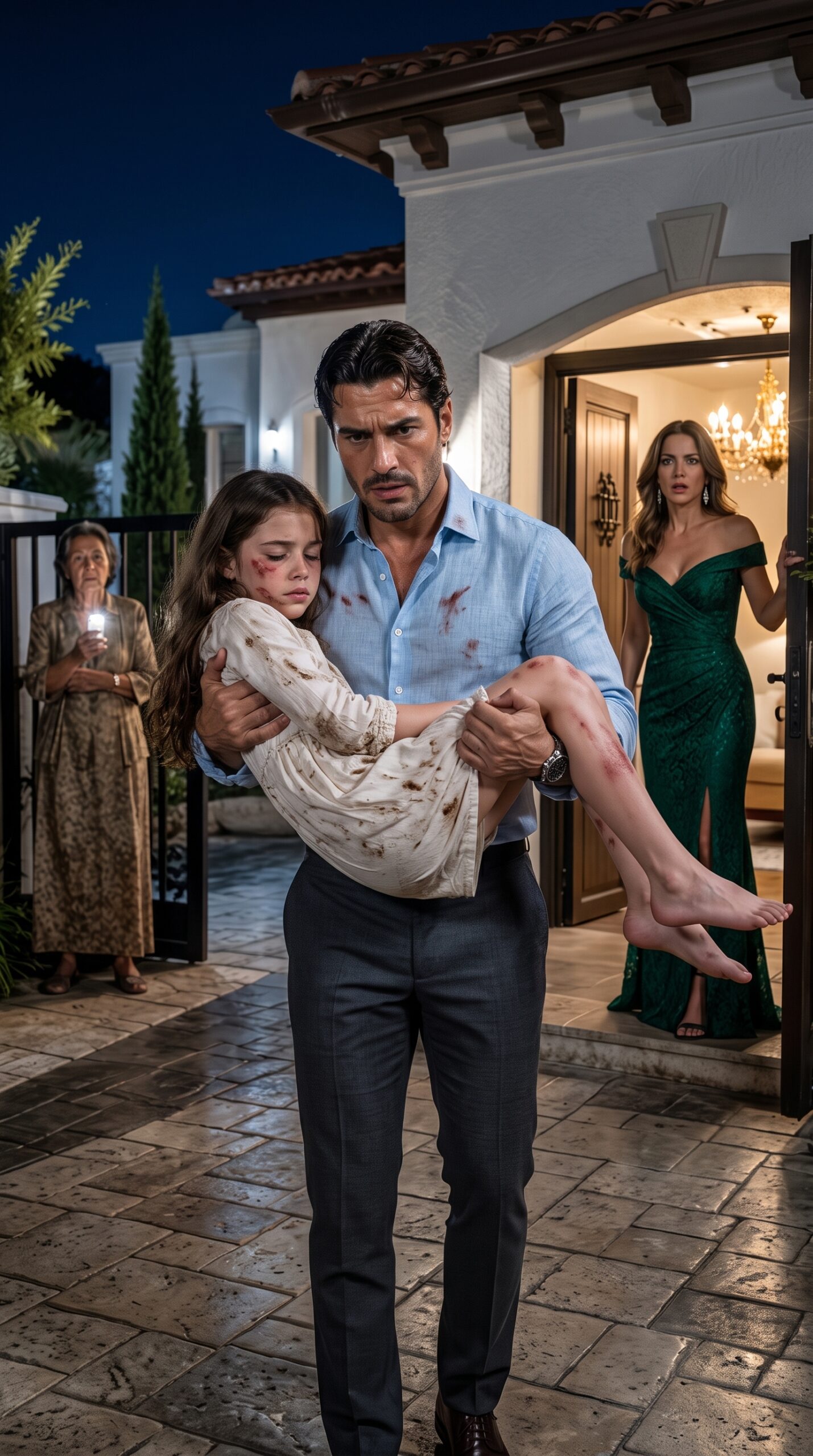
Diego Sandoval stood frozen at the entrance of his home, travel bag hanging off his shoulder. He had returned from León after four days finalizing a contract for the company he worked for, his shirt wrinkled, his back aching, and a desperate need to hug his daughter.
But Valentina didn’t run to him.
He found her sitting on the floor of her room, clutching a stuffed bear, still in her pajamas even though it wasn't yet 8 PM. Her eyes were red, hair tangled, and she had a strange way of sitting, as if any movement caused her pain.
Diego felt a tightening in his chest.
—Vale, my love… what happened?
The seven-year-old glanced towards the door before answering. In that house in the Jardines del Bosque neighborhood of Guadalajara, there was always noise: the TV blaring in the living room, the sounds of...
That night, the silence weighed heavier than any scream.
—The vase fell —Valentina whispered—. I was playing with my backpack and I knocked it over by accident.
—And then?
The girl swallowed hard.
—Mom got angry. She said I always messed everything up when you weren’t around. She grabbed my arm and threw me against the nightstand.
Diego dropped his bag to the floor.
—Where did you get hurt?
Valentina pointed to her side but didn’t lift her shirt. She was scared. That was what hurt Diego the most: not the bruise he couldn’t yet see, but the fear of his daughter to tell the truth in her own home.
—Let me see, sweetheart. I won’t hurt you.
Gingerly, he lifted the fabric. The bruise covered part of her ribs and extended towards her back. It was dark in the center, purple, with a red line like a wood mark. It didn’t look like a simple fall.
Diego felt anger, guilt, and shame all at once.
He had been in meetings, dining in hotel restaurants, answering emails late, while his daughter spent the night hiding pain beneath a big shirt.
—We’re going to the hospital.
Valentina’s eyes widened in terror.
—No, Dad. Mom said if you took me, everyone would know I’m a bad girl.
—You’re not bad. You’re a child. And no one has the right to ask you to hide a bruise.
At that moment, the front door swung open. Marisol entered with a pharmacy bag, sunglasses on her head, and her phone glued to her ear. Behind her was Doña Graciela, her mother, elegant, serious, with the face of a judge before hearing evidence.
Marisol froze at the sight of Diego carrying Valentina.
—What are you doing?
—I’m taking her to the ER.
—Oh, Diego, don’t start with your dramas. She fell while playing. I already put ointment on it.
—She told me what happened.
Marisol paled, but quickly clenched her jaw.
—Of course. Every time you show up, she plays the victim to get your sympathy.
Valentina buried her face in her dad’s neck.
Diego spoke slowly:
—Don’t ever say that about my daughter again.
Doña Graciela stepped forward.
—Look, son, accidents happen in every house. You’re not going to destroy your family over a tantrum.
Diego grabbed the keys.
—If you think this is a tantrum, the problem is worse than I thought.
Marisol stood in front of the door.
—If you go out with her, don’t come back.
Diego looked at his trembling daughter.
—Then I won’t come back.
As he crossed the gate, he saw the neighbor across the street, Doña Elvira, standing in her driveway with her phone in hand and tears in her eyes.
And before Diego could ask her anything, the woman said:
—I recorded what happened yesterday… but that wasn’t the only thing I heard.
PART 2
At the hospital, Valentina didn’t let go of Diego’s hand, not even when the doctor asked her to take a deep breath. Every time someone came too close, the girl shrank her shoulders and looked to the door, as if Marisol might appear and take her back.
Dr. Jimena Robles, a woman with a calm voice and very serious eyes, examined the bruise carefully. She didn’t make faces, didn’t exaggerate, but Diego noticed her lips pressed tightly together as she saw the mark.
—It doesn’t seem like a fracture —she said—, but it is a severe contusion. We’ll need to run tests, and I’ll also need to call social services.
Diego froze.
—Social services?
—When an injury doesn’t match a simple fall, we have to activate protocol.
Valentina looked down.
—I did fall… but because Mom pushed me.
The phrase hung in the office like a stone.
Diego felt the urge to cry, but he couldn’t. If he broke down, Valentina would feel alone again. So he breathed, kissed her forehead, and said:
—I believe you.
That night, while the girl rested with medication, Marisol arrived at the hospital accompanied by Doña Graciela. Marisol's mother entered first, as if she were there to complain about poor service in a store.
—What a disgrace, Diego. How could you bring the girl and make this scandal?
Marisol followed behind, her eyes red but filled with rage.
—I already spoke with a lawyer. If you try to take Vale, I’ll say you abandon her for weeks at a time for work.
Diego stood up.
—That doesn’t explain the bruise.
—It wasn’t that bad.
—It was for her.
Doña Graciela let out a bitter laugh.
—Kids nowadays can’t handle anything. Back then, a spanking would straighten anyone out.
Diego looked at her in disgust.
—My daughter doesn’t need to be straightened out. She needs not to be hurt.
At that moment, the social worker entered. Her name was Mariana Olvera. She asked to speak with Valentina when she woke up and to take medical photographs of the injury. Marisol immediately refused.
—I don’t authorize it.
Mariana didn’t budge.
—Mr. Sandoval has already authorized as the father. Furthermore, the minor has the right to be heard.
—She’s 7 —Marisol said—. She doesn’t know what she’s saying.
The social worker replied without raising her voice:
—That’s why we need to listen to her more carefully.
Diego felt that, for the first time in hours, someone understood.
Then his phone vibrated.
It was Doña Elvira.
“Diego, I’m sorry for getting involved. My garage camera recorded the entrance to your house. Yesterday, you can hear Valentina screaming. You can also see Marisol leave afterward and leave her alone for almost 3 hours. I have the complete video.”
Diego read the message twice.
Then he looked at Marisol.
—Where were you yesterday from 6 to 9?
She lost color.
—I went to buy some things.
—And you left Valentina alone, hurt?
Doña Graciela grabbed her daughter’s arm.
—Don’t answer.
But it was too late.
Valentina woke up to the noise. She saw her mom and hid behind the blanket. That gesture was enough for Mariana to ask Marisol to leave the room.
—She can’t kick me out. I’m her mother.
—And she is a scared child —Mariana replied—. If you don’t leave, I’ll call security.
Marisol stormed out, furious, but before leaving, she looked at Valentina with a coldness that Diego would never forget.
When they were alone with the social worker, Valentina took several minutes to speak. Mariana explained that no one was going to punish her, that she could stop whenever she wanted, and that telling the truth didn’t break families.
The girl hugged the stuffed bear to her chest.
—Mom told me that if Dad found out, she’d send me to a woman who takes girls who ruin their moms’ lives.
Diego felt the ground shift beneath him.
—Who told you that?
—Mom. And Grandma Graciela told her I was just like the other one.
Mariana raised her gaze.
—The other who?
Valentina blinked, confused.
—I don’t know. Sometimes Mom cries in the bathroom and says a name.
Diego leaned in a little closer.
—What name, Vale?
The girl whispered:
—Abril.
Marisol had never mentioned any Abril to him.
Not a cousin, not a sister, not a friend.
Nothing.
Diego stepped out into the hallway with his mind in chaos. Marisol was talking on the phone at the back, believing no one could hear her.
—Mom, I told you we shouldn’t have kept those papers… No, he doesn’t know about Abril… Of course he doesn’t know!
Diego felt a chill.
He called his sister Renata, who lived 20 minutes away.
—I need you to go to my house. Ask Doña Elvira to come with you. There are documents Marisol doesn’t want me to find. Record everything, please.
Renata didn’t ask questions.
—I’m on my way.
Meanwhile, the hospital continued its course: nurses coming in, stretchers passing by, families drinking coffee from cardboard cups. But for Diego, everything had stopped at a name.
Abril.
At 2:17 AM, Renata sent photos.
She had found a box inside Marisol’s closet, behind old suitcases. Inside were a birth certificate, papers from a foster home in Zapopan, payment receipts, and a letter signed by Marisol when she was 18.
Diego opened the image with cold hands.
“I declare my intention to give up the minor Abril…”
He sat down in a chair in the hallway.
Marisol had had another daughter before Valentina.
A daughter that her family erased as if she were a stain.
The next morning, Diego’s lawyer arrived at the hospital. His name was Rodrigo Cárdenas, a friend since college, and he had that dry calm of someone who had seen too many families pretend to love in front of a judge.
He reviewed the medical report, Doña Elvira’s videos, the statements, and the photos of the papers.
—We’re going to request protective measures and provisional custody —he said—. With this, Marisol shouldn’t come near without supervision.
Diego looked towards Valentina’s bed.
—And Abril?
Rodrigo took a deep breath.
—That could demonstrate a pattern of trauma and family concealment. But be careful: just because Marisol suffered doesn’t justify her hurting Valentina.
That phrase pierced Diego.
Hours later, Marisol returned to the hospital. This time, she didn’t come screaming. She arrived made up, in a white blouse, with a folder in hand, as if she wanted to look impeccable to negotiate a tragedy.
—We can fix this —she said in a low voice—. I’ll accept therapy. You won’t file charges. Valentina doesn’t need to know things she doesn’t understand.
Diego stared at her.
—Things like Abril?
Marisol's face crumbled.
Doña Graciela, who was following behind, interjected:
—Who told you that name?
Diego replied:
—You just confirmed she exists.
Marisol closed her eyes. For the first time, she didn’t seem angry. She seemed trapped.
—Abril was a youthful mistake.
Diego felt nausea.
—Don’t talk about a child as if she were trash.
Marisol pressed the folder against her chest.
—I was 18. I got pregnant by a boyfriend who left. My mom told me that if I had that baby, no decent man would marry me. They took me to an aunt, I had the baby and signed. I didn’t even know what I was signing properly.
Doña Graciela stiffened.
—I saved your life.
Marisol let out a broken laugh.
—No, Mom. You taught me to hide what hurt.
For a moment, Diego saw a wounded woman. But then he remembered Valentina trembling beneath a blanket.
—And then you passed that pain to my daughter.
Marisol cried.
—I didn’t want to. When Vale cries, when she throws things, when she looks at me like that… I feel like Abril comes back to collect everything.
—Valentina doesn’t owe you anything.
—I know.
—No. You don’t know. Because you hurt her and then asked her to lie.
Marisol lowered her head.
That same day, Diego filed the complaint. The hospital submitted the report. Mariana incorporated Valentina’s statement. Doña Elvira provided the videos. Rodrigo requested provisional custody and restraining measures.
Doña Graciela caused a scene in the courthouse hallway.
—You’re destroying my daughter!
Rodrigo looked at her unemotionally.
—No. We’re protecting a child.
Marisol's family began calling. An uncle said Diego was exaggerating. A cousin wrote that all mothers lose their patience. Another woman sent an audio saying that “dirty laundry should be washed at home.”
Diego deleted everything.
Because he had already understood something: some families don’t want peace; they want silence.
Valentina didn’t return to that house. Diego rented a small apartment near the Minerva. It had no garden or expensive furniture, but it had light, big windows, and a bedroom where the girl could choose yellow curtains.
The first nights, she slept with the lamp on.
Sometimes she asked:
—Does Mom know where we are?
Diego sat beside her.
—You’re safe. No one will punish you for telling the truth.
Therapy began two weeks later. Valentina drew girls hiding behind enormous doors. Then, little by little, the doors became smaller. Then windows appeared. One day she drew a house with a tree and wrote: “Here I breathe.”
Diego kept that drawing in his wallet.
Months later, the unexpected news arrived.
Rodrigo managed to locate Abril. She was 16 and lived with an adoptive family in Querétaro. She didn’t want to meet Marisol but agreed to send a letter to Valentina.
The letter said:
“I didn’t ruin anyone’s life. You didn’t either. Girls aren’t born to pay for adults’ fears.”
Valentina cried when the therapist read it to her.
—So, Mom wasn’t mad at me.
Diego knelt in front of her.
—No, sweetheart. Mom had an old pain. But that pain was never your fault.
Marisol lost temporary custody and received supervised visits, conditioned on real therapy. At first, Valentina didn’t want to see her. Diego respected that.
When she finally accepted, it was in a family center with a psychologist present. Marisol entered without makeup, with trembling hands. She didn’t try to hug her.
That was her first correct act.
—Valentina —she said in a broken voice—, what I did was wrong. It wasn’t your fault. I was the adult. You were the child. I shouldn’t have touched you, scared you, or asked you to keep secrets.
Valentina looked at her in silence.
—I don’t want to live with you.
Marisol closed her eyes, as if that phrase had broken something inside her.
—I understand.
The girl squeezed Diego’s hand.
—But I want you to keep going to therapy. Because if one day I have kids, I don’t want my mom to scare them.
The psychologist lowered her gaze. Diego felt tears burning.
There was no perfect ending. Marisol didn’t heal overnight. Doña Graciela never accepted her guilt and ended up with prohibited visits. Diego had to change schedules, learn to comb Valentina’s hair, burn quesadillas, and arrive late to school meetings.
But the small house filled with something that was once missing: calm.
A year later, Valentina participated in a school play. Diego arrived with yellow flowers. Marisol was there too, sitting at the back, with permission from the court and accompanied by her therapist.
Valentina came out dressed as a butterfly. When she said her line, she looked at the audience. For a moment, Diego saw the ancient fear cross her eyes.
Then she took a deep breath and spoke loudly:
—A girl doesn’t bloom where she is trampled. She blooms where she is cared for.
The auditorium applauded without knowing what that phrase truly meant.
After the show, Valentina ran to Diego.
—Did I do well, Dad?
He hugged her gently, even though she no longer had a bruise.
—You were amazing.
That night, before sleeping, Valentina left her stuffed bear on a shelf.
—I don’t need it to take care of me so much anymore.
Diego smiled with tear-filled eyes.
—Oh, really?
—No. Now I know how to talk.
Diego turned off the lamp but left a dim light on.
Before leaving, Valentina called him:
—Dad.
—Yes, my love?
—Thank you for believing me.
Diego stood at the door, feeling that phrase weighed more than any guilt and was worth more than any contract.
Because a family isn’t saved by hiding bruises.
It’s saved when someone hears a whisper, opens the door, and decides not to look away.





