PART 1
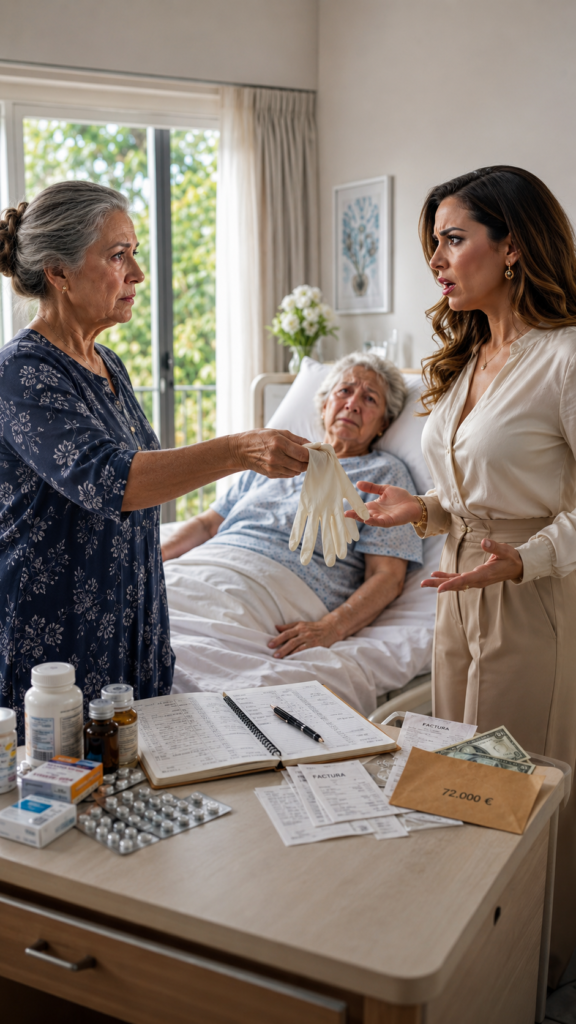
—If you can’t even change a diaper properly, Rosa, then why do you come here every day?
Mariana's voice crashed through the room like a broken plate.
Doña Carmen, her 86-year-old mother, lay in bed, eyes glistening and mouth twisted from the stroke that had stolen almost all her words. Beside the bed stood Rosa Villaseñor, gloved, hair tied back, a clean towel draped over her shoulder.
At the door, Julio, her son, said nothing.
He only looked down.
Rosa didn’t cry. She didn’t scream. She finished adjusting the sheets, placed the used diaper in a bag, kissed Doña Carmen’s forehead, and took off her gloves with a calmness that frightened more than any scream.
But to understand why that afternoon she took her bag and left that house in Tlaquepaque without looking back, we must go back 8 months.
Rosa was 64 years old, living alone in a little house in the Las Huertas neighborhood, surrounded by pots of basil, an altar for her deceased husband, and a quiet routine she had spent years building. She had raised three children by selling tamales, doing laundry for others, and enduring silences that many women her age knew all too well.
One morning, Mariana came to her door crying.
—Doña Rosita, I don’t know who else to turn to —she said, clutching a medical folder against her chest—. My mom had a stroke. She can’t walk, she barely speaks, she needs diapers, medicine, baths, special food… and we can’t afford a nurse.
Rosa knew Doña Carmen from family gatherings. She was a sweet lady, the kind who always brought mosaic gelatin and asked about everyone. Seeing her reduced to a bed broke Rosa’s heart.
—It will just be for a little while —Mariana promised—. A couple of months, while we get settled. You know how to care; you have patience. My mom would be better with someone she trusts.
Julio, Rosa's eldest son and Mariana's husband, took her hand.
—Mom, please. I don’t know what we would do without you.
That phrase opened an old wound. Since her husband died, Rosa had only felt useful when someone needed her. She thought helping an elderly woman was an act of love, not a chain.
She accepted.
At first, everything seemed grateful. Mariana sent her messages with hearts. Julio brought her sweet bread on Sundays. Doña Carmen squeezed her hand and murmured something that sounded like “thank you.”
Rosa arrived at 6 a.m. She prepared porridge, measured out pills, changed sheets, bathed Doña Carmen, cleaned the wheelchair, and sat her by the window so she could see the jacarandas.
Then came the lists taped to the refrigerator.
“Medicine 8:00.”
“Diaper every 4 hours.”
“Don’t give her bread.”
“Clean it well.”
Then came the tone.
—Doña Rosa, don’t sit her like that.
—Doña Rosa, check better.
—Doña Rosa, don’t get so distracted.
Rosa swallowed hard and repeated to herself that Mariana was tired, that a worried daughter says ugly things without meaning it.
But the 2 months turned into 4. Then 6. Then 8.
Rosa stopped going to the rosary, stopped walking in the park, stopped visiting her friends. Her life began to fit between diapers, medications, and orders.
One Sunday, during a family meal, Mariana asked her to serve the plates before sitting down.
—This way, you’re more attentive to my mom —she said, as if it were the most normal thing in the world.
Rosa ate her soup cold, standing next to the kitchen.
That afternoon, she realized they no longer saw her as family.
But the worst came that Tuesday when Doña Carmen had an accident in bed, and Rosa tried to change her carefully.
Mariana walked in, grimaced, and uttered the cruelest phrase.
Julio was there.
And he didn’t defend his mother.
Rosa took her bag, opened the door, and walked out without saying a word, unaware that that night, while checking some messages, she would discover a truth capable of tearing the whole family apart.
PART 2
Rosa walked three blocks to her house, feeling that each step returned a piece of her dignity.
She didn’t go fast. Her knees ached, her hands burned from so much soap, and her throat felt tight. But she didn’t stop. Not even when her phone started vibrating inside her bag.
First it was Mariana.
Then Julio.
Then Mariana again.
Rosa didn’t answer.
When she arrived home, she locked the door, sat in the living room, and looked at her half-dry plants. The bougainvilleas, once her pride, were thin, sad, covered with fallen leaves.
Then she cried.
She didn’t cry for Mariana. She didn’t cry just for the insult. She cried for the 12 daily hours nobody saw, for the breakfasts she never got to eat, for the afternoons when Doña Carmen cried, and she consoled her while her own back begged for help.
She cried for her son, above all.
Because a mother can endure many things, but seeing a son remain silent while she is humiliated is a wound that doesn’t heal with a “sorry, ma’am.”
At 9:20 that night, Julio knocked on the door.
—Mom, please open.
Rosa took her time getting up. When she opened it, Julio was disheveled, with the face of a scolded child and his phone in hand.
—Mariana is very upset —he said—. Doña Carmen needs attention. You can’t just walk out like this.
Rosa looked at him in silence.
—Can’t I?
—I don’t mean that. It’s just… Mom, you know how the situation is.
—The situation is this way because you all wanted it to be this way.
Julio swallowed hard.
—Mariana shouldn’t have talked to you like that.
—You shouldn’t have stayed silent either.
That phrase hit him harder than a scream.
Julio looked down, just like in the room.
—I’m sorry.
—I didn’t come into this world to care for your mother-in-law for free while you all live comfortably. And certainly not to be treated like a servant.
—Mom, you always said you wanted to help.
—Helping doesn’t mean disappearing, Julio. Helping doesn’t mean making me eat in the kitchen. Helping doesn’t mean scolding me for being 15 minutes late when I don’t even get paid.
Julio sat down on the couch without asking. He was nervous.
—It’s just that you don’t know how much everything costs.
Rosa felt something strange in that phrase. It wasn’t sadness. It was suspicion.
—What everything?
Julio fell silent.
—The diapers, the medicines, the special food…
Rosa went for an old notebook she kept by the phone. She opened it on the table. She had noted every expense she had paid herself “while Mariana would reimburse her later”: serums, cream for rashes, gauze, wipes, even taxis to the clinic when their truck “was out of gas.”
—Here are my expenses —she said—. Over 5,800 pesos. And that’s without counting my time.
Julio looked at the notebook and went pale.
—Mom…
—Tell me the truth. Is there money for Doña Carmen's care?
He took too long to respond.
—Mariana handles that.
Rosa understood it wasn’t a no.
That night, after Julio left without convincing her to return, Rosa opened her phone. There were 23 messages from Mariana, almost all with insults disguised as urgency.
“What little humanity.”
“My mom isn’t to blame.”
“If something happens to you in old age, remember this.”
“You left a sick person behind.”
Rosa was about to turn off her phone when a message from Lucía, Mariana’s younger sister, arrived.
“Doña Rosa, sorry for writing late. I need to see you. My sister is saying very ugly things about you, but I have proof of what really happened.”
Rosa felt a chill.
Minutes later, Lucía sent screenshots.
They were conversations from a family group called “Mom Carmen.”
In the messages, Mariana’s uncles asked:
“Is there enough for the caregiver?”
“We’ll deposit another 10,000 on Friday.”
“Ask the lady who cares for Carmen for receipts.”
And Mariana replied:
“Yes, all good.”
“The caregiver is expensive, but my mom is very well taken care of.”
“I’ll send you proof later.”
Rosa brought the phone closer to her eyes.
Caregiver.
Expensive.
Receipts.
For 8 months, Mariana had been receiving money to pay someone. But the one lifting Doña Carmen, the one cleaning her body, the one listening to her moans in the afternoon, the one going home with her clothes smelling of medicine and exhaustion was Rosa.
For free.
Lucía sent another screenshot.
“Fer, how much does your mother-in-law charge?”
“Nothing, aunt. She helps out of love. But don’t say anything, because if she finds out, she’ll want us to give her a share.”
Rosa set the phone down on the table.
There was the proof no one expected.
It wasn’t a misunderstanding. It wasn’t stress. It wasn’t a lack of organization.
It was abuse.
The next day, Rosa agreed to meet Lucía at a café near the Parián. She arrived with a shopping bag, her notebooks, and a calmness that didn’t seem like her.
Lucía was crying.
—Doña Rosa, I should have spoken up sooner. My sister received 10,000 pesos a month from my uncles, in addition to my mom’s pension. She told them she had a part-time nurse.
—For how long?
—Since the first month.
Rosa closed her eyes.
8 months.
80,000 pesos.
Lucía pulled out a folder with deposits, screenshots, and audios.
—My uncles are furious. They want to confront her, but they need to know if you want to speak up.
The Rosa of before would have said: “I don’t want trouble.” She would have thought of Julio, of family, of what people would say. She would have preferred to swallow the injustice so that no one got upset.
But that woman had stayed in Mariana’s house, along with the gloves thrown in the trash.
—Yes, I will speak up —she said—. But not to get revenge. So that they never use my love as if it were an obligation again.
The meeting was Saturday at Mariana’s uncles’ house in Zapopan. In the living room were Lucía, two uncles, a lawyer cousin, Julio, and Mariana. Doña Carmen wasn’t there; she had been temporarily moved to a specialized residence while they decided what to do.
Mariana entered furious.
—Are you really going to believe her before me?
Rosa didn’t answer.
The lawyer cousin demanded order.
—We’re not here to shout. We’re here to review facts.
Mariana crossed her arms.
—Doña Rosa helped, yes, but it wasn’t as she says. She came for a few hours.
Rosa opened her notebook.
—Monday to Saturday, from 6:00 to 6:30. Sunday, from 7:00 to 3:00. Here are the medicines, the diaper changes, the appointments, the purchases, and the messages where Mariana asked me to stay longer.
Lucía placed the screenshots on the table.
One of the uncles read aloud:
“My mother-in-law doesn’t charge anything. If she finds out, she’ll want a share.”
Silence fell heavy.
Julio looked at Mariana as if he had just met her.
—Did you write that?
Mariana pressed her lips together.
—I was desperate. You don’t understand what it’s like to have a sick mom.
Mariana’s aunt slammed her hand on the table.
—Don’t use your mom to justify that you stole money.
—I didn’t steal! It was for expenses.
Rosa spoke for the first time.
—Then why did you hide from me that money existed?
Mariana didn’t answer.
—Why did you call me useless when you knew I was doing the work you were being paid for?
Mariana began to cry, but no one rushed to console her.
—I thought you were doing it willingly.
Rosa nodded slowly.
—I did it out of love. That was the problem. You confused my love with permission to exploit me.
Julio covered his face. His eyes were red.
—Mom, I knew there were deposits, but Mariana told me they were for medications. I didn’t ask more because it suited me not to know.
That confession hurt, but it also opened the door to the complete truth.
Rosa looked at him without anger.
—Silence also hurts, son.
The lawyer cousin was direct: Mariana had to return the money to her uncles, account for Doña Carmen’s pension, and sign a document acknowledging that Rosa had no obligation to provide care. If she didn’t, they would file a complaint for breach of trust and possible mismanagement of the funds of an elderly woman.
Mariana crumbled.
—I’m going to be destroyed.
Rosa took her bag.
—No, Mariana. You built this. We just turned on the light.
The consequences came quickly.
Mariana had to sell her truck to return part of the money. Her uncles stopped depositing and took legal control of Doña Carmen’s expenses. Julio moved in with a friend for a few days. Then he started therapy because he understood that he had allowed his mother to become invisible within his own family.
Doña Carmen ended up in a clean residence, with skilled nurses and organized visits. Rosa went to see her a month later, not as a forced caregiver, but as someone who still cared for her.
When she entered the room, Doña Carmen recognized her.
Her eyes filled with tears.
—Ro… sa —she murmured with effort.
Rosa sat beside her and took her hand.
—I’m here, Doña Carmen. But now I came to visit you, not to carry it all.
The elderly woman tried to say something more. Only a broken word came out.
—For… give.
Rosa’s chest tightened.
—You don’t have to apologize to me. You were used too.
That phrase made her cry.
Because in all this story, Doña Carmen hadn’t been seen as a person either. She had been a pretext, an expense, a blame, an excuse. An elderly woman turned into currency to manipulate everyone.
As months passed, Rosa regained her life.
She returned to the Tuesday market. She went back to the rosary. She watered her plants. She painted her door blue. She enrolled in a sewing workshop at the DIF, where other women her age began to share similar stories.
One cared for grandchildren from Monday to Friday without anyone asking if she could.
Another lent money to adult children who called her selfish when she said no.
Another had given up her dental treatment to pay for a granddaughter’s quinceañera.
Rosa listened to them and always said the same:
—Being good doesn’t mean living on your knees.
Julio started visiting her every 15 days. At first, he came with flowers, bread, or guilt. Rosa accepted the bread, but not the guilt wrapped in pity.
—I don’t want you to come to feel like a good son for one hour —she told him one afternoon—. I want you to learn to see me as a person.
He cried.
—I’m ashamed, Mom.
—Let it be. But let it change you.
Their relationship didn’t heal immediately. No real wound closes with a pretty apology. But Julio began to listen, to ask, to respect. And for the first time in years, Rosa felt her son wasn’t coming to ask her for something, but to get to know her.
Mariana apologized months later, outside a pharmacy.
She looked thinner, without makeup, with a bag of medications in hand.
—Doña Rosa, I was awful to you.
Rosa looked at her calmly.
She no longer felt hatred. That surprised her. Just distance.
—You were.
Mariana looked down.
—I’m sorry.
—I accept your apology. But accepting an apology doesn’t mean reopening the door.
Mariana nodded, crying.
—I understand.
—I hope you also understand something else. An elderly woman isn’t worth less because she has time. A mother isn’t a servant because she loves. And a mother-in-law doesn’t become disposable just because she learned to endure.
Mariana said nothing.
Rosa kept walking.
She didn’t feel victorious. She felt at peace.
Later, when someone asked her if she didn’t regret stopping the care for Doña Carmen, Rosa answered without raising her voice:
—I didn’t abandon her. I stopped allowing them to abandon me.
And that phrase became a kind of advice in her neighborhood.
Because many families boast about their mothers while serving them, call them saints while they sacrifice, and accuse them of being bad when they finally rest.
Rosa learned late, but she learned well.
Love shouldn’t be paid for with humiliation.
Family doesn’t have the right to devour someone who is always available.
And dignity isn’t borrowed or negotiated in silence.
It is reclaimed the day a woman takes off her gloves, grabs her bag, looks straight at those who used her, and decides she will never again confuse love with obligation.





