PART 1
When Adrián Montes arrived at the country house in Valle de Bravo, he wasn't looking for answers. He was there to say goodbye.
It had been almost two years since Camila, his wife, died of cancer. Since then, Adrián, owner of hotels and construction firms, had lived surrounded by employees, lawyers, and a silence that even money couldn’t erase.
The lakeside house was the last remnant of her.
That’s why he decided to sell it. He said it was time to close chapters, but in truth, he just wanted to stop hearing Camila’s voice echo in every room.
But as he stepped down from the truck, he found two identical little girls sitting on the porch.
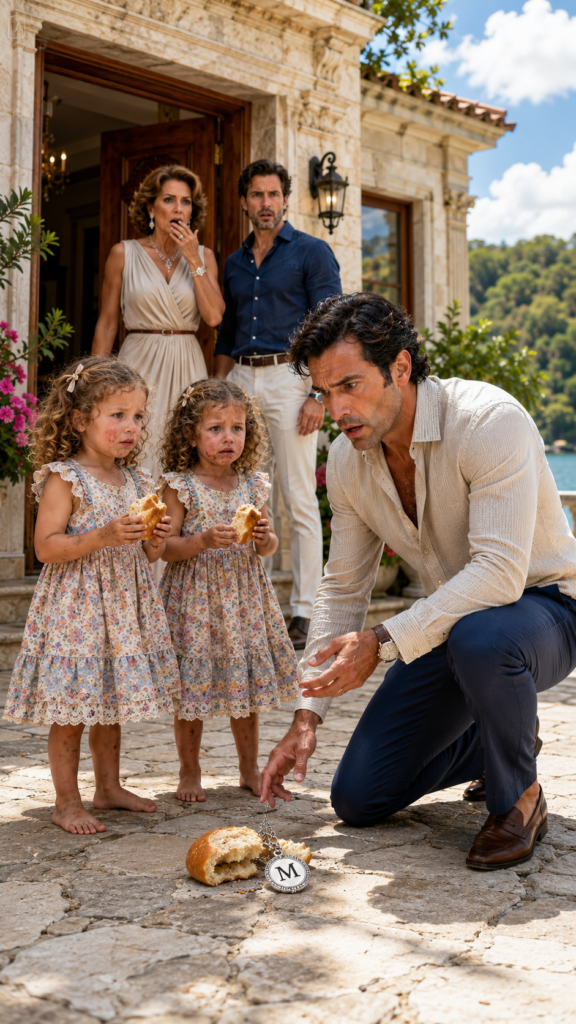
They were barefoot, dirty, wearing stained dresses, and clutching a dry bolillo between their hands. They looked about three years old. One held a small cloth bag. The other looked on without crying, her calmness cutting deeper than any scream.
—What are you doing here, little ones? —Adrián asked, kneeling down.
The bravest one lifted her face.
—I’m Abril.
Then she pointed to her sister.
—She’s Mar.
Adrián’s chest tightened. Camila always said that if she ever had daughters, she’d name them after things that couldn’t be contained: abril, mar, luz, cielo.
—Where’s your mom?
Mar hugged the bolillo tightly.
—She fell asleep and never woke up.
Adrián couldn’t reply.
He brought them into the house, washed their hands, and prepared warm milk, rice, and eggs. The girls ate slowly, savoring each bite as if being hungry embarrassed them.
He called the municipal police, the DIF, and a pediatrician. Everyone promised to look into the case. Everyone said that since it was the weekend, someone would come on Monday.
Monday.
As if two abandoned girls could wait inside a file.
That night he tucked them into the yellow room that Camila had painted before she got sick, the room that never had a baby.
Seeing them asleep there, in his old shirts that reached their feet, Adrián felt the past breathing down his neck.
The next day, his mother, Doña Teresa, arrived unannounced with his brother Rodrigo and his sister-in-law Natalia.
As soon as she saw the girls, she stiffened.
—Adrián, tell me you didn’t bring those creatures into the house.
—I found them outside. They were alone.
Rodrigo let out a nervous laugh.
—Come on, man. Someone’s trying to milk you.
Natalia wrinkled her nose.
—Or set you up for legal trouble.
Abril hid behind Adrián.
—They’re girls, not files.
Doña Teresa moved closer, icy.
—If those girls set foot on family property again, I’ll call the police myself. They’re not your responsibility.
Mar stepped back, frightened. The bolillo fell from her hands and broke against the floor.
From inside rolled out a silver medallion.
Adrián picked it up.
On the back was an engraved letter: C.
The same initial as Camila.
Doña Teresa lost color from her face. Rodrigo stopped smiling. Natalia lowered her eyes.
And Adrián understood that these girls hadn’t come by chance.
He couldn’t believe what he was about to discover.
PART 2
The medallion was small, scratched, with an almost erased virgencita. But Adrián recognized it instantly.
Camila had an identical one. She wore it since they were dating. She said a woman who helped her when she arrived alone in Mexico City had given it to her.
—Where did you get this? —Adrián asked.
Mar stretched out her hand.
—from Mom Rosa.
—Who is Rosa?
Doña Teresa answered too quickly.
—Just someone, surely. Adrián, don’t start with fantasies. Camila died almost two years ago.
—No one mentioned Camila —he replied.
The silence fell heavily.
That night, when Abril and Mar were fast asleep, Adrián entered Camila's study. He hadn’t touched that place since the funeral. He rummaged through drawers, medical files, receipts, and boxes full of photos.
He found a notebook hidden behind several albums.
On the first page, in Camila’s handwriting, it read:
“If Adrián finds this, it means the truth has already knocked on the door.”
He kept reading with frozen hands.
Camila had frozen her eggs before starting chemotherapy. She hadn’t told him because he was already shattered by the diagnosis. She feared giving him hope that could break him even more.
Then she searched for a private clinic in Toluca. A woman named Rosa Elena agreed to be a surrogate. At first, everything was in order: contracts, doctors, tests.
Then came phrases that made him tremble.
“Teresa reviewed my papers.”
“Rodrigo knows about the clinic.”
“They threatened me to erase everything.”
“If the girls are born and I’m not there, Adrián must know that they are his daughters.”
Adrián stopped breathing.
His daughters.
Abril and Mar were his daughters.
The blow was so strong he couldn’t cry. He only remembered every night he had cursed God for leaving him family-less, unaware that somewhere two girls had also been kept away from him.
At 2:17 AM, he heard noise at the back door.
He hurried downstairs with the notebook in hand and found Rodrigo coming in with some old keys.
—What are you doing here?
Rodrigo froze.
—I came to talk to you, dude. Mom is worried.
—At 2:17?
Rodrigo’s gaze fell on the notebook.
—Give it to me.
—What did you hide?
Rodrigo swallowed hard.
—Adrián, seriously, let the DIF take those girls tomorrow. You’re getting into something you don’t understand.
—Are they my daughters?
Rodrigo lowered his gaze.
That answered everything.
Adrián ran upstairs, locked the girls' room, and called Samuel Ortega, his lawyer. He also requested an urgent DNA test and sent copies of the notebook to three different emails.
By dawn, Doña Teresa arrived with a social worker and two municipal police officers.
She came made up, arranged, ready to act.
—My son isn’t well —she said—. Since he became a widower, he confuses pain with signs. Those girls need to go to an institution.
Abril began to cry. Mar didn’t cry; she just clutched her cloth bag tighter.
The social worker, Miriam Paredes, looked at everyone cautiously.
—We received an anonymous report that two minors were at risk inside this property.
Samuel arrived before Adrián could respond.
—Curious —the lawyer said—. The report is anonymous, yet the lady appears accompanying the authority.
Doña Teresa lifted her chin.
—I’m their mother. I have the right to protect him.
—No —Adrián said—. What you did was rob me.
Rodrigo appeared in the hallway, pale. Natalia followed behind, silently crying.
—Mom, no more —Rodrigo murmured.
—Shut up —Doña Teresa ordered.
But Rodrigo sat on the couch and confessed.
Camila had indeed left daughters. Rosa Elena carried the pregnancy to term. Camila died before seeing them born but left letters, contracts, and a clear instruction: if anything happened to her, Adrián needed to know everything.
Doña Teresa discovered the plan while reviewing Camila’s medical papers. She said her daughter-in-law was obsessed, wanting to tie Adrián down even after death. She also feared something else: if biological daughters appeared, they would change inheritances, trusts, and family properties.
—You were shattered —Doña Teresa said—. You couldn’t raise babies. I made the decision you couldn’t make.
Adrián looked at her with a quiet rage.
—You took three years away from me with my daughters.
—I saved you from ruining your life.
—They are my life.
Rodrigo continued speaking. The clinic shut down a year later due to allegations of altered records. Doña Teresa paid to erase records and deposited money to Rosa every month to keep her away.
But Rosa fell ill. Without family, resources, and fearing death would leave the girls alone, she decided to take them to the only address Camila had repeatedly told her: the lakeside house.
—Mom wanted to arrive before you —Rodrigo said—. She found out you were coming because Renato, your therapist, informed the family. He thought it was an emotional breakthrough. He knew nothing.
Adrián felt nauseous.
His mother had rushed to erase his daughters, not save them.
Then Mar opened her cloth bag. She pulled out a folded, dirty, almost torn napkin.
—Mom Rosa said it was for the sad man of the pretty house.
Adrián took it carefully.
The note read:
“Mr. Adrián, I’m sorry. I was paid to keep quiet, but I can’t anymore. Abril and Mar are your daughters and Mrs. Camila’s. She made me promise that if anything happened to me, I would bring them here. Your mom didn’t want you to know. Rodrigo knows. Don’t let them take them away. They have no one else.”
At the bottom was a name:
Rosa Elena Martínez.
Miriam requested the note. Samuel took photos. One of the policemen stopped looking at the ground.
Doña Teresa still tried to impose herself.
—A napkin proves nothing. A dead woman can’t testify. And those girls don’t even know what they’re saying.
Then Abril spoke.
—The bad lady said Dad didn’t want us.
Everything froze.
Adrián knelt in front of her.
—What lady, my love?
Abril pointed at Doña Teresa.
—Her.
Doña Teresa stepped back.
Miriam closed the folder.
—The minors will not be removed from this house today. They will remain temporarily under the care of Mr. Montes while a formal investigation begins, with supervision from the DIF and immediate medical evaluation.
Doña Teresa exploded. She threatened lawsuits, contacts, and judges. She shouted that no one would believe a poor surrogate, a dead sick woman, and two dirty girls.
But the more she spoke, the more she revealed the truth.
The DNA test arrived nine days later.
99.99%.
Abril and Mar were biological daughters of Adrián Montes and Camila Salazar.
Adrián received the result in the parking lot of the lab. The girls slept in the backseat, hugging a stuffed bear.
He read the document once. Then again. After a few steps, he doubled over beside a jacaranda.
He cried for Camila. He cried for Rosa. He cried for the three stolen years. He cried for every birthday he hadn’t celebrated, every fever he hadn’t cared for, every night those girls had perhaps asked about a dad someone told them didn’t exist.
The legal process was tough. Doña Teresa tried to defend herself, claiming she did everything for her son’s emotional stability. But the deposits to Rosa, the calls to the clinic, the deleted messages, and Rodrigo’s confession sunk her.
She didn’t go to prison immediately but was under investigation and prohibited from approaching the girls.
Adrián never called her mom again.
Rodrigo testified everything. Adrián didn’t forgive him. Not yet. Perhaps never completely. But he allowed him to collaborate because Camila’s truth deserved to come to light cleanly.
Natalia separated from Rodrigo months later. The Montes family, elegant in galas and magazine smiles, was shattered before everyone.
And for the first time, Adrián didn’t try to save appearances.
He sold the Lomas mansion. He didn’t want to raise his daughters within walls where money had mattered more than blood. He kept the house in Valle de Bravo, the same one where Camila had envisioned a life that others had tried to erase.
He tended to the garden. He painted the yellow room. On one wall, he painted blue waves for Mar. On the other, spring flowers for Abril. The girls chose mismatched blankets: one with dinosaurs and another with stars.
Adrián thought it was perfect.
Six months later, the legal recognition was finalized.
Abril and Mar Montes Salazar.
Daughters of Adrián and Camila.
In the family documents, he requested to also preserve Rosa Elena’s name, not as a legal mother, but as the woman who protected them until her last day. He had a simple plaque placed on her tomb:
“Thank you for bringing them home.”
One Sunday, Samuel found a final letter from Camila among the recovered files from the clinic.
Adrián took two days to open it.
It read:
“Love, if you are reading this, perhaps our daughters are already with you. I’m sorry for keeping quiet. I didn’t mean to leave you with hope that could break you if I didn’t survive. But I needed to try to leave you life because you gave me the most beautiful life I ever had. If Abril and Mar reach your arms, don’t think I arrived late. Think that I found a way to come back home.”
Adrián read the letter on the porch where he first found them.
The girls were running on the grass. Mar wore the clean medallion on a new chain. Abril fell, got dirt on her knee, and let out a laugh instead of crying.
That night, before sleeping, Mar asked:
—Does Mom Camila see us?
Adrián swallowed hard.
—Yes, my love. I believe she does.
Abril hugged her pillow.
—And Mom Rosa?
—Her too.
—Then we have two moms in heaven.
Adrián kissed their foreheads.
—Yes. And both took care of you so you could come to me.
When he closed the girls' room door, he understood that love doesn’t always leave when someone dies. Sometimes it hides in a notebook, in a napkin, in a medallion inside a hard bolillo. Sometimes it crosses corrupt clinics, ambitious families, bought silences, and lost years.
Sometimes it arrives barefoot, hungry, afraid, but it arrives.
Money could erase papers. It could buy silences. It could shut mouths for three years.
But it couldn’t stop two girls with a dry bolillo, four dirty hands, and a word that returned Adrián’s will to live:
—Dad.





