PART 1
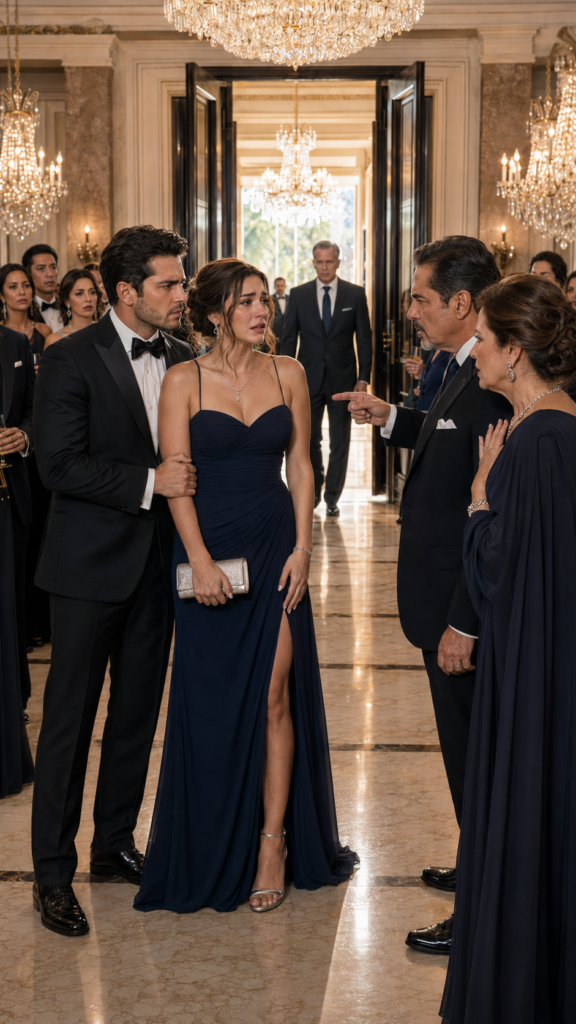
"Get out of my house. A woman like you will never tarnish the Del Valle name."
The words echoed in the garden of a mansion in San Pedro Garza García, in front of businessmen, politicians, architects, society influencers, and half of the Del Valle Infrastructure board.
Nobody moved.
Not even Mariana Ríos.
She stood next to her husband, Sebastián Del Valle, in a simple yet elegant dark green dress, her hair cascading in soft waves, a silver bracelet that seemed too humble for a night adorned with expensive watches and impossible necklaces.
She didn’t look poor.
But she also didn’t look like a woman willing to pretend to be anything other than herself.
Don Ernesto Del Valle stared at her as if he had just discovered a stain in the middle of his perfect party.
That night, they celebrated the 40th anniversary of his construction company, a firm that had built luxury subdivisions in Monterrey, towers in Guadalajara, hotels in Los Cabos, and several public projects that no one spoke about too much.
There was mariachi music, imported whiskey, cameras, giant screens, and a main table decorated with white flowers brought from Puebla.
But everyone knew the real reason for the gala was something else.
Consorcio Herrera was about to choose the company that would build the new Pacific tourist train, a project worth billions of pesos. If Del Valle Infrastructure won, Ernesto would cement his status as the most powerful builder in the north of the country.
The name Don Arturo Herrera circulated among the guests like a legend.
They said he was a rare businessman, one of those who don’t appear in magazines, don’t accept flattery, and research how cleaning staff are treated before signing a contract.
Mariana heard his name several times during the night.
She said nothing.
Before the scandal, she had helped a waitress pick up broken glasses, greeted the gardener by name, and asked about the operation of Don Chema’s wife, the family chauffeur.
"Did she come out of the hospital okay?"
Don Chema was moved.
"Yes, Mrs. Mariana. Thank you for remembering. You really have a heart, I mean it."
From the terrace, Ernesto watched her with contempt.
"Look at her," his wife, Cecilia, murmured. "Always so close to the help."
Cecilia wore an antique butterfly brooch, made of gold and emeralds, which she claimed had belonged to her grandmother. She mentioned it at every family meal as if it were a medal of noble blood.
Since Sebastián married Mariana, Cecilia repeated that this piece of jewelry must never fall into "the wrong hands."
Sebastián had met Mariana after a hurricane in Veracruz, when they both helped rebuild homes for families who had lost everything.
She arrived with mud-covered boots, carrying sheets of metal, talking to children, cooks, and bricklayers as if they were all equally important.
When Sebastián asked about her family, Mariana simply said:
"They’re quiet people. They don’t like noise."
She never boasted about her last name.
Never asked for favors.
Never accepted money from the Del Valles.
And that, for Ernesto, was suspicious.
In his world, those who didn’t flaunt their origins were hiding poverty, debt, or shame.
That night, after two glasses of tequila, he decided to expose her.
First, he asked why her parents never attended family events.
Then, with a cruel smile, he said that some women were experts at charming heirs.
Finally, when everyone was already turning to look, he unleashed the words that split the garden in two.
"Get out of my house. A woman like you will never tarnish the Del Valle name."
Mariana felt a fire ignite in her chest.
But she didn’t lower her gaze.
"Don Ernesto, I never wanted your name. I only wanted your son."
Sebastián stepped forward.
"Dad, that’s enough."
Ernesto let out a dry laugh.
"If you’re with her, forget about your position, your shares, and any inheritance."
Sebastián looked at Mariana.
She was pale but standing tall.
Then he took her hand.
"I’m leaving with my wife."
Some guests started recording. Others pretended not to watch, though they were dying to see more.
Mariana and Sebastián headed for the exit when Cecilia shouted:
"My brooch!"
Everyone turned.
Cecilia was clutching her chest, desperate.
"My grandmother’s butterfly is gone."
She checked her shawl, her purse, the table. Then she slowly lifted her gaze to Mariana.
"You were near me a moment ago."
Mariana understood the accusation before hearing it.
"Don’t you dare."
Cecilia pointed to her purse.
"Have it searched."
Sebastián stepped in front.
"No one touches my wife."
Ernesto called the head of security.
"Ramírez, check her purse right here."
Mariana took a deep breath, opened her bag, and placed it on the table.
"Go ahead. Since you want to humiliate me, do it in front of everyone."
Ramírez pulled out a wallet, some keys, a phone, a handkerchief, a notebook, and a medal of the Virgin of Guadalupe.
Nothing more.
The brooch did not appear.
Sebastián looked at his parents with rage.
"Now apologize."
But Ernesto didn’t back down.
"Not finding it there means nothing. Crafty people know how to hide things."
Cecilia pressed her lips together and launched the phrase that left Mariana frozen.
"Then check her car. Girls like her always carry secrets in the trunk."
At that moment, Mariana's phone vibrated.
The message read:
"I’ve arrived, daughter. I’m coming in."
PART 2
The main doors of the mansion opened before Mariana could respond.
A 62-year-old man crossed the foyer with a calmness that unsettled everyone.
He had no bodyguards.
He didn’t raise his voice.
He didn’t need to.
He wore a pristine navy blue suit, with no flashy jewelry, no ostentatious watch. He walked like men who don’t have to prove anything because everyone else already knows who they are.
Ramírez, the head of security, was the first to stiffen.
"Don Arturo Herrera…"
The murmuring died abruptly.
Ernesto Del Valle felt his blood rush to his feet.
For ten months, he had tried to secure a private meeting with Arturo Herrera. He sent folders, invitations, corporate gifts, even a ridiculously expensive bottle of aged tequila that came back unopened.
And now Arturo Herrera was in his house.
Right after his family had publicly accused his daughter-in-law of theft.
Ernesto straightened his jacket and walked toward him with a stiff smile.
"Don Arturo, what an honor. I’m sorry you arrived at such an uncomfortable family moment."
Arturo didn’t shake his hand.
He looked at Mariana’s open bag, her personal belongings scattered on the table, the phones recording, and Sebastián’s face filled with fury.
Then he looked at Mariana.
His expression softened.
"It doesn’t seem uncomfortable, Ernesto. It seems like an injustice."
Cecilia paled.
Ernesto swallowed hard.
"It was a misunderstanding. A family jewel disappeared, and my wife got upset."
"And that’s why you decided to accuse a woman without evidence?"
Nobody responded.
Mariana breathed as if she could finally release the air she had been holding all night.
"You’re late," she said softly.
Arturo looked at her with tenderness.
"I arrived just in time to see what I needed to see."
The phrase fell like a stone.
Sebastián turned to Mariana, confused.
He knew his wife came from a reserved family. He knew she avoided talking about money, surnames, and power.
But he never imagined she personally knew the man whose contract could save or sink the Del Valles.
Ernesto noticed it too.
"Do you two know each other?"
Arturo walked to the table.
He picked up the medal of the Virgin resting next to Mariana’s wallet, caressed it with his fingers, and returned it to its place.
"Before I answer, I want to ask something. If the brooch didn’t appear in her bag, why hasn’t anyone apologized?"
Cecilia opened her mouth, but couldn’t say anything.
At that moment, an employee rushed out from the house.
It was Rosita, a woman who had worked for the Del Valles for 16 years. She came trembling with a velvet box in her hands.
"Mrs. Cecilia… forgive me, but I found this on your vanity."
The entire garden stood still.
Rosita opened the box.
The gold and emerald butterfly shimmered under the lights.
"You took it off when you went up to change your earrings," Rosita explained. "You asked me to keep it, but then I was called to the kitchen, and I forgot to tell you."
The silence was brutal.
Some stopped recording.
Others continued, now with more eagerness.
Cecilia covered her mouth with one hand.
Ernesto looked at the jewel as if it had spat in his face.
Sebastián let out a bitter laugh.
"You accused Mariana over a jewel that you left upstairs."
Mariana didn’t cry.
And that’s why it hurt more.
"You weren’t looking for a brooch," she said firmly. "You were looking for an excuse to treat me the way you always wanted to treat me."
Cecilia lowered her gaze.
But Ernesto, cornered, chose pride again.
"I accept that there was a misunderstanding. But that doesn’t change the main issue. This woman hid her origins for two years. In families like ours, that matters."
Arturo looked at him intently.
"You’re right. Origins matter. But not in the way you think."
A murmur rippled through the tables.
Arturo took out a black envelope with the Consorcio Herrera seal and placed it on the table, right next to Mariana’s open bag.
"I didn’t come tonight to toast your anniversary. I came to observe."
Ernesto blinked.
"Observe?"
"Before awarding a multi-billion project, I need to see how a company behaves when it thinks no one important is watching."
Ernesto’s jaw tightened.
"Del Valle Infrastructure has 40 years of prestige."
"Prestige means nothing if it’s used to trample an innocent person."
Arturo turned to Sebastián.
"And you, young man, chose your wife before knowing who was crossing that door. That says a lot too."
Sebastián looked at Mariana.
"What’s going on?"
Mariana squeezed his hand.
For the first time that night, she seemed scared.
"Forgive me. I wanted your family to love me without my last name."
Ernesto frowned.
Arturo stood next to her, calm, firm, impossible to ignore.
"Ladies and gentlemen, the woman you called poor, the woman you searched like a criminal, the woman you wanted to throw out of this house in front of everyone…"
He paused.
No one breathed.
"Is my daughter."
The revelation crashed over the party like thunder.
Cecilia froze.
Ernesto opened his mouth but found no words that could save him.
Sebastián slowly released Mariana’s hand, not out of rejection, but from shock.
"Your dad is Arturo Herrera?"
She looked down.
"Yes."
"Why didn’t you tell me?"
He didn’t sound angry.
He sounded hurt.
Mariana swallowed.
"Because since I was a child, I saw how people changed when they heard my last name. They stopped talking to me and started talking to my dad's money. With you, it was different. You met me covered in mud, carrying sheets, sweaty, tired. You talked to me as a person, not as an heiress."
Sebastián listened in silence.
She continued:
"I thought that if your family accepted me without knowing who I was, then their affection would be real. I was wrong about them. But not about you."
Sebastián closed his eyes for a second.
Then he took her hand again.
"You didn’t make a mistake with me."
That gesture finally broke Ernesto.
Arturo opened the black envelope and pulled out several documents.
"Here’s the final evaluation of the Pacific tourist train. Del Valle Infrastructure was one of the three finalists."
Ernesto reacted immediately.
"Don Arturo, please. What you saw tonight doesn’t represent my company. We can discuss this privately, calmly."
Arturo shook his head slowly.
"On the contrary. What I saw represents too much. It represents a culture where a person’s value depends on the car they drive, the clothes they wear, or the last name they can flaunt."
One of Ernesto’s partners lowered his gaze.
He had seen everything and said nothing.
Cecilia tried to approach Mariana.
"Daughter, I didn’t know…"
Mariana raised her hand.
"Don’t call me daughter. For two years, you treated me like an intruder."
Cecilia was rooted to the spot.
"I was nervous about the brooch."
"No," Mariana responded. "You were waiting for something to appear to confirm what you already thought of me."
The words were calm.
But they stung like a slap.
Ernesto looked at Sebastián.
"You know what’s at stake. Don’t let a scene destroy what our family has built."
Sebastián looked at him as if he finally understood the man he had tried to please his entire life.
"Mariana didn’t destroy it. You did when you chose to humiliate her instead of getting to know her."
"I’m your father."
"And she is my wife."
The garden murmured.
This time it wasn’t morbid curiosity.
It was recognition.
Arturo put the documents away.
"Consorcio Herrera withdraws Del Valle Infrastructure from the selection process."
Ernesto paled.
"You can’t do that over a personal matter."
"I can do it for ethical reasons. And tonight, you turned ethics into public evidence."
The guests began to discreetly leave.
The videos were already on social media.
In less than an hour, Facebook was ablaze with the title:
"Tycoon Humiliates His Daughter-in-Law for Being Poor and Discovers She’s the Daughter of the Businessman He Needed."
But the hardest blow didn’t come that night.
It came the next day.
At 7:00 AM, Consorcio Herrera published a statement:
"Human dignity and respect for workers are essential conditions for any alliance."
It didn’t mention the Del Valles.
There was no need.
By 9:30, two investors requested to review contracts.
At 11:00, a client canceled a meeting.
At 1:00, the board convened an extraordinary session.
Ernesto arrived believing he could still control the damage.
He found everyone serious.
The chairwoman of the board, Clara Ibarra, spoke bluntly.
"Ernesto, a company that boasts about building the future cannot tolerate its director destroying people in his own home."
"It was a family dispute."
"It was a public humiliation, classist and reputational."
After two hours, the board voted to suspend him temporarily from the general management. They also demanded a public apology to Mariana and Sebastián, as well as an internal investigation for abuse of power.
Ernesto left without bodyguards.
Without applause.
Without paid cameras.
For the first time in 40 years, he walked alone.
Meanwhile, Mariana and Sebastián moved to a small apartment in the Roma neighborhood of Mexico City.
It had no garden.
No fountain.
No long tables or last name carved at the entrance.
But that night they dined on tacos de suadero on mismatched plates, sitting at the kitchen bar, and they could breathe.
"I should have told you earlier," Mariana said.
Sebastián took her hand.
"Maybe. But my family should have treated you well without needing to know."
She smiled sadly.
"That was all I wanted to prove."
Six months passed.
The video stopped trending, but its consequences remained alive.
Del Valle Infrastructure survived, though no longer under Ernesto’s command. The company had to open investigations, change management, and listen to employees who had been silent about mistreatment for years.
Cecilia sent flowers four times.
Mariana responded to only one message:
"I wish you peace, but I cannot open a door you closed so cruelly."
Sebastián formally renounced any conditional inheritance.
Arturo Herrera offered him a job, but Sebastián set a condition.
"I don’t want to come in as a son-in-law. I want to start from the bottom."
Arturo barely smiled.
"Then maybe you do deserve to be close to my daughter."
Sebastián began by reviewing minor files, visiting construction sites, talking with bricklayers, engineers, and families affected by poorly planned projects.
He learned that a company isn’t measured by its tallest buildings, but by the lives it touches while raising them.
One Sunday, Mariana invited her father to eat green enchiladas.
There were no waiters.
No photographers.
No politicians trying to look good.
Just a small kitchen, warm tortillas, and a rare peace.
When they finished, Arturo asked:
"Do you regret hiding who you were?"
Mariana looked at Sebastián, who was awkwardly washing dishes with charming clumsiness.
"No. It hurt, but it showed me the truth."
"What truth?"
She took a deep breath.
"That there are people who only respect a fortune when it’s right in front of them. And there are others who take your hand when they believe you’re about to lose everything."
Weeks later, Ernesto sent a handwritten letter.
He didn’t ask to recover the contract.
He didn’t ask to return to the company.
For the first time, he didn’t speak of prestige.
"Mariana, I was wrong. Not for ignoring who your father was, but for believing you needed to be the daughter of someone powerful to deserve respect."
Mariana read the letter in silence.
She didn’t cry.
She didn’t tear it up.
She kept it in a drawer.
Sebastián asked her:
"Are you going to respond?"
She looked out the window, where a corn vendor pushed her cart under the orange afternoon.
"Maybe someday. Forgiving doesn’t always mean opening the door right away."
That night they walked through a park full of families, children with balloons, and couples buying esquites.
Mariana no longer needed to hide her last name.
But she also didn’t need to use it as a shield.
Because she understood something that many still debate when watching that video:
Family isn’t proven by blood, money, or tradition.
It’s proven when someone stands by your side while everyone else tries to see you fall.
And in a mansion where they wanted to humiliate her for appearing simple, Mariana left an indelible lesson:
Respect that only appears when power is discovered isn’t respect.
It’s fear disguised as good manners.





