PART 1
It took Doña Mercedes Arriaga 72 years to accept a truth that hurt more than her weary knees: not all children come home out of love.
Some return to measure doorways, calculate plots, and ask, with false smiles, how long it will be before a mother becomes an inheritance.
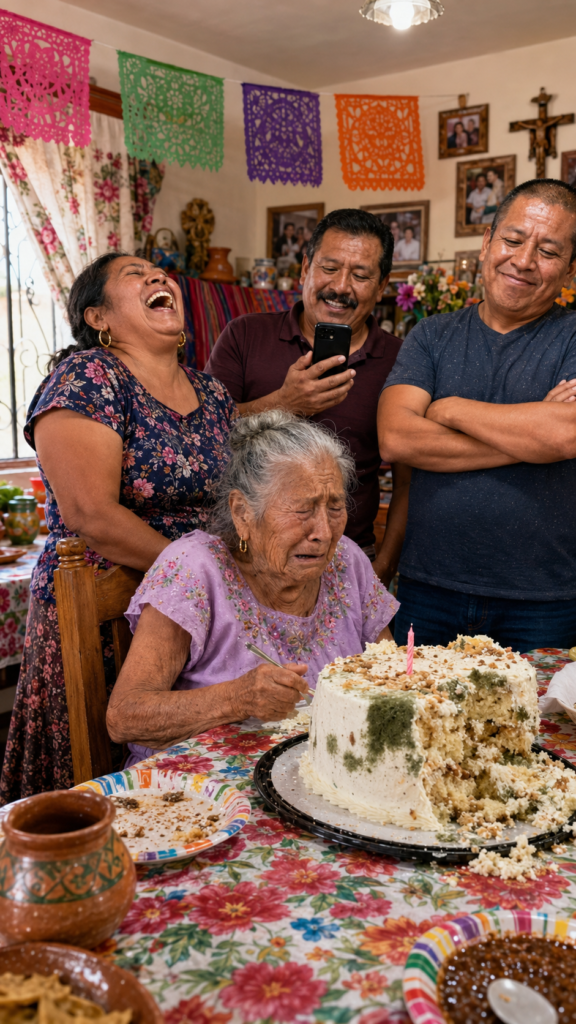
She lived in an old mansion made of yellow stone in the Analco neighborhood of Guadalajara. It had a yard with geraniums, a dry fountain, and a long table where, for years, she served birria, pot beans, cinnamon coffee, and sweet bread for the whole family.
This Sunday, she was turning 72.
From early on, she put on her lilac dress, the one she had worn at her golden wedding anniversary with Don Ignacio, her late husband. She carefully styled her hair, cleaned his portrait, and set 12 plates on the table.
Her three children had promised to visit her.
Arturo, the oldest, called her mid-morning.
“Today we’re going to pamper you, Mom. No cooking for you.”
Patricia, the middle child, sent a syrupy audio message.
“Mom, you deserve everything. You’ll see what a beautiful surprise we have for you.”
And Kevin, the youngest, who felt like an influencer because he made heavy jokes on Facebook, wrote in the family group:
“Get ready, Grandma, today you’re going to break the internet.”
Doña Mercedes smiled, not realizing that phrase was loaded not with affection but with mockery.
Since Don Ignacio passed away, her children hardly hugged her anymore. They came to check for cracks, deeds, property tax receipts, and old drawers.
Arturo always repeated the same thing:
“This house is too much for you alone, Mom.”
Patricia feigned concern.
“One day you’re going to fall, and nobody will know.”
Kevin, more cynical, said:
“This yard is perfect for filming vintage content, very Mexican. When it’s mine, I’ll make it awesome.”
She remained silent.
Like many mothers, she believed that enduring was another form of love.
At 7:30 PM, they all arrived. Her children, their partners, and five grandchildren.
But no one brought flowers.
No one brought mariachi.
No one brought cake.
Only black bags, warm sodas, disposable cups, and a tray of flattened tacos that already smelled of old grease.
Doña Mercedes felt a hole in her chest but smiled.
“I’m so glad you came, children.”
Arturo gave her a quick, almost obligatory kiss.
Patricia complained about the smell of copal next to her father’s portrait.
Kevin walked in filming.
He pointed his phone at his mother’s face, her trembling hands, the wrinkles on her neck, and the lilac dress.
“Say hi, Grandma. Say something emotional for the crowd.”
She fidgeted nervously.
“Thank you for coming. May God take good care of you all.”
Kevin laughed.
“How sweet, for real. This is going to blow up.”
After eating, Arturo turned off the patio light.
“Now for the real gift.”
Patricia came in carrying a huge box wrapped in silver paper with a red bow.
Doña Mercedes put her hands to her chest.
For one second, she thought maybe she had been mistaken.
Maybe they really did love her.
Maybe her children were still those kids who ran to her arms when the sky thundered.
She opened the box carefully.
The smell hit her first.
Inside were orange peels, stained napkins, chicken bones, crushed cans, hard tortillas, dirty diapers, and rotten food scraps.
On top was a card written in black marker.
“For the old lady who only gets in the way.”
The patio fell silent.
A small granddaughter began to cry.
But Arturo burst out laughing.
Patricia covered her mouth to hide her laughter.
Kevin brought the phone in closer.
“Don’t get upset, Grandma. It’s dark humor. People love this stuff. We’re going to make you famous.”
Doña Mercedes looked at the trash.
Then she looked at her three children.
They were the same ones for whom she sold tamales in the rain. The same ones for whom she pawned her baptism necklace. The same ones who ate hot meals while she pretended not to be hungry.
She didn’t cry.
And that bothered them.
Arturo mocked her.
“Come on, Mom, you always say not to waste.”
Patricia added:
“At your age, you don’t even need expensive gifts.”
Kevin kept filming.
“Say something stronger, dude, so we can stir up a debate.”
Then Doña Mercedes lifted her face.
Her eyes no longer held tenderness.
They had a calmness that scared even the grandchildren.
“Thank you,” she said slowly.
“Today, you didn’t gift me trash. You gifted me the truth.”
No one understood.
The party ended in less than 20 minutes.
They left behind scattered plates, crushed cups, and the rotten box on the table where Don Ignacio had celebrated his last birthday.
When the gate closed, Doña Mercedes walked to her husband’s portrait.
She wiped the glass with the sleeve of her lilac dress.
“Forgive me, Nacho. I thought we raised a family. But we raised vultures.”
Then she took the phone and called Licenciado Robles, the notary who had known her husband for over 30 years.
“Licenciado, tomorrow first thing, I’m changing my will.”
There was silence on the other end.
She took a deep breath.
“And this time my children will not receive a single brick from this house.”
As the trash continued to rot in the yard, Doña Mercedes understood that her children had just opened a door they could never close again.
PART 2
The next morning, Doña Mercedes arrived at Licenciado Ernesto Robles’ office with a blue folder pressed against her chest.
She didn’t look defeated.
She looked awake.
The notary received her standing, as he always did with her. He knew her story from when she was young, when Mercedes and Don Ignacio sold menudo on Sundays at a corner near the San Juan de Dios market.
He also knew that this mansion was not an inherited luxury.
It was the sum of 40 years of sleepless nights, of saving pennies, of debts paid peso by peso, and a couple who had worked until their hands were filled with cracks.
“Doña Meche,” he said, concerned, “did something happen?”
She placed the folder on his desk.
“What had to happen, happened.”
Inside were the deeds, account statements, the lease for a shop in Tonalá, family jewels, and the previous will.
Everything was divided into three parts.
Arturo, Patricia, and Kevin would receive the house, the shop, the savings, and even Don Ignacio’s ring.
That’s what she had decided years ago, when she still confused absence with fatigue and rudeness with character.
The notary reviewed the papers.
“Are you completely sure?”
Doña Mercedes took out her cell phone.
She explained nothing.
She only played the video.
The box of trash appeared on the screen.
Laughter echoed.
The card was crystal clear.
“For the old lady who only gets in the way.”
The notary remained silent for several seconds.
When the video finished, he lowered his gaze.
“That wasn’t a joke.”
“No,” she replied. “It was a farewell. Only they didn’t know that the one who was saying goodbye was me.”
The notary took a deep breath.
“What do you want to do?”
She straightened her back.
“I’m going to leave each of my children 1 peso.”
Robles looked up.
“1 peso?”
“Yes. So it’s clear that I didn’t forget them. I want the law to know that I thought of them when I decided not to reward them.”
The rest would have another destination.
The mansion would become a daytime refuge for abandoned elderly people.
The shop in Tonalá would be a community kitchen.
The savings would pay for medicines, consultations, and food for elderly people without families.
The jewels would be sold to fund scholarships for girls from poor neighborhoods who wanted to study.
She would only keep her wedding band.
“That’s not for sale,” she said. “It reminds me that I once had a home.”
The notary began drafting.
Each clause seemed to close a window.
Each signature felt like taking away a key that her children never deserved.
Before finishing, Robles opened a drawer.
“There’s something Don Ignacio left me before he died.”
Doña Mercedes froze.
The notary pulled out a yellowed envelope.
“He asked me to give it to you only if you ever came to change the will because of your children.”
She felt the air catch in her throat.
The envelope had her husband’s handwriting.
She opened it with trembling hands.
The letter said:
“Meche of my soul, if you’re reading this, it’s because our children taught you what I had already seen and didn’t have the heart to tell you. When I fell ill, Arturo wanted me to sign a power of attorney for the house. Patricia said you were losing your mind. Kevin recorded me without permission to use my voice when I was no longer here. I didn’t sign anything. This house is yours. Don’t let them take it from you. And remember: blood weighs, but dignity does too. Your Nacho.”
Doña Mercedes covered her mouth.
Now she cried.
But not for Arturo, Patricia, or Kevin.
She cried for Ignacio.
For all the times he kept silent to avoid breaking her heart.
For all the signs she chose not to see.
The cruelty of her children hadn’t started with a box of trash.
It had been brewing for years.
And she was just beginning to accept it.
She left the notary’s office with the new will signed and a copy of the letter tucked away in her bag.
In the days that followed, her children appeared as if nothing had happened.
Arturo arrived with a folder.
“Mom, we need to review your papers. I don’t want you to get cheated.”
She didn’t open the gate.
“I already reviewed them.”
Patricia came with jello and a sweet voice.
“I came to keep you company, momma. It hurts to see you alone.”
Mercedes replied from the window:
“Loneliness doesn’t hurt me. Hypocrisy does.”
Kevin sent messages.
“Grandma, let’s film a reconciliation video. Something nice. People love it when families forgive each other.”
She didn’t respond.
But the problem exploded all on its own.
Kevin uploaded the trash video thinking everyone would laugh.
That fool thought Mexico would applaud the humiliation of a grandmother.
He was wrong.
The video was shared thousands of times.
People saw a 72-year-old woman receiving trash from her own children.
They saw the card.
They saw the laughter.
They saw the terrified grandchildren.
And the comments ignited.
“That’s not humor, it’s evil.”
“Such a low blow.”
“That lady deserves respect.”
“I hope she leaves them without an inheritance.”
Arturo was called at work.
Patricia received complaints at the salon where she attended clients.
Kevin had collaborations canceled, pages shut down, and even lost a contract with a local brand.
Suddenly, they were no longer the funny ones.
They were the cruel children who humiliated their mother for likes.
Then they ran to find Doña Mercedes.
Not out of love.
Out of fear.
They arrived one Friday afternoon unannounced.
Arturo pushed the gate as if he still had a right.
“Did you see what you caused? They’re tearing our lives apart.”
Mercedes was sitting in the yard, sipping cinnamon coffee from a clay mug.
“I didn’t upload the video.”
Kevin, pale and with dark circles under his eyes, raised his hands.
“I already deleted it, Grandma. But people keep uploading it. Seriously, they’re intense.”
She stared at him.
“They aren’t intense. They’re witnesses.”
Patricia began to cry.
“Mom, it was a dumb joke. It got out of hand.”
“A joke makes everyone laugh,” Mercedes replied. “What you did only made you laugh.”
Arturo slammed the table.
“Enough of playing the victim. We are your children. Your blood.”
Doña Mercedes slowly stood up.
The elderly woman who used to greet them with hot food was no longer there.
Before them stood a tired but whole mother.
“My children were the kids I cared for through fever. The young adults for whom I sold food until my back gave out. The adults I helped with debts, divorces, rents, and down payments.”
She pointed at each of them.
“You three are strangers who gifted me trash to gain likes.”
Arturo gritted his teeth.
“Careful, Mom. That house is also ours.”
Mercedes let out a dry laugh.
“This house was paid for by Ignacio and me. You three only learned to see it as loot.”
Patricia tried to stab her with one last knife.
“Dad would never have done this to us. He loved us.”
Mercedes went into the living room.
She returned with Ignacio’s letter.
She placed it on the table.
“Your father knew you better than I did.”
Arturo read two lines and turned pale.
Patricia snatched the page from him.
Kevin recoiled as if the world had been turned off.
The secret they thought buried had just returned with their father’s own handwriting.
“Before he died,” Mercedes said, “you tried to take the house from a sick man. Then you came to humiliate his widow.”
No one replied.
Because it was true.
Then she pulled out the copy of the new will.
“The house, the shop, the accounts, and the jewels will no longer be for you.”
Arturo’s eyes widened.
“You can’t do that.”
“I just did.”
Patricia screamed:
“Mom, please!”
“Each one gets 1 peso.”
Kevin slumped into a chair.
“No way…”
Arturo lost control.
“Crazy old lady. You’re going to regret this.”
Mercedes didn’t back down.
“I regret giving you so much without teaching you respect. Not this.”
Patricia knelt.
“I’m sorry, Mom. We’re your children.”
Mercedes felt something breaking inside her.
Of course she loved them.
That was the pain.
But love would no longer serve as a doormat for them.
“I forgive you,” she said.
The three looked up.
She finished:
“But I won’t reward you.”
Arturo stormed out cursing.
Patricia left crying.
Kevin remained at the door, destroyed.
“Is there really no way?”
Mercedes looked at him sadly.
“There is a way. Work. Apologize without a camera. Hug your children without thinking of money. And learn to be a family before wanting to inherit one.”
Months later, the mansion opened as Casa Ignacio y Mercedes.
The yard where they once left trash filled with clean tables, soft music, hot broth, sweet bread, and elderly people nobody visited.
More than 60 people ate there on the first day.
Some cried upon receiving a plate served with care.
Others kissed Doña Mercedes’ hand as if she were their own mother.
On the wall, they placed a bronze plaque:
“True family is not the one that waits for your death to divide your things, but the one that cares for your life while you still breathe.”
Doña Mercedes looked at Ignacio’s portrait and smiled.
For the first time in years, the house didn’t feel empty.
And though many will say a mother should forgive everything, she learned a truth that burns but frees:
Forgiving doesn’t mean reopening the door to someone who only enters to trample you.





