PART 1
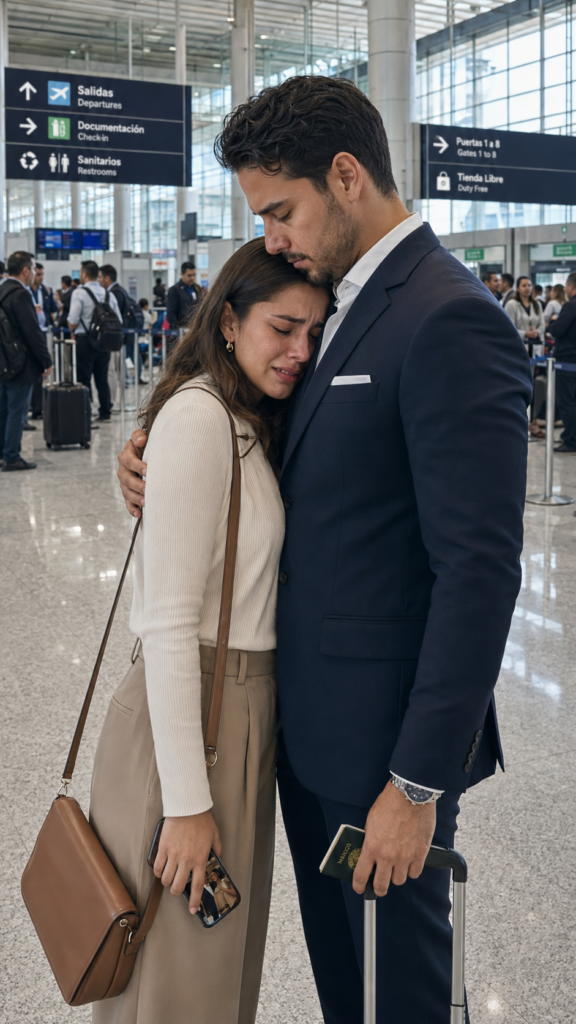
Camila Duarte cried, clinging to her husband in front of the international departures hall of Mexico City International Airport.
To anyone watching, it seemed like a soul-crushing farewell.
Sebastián stroked her hair, kissed her forehead, and repeated that two years in Zurich would fly by, that this contract was the opportunity they had always waited for.
—Hang in there, my love —he said softly—. I’m doing this for us.
Camila squeezed her fingers against her navy blue blazer.
—Promise me you’ll call me every day.
—Every day, no exceptions.
He smiled with that perfect tenderness that had made her feel safe for six years.
But that morning, every word from Sebastián sounded rehearsed.
Every caress felt like a taunt.
Because three days earlier, while he showered in their Santa Fe apartment, Camila had seen an open notification on his laptop.
It wasn’t an email from a Swiss company.
It wasn’t an international contract.
It was a lease agreement for a penthouse in Palm Springs, California, signed by Sebastián Rivas and Elisa Montalvo.
Elisa, the “project partner.”
The woman he always introduced as just an office colleague.
The same woman who appeared in several photos, pregnant, smiling next to a designer white crib.
Camila felt the floor drop beneath her.
But she kept reading.
There were tickets, reservations, advance payments, messages about a discreet move, and a plan to gradually withdraw $12,500,000 MXN from their joint account.
Most of that money came from her grandmother Socorro's inheritance.
Sebastián had insisted for years on pooling everything together “out of trust.”
And she, believing that love also meant sharing a future, had agreed.
Now she understood he didn’t want to build anything with her.
He wanted to drain her.
At the airport, Sebastián pulled away slightly and wiped a tear from her cheek with his thumb.
—Don’t break down, okay? You’re strong.
Camila almost laughed.
She didn’t know how much.
When he crossed through security, he turned one last time and raised his hand.
She did the same.
As soon as he vanished into the crowd, she stopped crying.
She pulled out a tissue, dried her face, and walked toward the parking lot with a calm that frightened her.
On the way back to Santa Fe, she didn’t play any music.
She only thought about her grandmother, the years of labor, the Sundays when Sebastián called her “my queen” while secretly planning another life.
She entered the apartment without taking off her heels.
She went straight to the study, opened her online banking, and looked at the balance.
$12,500,000 MXN.
Her finger hovered over the transfer button.
Then her cell vibrated.
An unknown number sent her a photo.
Sebastián was sitting in front of a notary in Polanco.
On the document he held was a signature identical to Camila’s.
And above it, in cold letters, it read:
SPECIAL POWER TO MORTGAGE AND DISPOSE OF ASSETS.
The next message froze her.
“Don’t transfer yet. Your husband forged your signature. He wants to mortgage the house your grandmother left you.”
PART 2
Camila stared at the screen, breathless.
It wasn’t just infidelity.
It wasn’t just abandonment disguised as work sacrifice.
Sebastián had crafted a plan to take her money, mortgage her grandmother’s house, and disappear while she waited like a fool, imagining him amidst snow, Swiss watches, and important meetings.
She closed the banking window.
Not because she regretted it.
But because she realized that a furious woman could lose a battle if she acted out of rage, but a cold woman could win an entire war.
She called Mariana Solís, her college friend and family lawyer.
Mariana arrived 40 minutes later, without makeup, carrying a folder, her laptop, and that look of someone who didn’t need to shout to instill fear.
Camila showed her everything: the Palm Springs contract, Elisa’s photos, the emails, the prepared bank transactions, and the notary’s photo.
Mariana didn’t say “I’m sorry.”
She just took a deep breath and opened her laptop.
—This is no longer divorce, Cami. This smells like fraud, forgery, and breach of trust. You’re not moving a peso without leaving a record.
That night they began.
They alerted the bank, requested a watch for suspicious transactions, blocked international transfers, and demanded that any credit linked to Camila be halted until further review.
They also sent proof that the money came from inheritance and investments made before the marriage.
Then Mariana called the notary.
The woman who had sent the message was named Abril Castañeda, legal assistant.
She arrived at the apartment around 10 PM, with a black folder pressed to her chest and red eyes.
—I didn’t know whether to get involved —she confessed—. But when I saw your signature, something didn’t add up. Then I heard Mr. Sebastián say that you were “emotionally manageable.”
Camila felt a dry stab in her chest.
Abril pulled out copies of printed emails.
In one, Sebastián wrote to a financial advisor:
“Camila thinks I’ll be in Zurich. Once she gets used to the distance, we’ll release the credit and move the capital to the United States.”
In another, he said:
“Elisa doesn’t know all the details. Better that way. She’s pregnant, and I don’t want her stressed out.”
Camila looked up.
—Elisa doesn’t know?
Abril shook her head.
—I think he lied to her too.
Mariana carefully gathered the documents.
—Perfect. So we have two victims and one cynic who thought he could manage everyone.
At 3:18 AM, Sebastián called.
Camila answered.
—Honey, I’m back —he said, his voice tired.
—Back in Zurich?
There was a brief silence.
—Yeah, of course. It’s freezing. The flight was rough.
Behind his voice, an automatic door opened, and a woman spoke in English:
“Welcome to Palm Springs.”
Camila closed her eyes.
The lie wasn’t even well crafted anymore.
—Rest —she replied.
—Tomorrow I have a lot of meetings. I might not be able to call you.
—Don’t worry. I have things to do too.
—Are you okay?
Camila glanced at the photo of her forged signature.
—Better than you can imagine.
And she hung up.
For the next four days, Sebastián went from loving husband to desperate man.
First, he sent hearts.
Then long audio messages.
Then questions.
“Why is the bank asking for authorization?”
“Did you change something in the account?”
“Camila, answer me, come on.”
On the fifth day came the true message:
“What did you do?”
She replied:
“I protected what is mine.”
It took him nine minutes to respond.
“That account is mine too.”
Camila wrote:
“Then you won’t have a problem explaining why you wanted to move it secretly from Palm Springs.”
He never replied again.
That same afternoon, Sebastián took a flight back to Mexico.
He arrived at the apartment at 8:40 PM.
Camila watched him through the elevator’s security camera.
He carried the same elegant suitcase, the same expensive jacket, and the same offended look he always wore when he wanted to make her feel guilty.
He rang the doorbell.
Then he knocked on the door.
—Camila, open up! We need to talk!
Mariana was sitting in the living room with two folders on the table and a recorder running.
—You’re not obligated —she said.
Camila stood up.
—Yes. I want to see his face.
She opened the door.
Sebastián tried to smile.
—My love...
—Don’t call me that.
He entered without permission, as if he still had the right to occupy any space of hers.
—You blocked my account. You’re getting me into serious trouble.
—With Elisa or with the bank?
Sebastián’s face barely shifted, but it was enough.
—I don’t know what you’re talking about.
Camila placed the Palm Springs contract in front of him.
Then the photos.
Next, the emails.
Finally, the false power of attorney.
Sebastián took the sheets with tense hands.
—This isn’t what it looks like.
Camila let out a dry laugh.
—It looks like you invented a job in Zurich to run off with your pregnant mistress. It looks like you wanted to take $12,500,000 MXN from an account where almost everything was mine. And it looks like you forged my signature to mortgage my grandmother’s house.
—I was going to explain.
—When? When I was already in debt? When your child was born in a crib paid for with my inheritance?
He clenched his jaw.
—You have no idea about the pressure I’ve been under.
—Seriously, Sebastián, do you also want me to feel sorry for you?
Before he could respond, the elevator chimed.
Camila turned.
Elisa appeared at the door.
She looked pale, wearing a beige dress, a long coat, and one hand on her belly.
She didn’t seem like a victorious mistress.
She looked like a woman whose world had just been shattered.
—So you weren’t divorced? —she asked, her voice breaking.
Sebastián closed his eyes.
—Elisa, don’t do this here.
She pulled a crumpled envelope from her bag.
—You told me you had already signed. You told me Camila knew about me, that you were just waiting for a form.
Mariana took the papers.
She reviewed them in silence.
—These are also fake.
Elisa covered her mouth.
Camila felt anger, yes.
But also a strange sadness.
Because in front of her wasn’t the woman who had stolen her husband.
It was another person trapped in the same web.
—I knew you existed —Elisa admitted, crying—. I won’t deny that. But he swore to me that you no longer lived as a couple. He told me you had kept everything and that he was starting over.
Camila looked at her sternly.
—You should have verified.
—I know. And I’ll bear that. But I didn’t know about your money. I didn’t know about your signature. I didn’t know he wanted to leave you in debt.
Sebastián tried to approach Elisa.
—Baby, listen to me...
She took a step back.
—Don’t call me that again.
For the first time, Sebastián had no words.
He looked at Camila, then at Elisa, then at Mariana and the folders full of evidence.
The mask of the successful man fell right there.
He was no longer the brilliant executive everyone admired.
He was a guy cornered by his own lies.
—We can fix this —he said, almost pleading—. Camila, please. Don’t destroy me.
She felt an old pain stir within her chest.
For years, Sebastián had trained her to feel guilty every time she defended herself.
Guilty for asking.
Guilty for distrust.
Guilty for having more money than him.
Guilty for not forgiving quickly.
But that night she understood.
Setting boundaries wasn’t cruelty.
It was survival.
—I’m not destroying you —she said—. I’m just letting what you did catch up with you.
Mariana called security.
Sebastián wanted to talk, to explain, to cry, to promise.
No one believed him.
Elisa left first, without looking at him.
He exited after, escorted by two guards, suitcase in hand, dignity in tatters.
The following months were heavy.
Statements.
Hearings.
Signature examinations.
Bank reviews.
Calls that Camila didn’t answer.
Letters where Sebastián said he missed her, that he had made a mistake, that the pressure of the future made him commit errors.
But he never wrote a simple phrase:
“I hurt you.”
He always talked about what he had lost.
His job.
His reputation.
His family.
His freedom.
And that confirmed what Camila already knew: Sebastián wasn’t sorry for hurting her, he was sorry he had been discovered.
The divorce was resolved almost a year later.
Camila’s inheritance was protected.
Her grandmother’s house was never mortgaged.
The process for forgery and attempted fraud continued its course.
Sebastián lost his position when the company discovered he had used internal documents to fake the supposed international assignment.
Elisa had her baby far from him.
Some time later, she sent Camila a short message:
“Sorry for believing a man who offered me love while he stole another woman’s life.”
Camila took time to respond.
In the end, she wrote:
“Neither of us should ever accept crumbs disguised as future.”
They didn’t become friends.
There was no need.
Sometimes justice doesn’t unite people.
It just allows them to exit the same fire through different doors.
Camila changed the locks, painted the study, and removed all the wedding photos.
On the main wall, she placed an image of her grandmother Socorro, smiling with that strong gaze of a woman who had worked her entire life to be independent.
Every morning, seeing it, Camila remembered that the greatest inheritance hadn’t been the millions or the house.
It had been dignity.
A year later, she returned to the airport.
The same place where she pretended to cry as Sebastián left to live a lie.
But this time, she wouldn’t be saying goodbye to anyone.
She carried a small suitcase, a ticket, and an invitation to give a talk on financial independence for Mexican women.
The destination was Zurich.
The city Sebastián had used as a cover ended up being Camila’s first real trip towards a new life.
When boarding was announced, she looked at the screens and smiled.
Not because it no longer hurt.
But because she finally understood something many women learn too late:
You don’t always break your heart when someone leaves.
Sometimes they return it to you.
She boarded the plane with her name clean, her house intact, and her future in her hands.
And as Mexico City shrank beneath the clouds, Camila knew the woman Sebastián had left crying at the airport no longer existed.
The one traveling now was not waiting for anyone.
She was choosing herself.





