PART 1
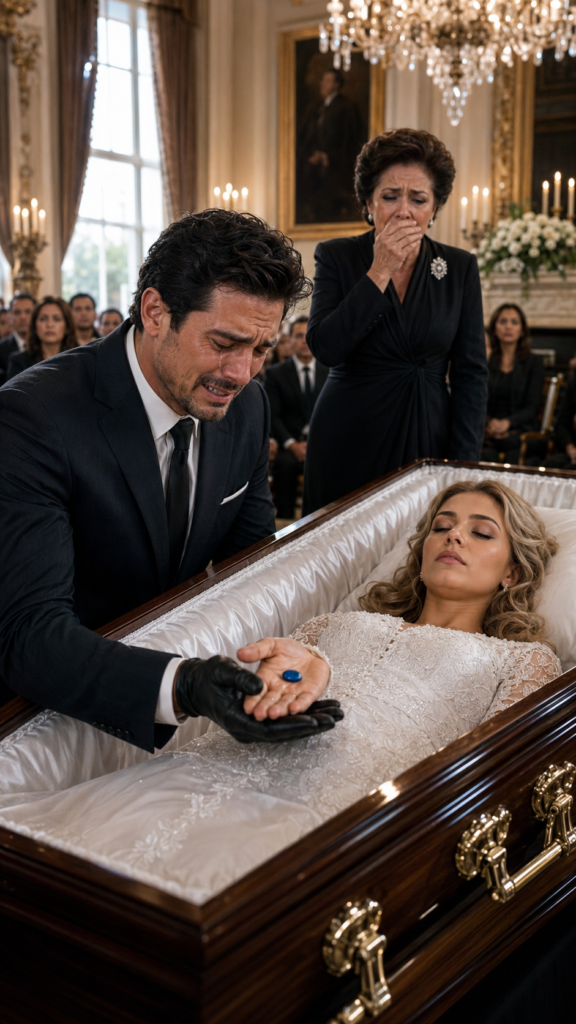
Alejandro kissed the cold forehead of his wife inside the casket and felt something in the world shatter silently.
Marisol lay there, dressed in a white gown she would never have chosen, surrounded by expensive flowers and lit candles in the main hall of the Los Encinos estate in Tequila, Jalisco.
Doña Elena, her mother, stood next to the portrait of their grandfather, dressed in black, perfect, dry, as if pain were a breach of etiquette.
“She died in childbirth,” she said as soon as she saw him enter. “And the girl didn’t survive either.”
Alejandro had come from Mexico City, where he had spent three weeks trying to secure a loan to save the family distillery. He had imagined arriving with toys, cravings for Marisol, buzzing with the excitement of meeting his daughter.
But he found a casket.
And his mother controlling every tear as if it were a village mass.
Sebastián, his younger brother, stood by the bar in the hall with a shot glass of tequila in hand. He wore dark glasses and a navy blue blazer, even though it was 4 PM and the sun wasn’t shining inside the house.
“Bro,” he murmured. “I’m sorry. Life is cruel.”
Alejandro didn’t respond.
He moved closer to the casket.
Marisol looked like she was sleeping, but something felt off. Her hands were arranged on her chest, as if someone had wanted to turn her into an obedient doll.
She always said she didn’t want to look “like a funeral postcard.”
Moreover, one of her hands was clenched.
Tight.
Almost in anger.
Alejandro carefully took her stiff fingers.
“Don’t touch her,” ordered Doña Elena.
The voice didn’t sound like a plea. It sounded like a threat.
“She’s my wife,” he replied without looking at her.
“She’s dead, Alejandro. Don’t make a scene.”
He continued.
He opened each finger until something fell onto the white fabric of the casket.
It was a navy blue button, with a thread ripped violently.
Alejandro picked it up without anyone else noticing.
He recognized it instantly.
It was from Sebastián’s blazer.
When he lifted his gaze, he noticed something else: his brother had a fresh scratch on his neck, badly hidden beneath the collar of his shirt.
Doña Elena went pale.
“Don’t you dare jump to absurd conclusions,” she whispered.
Alejandro tucked the button into his pocket.
“Too late, Mom.”
The room fell silent.
The staff lowered their heads. The old foreman of the estate crossed himself. Sebastián let out a nervous laugh.
“What’s wrong with you, dude? You’re wrecked. You’re seeing ghosts.”
Alejandro stared at him.
“No. I’m seeing very clearly.”
His mother stepped closer.
“The cremation will be tomorrow. Quick. Private. Marisol doesn’t deserve to be inspected like merchandise.”
That’s when he understood.
They didn’t want to bury her.
They wanted to make her disappear.
That night, Alejandro pretended to break down. He let his mother decide flowers, schedule, and prayers. He allowed Sebastián to receive condolences as if he were the widow.
But when everyone fell asleep, he entered his father’s office and opened the safe behind an old painting.
Inside remained the envelope Marisol had signed six months before, when she uncovered fake invoices, diverted funds, and documents pointing directly to Sebastián.
If anything happened to her, Alejandro would have legal authority to demand an autopsy, review accounts, and protect his daughter.
Marisol didn’t trust that family.
And now he didn’t either.
He dialed Dr. Renata Villarreal, a friend of Marisol’s and a gynecologist at a private hospital in Guadalajara.
She answered with a trembling voice.
“Alejandro… thank God. I’ve been searching for you for hours.”
He closed his eyes.
“Tell me the truth.”
Renata was silent for a few seconds.
“Marisol didn’t arrive alive at the hospital. She was brought in without records, without identification, and your mother requested immediate cremation.”
Alejandro felt the blood drain from his face.
“And my daughter?”
On the other end, the doctor barely breathed.
“I can’t say it over the phone. Come tomorrow at six. Enter through the emergency room. And don’t tell anyone.”
Alejandro hung up, looking at the navy blue button in his hand.
Then he understood that Marisol, even in death, had left him one last clue.
And what he was about to discover could destroy his entire family.
PART 2
At 5:15 AM, Alejandro left the estate without turning on the car lights.
The road to Guadalajara was dark, damp, silent. In the passenger seat lay Marisol’s legal envelope, and in his pocket, the button that felt like it was burning his leg.
He wasn’t crying.
He had cried inwardly all night.
Now he held something else: a cold rage, one that no longer screamed.
Dr. Renata was waiting for him at a side door of the hospital. She wasn’t wearing a lab coat. Her hair was tied up, deep dark circles under her eyes, and a folder hugged tightly to her chest.
“We have little time,” she said. “Your mother has called three times asking if anyone has checked the body.”
Alejandro clenched his jaw.
“Where is my daughter?”
Renata looked at him with a sorrow that shattered his soul.
“First, you need to see this.”
She led him to a small office, locked the door, and pulled out an evidence bag.
Inside was Marisol’s cell phone.
The screen was cracked. The case had a dark stain in one corner.
“A nurse found it hidden in Marisol’s clothes,” Renata explained. “Your mother wanted to take all her belongings, but this girl got scared and gave it to me.”
Alejandro swallowed hard.
“Does it work?”
“We were able to recover a video.”
Renata handed him a pair of headphones.
The screen trembled.
He saw Marisol’s bedroom in the estate. The image was tilted, as if the phone had fallen beside a chair. Her ragged breathing could be heard.
Then Sebastián’s voice appeared.
“Sign, Marisol. Don’t play the martyr. Alejandro won’t even find out.”
Next, Doña Elena spoke, calm, cruel.
“When the girl is born, we’ll say it was a complication. It’s better than a characterless child inheriting what this family built.”
Marisol replied in a thread of voice.
“My daughter isn’t yours.”
Sebastián moved closer.
“Don’t be stubborn. With that baby alive, Alejandro controls the actions. Without her, Mom decides everything.”
There was a struggle.
Marisol screamed.
The image shook violently.
Then a dull thud was heard.
Alejandro took off the headphones as if they were burning.
For the first time, tears filled his eyes, but didn’t fall.
“They killed her,” he said.
Renata looked down.
“Yes.”
“And my daughter?”
The doctor opened another door.
They walked down a restricted hallway to the neonatal unit. The sound of the machines was soft, constant, almost sacred.
In an incubator, wrapped in a pink blanket, lay a tiny baby.
Alive.
Breathing.
Barely moving her fingers.
Alejandro felt drained.
He leaned against the glass, bent over with pain and relief at the same time.
“They said she was dead,” he murmured.
“Your mother tried to register her as stillborn,” Renata said. “But she was born with a pulse. Weak, premature, but alive. I admitted her under temporary medical protection because I knew that if they found out, they would come back.”
Alejandro placed two fingers on the glass.
The baby opened her tiny hand a little.
“Lucía,” he whispered. “Your mom wanted to name you Lucía.”
Renata handed him the folder.
“There’s more. Injuries on Marisol incompatible with a natural death from childbirth. DNA under her nails. Sebastián’s scratch may match. There are also transfers to a notary and to a hospital administrator.”
Alejandro reviewed the pages.
Dates.
Names.
Stamps.
Account captures.
Everything formed a terrible line.
His mother and brother hadn’t acted out of panic.
They had planned to erase Marisol and Lucía to take over the distillery, sell the land to a foreign consortium, and control the inheritance that their grandfather had left protected for the next generation.
“Does the prosecutor know?” he asked.
Renata nodded.
“Yes. But they need to catch them where they can’t deny anything. Tomorrow, during the funeral, they’re going to intervene. You have to endure.”
Endure.
That word pierced him like glass.
He returned to the estate at noon.
Doña Elena was waiting for him in the dining room with black coffee and an elegant folder on the table.
“Before the funeral, we need to sign a few things,” she said.
Sebastián was sitting next to her. He wore another navy blue blazer, new, without missing buttons.
Too obvious.
The family notary, Arturo Beltrán, adjusted his glasses and opened a document.
“Mrs. Marisol Herrera de Montiel left a rights transfer signed two days before her death. It transfers her shares and any rights derived from the minor to Mrs. Elena Montiel.”
Alejandro lifted his gaze.
“From the minor?”
The notary turned red.
Doña Elena quickly intervened.
“It’s legal language, son. Don’t get intense.”
Alejandro extended his hand.
“I want to see the signature.”
The notary hesitated but passed it to him.
Alejandro looked at it for barely three seconds.
“Marisol was left-handed.”
Silence.
“And this signature was made by someone right-handed.”
Sebastián scoffed.
“Seriously, Alejandro, you’re wrong. You lost your wife and you’re looking for someone to blame where there isn’t any.”
Alejandro calmly folded the paper.
“I’m not looking for someone to blame. I’ve already found them.”
Doña Elena slammed the table.
“Enough! Tomorrow, the body will be cremated, and this embarrassment will end.”
Alejandro looked at her like he had never looked at her before.
“Tomorrow something will end, yes. But it won’t be what you think.”
That night, no one slept peacefully.
Sebastián walked the hallways. Doña Elena made calls in hushed tones. The notary stayed in the house, supposedly to “resolve details.”
Alejandro remained in Marisol’s room.
There he found a wooden box inside the closet.
There were letters, ultrasound photos, and a folded note.
Marisol’s handwriting was firm, beautiful.
“If something happens to me, don’t let your mother decide for our daughter. Elena doesn’t love, she possesses. Sebastián doesn’t help, he calculates. You’re good, Ale, but being good doesn’t mean letting them trample you.”
Alejandro held the letter to his chest.
Then he truly cried.
He cried silently, sitting on the floor, surrounded by the smell of Marisol in her dresses.
The next day, the funeral took place in a private chapel near the estate.
Doña Elena chose white flowers, soft music, and a 30-minute ceremony. She didn’t allow photos. She didn’t allow anyone to get too close to the casket.
She wanted to control even the distance between the living and the truth.
Sebastián arrived late, wearing dark glasses and a tense smile.
The notary was in the third row, sweating as if the chapel were an oven.
When the priest asked if anyone wanted to say a few words, Doña Elena stepped forward first.
Alejandro stopped her with a hand.
“I’m going to speak.”
His mother gritted her teeth.
“Don’t do anything foolish.”
He positioned himself in front of everyone.
There were workers from the distillery, Marisol’s neighbors, cousins, old employees, people who had watched Alejandro and Sebastián grow up among tequila barrels and inheritance disputes.
“Marisol deserved a farewell with truth,” he began.
A murmur ran through the chapel.
Doña Elena tensed.
Alejandro pulled out the navy blue button and raised it.
“I found this in my wife’s clenched hand. She didn’t let go of it even after she died. She tore it from the clothes of the person who attacked her.”
Sebastián stepped back.
“That proves nothing.”
Alejandro looked at him.
“Not yet.”
The chapel doors swung open.
Two investigators entered, a prosecutor, Dr. Renata, and an expert with a laptop.
Doña Elena lost her color.
“This is disrespectful,” she screamed. “We’re at a funeral.”
The prosecutor replied without raising her voice.
“We are here for an investigation into homicide, forgery of documents, asset fraud, and concealment of a minor’s identity.”
The word “minor” fell like a bomb.
Several people turned.
Sebastián whispered:
“Minor?”
Alejandro walked up to him.
“My daughter is alive.”
Sebastián’s face crumpled.
There was no surprise.
There was terror.
And that terror betrayed him before any evidence could.
Doña Elena tried to speak, but the prosecutor gestured.
The expert connected Marisol’s cell phone to the chapel screen. The image appeared shaky. They heard Marisol’s breathing.
Then Sebastián’s voice filled the place.
“Sign, Marisol. Don’t play the martyr.”
Someone cried out loud.
Then Doña Elena’s voice was heard:
“When the girl is born, we’ll say it was a complication.”
The entire chapel turned to her.
The face of the great matriarch, the woman who boasted of her name, mass, and charity, crumbled.
“That video is manipulated!” Sebastián shouted.
Renata stepped forward.
“The file has forensic recovery, date, location, and chain of custody. Moreover, there’s DNA under Marisol’s nails, injuries incompatible with childbirth, and altered hospital records.”
The prosecutor opened another folder.
“There are also transfers to notary Arturo Beltrán and payments to administrative staff to register the baby as deceased.”
The notary slumped in the bench.
“I didn’t know they were going to kill her,” he stammered. “They just asked me to prepare the transfer.”
Doña Elena turned toward him.
“Shut up, idiot!”
But it was too late.
The entire chapel had heard enough.
An officer approached Sebastián.
He tried to run toward a side door, but two distillery workers stepped in his way. They didn’t touch him. They just stood there, firm, like a wall of dignity.
The officers handcuffed him.
Sebastián began to cry.
“It was Mom,” he said. “She said that if that girl was born, she would take everything from us.”
Doña Elena looked at him with contempt.
“Coward.”
Alejandro felt nauseous.
For years he believed his brother was weak due to ambition and his mother tough due to fear.
Now he understood something worse: neither of them had any depth.
When they handcuffed Doña Elena, she screamed:
“Alejandro, I’m your mother!”
He looked at her without hatred, but without obedience.
“And Marisol was my wife. And Lucía is my daughter.”
Doña Elena wanted to respond, but the officers took her away amid screams, broken prayers, and murmurs of horror.
The casket remained silent.
Alejandro approached, placed his hand on the wood, and closed his eyes.
Justice didn’t bring Marisol back.
It didn’t restore her laughter in the kitchen, her off-key songs, or her way of dancing barefoot when it rained over the agaves.
But it prevented them from killing her twice.
Once with blows.
Another with lies.
Months later, the Los Encinos estate stopped smelling of confinement.
Alejandro opened the windows, removed his mother’s dark furniture, and turned part of the distillery into a foundation for pregnant women without family support.
He named it the Marisol Herrera Foundation.
Sebastián faced trial in preventive detention. Doña Elena tried to blame him for everything, but her calls, transfers, and order for cremation sank her deeper.
The notary lost his license and agreed to cooperate.
Lucía grew strong.
Tiny, yes, but stubborn like her mother.
One afternoon, Alejandro took her to the agave field at sunset. In one hand, she held her pink blanket. In the other, a wooden box.
Inside lay Marisol’s ring and the navy blue button.
He didn’t keep it out of hatred.
He kept it to remember that Marisol fought until the last second.
That a woman they tried to erase left the exact proof to save her daughter.
Lucía squeezed Alejandro’s finger with her tiny hand.
He looked at the golden sky of Jalisco and whispered:
“Your mom won, my girl. She just needed Dad to understand her last signal.”





