PART 1
—My son is being taken in. Keep her alive as best you can.
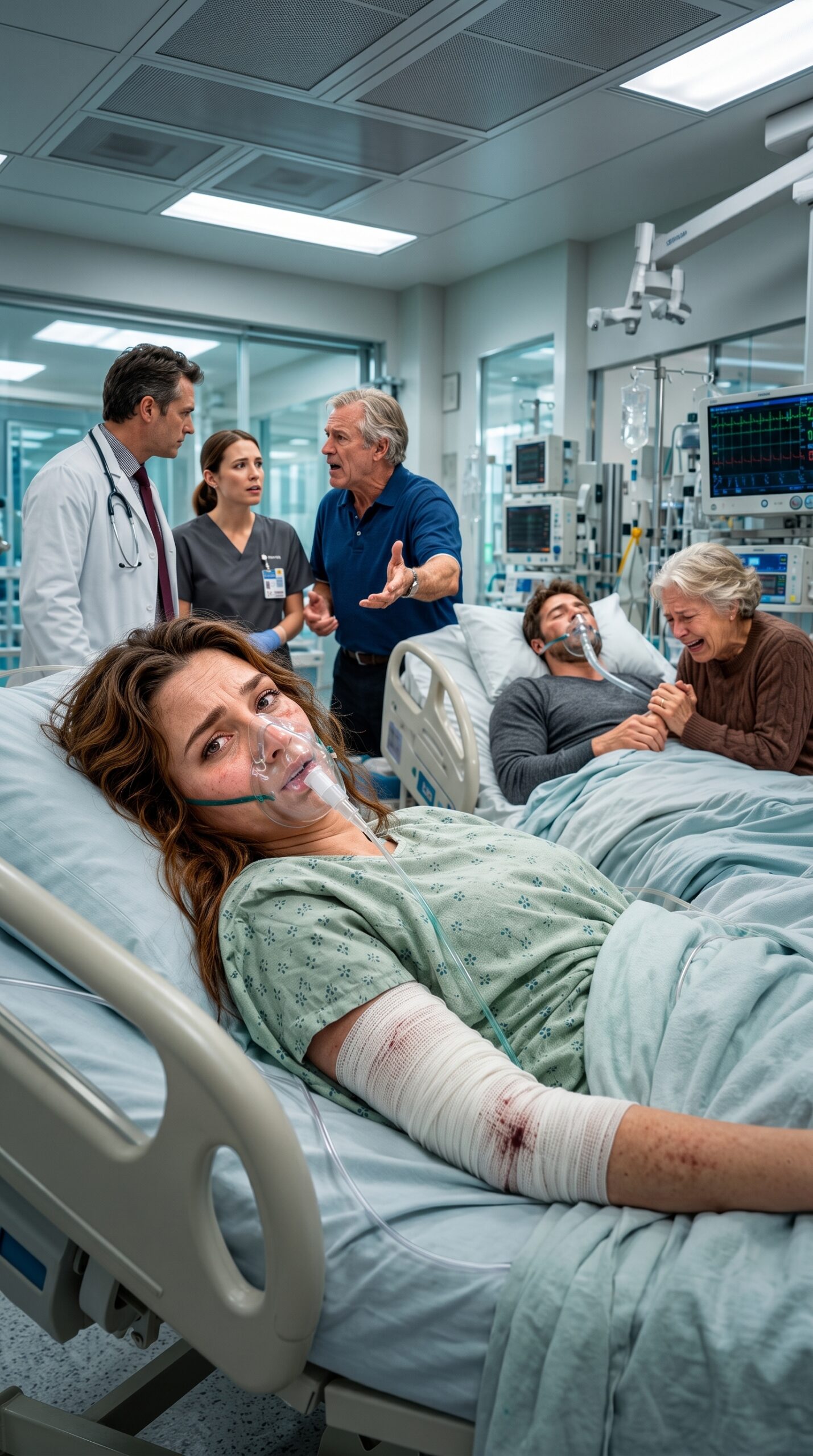
Camila Duarte heard her mother’s voice amid alarms, hurried footsteps, and the acrid smell of emergency.
She couldn’t open her eyes.
It hurt to breathe. Her throat felt dry, her head was splitting, and a horrible pressure was building beneath her ribs. Outside, the rain pounded against the windows of San Ángel Hospital like someone was throwing stones.
—Ma'am, both arrived in critical condition —a doctor said—. We can’t prioritize based on family whim.
—It’s not whim —Doña Elvira replied, her calm chilling—. Diego is 27. My son has a future. Camila was always difficult; she was always the one causing trouble.
Camila wanted to speak, but only air escaped her lips.
Her father, Ramiro Duarte, approached the doctor and lowered his voice, but not enough.
—If Diego needs blood, tissue, marrow, or anything compatible, use her. That’s what family is for. We’ll cover the costs.
The doctor didn’t respond immediately.
Camila felt the physical pain shrink in comparison.
For six years, she had paid the mortgage on the house in Satélite. She had cleared her mother’s credit cards, her father’s loans, and even Diego’s fines for his drunken escapades.
Diego was the favorite.
The one who never finished anything but was always “poor thing.” The one who crashed cars, lied, cried, and received hugs.
That night, after a meeting in Polanco, he snatched the keys to her truck.
He was drunk.
Camila tried to stop him as he demanded 750,000 pesos to cover a debt from his “import business.”
—I’m not paying you another peso —she told him.
Diego let out an ugly laugh.
—Then you won’t be submitting that audit, sis.
Then came the slap.
The swerve.
The wet pavement.
The white lights of a trailer.
The impact.
And now her parents wanted to use her body to save the very man who had nearly killed her.
—No one will touch this patient without legal and medical authorization —the surgeon said—. This is a hospital, not a butcher shop.
Ramiro clenched his jaw.
—Don’t get delicate, doctor. Everyone knows how things get done around here.
A young nurse took Camila’s wrist to check her pulse.
Camila gathered all the strength she had left.
She moved one finger.
Then two.
Then three.
It was a signal she used in her work as a forensic auditor: conscious, risk, record.
The nurse froze.
Camila repeated the pattern.
The nurse released her hand and left without causing a stir.
A few minutes later, firm heels clicked on the wet floor.
—Get away from that gurney —a woman ordered.
Doña Elvira turned furious.
—And who do you think you are, coming here to order around my daughter?
—I’m Isabel Arriaga —the woman said—. President of the board of this hospital.
Silence fell heavily.
Camila recognized that name. Arriaga appeared in business news, medical foundations, and magazine covers.
But what came next stole the breath from everyone.
—And Camila is not your daughter —Isabel said, her voice cracking with rage—. She’s mine.
Ramiro paled.
Doña Elvira opened her mouth but said nothing.
Isabel approached the gurney and placed a silver medallion with a dragonfly engraved next to Camila’s fingers.
Camila had worn one just like it since she was a child.
—They took it from me 28 years ago —Isabel whispered—. And what a fucking mistake they made believing a mother stops searching.
On the other side of a curtain, Diego groaned.
Doña Elvira ran toward him, crying.
No one ran to Camila.
And as the machine pushed air into her lungs, Camila understood that the accident was not the greatest tragedy of that night.
The real nightmare had just opened the door.
PART 2
Camila woke up 10 hours later with four broken ribs, her right leg immobilized, and a wound on her forehead that seemed to split her life in two.
Isabel Arriaga was still there.
She didn’t leap at her. She didn’t ask her to call her mom. She didn’t cry over her as if Camila’s pain were a stage for her own drama.
She simply sat next to the bed, in a wrinkled jacket, swollen eyes, and hands clenched over her purse.
She looked like a woman who had been holding her breath for 28 years.
—You don’t have to believe me today —Isabel said—. You don’t have to love me. Or forgive me. I just need you to know one thing: from this moment on, no one will decide over your body or your life again.
Camila looked at the medallion on the table.
—How did you know it was me?
Isabel took a deep breath.
—Six weeks ago, you uploaded a genetic test to a private platform. My lawyers have been monitoring matches for years. When your profile appeared, we sent out confirmations.
Camila closed her eyes.
She had bought that test because her story never added up.
Her birth certificate had strange corrections. The clinic where she supposedly was born in Toluca had closed before the marked date. Every time she asked, Elvira called her ungrateful. Ramiro said that searching for origins was for idle people.
Isabel carefully told her everything.
Camila’s real name was Camila Arriaga Luján.
She had vanished from a private clinic in Guadalajara when she was 9 months old. Isabel had been hospitalized for a complication. Her husband had died two months prior in an industrial accident.
Elvira worked in night admissions.
Ramiro sold surgical supplies to that same clinic.
They were interrogated, but they disappeared before the case progressed. They changed cities, altered documents, and built a family on top of a stolen child.
Camila didn’t cry.
Not yet.
She had spent so many years hearing that she was intense, dramatic, and ungrateful, that the truth did not destroy her.
It settled within her.
The nurse who understood her signal entered with a tablet. Her name was Abril.
—I saved what I could before they closed the hallway —she said—. The critical area system also captured audio.
First, Elvira’s voice was heard:
“Camila was always difficult.”
Then Ramiro:
“If Diego needs blood, tissue, marrow, or anything compatible, use her.”
Camila looked at the ceiling.
Seriously, not even when they thought she might die could they pretend to have any affection.
But Abril had more.
She showed footage from the building where Camila lived in Colonia Roma Sur. Just 50 minutes after the crash, Elvira and Ramiro entered with the emergency key she had trusted them with.
They left with her laptop, a gray folder, and her passport.
Camila felt her heart race.
—The gray folder —she whispered.
It held copies of an audit she hadn’t submitted yet: fake invoices, shell companies, triangulated transfers, and contracts linked to Diego’s business.
For months, she had suspected that her brother was not just in debt.
He was laundering money for businesses in Querétaro and using Camila’s electronic signature to validate transactions.
Isabel clenched her fists.
—I’m going to take them down.
Camila barely raised her hand.
—Don’t tell them you know about the DNA yet.
—You just came out of surgery.
—That’s why they think I’m defenseless —Camila said, her voice hoarse—. Let them feel overconfident.
In the hallway, Elvira’s voice was heard.
—My daughter is very confused. She’s always been jealous of Diego.
Ramiro added:
—We have proof. She stole money from her brother and caused the crash because he caught her.
Camila felt a chill harder than the anesthesia.
It wasn’t improvised.
They had already prepared a story to bury her legally before knowing if she would survive.
Camila asked for three things.
To preserve the audios from the hospital.
To contact her office’s lawyer.
And to activate an encrypted file she had programmed to send herself if she didn’t show up for a meeting on Monday.
Then she asked about her truck.
—It had a front camera with cloud backup —she murmured.
Isabel looked at her, surprised.
Camila almost smiled.
—I audit frauds, Mrs. Arriaga. Thieves think everything can be stored in a folder. How sweet.
That night, Diego woke up in a nearby room.
His voice was weak but just as arrogant.
—What if she remembers?
—We’ll say she’s lost her mind —Elvira replied—. With the blows, anyone would believe us.
Ramiro let out a low laugh.
—Besides, that woman Arriaga seems desperate. Once Camila signs the power, we move her accounts and that’s it.
Camila closed her eyes.
She had heard enough.
At 4:20 AM, Elvira and Ramiro entered her room with rehearsed worried faces.
—My girl —Elvira said, stroking her hair—. What a scare you gave us. Diego needs another operation, and we have to protect your things.
Ramiro placed a board with papers on the bed.
—Sign here. It’s to manage your accounts while you recover.
It wasn’t a medical permission.
It was a power of attorney to control her apartment, her shares, her professional signature, and her money.
Camila opened her eyes.
—How quickly you stopped being anxious.
Elvira froze.
Ramiro withdrew the pen.
—Daughter, you’re sedated.
—I heard you in the ER —Camila said—. I also heard you in the hallway. I know you entered my apartment.
The door opened.
Isabel entered with two agents from the Prosecutor’s Office, Camila’s lawyer, the chief surgeon, Abril, and hospital security personnel.
Diego appeared seconds later in a wheelchair, pushed by an orderly. He was bandaged, pale, with a neck brace, but still wearing that spoiled child’s smirk.
—No one will believe you —he said—. You were almost dead.
The lawyer connected a tablet to the screen.
—Then let the camera testify.
The recording appeared.
The truck moved through the rain along Periférico. Diego was driving with one hand, holding a small bottle with the other. Camila was in the passenger seat, trying to take away his phone.
—I’m submitting the report tomorrow —Camila was heard saying—. It’s over, Diego. I’m not covering your mess anymore.
He glared at her with hatred.
—You’re not ruining me.
—You ruined yourself.
Diego hit her on the temple.
Elvira covered her mouth with her hands.
On the screen, Diego jerked the wheel and accelerated.
—Transfer the 750,000 or no one arrives alive —he spat.
Then the trailer’s headlights appeared.
The image cut off with a crash.
Diego stopped smiling.
—That was edited.
The lawyer didn’t respond. He played the audio from the hospital.
Elvira’s voice filled the room.
“Camila was always difficult.”
Then Ramiro:
“If Diego needs blood, tissue, marrow, or anything compatible, use her.”
Then another phrase, lower but crystal clear:
“That’s what she’s been good for all her life.”
No one moved.
The silence was worse than a scream.
—That’s illegal! —Ramiro bellowed—. You can’t record us like that!
The chief surgeon stepped forward.
—It was recorded in a critical area under security protocol while you attempted to pressure medical decisions and offer money to the staff. Don’t confuse this hospital with your home.
The lawyer then opened Camila’s encrypted package.
Transfers to phantom companies in Querétaro appeared.
Invoices made with her electronic signature while she was in Mérida giving a training session.
Emails from Diego saying: “Move that before the intense one checks it.”
Messages from Ramiro warning: “Camila is asking too many questions.”
Footage of Elvira and Ramiro stealing the gray folder appeared.
Isabel placed another folder on the table.
This one didn’t talk about money.
It talked about blood.
DNA evidence.
Reports from the Guadalajara clinic.
Old photographs of Elvira in admissions.
Entry records for Ramiro in the nursery area the night a baby named Camila Arriaga Luján disappeared.
Isabel’s daughter.
The child they didn’t adopt.
The child they stole.
Elvira began to cry, but no longer as an offended mother. She cried like someone trapped with dirt-stained hands.
—We raised her —she said—. We gave her school, a roof, food. Doesn’t that count?
Camila looked at her from the bed.
Her face was swollen, her mouth was split, and one eye was black. Yet, her voice came out strong.
—You gave me just enough for me to work for you.
—We’re your parents —Ramiro said.
—No —Camila replied—. You’re my kidnappers.
Diego slammed his arm against the chair.
—And me? Are you going to deny I’m your brother too?
Camila slowly turned her gaze toward him.
She remembered birthdays where Diego received watches and she got “we’ll see later.” She remembered midnight calls to pay bail. She remembered Elvira repeating that a good sister sacrifices without asking questions.
—You were never my brother —she said—. You were the boy I was forced to save while he learned to destroy me.
The agents moved in.
Diego was arrested for intoxicated driving, aggravated assault, attempted murder, forgery, money laundering, and conspiracy.
Ramiro and Elvira were arrested for kidnapping, identity fraud, evidence theft, coercion, bribery, and participation in an illicit financial network.
When Elvira was handcuffed, she fell next to the bed.
—Camila, please. I bathed you, I combed your hair, I took you to elementary school. You can’t do this to us.
Camila took the silver medallion.
—You also offered my body while I was still breathing.
—I was desperate!
—No —Camila said—. You were sure I couldn’t hear you.
Ramiro tried to talk to Isabel.
—This can be resolved privately. We can all gain something.
Isabel looked at him without blinking.
—You robbed me of 28 years. There’s no such thing as “private” for that.
Before they took them away, Camila revoked powers, insurances, and beneficiaries. She removed Elvira, Ramiro, and Diego from her accounts. She ordered the legal recovery of the house in Satélite that she had paid for six years.
The same house where she was called a burden.
The same house built with her money and a lie.
—We’re your family —Elvira sobbed from the door.
Camila closed her eyes.
—My family wouldn’t have put a price on me.
Eight months later, Diego accepted a deal when his partners abandoned him, and the frozen accounts began to speak. Elvira and Ramiro received long sentences. The house in Satélite was sold to repair part of the damage to fraud victims.
The neighbors who called them “exemplary family” saw in the news what lay behind their Sunday smiles.
Camila took time to heal.
She learned to walk without grinding her teeth. She learned to sleep without imagining keys turning in the door. She learned to look at Isabel without feeling the word mom was too heavy.
Isabel never demanded it from her.
She just was.
In therapies. In hearings. In silences. In afternoons when Camila asked to see baby photos and then cried, not knowing if she cried for what was lost or for what was found.
A year later, Camila accepted to lead a financial unit at the Arriaga Foundation to investigate family fraud, economic exploitation, and networks that use love as a pretext for enslavement.
On the anniversary of the accident, Camila and Isabel went to a viewpoint at dawn.
Camila pulled out the old key to the house in Satélite.
She looked at it for a few seconds.
Then she dropped it into a storm drain.
There was no speech.
There was no music.
Just the small sound of a false life disappearing into darkness.
Camila touched her silver medallion.
For the first time, surviving didn’t feel like a debt.
It felt like something that was hers.
And she understood that sometimes justice doesn’t arrive with noise, but by opening your eyes just when the traitors believe you can’t hear anymore.





