PART 1
—Your dad died a year ago, Mateo… and this house no longer belongs to you. Don’t make a scene and just leave.
Patricia Salvatierra said this standing in the doorway, her calm so cold it felt rehearsed.
Mateo had just been released from Barrientos prison after three years for a fraud he’d always denied. He carried a worn backpack, a second-hand jacket, and the same look of someone who learned not to cry where others sneered.
For 1,095 nights, he had imagined this return.
He imagined Don Ernesto Villarreal waiting for him in the living room, with coffee brewing, construction plans spread across the table, and that phrase he’d repeated to him since childhood:
—The truth doesn’t die, son. It just takes time to find the door.
But the house in the Narvarte neighborhood no longer smelled of wood, fresh cement, or Sunday beef broth.
The rose bushes planted by his mother had vanished. The façade was painted an expensive white, with no trace of his father’s old flower pots. In the garage, there was a black truck and a red sports car Mateo had never seen.
Even the door was different.
Black, shiny, with a camera and a digital lock.
Mateo knocked three times. Not as a visitor. He knocked as a son.
Patricia opened wearing a beige dress, perfect nails, and a gold chain around her neck. She looked him up and down as if he were trash stuck to her shoes.
—You’re out earlier than expected —she said.
Mateo swallowed hard.
—Where’s my dad?
She tilted her head, pretending to be sorry.
—Oh, Mateo… your dad has passed on. Cancer. It was quick. Very sad. We buried him a year ago.
He felt the ground buckle beneath him.
—And no one told me? No one asked to let me see him?
Patricia smiled faintly.
—You were in prison for robbing your dad’s construction company. Did you really think he wanted your face at his funeral?
—I didn’t steal anything.
—That’s what you said at the trial. And look how that turned out.
Mateo tried to look inside.
The family photos were gone. Don Ernesto’s hat was no longer on the coat rack. The portrait of his mother next to the Virgin of Guadalupe was missing.
There was only marble, new furniture, and an unbearable smell of expensive perfume.
—Let me in. I just want to see his room.
—His room doesn’t exist anymore. I turned it into a walk-in closet.
Then Darío appeared, Patricia’s son, descending the stairs with a mocking grin.
—Look who’s back, Mom. The ex-convict returned for his cut.
Mateo clenched his fists but didn’t advance.
Patricia moved in closer.
—If you knock on this door again, I’ll call the cops. With your record, buddy, it won’t be good for you.
And she closed the door.
The click of the lock sounded louder than any insult.
Mateo didn’t scream. He didn’t pound on the door. He walked away with his backpack slung over his shoulder toward the Jardines del Sur Cemetery, where his father had always said he wanted to rest next to Mateo’s mother.
He needed to see his name.
He needed to apologize for not being there.
An old caretaker, wearing a worn hat and hands full of dirt, stopped him by the cypress trees.
—Who are you looking for, young man?
—Ernesto Villarreal. His wife said he was buried here.
The man stood still.
—You’re Mateo, aren’t you?
Mateo felt a chill down his spine.
—How do you know my name?
The caretaker glanced toward the entrance, lowered his voice, and pulled out a yellowed envelope from his jacket.
—Because your dad asked me to give you this if you ever came looking for him.
Inside was a letter and a small key with a rusty tag:
STORAGE 17.
Mateo opened the letter with trembling fingers.
The first line read:
“Son, if you’re reading this, Patricia has already started lying to you.”
And then Mateo understood that his father wasn’t just dead.
Someone had tried to erase him.
PART 2
Mateo read the letter while sitting on a bench in the cemetery, with his backpack between his legs and his heart pounding as if it wanted to escape.
The handwriting was his father’s: large, firm, slanted to the right.
“Son, I’m sorry for not visiting you. It wasn’t because I doubted you forever. It was because they made me believe a lie when I was sick, weak, and surrounded by people who didn’t want me to hear your voice.”
Mateo closed his eyes.
For three years, he had believed that his father had abandoned him out of shame.
The letter continued.
“Patricia and Darío showed me fake papers. They swore to me that you had stolen money from the construction company. They told me you used internal codes, moved payments, and left the company on the brink of bankruptcy.”
Mateo struggled to breathe.
“But later, I found duplicate invoices, transfers to ghost suppliers, and my signature on days when I was sedated from chemotherapy. I also found your password written in a notebook of Patricia’s.”
The caretaker, who introduced himself as Don Julián, sat next to him.
—Your dad used to come here in secret —he murmured—. He said you would need proof, not tears.
Mateo kept reading.
“Everything is in storage 17, in Azcapotzalco. Don’t confront Patricia without checking first. That woman doesn’t improvise. And neither does Darío. They took three years from you, son. Don’t let them take the truth from you too.”
At the end was a short phrase:
“I believed in you too late, but I have always loved you. Dad.”
Mateo didn’t cry.
Not yet.
He borrowed 200 pesos from Don Julián and took a bus to a warehouse district, among mechanic shops, taco stands, and dusty streets.
The key opened storage 17 with a creak.
Inside, there were no old furniture or boxes of memories.
There was a war silently prepared.
White folders stacked by date. Envelopes with bank seals. Copies of contracts. Printed photos. A USB drive taped to a folding table.
On top was a note that read:
“Start here.”
Mateo connected the USB drive to Don Julián’s borrowed cell phone, using an old adapter he found in a box.
The screen took a while to load.
Then his father appeared.
Don Ernesto looked thin, his face gaunt, a blanket draped over his shoulders. He sat in his old workshop. Behind him, one could see construction helmets, rolled-up plans, and a photo of Mateo’s mother.
—Mateo —he said in a weak voice—, if you’re watching this, it means you got out. And I wasn’t there to hug you. I’m sorry.
Mateo covered his mouth with his hand.
—You didn’t steal a dime. Darío diverted money using fake suppliers. Patricia gave him your codes. They entered your apartment with a duplicate key and planted files on your computer. I found the copy inside her bag.
The video’s voice broke, but he continued.
—They also forged my signature to change the will when they already had me medicated. Patricia said she was taking care of me, but she isolated me. She hid my cell phone. She told me you hated me, that you’d get out of prison just to take my money.
Mateo felt a rage so heavy he couldn’t move.
His father breathed with difficulty.
—If she told you that I’m buried with your mother, that’s also a lie. I bought that space years ago. I wanted to rest next to her. Don’t let her decide where my name ends.
The video ended.
For the first time, Mateo cried.
It wasn’t a loud cry. It was dry, broken, as if each tear ripped a piece of prison from his chest.
Then he began to review everything.
There were transfers worth millions to non-existent companies in Cancún and Monterrey. There were emails between Darío and an accountant named Saúl, where they discussed “putting everything on the troublesome son.” There were photos of Patricia entering Mateo’s building two days before the police found the computer with fake evidence.
And there was a red folder.
On the cover, it read:
“CONFESSION.”
Inside was a sheet signed by Darío. He admitted to using Mateo’s account to move payments and cover gambling debts.
Below was a note from Don Ernesto:
“They stole this from you. Get it back without becoming like them.”
Mateo could have gone that night to smash down the door of the house.
He could have shouted in Patricia’s face. He could have hit Darío. He could have given everyone the spectacle they expected from the “ex-con.”
But he didn’t.
He slept sitting in the storage room, with the USB inside his sock and the key clenched in his hand.
The next morning, he went to a legal aid office for released individuals. There he met Lucía Robles, a short-haired attorney with a serious look and zero patience for injustices.
Lucía reviewed the documents for almost three hours.
When she finished, she didn’t say “poor thing.”
She said:
—Mateo, this isn’t just an appeal. This is fraud, forgery, identity theft, manipulation of a will, and possible funeral covering-up. If we handle this correctly, your conviction will collapse.
Mateo looked at her with fatigue.
—And if they say I’m trash again?
Lucía closed the red folder.
—Then we’ll put in front of them your dad’s voice.
The first notifications arrived 12 days later.
They froze accounts related to Darío. They requested bank records. They asked to review Mateo’s sentence. They also demanded certified copies of the will and the funeral arrangements for Don Ernesto.
That same afternoon, Patricia called.
Her voice sounded sweet, false, like a commercial for a happy family.
—Mateo, son, I received some horrible documents. I don’t know what they told you, but we can settle this at home. We’re family.
Mateo looked at the USB on the table.
—Family doesn’t plant false evidence on an innocent’s computer.
There was silence.
Then Patricia spoke softly.
—You were locked up for three years. People have already decided who you are. Do you really think they’ll believe an ex-con?
Mateo replied without raising his voice.
—They don’t have to believe me. They just have to listen to my dad.
And he hung up.
The process lasted eight months.
Darío was the first to crack. When the prosecution showed him the transfers, the messages with the accountant, and his own signed confession, he started to sweat like a kid caught stealing in a convenience store.
At first, he said he didn’t remember.
Then he said Patricia forced him.
Finally, when he discovered that his mother intended to blame him for everything, he decided to save himself.
He testified against her.
He said Patricia copied Mateo’s codes from an old office notebook. He said she kept a copy of the key to his apartment for years. He said it was her who convinced Don Ernesto not to visit his son, repeating that Mateo only wanted inheritance.
He also told the worst.
When Don Ernesto began to suspect, Patricia hid his cell phone, changed his medications without telling him, and told the doctors he was delirious from chemotherapy.
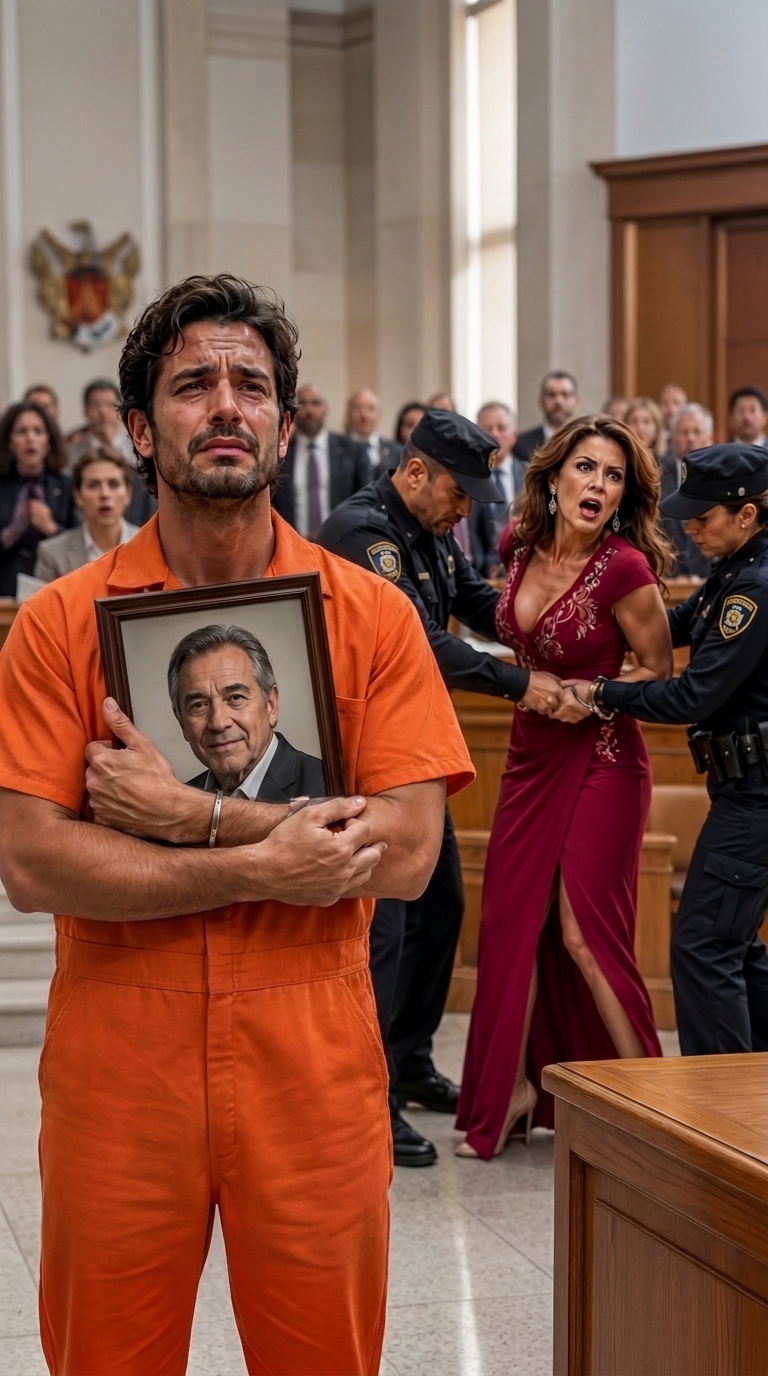
In the hearing, Patricia arrived dressed in white, with a rosary in her hands and tears ready.
She spoke of love. Of sacrifice. Of a confused widow who was just trying to protect the family business.
But then Lucía projected the video.
The room went silent when Don Ernesto appeared.
His voice was weak but unwavering.
He recounted the forged signatures. The stolen codes. The planted computer. He said Mateo was innocent. He said he regretted doubting.
And when he said:
—I love you, son. Even if I arrived late.
Mateo lowered his head and cried without shame.
Three weeks later, the conviction was overturned. The court acknowledged that the evidence used against Mateo had been fabricated.
His name was cleared on paper.
But paper doesn’t return three years.
It doesn’t return the nights in a cell. It doesn’t return the beatings. It doesn’t return the fear. It doesn’t return the last Christmas with his father. It doesn’t return the right to say goodbye.
Still, Mateo breathed outside the courthouse as if the air finally didn’t weigh him down.
Patricia and Darío were charged with fraud, forgery, identity misuse, and criminal association. Darío accepted a deal to reduce his sentence. Patricia fought until the end.
But what ultimately sank her wasn’t the money.
It was the funeral arrangement.
Don Ernesto had bought a double space in Jardines del Sur, next to his wife. He had left everything paid. He even signed a letter asking to be buried beside her.
Patricia canceled the service after his death.
She collected the reimbursement.
She collected the funeral insurance.
And sent the body to a municipal graveyard on the outskirts of Ecatepec, with a cheap plaque that didn’t even have his full name.
Ernesto V.
Nothing more.
She didn’t do it out of necessity.
She did it for punishment.
Because Don Ernesto discovered her. Because he gathered evidence. Because even while sick, he wanted to save his son.
Patricia couldn’t silence him after death, but she did try to erase the place where Mateo could mourn him.
When Lucía gave him the address, Mateo said nothing.
Don Julián insisted on accompanying him.
—A son shouldn’t find his father alone twice —he said.
The municipal cemetery was far from the pretty city where Patricia boasted of being a respectable widow. There were crooked crosses, sun-burned plastic flowers, dry earth, and skinny dogs wandering among forgotten graves.
A caretaker led them to a row in the back.
—Here it is.
Mateo knelt before the rusty plaque.
Ernesto V.
He ran his fingers over those two incomplete words and finally broke down completely.
He cried for his father. For his mother. For the boy who entered prison innocent. For the man who emerged with scars. For all the hugs that would never arrive.
—I know everything now, Dad —he whispered—. They couldn’t win against us.
Months later, the court returned the house as part of the restitution.
Mateo entered only once.
Patricia’s expensive furniture looked ridiculous in that living room where Don Ernesto used to discuss construction and dreams.
He climbed to his father’s old room, now converted into a walk-in closet.
Behind a panel, he found a small wooden box.
Inside was a photo: Mateo as a child, wearing a yellow toy helmet, standing next to Don Ernesto on a construction site.
On the back, it read:
“My son Mateo, the only partner who will never betray me.”
Mateo sat on the floor and hugged the photo for a long time.
Then he sold the house.
Not because he didn’t love it, but because there are walls that hold too many ghosts.
With that money, he paid for the legal exhumation of his father and finally took him next to his mother. He also reopened the company under a different name: Villarreal Constructions.
He hired people who had been released from prison and whom no one wanted to employ.
Because Mateo knew what it was like to wear a conviction stamped on your forehead, even when the guilt wasn’t yours.
The day they placed the new headstone, there was no grand speech.
Just a simple plaque:
Ernesto Villarreal
Father, builder, and a true man.
Below, Mateo had engraved the phrase that had held him even in prison:
“The truth doesn’t die. It just takes time to find the door.”
Patricia lost the house, the money, and the surname she used as a mask.
But her worst punishment wasn’t the sentence.
It was hearing, before everyone, the voice of the man she tried to erase defending the son she sent to prison.
Mateo lost three years.
But Patricia lost something much bigger.
She lost the lie with which she had built her entire life.
And since then, many in the neighborhood wondered what hurts more: having a stepmother slam a door in your face… or a father, from the wrong grave, finding the key to open the truth.





