PART 1
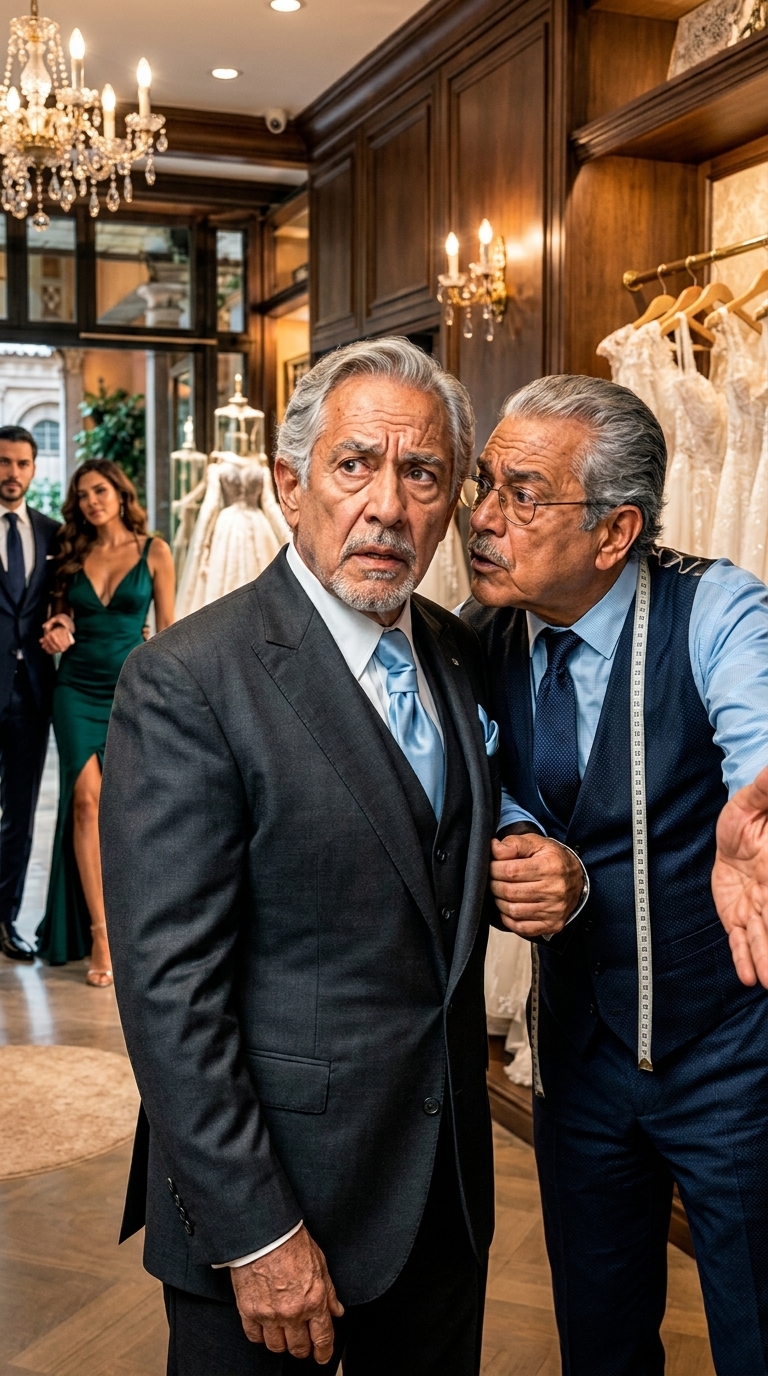
Don Ernesto Salvatierra arrived at the bridal store in the Historic Center five days before his daughter's wedding.
At 72 years old, his hands were stained from years of blueprints, cement, and steel, and his heart had been shattered since his wife passed six years ago.
His daughter, Camila, was all he had left.
She was to marry Bruno Armenta, a suave, educated man, the type who greeted with a perfect smile and spoke about investments as if money sprouted from pots.
Camila adored him.
Ernesto did not.
He couldn’t explain why, but every time Bruno placed a hand on his daughter’s waist, something in his chest screeched like a rusty rod.
Yet, he remained silent.
Because Camila was 31, had a lovely flower shop in the Roma neighborhood, and since her mother’s death, she had barely smiled.
The wedding was set to take place at a hacienda in Morelos. Ernesto paid for everything: the dress, the banquet, the mariachi, the honeymoon, and even the “romantic” trip to the Nevado de Toluca that Bruno insisted on.
Camila hated the cold.
But she claimed that with Bruno, everything filled her with hope.
That Tuesday, Ernesto entered Doña Mercedes' boutique, an old friend of his wife. He was there for the final fitting of his suit.
The bell rang.
Doña Mercedes looked up and turned pale.
She didn’t greet him.
No smile.
She merely rushed to the door, flipped the sign to “closed,” and locked it.
—Don Ernesto —she whispered—, come with me. Right now.
—What’s wrong, Meche?
She didn’t answer.
She grabbed his arm and pulled him into the large fitting room, the one where brides looked at themselves with veils and tears.
—Get in here. Don’t make a sound. Whatever happens, don’t come out.
—Are you crazy?
Doña Mercedes had fear-filled eyes.
—For the memory of your wife, trust me.
She shut the door.
Ernesto stood in the dim light, breathing heavily, feeling ridiculous.
He was about to open the door when he heard the bell ring again.
Then a male voice.
Bruno.
And after, the voice of Renata, the supposed cousin who had come from Monterrey to help with the wedding.
They sat in the fitting room, just on the other side of the wooden wall.
—The old man is already soft —Bruno said, dropping his kind tone—. At the rehearsal dinner, he’ll sign everything. He thinks it’s a trust to protect Camila.
Renata let out a giggle.
—And the medical authorization?
—It’s in the papers. He won’t even read it, the fool.
Ernesto felt the blood drain to his feet.
—Once he signs —Renata continued—, the $200 million insurance is clean. After the trip to the Nevado, everyone will believe the poor bride collapsed.
Bruno chuckled softly.
—A widow before being a wife. How ironic, right?
Ernesto gripped the curtain to keep from collapsing.
—Camila takes the capsules without asking —Bruno added—. She thinks they're vitamins for stress. By Friday, she’ll be weak. In the altitude, with the cold and no signal, no one will be able to save her.
The old engineer stopped breathing.
His daughter was not going to get married.
They were leading her straight to her grave.
PART 2
When Bruno and Renata left the boutique, Doña Mercedes opened the fitting room.
Ernesto didn’t shout.
He didn’t cry.
He just stepped out with a hardened face, as if he had suddenly aged another 20 years.
—Meche —he said with a broken voice—, how long have you known this?
—They came last week —she replied—. They thought I was in the storeroom. I heard them talking about papers, insurance, and your daughter. I didn’t know how to tell you without sounding like a nosy old lady.
Ernesto took her hand.
—You just saved the only thing I have left.
He stepped out onto the street with his unfinished suit and a rage that burned his eyes.
His first impulse was to go to Camila’s apartment and smash Bruno’s face in.
And that’s exactly what he did.
It was his first mistake.
Camila opened the door, a box of wedding mementos in her hands. She had dark circles under her eyes, pale lips, and a weary smile.
Bruno was in the living room, calm, checking his phone.
—I know everything —Ernesto spat—. The insurance, the medical authorization, the capsules, the trip. I know you want to kill my daughter.
Camila froze.
—Dad, what are you saying?
Bruno raised his hands as if calming a lost man.
—Don Ernesto, I understand that you miss your wife, but this is delicate.
He pulled out a black folder from the desk and laid papers on the table.
He talked about asset protection, banking procedures, investment insurance, and medical protocols for adventure travel.
He explained it so beautifully that it almost sounded true.
Camila cried.
—Dad, honestly, I don’t know what to do with you —she said—. Ever since Mom died, you’ve wanted to control my life. Bruno loves me. Why can’t you accept that I’m happy?
It hurt Ernesto more than any blow.
Bruno hugged her.
And over Camila’s shoulder, he smiled.
A tiny smile.
Dirty.
Victorious.
In that moment, Ernesto understood that if he kept shouting, he would lose his daughter.
He had to do what he had done all his life: find the crack before the building came crashing down.
The next day, he called Camila.
He apologized.
Said that grief had made him distrustful. That seeing his only daughter marry stirred old wounds.
Camila hesitated, but her heart was noble.
She agreed to have breakfast with him, Bruno, and Renata at a restaurant in Polanco to “make peace.”
Ernesto arrived on time.
He smiled.
Ordered coffee from a pot.
And observed.
Bruno talked too much about his “noble” family in San Pedro Garza García, about businesses in Texas, about friends in Madrid.
But when he lifted the cup, Ernesto saw his watch.
It was fake.
Not fake like from a flea market, but fake. An expensive copy to impress those who don’t look closely.
First crack.
Then Renata leaned down to “pick up” a napkin. Bruno placed his hand on her thigh under the table.
Not a cousin's gesture.
An affair's gesture.
Second crack.
Then he looked at Camila.
His daughter was slow. She responded late. She stared into the void as if the world was arriving late.
—She’s nervous about the wedding —Bruno said, answering for her.
Ernesto said nothing.
But inside, he was already sure.
That same afternoon, he sought out Natalia Beltrán, a former financial investigator who had helped him years before with a construction fraud case.
—I need to know who Bruno Armenta is —he told her—. And I need it without errors.
Natalia took 36 hours.
What she found was worse than any suspicion.
Bruno Armenta didn’t exist.
His real name was Mauro Lezama. He had used four identities in ten years. He had complaints for financial fraud against single women, widows, and heirs.
Renata was not his cousin.
She was his legal wife for nine years.
And there was more.
In Veracruz, a woman named Isabel Ríos died during a boat ride. Mauro appeared crying in local newspapers, collected a multimillion-dollar insurance payout, and disappeared three weeks later.
In Puebla, another woman lost all her properties after signing powers of attorney before a wedding that never happened.
Ernesto felt nauseous.
He was not facing a freeloader.
He was facing a predator.
Natalia obtained an order with the help of a known prosecutor. While Mauro and Renata were at a menu tasting, they entered the apartment he shared with Camila.
In the bathroom, they found a bottle of blue capsules, unlabeled, hidden behind a perfume.
Camila thought they were vitamins.
The lab confirmed they contained a dangerous mixture that could cause weakness, confusion, and cardiac failure under physical effort or altitude.
Ernesto read the report sitting in his truck.
He couldn’t drive.
He just rested his forehead on the steering wheel and cried like he hadn’t cried even on the day he buried his wife.
—He’s killing her slowly —he murmured.
Natalia, sitting next to him, was direct.
—If you confront him, he’ll escape. If you hit him, you’ll end up in jail. If you want to save her for good, we need you to sign.
—Sign what?
—Your own sentence.
The trap was the rehearsal dinner.
The hacienda in Morelos was lit with candles, bougainvilleas, and long tables filled with glasses. Guests toasted, took photos, and commented on how beautiful the wedding would be.
Camila arrived in a simple white dress.
Gorgeous.
But dim.
Ernesto had to shove his hands into his pockets to keep from running to her, scooping her up like when she was a girl and taking her away.
Bruno looked impeccable.
Renata too.
Both seemed calm, like two vultures dressed for a gala.
In the middle of dinner, Ernesto stood to toast.
The room fell silent.
—When my wife Elena died —he said—, I thought the house was crumbling around me as well. But Camila taught me that a family can stand tall even when a column is missing.
Camila looked at him with tears.
—Today I want to apologize to my daughter —he continued—. For my fears, for my clumsiness, and for not always knowing how to tell you how much I love you.
Bruno smiled, satisfied.
He thought he had won.
Ernesto lifted his glass.
—And as a sign of trust, tonight we’ll sign the trust that will protect your future.
Mauro’s eyes sparkled.
A notary approached with the folder.
But it was not the notary Mauro expected.
It was an undercover agent.
The documents looked the same. However, they contained a special clause: by signing with a false identity, Mauro would activate the nullification of any medical power, freeze the accounts linked to the insurance, and recognize under protest an identity that was not his own.
Renata raised her glass.
Mauro picked up the pen.
Ernesto didn’t breathe.
Camila watched the scene confused.
The pen touched the paper.
Mauro signed: Bruno Armenta.
Then the music stopped.
The waiters set down their trays.
The valets entered through the main door.
The mariachi band lowered their instruments.
Everyone pulled out badges.
—Mauro Lezama —the prosecutor said, advancing toward him—, you are under arrest for identity fraud, fraud, criminal association, and attempted homicide.
The room exploded in screams.
Renata tried to run through the garden, but two agents stopped her by the fountain.
Mauro stood up furiously.
—This is nonsense! I am Bruno Armenta!
The screen in the hall lit up.
First, his marriage certificate with Renata appeared.
Then his records with other names.
Next, the toxicology report of the capsules.
And finally, the picture of Isabel Ríos, the woman who died in Veracruz.
Camila clutched her chest.
—No… it can’t be…
Mauro attempted to approach.
—Baby, listen to me. Your dad is crazy. He set this all up because he can’t stand losing you.
Camila took a step back.
He tried to grab her hand.
She slapped him.
The sound was dry, loud, necessary.
—Don’t call me baby —she said, her voice broken—. You were killing me.
Ernesto walked toward his daughter.
He didn’t touch her right away.
He was afraid she would still hate him.
But Camila fell into his arms like when she was small and had nightmares.
—Forgive me, Dad —she cried—. I thought you were the enemy.
Ernesto held her against his chest.
—No, my girl. Monsters don’t come with claws. They come with flowers, promises, and expensive suits.
Mauro was taken away in handcuffs amidst cameras and murmurs. Renata was also screaming that it was all a lie, but no one heard her.
The wedding was canceled that same night.
Camila spent three weeks in a private clinic. Her body needed to be cleansed of what Mauro had given her little by little. Her heart needed more time.
She cried out of shame.
Out of rage.
For having defended the man who nearly killed her.
Ernesto sat by her bedside every day, bringing her broth, fresh flowers, and silence when she didn’t want to talk.
Months later, Camila reopened her flower shop.
The first collection was called “Roots.”
In the showcase, she placed a huge arrangement of white flowers held up by steel wires, as if they were invisible columns.
Underneath, she wrote a phrase:
“My father didn’t destroy my wedding. He saved my life.”
People paused to read it.
Some cried.
Others said that a father shouldn’t interfere so much.
And that’s where the discussion began.
Because there are those who believe that loving means letting someone make mistakes.
But Ernesto learned something different.
Sometimes love is staying silent to observe.
Sometimes love is playing the villain for a few hours to prevent a funeral.
And sometimes a father doesn’t need a cape, a gun, or strength.
He just needs to listen behind a thin wall, see the cracks that no one else sees, and hold his daughter’s life with all his body before someone tears it down forever.





