PART 1
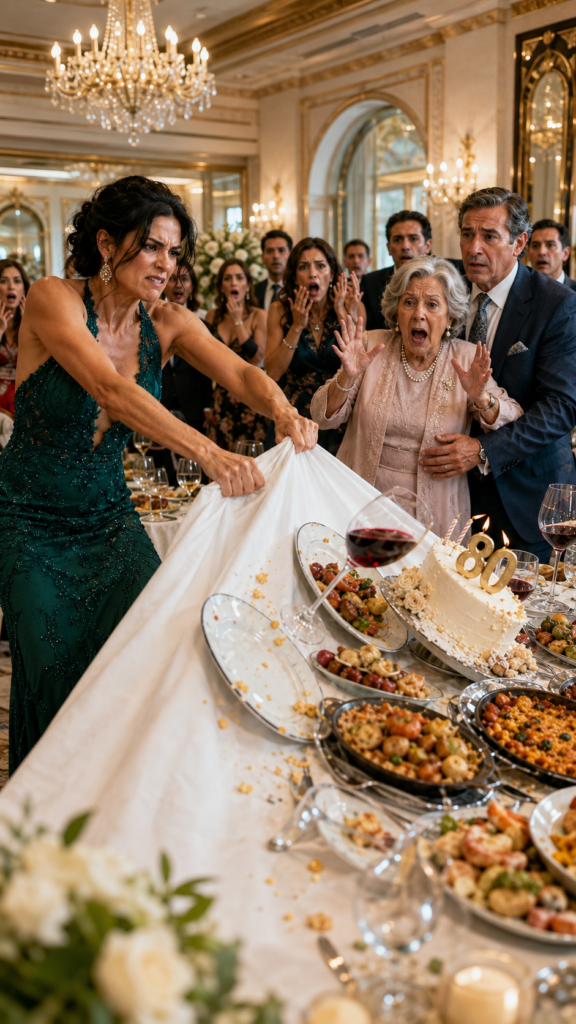
Don Álvaro's 80th birthday was celebrated in a private room at an expensive restaurant in Lomas de Chapultepec.
There were white flowers, soft music, shining glasses, and family members who only smiled when someone pulled out a phone to record.
Among them was Mariana Torres, clutching a thermal pot to her chest.
She was 48 years old, her hair neatly tied back, hands rough, and wearing the simplest dress of the table. For 12 years, she had sold moles, sauces, and artisanal cheeses at the Coyoacán Market. Her customers called her Doña Mari out of respect.
But in her husband’s family, they called her something else.
“The one from the stall.”
Her mother-in-law, Rebeca Armenta, could never accept that her youngest son, Julián, married a woman who smelled of roasted chili, cilantro, and hard work. To Rebeca, the family should mingle with those of long surnames, not a merchant who woke up at 4 in the morning.
Julián was an accountant at a medium-sized company. Noble, quiet, too accustomed to lowering his gaze when his mother raised her voice.
His older brother, Esteban, was a plastic surgeon, arrogant and cruel. He was married to Bárbara, a lawyer who spoke as if each word cost dollars.
That afternoon, Mariana had prepared seafood broth for Don Álvaro, her father-in-law. He was the only one in the family who always treated her like a person. The only one who called her “daughter,” saved her a seat, and ate her dishes as if they were a celebration.
When Mariana approached with the plate, the old man smiled.
—My favorite broth.
But Rebeca snatched the spoon away before he could taste it.
She barely dipped it in, made a face of disgust, and released a dry laugh.
—Is this what you brought? It smells like poverty, Mariana. Like a filthy diner kitchen. How sad that you can’t shake off your commonness, even with a new dress.
The room turned cold.
The broth spilled onto the floor when Rebeca pushed the plate away with disdain. The stain spread over the light carpet like a wound.
Bárbara covered her nose.
—Seriously, someone should take that out before it scares the guests away.
Mariana looked at Julián.
He pressed his lips together but said nothing.
That silence hurt more than the insult.
Rebeca leaned toward her.
—Pick up your mess and then go to the kitchen. You didn’t come as a guest. You came to help.
Then Mariana set the pot down on the table, removed the white apron still folded on her arm, and placed it in front of her mother-in-law.
—From today on, my service to this family is over.
Esteban stood up in fury.
—Who do you think you are, you old hag?
He tried to grab her arm, but Mariana opened a black folder she had in her bag.
The first page displayed a notarized deed.
And when Rebeca read the name of the restaurant’s owner, she gasped for air.
No one could believe what was about to happen...
PART 2
Mariana placed the folder on the table, right on top of the embroidered tablecloth that Rebeca had brought from Italy to show off.
She didn’t scream.
That was what frightened them the most.
—This restaurant —she said— does not belong to the group of investors you admire so much. It belongs to Maíz del Sur Patrimonial.
Bárbara let out a nervous laugh.
—And so what? You probably clean offices there.
Mariana turned the next page.
—I am the CEO.
Bárbara’s laughter died in her throat.
Esteban snatched the document from her hands. He scanned it for mistakes, a false signature, an impossible date. But the seals were there: notary, Public Registry, legal powers, assembly minutes.
Rebeca recoiled as if the folder were burning.
—This is nonsense.
Don Álvaro, who until then had remained silent, slowly rose, leaning on his cane.
—No, Rebeca. The nonsense was watching you humiliate the only person who cared for this family without asking for applause for 12 years.
Everyone turned to him.
The old man in the gray sweater, whom they used to interrupt during meals, had a firm gaze.
—Twenty-five years ago, I bought land in Querétaro, Mérida, and Nayarit. At that time, you mocked me. You said they were worthless lots. Today they are warehouses, hotels, shops, and tourist developments.
Esteban swallowed hard.
—Dad, why didn’t you ever tell us?
Don Álvaro smiled without joy.
—Because I wanted to see if you loved me or my properties. The answer was pretty clear, wasn’t it?
Rebeca tried to approach him.
—Álvaro, I’m your wife.
—You were my wife when it suited you to pose for photos. When I got sick, Mariana was the one who took me to the doctor. When I forgot to pay taxes, Mariana organized my papers. When you called me an old useless man, she brought me hot soup to my room.
Julián lowered his head, but this time not out of fear.
It was shame.
Mariana took a deep breath.
—I never sought to keep anything. Don Álvaro asked me for help because you all were too busy fighting over an inheritance you didn’t even know.
Bárbara regained her professional tone.
—If there was a transfer of assets, it can be contested. The family has inheritance rights.
Mariana opened another section of the folder.
—That’s why I brought copies.
On the table appeared medical opinions, notarized documents, appraisals, signing videos, and opinions from four inheritance lawyers. Each document confirmed that Don Álvaro acted with full capacity and that the companies were not donated all at once, but reorganized over years.
Bárbara read a page and turned pale.
—This is airtight.
—Legally, fiscally, and morally —Mariana replied.
Esteban slammed the table.
—You can’t leave us with nothing!
Don Álvaro looked at him with sadness.
—I didn’t leave you with nothing. You lost your shame a long time ago.
The silence was brutal.
Then Esteban’s phone rang.
It was his clinic in Santa Fe. His administrator spoke quickly, almost stuttering. The lease contract for the floor where his office operated had just come under review for “reputational risk.”
Esteban looked at Mariana.
—No...
—Yes —she said—. That building also belongs to Maíz del Sur.
Bárbara received another message at the same time. Her firm was removing her from a million-dollar account related to boutique hotels in Riviera Nayarit. The client didn’t want to be represented by a lawyer marked for coercion.
Mariana pulled out a third document.
—Do you remember this contract?
Bárbara recognized it instantly. Months earlier, she had gone to the market to pressure Mariana into selling her stall below its real value. She hinted that they could shut down her stall for supposed irregularities.
—You recorded...
—I recorded because I learned that when a poor woman speaks, no one believes her. But when a poor woman keeps evidence, everyone gets scared.
Rebeca began to tremble.
—Mariana, dear, don’t exaggerate. It was a joke. I have character, you know.
Mariana looked at her with a calm that hurt more than any scream.
—Don’t call me dear. You never wanted me as a daughter. You wanted me as a free servant.
The mother-in-law covered her face, but no one rushed to comfort her.
Don Álvaro pulled out a cream-colored envelope and placed it in front of her.
—I also brought this.
Rebeca opened it with trembling fingers. When she saw the words “separation agreement,” she gasped.
—Are you going to leave me at our age?
—At our age, I no longer want to live with someone who despises the bread of others.
Julián broke down.
He approached Mariana with red eyes.
—I’m sorry. I should have defended you before today. I have no excuse.
Mariana held his gaze.
—I don’t need a man who cries when it’s all over. I need a partner who speaks when the abuse starts.
Julián nodded, shattered.
—I will learn.
—You better —she replied—, because I have already learned to walk alone.
That phrase cut through everyone’s chest.
The guests, hiding behind their glasses, began to record. In minutes, the video would be in group chats.
But the most powerful moment wasn’t the public downfall.
It was what Mariana did next.
Instead of selling the markets to build towers, she bought three more old stalls and turned them into a network of community kitchens for women who had lost businesses due to family debts. She provided legal advice, refrigerators, fair contracts, and training to sell to hotels.
The seafood broth that Rebeca had spilled on the floor became the star dish of a brand called Caldo de Casa.
Each label carried a small phrase:
“Honest work doesn’t smell like poverty. It smells like dignity.”
The phrase went viral.
Thousands of women began sharing photos of their aprons, their stalls, their pots, their cleaning uniforms, their tired hands. Some shared stories of how their mothers-in-law had treated them poorly. Others tagged family members who had never given them their place.
Bárbara lost her position at the firm. Not for being a bad lawyer, but because no one wanted to trust someone capable of using the law to crush a market woman.
Esteban closed his luxury clinic. His wealthiest patients left when the scandal grew. The man who once mocked the stalls ended up renting a small office next to a pharmacy.
Rebeca was the one who fell the hardest.
First, she went with Esteban. It lasted two months. Then with a niece. It lasted 18 days. After that, she wanted to settle with Julián, but he set conditions: therapy, public apology, and absolute respect for Mariana.
Rebeca refused.
One morning, she appeared at the Coyoacán Market wearing dark glasses and a worn-out designer bag from the corners.
She searched for Mariana among the aisles filled with fruit, flowers, freshly made tortillas, and the voices of vendors.
She found her in a renovated stall, with blue tiles, clean tables, and young people learning to prepare sauces. Mariana wore an apron, yes. But now it was not a symbol of humiliation. It was a uniform of authority.
—I need to talk to you —murmured Rebeca.
Mariana turned off the stove and stepped into the hallway.
—I’m listening.
The mother-in-law swallowed hard.
—I have nowhere to stay. Esteban is in debt. Bárbara won’t even answer me. I… I was hard on you, but you are family.
Mariana felt an old pain stir within her chest.
For a moment, she remembered all the times she stayed washing dishes while everyone else toasted. She remembered the laughter, the nicknames, Julián’s silences, the plate of broth crashing against the carpet.
She could have taken revenge with a cruel phrase.
She didn’t.
—I will pay for three months in a decent residence —she said—. I will also cover ten therapy sessions. But you will not live with me, and you will not step back into my house until you understand what you did.
Rebeca began to cry.
—is that all?
—No. There’s something else.
Mariana handed her a sheet.
It was a written apology that Rebeca would have to read at the next family meeting.
The mother-in-law read it and became indignant.
—This humiliates me.
Mariana stepped close enough for only her to hear.
—No, Doña Rebeca. This does not humiliate you. It exposes you. The humiliation was what you did to me for 12 years.
Rebeca lowered her eyes.
That afternoon, Mariana returned to her kitchen. Don Álvaro was sitting by the window of the stall, tasting a cup of broth.
—It's better than ever, daughter —he said.
Julián, by his side, was washing dishes without anyone asking him. Awkward, splashed, but present.
Mariana looked at him, and for the first time, she didn’t feel anger. She felt that justice doesn’t always shout. Sometimes it arrives with a folder, a recipe, and the decision not to bow her head again.
Months later, when the video circulated again on Facebook, people were still debating.
Some said that Mariana was too harsh.
Others claimed she was still too lenient.
But those who had been treated as less for selling, cooking, cleaning, or caring understood the truth without needing an explanation.
Because there are families that only respect a deed.
And there are women who, when they finally open their folder, show the entire world how much their dignity is worth.