PART 1
The first sound was Camila's laughter.
The second was the splash of water.
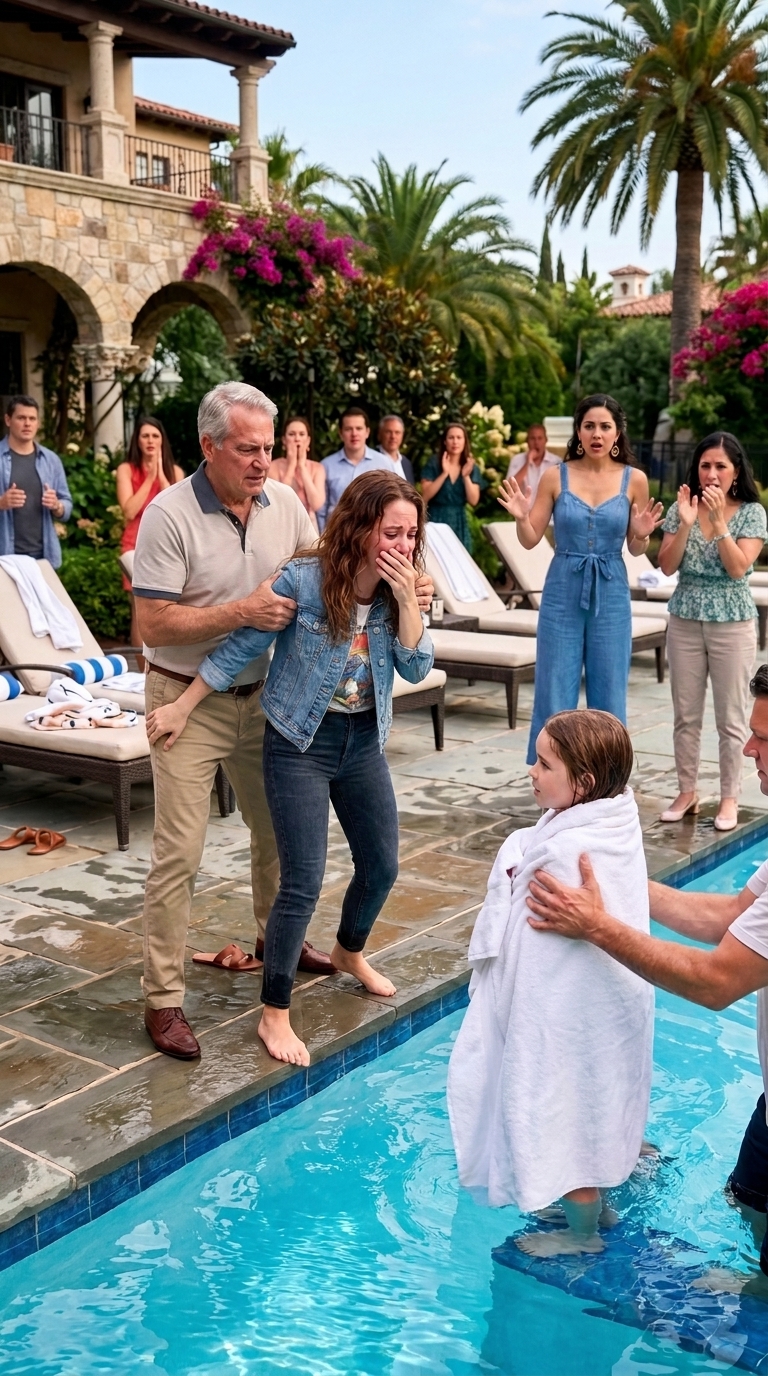
For one second, Mariana couldn’t comprehend what her eyes had just seen. Her five-year-old daughter stood by the hotel pool in Cuernavaca, dressed in her yellow Sunday dress, with a white sweater and the silver shoes she had chosen herself that morning.
Camila held a glass of lemonade that Mariana had just bought for her.
Verónica, Mariana's younger sister, approached the girl with that mocking smile she always wore when she wanted to provoke.
Then she pushed her.
Camila fell into the pool fully dressed.
The glass flew from her hand. The lemonade mixed with the blue water. The girl disappeared beneath the surface without having time to scream.
Some people gasped. A waiter dropped a tray. Mariana threw down her bag, kicked off a heel, and ran towards the pool without thinking.
But a hand gripped her neck.
Don Arturo, her father, yanked her back with such force that Mariana fell to her knees on the wet floor. His fingers dug into her throat as if he wanted to rip her from life itself.
“Dad, let me go!” she screamed.
He didn’t let her go.
Verónica stood at the edge of the pool, arms crossed, watching the bubbles rise from where Camila had sunk.
Patricia, Mariana’s mother, covered her mouth with her hands but didn’t take a single step.
Marcos, her brother, turned away, as if this was a family shame that shouldn’t be made public.
Mariana clawed at her father's wrist.
Camila’s hand barely surfaced before disappearing again.
“She can’t swim!” Mariana shouted. “She’s five years old, for God’s sake!”
Don Arturo leaned closer to her ear. He smelled of whiskey, mint gum, and arrogance.
“If she survives, she survives,” he murmured. “If she can’t handle the water, she doesn’t deserve life.”
Something inside Mariana went dark.
It wasn’t fear.
It wasn’t calm.
It was a coldness so profound that even her tears got stuck in her throat.
She drove her elbow back with all her strength and hit him in the ribs. Don Arturo grunted. Mariana broke free and dove into the pool.
The icy water closed around her chest. She opened her eyes against the sting of chlorine and saw Camila sinking, her dress bloated like a broken flower and her silver shoes pulling her down.
Mariana grabbed her under the arms and kicked towards the surface.
When she finally got her to the edge, Camila’s lips were purple.
“Call 911!” Mariana screamed.
An unknown man began to give her mouth-to-mouth. A woman hugged Mariana to keep her from collapsing. Verónica scoffed, almost annoyed:
“Oh, come on. It was a joke.”
Don Arturo, still standing, shouted louder:
“Children need discipline. That’s how they get strong.”
Then Mariana lifted her gaze, soaked, trembling, with blood on her knees.
And in that moment, in front of everyone, she decided that this family had just lost her forever.
PART 2
The ambulance arrived in less than ten minutes.
Camila coughed up water onto the floor before the paramedics placed her on the stretcher. Mariana wanted to go with her, but a municipal police officer asked her to calm down and explain what had happened.
She didn’t respond immediately.
She looked at her daughter, wrapped in a thermal blanket, crying softly, calling for her with a voice that no longer sounded like a child but like a wounded little animal.
Then she glanced at her family.
Verónica still wore a stony face, though her hands trembled. Patricia cried without tears, as if she cared more about the scandal than the girl. Marcos nervously checked his phone. Don Arturo adjusted his shirt, trying to regain his authority.
“It was an accident,” he said. “A silly mistake among family.”
Mariana let out a dry, broken laugh.
A laugh devoid of joy.
“No,” she said. “It was attempted murder.”
Verónica’s eyes widened.
“Are you crazy, Mariana? Come on, it was just a game.”
“My daughter can’t swim.”
“Well, that’s why she needs to learn.”
Mariana took a step toward her, soaked, barefoot, her makeup smeared, and her neck marked by her father’s grip.
“You weren’t teaching her. You were punishing her because everyone praised her today and no one talked about you.”
Verónica fell silent.
That day marked the 40th anniversary of Hotel Las Bugambilias, a famous family business in Cuernavaca. Don Arturo had organized an elegant meal for partners, longtime employees, and important acquaintances.
Mariana had come only because Camila wanted to see her grandmother Patricia.
For years, Mariana had been the uncomfortable daughter. The one who studied management, the one who questioned the accounts, the one who wouldn’t let herself be humiliated at meals. Verónica, on the other hand, was the favored one, living off parties, designer brands, and Don Arturo’s whims.
Camila was the only granddaughter.
And Verónica could never stand that.
Since the girl was born, she had called her “dramatic,” “whiny,” “delicate.” If Camila didn’t want to greet a drunken uncle with a kiss, Verónica would say she was spoiled. If she was afraid of the water, Don Arturo would say Mariana was raising her weak.
But that day they crossed a line that had no return.
In the hospital, Camila was kept under observation for mild aspiration. She was alive but scared. She wouldn’t let go of Mariana’s hand, not even for the doctor to examine her.
When a doctor asked what had happened, Mariana spoke clearly.
She named Verónica.
She named Don Arturo.
She named Patricia and Marcos as witnesses who had done nothing.
The silence in the room fell like a stone.
Don Arturo approached Mariana in a low voice.
“Think carefully about what you’re going to say. You know who pays for your apartment, who pays for the girl’s school.”
Mariana looked at him.
“You haven’t paid for anything in eight months.”
He frowned.
“Don’t act so dignified.”
Mariana pulled her cell phone from her wet bag. It wouldn’t turn on. Then she asked a nurse for a phone and dialed a number from memory.
“Mr. Rivas, it’s Mariana Salcedo. Activate everything.”
Don Arturo paled.
For the first time that afternoon, his face lost its arrogance.
Verónica sneered.
“What are you going to activate? Your drama?”
Mariana didn’t answer.
Two hours later, two lawyers arrived at the hospital. One carried a black folder. The other, a USB drive in a sealed bag.
Mr. Rivas was a serious man in a gray suit who had worked for Mariana’s grandmother before she died.
“Mrs. Mariana,” he said, “we’ve reviewed the hotel cameras. There are three angles showing clearly how Mrs. Verónica pushes the child. We can also hear part of what Mr. Arturo said.”
Patricia let out a moan.
“No, no, that can’t come out. It’s the family’s reputation.”
Mariana looked at her with a sadness that hurt more than anger.
“The reputation? That’s what you care about? Not your granddaughter?”
Patricia lowered her gaze.
Then came the twist nobody expected.
Mr. Rivas opened the folder and laid several documents in front of Don Arturo.
“Also, Mrs. Mariana, as you requested, the asset protection clause from Doña Mercedes’ will is being executed.”
Don Arturo pressed his lips together.
“That’s not valid.”
“It is,” the lawyer replied. “You signed it when you agreed to manage the hotel. Las Bugambilias was not yours. You were merely the administrator while the main heir did not claim control.”
Verónica blinked.
“Which main heir?”
The lawyer looked at Mariana.
“Her.”
The hallway froze.
Marcos stopped looking at his phone.
Patricia leaned against the wall.
Don Arturo looked like he was about to explode.
The truth was that Doña Mercedes, the paternal grandmother, never trusted her son Arturo. She knew he was violent, drunk, and obsessed with the family name. That’s why she left 60% of the hotel shares to Mariana, but with one condition: she could take full control if she proved that Don Arturo posed a direct risk to a minor descendant or used the family estate to cover up violence.
For years, Mariana didn’t want to touch that clause.
She didn’t want a war.
She didn’t want to destroy her family.
She only wanted peace for Camila.
But seeing her daughter sinking in that pool made her understand that peace with monsters always comes at the expense of the innocent.
Don Arturo slammed his hand on the waiting room table.
“I built that hotel!”
“The employees built it,” Mariana said. “You only learned how to yell at them.”
“You’re ungrateful.”
“No. I’m the mother of the girl you let die.”
Verónica approached Don Arturo.
“Dad, tell her she can’t do this. Tell her it’s all a show.”
But Don Arturo knew she could.
The cameras, the witnesses, the threats, the bank statements, the false payrolls, and the inflated contracts that Mariana had been documenting for months with Mr. Rivas were ready.
That day, she wasn’t just going to report an assault.
She was going to take away the hotel, the accounts, the cars, the vacation house, and the mask of a respectable family they had worn their whole lives.
Marcos tried to intervene.
“Mariana, think about Mom. This is going to be everywhere.”
She looked at him coldly.
“You watched Camila sink and turned your face. Don’t talk to me about Mom.”
At midnight, police took her full statement. A guest handed over a video recorded on his phone. It showed Verónica pushing Camila and Don Arturo holding Mariana by the neck.
It also captured the complete phrase.
“If she can’t handle the water, she doesn’t deserve life.”
When Patricia heard that played out loud, she clutched her chest.
Not because she felt guilty.
But because she understood that there was no way to hide it anymore.
Verónica was summoned for injuries and violence against a minor. Don Arturo was arrested that same night for obstruction of assistance, assault, and threats. They didn’t cuff him in front of the partners because Mariana asked.
They cuffed him in front of everyone because they could no longer protect him.
The next day, the video began circulating on social media.
“5-Year-Old Pushed into Pool at Luxury Hotel.”
“Grandfather Prevents Rescue and Utters Monstrous Phrase.”
“Salcedo Family Under Investigation.”
The comments blazed.
Some said Mariana should forgive because it was family. Others called for jail time. A few defended Verónica, saying it was a bad joke. But most repeated the same:
“A joke doesn’t leave a child with purple lips.”
In less than 72 hours, Mariana walked through the front door of Hotel Las Bugambilias with a court order. The employees stared at her in silence.
Many remembered her as a child, running between the tables while her grandmother Mercedes checked the fresh flowers in the lobby.
The manager, who had always obeyed Don Arturo, tried to block her path.
“We need instructions from Mr. Arturo.”
Mariana placed the documents on the counter.
“From today, I’m giving the instructions.”
No one applauded.
No one shouted.
But several maids cried.
One of them, Doña Lucha, approached and whispered:
“Your grandmother would be proud, dear.”
That phrase nearly broke Mariana.
But she couldn’t break yet.
She changed locks, froze accounts, canceled corporate cards, and ordered an audit. In one week, they discovered millions in misappropriations, payments to Verónica's ghost companies, and transfers to Patricia’s personal account.
The mother who did not move to save Camila had been moving for years to sign checks.
When Mariana confronted her, Patricia cried.
“Your father forced me.”
“Did he also force you to stand there watching my daughter drown?”
Patricia didn’t respond.
Because that was the only truth that had no excuse.
Camila took weeks to sleep without nightmares. At first, she didn’t want to bathe alone. If she heard running water, she would hide under the table. Mariana left the hotel in the hands of an external director and devoted herself to taking her to therapy.
One afternoon, Camila asked her:
“Mommy, did my aunt want me to die?”
Mariana felt the world shatter again.
She knelt in front of her.
“Your aunt did something very wrong. And your grandfather too. But you did nothing to deserve it.”
Camila looked down at her new shoes.
“Then why didn’t they love me?”
Mariana hugged her so tightly she could hardly speak.
“Because some people confuse love with control. And when they can’t control, they hurt.”
The family trial was a circus.
Don Arturo arrived in an expensive suit, cane in hand, playing the victim. Verónica showed up crying, claiming it was an innocent impulse. Patricia testified that everything happened too quickly. Marcos said he didn’t remember well.
But the video remembered everything.
Paramedics, guests, the doctor, and the man who provided first aid to Camila all testified.
Then came the final piece of evidence.
An audio recording from three days earlier.
In it, Don Arturo told Verónica that Mariana was “too uppity” and that they needed to teach her a lesson to stop her from threatening with audits.
Verónica asked:
“And if I use the girl? That brat cries about everything.”
Don Arturo replied:
“Do what you have to do. Mariana breaks when it comes to that little girl.”
The room fell silent.
Mariana did not cry.
She had cried all a mother could cry.
Verónica covered her face. Don Arturo stared at the floor. Patricia closed her eyes as if that could erase years of cowardice.
The sentence didn’t give them everything Mariana wanted, for justice rarely repairs completely what cruelty breaks. But there were restraining orders, formal charges, loss of asset control, and a tax investigation that ultimately sank Don Arturo.
Verónica lost her apartment, her credit cards, and her place in the company.
Patricia had to sell her jewelry to pay for lawyers.
Marcos, who always looked the other way, lost the job he had without working.
And Don Arturo, the man who said children should be made strong through blows, ended up begging for a call from a cold cell.
Mariana never went to see him.
Not out of vengeance.
But for peace.
Months later, Hotel Las Bugambilias changed its name. Mariana turned it into a family space with free swimming lessons for kids, safety protocols, and a plaque in the garden with Doña Mercedes’ name.
On inauguration day, Camila approached the pool in a purple swimsuit. She trembled but held her mother’s hand.
“What if I get scared?” she asked.
Mariana kissed her forehead.
“Then we’ll leave. No one will force you to be strong by suffering.”
Camila dipped one foot into the water.
Then the other.
She didn’t swim much. She just stayed on the first step, gripping Mariana’s hand. But she smiled.
And that smile was more powerful than any sentence.
Because in the end, Mariana took everything they valued: the money, the clean name, the hotel, the lies, and the right to call themselves family.
But what she truly wanted to recover was never an inheritance.
It was the certainty that her daughter could live without fear.
And maybe that’s why the story divided thousands on Facebook: some said Mariana destroyed her own blood; others understood that blood means nothing when someone lets go of your hand while you sink.





