PART 1
The doctor delivered the news at 8:17 in the morning, in a cold office at ABC Hospital in Santa Fe.
—I’m so sorry, Mr. Santillán —the cardiologist said, lowering his voice—. Mateo’s heart is failing faster than we expected. It can no longer endure the treatments. If he continues to refuse food and therapy… he may have 14 days left.
Emilio Santillán didn’t blink.
His son was only 25.
There was a time when Mateo ran barefoot through the vast garden of their home in Bosques de las Lomas, building forts with cushions and begging his mom to make red velvet cake because he said it tasted “like a real birthday.”
Now he was glued to a wheelchair, with pale lips and a vacant stare.
Emilio didn’t cry.
He hadn’t cried in 10 years, since the night Renata, his wife, collapsed during a family dinner. One minute she was laughing at one of Mateo’s bad jokes, and the next, she wasn’t breathing.
Since then, Emilio did the only thing he knew how to do.
He worked.
He bought land.
He built buildings.
He turned forgotten neighborhoods into luxury towers.
People called him “the man who could buy anything.”
But he couldn’t sit next to his son and ask him if he was afraid.
So he bought private doctors, nurses, specialists from Monterrey, Houston, and Guadalajara. He bought machines, imported medications, expensive tests.
He bought everything.
Except time.
That afternoon he took Mateo back home.
The boy’s room overlooked a jacaranda tree that Renata had planted when he was born. Mateo stood by the window, wrapped in a gray sweater, staring at the branches as if they were the only thing still speaking to him.
He didn’t have breakfast.
He didn’t eat.
He didn’t have dinner.
The first nurse quit the next day.
—He doesn’t want help, sir —she whispered—. He doesn’t want anything.
—Hire someone else —Emilio replied, curt.
By Friday, two more nurses had left.
Then Lucía Márquez arrived.
She was 26, with an old canvas suitcase and a worn brown coat. Her dark eyes seemed calm, but they carried a sadness that didn’t fit her age.
Doña Elvira, the housekeeper, welcomed her.
—You’re not just here to clean, girl.
—I know.
—The gentleman’s son is very sick.
—I was told.
—He doesn’t eat, barely speaks, and hates being hovered over.
Lucía nodded.
—Honestly, no one likes being treated like a dying person before they’re dead.
Doña Elvira fell silent.
It was the most honest thing anyone had said in that house for weeks.
When Lucía entered Mateo’s room, she didn’t talk to him about faith, or struggle, or miracles.
She simply pulled up a chair and looked at the jacaranda with him.
They spent six minutes in silence.
Then she said:
—That tree looks like it thinks it’s an artist.
Mateo barely moved his eyes.
—Not in a bad way —Lucía added—. Just dramatic. Like it knows it’s the prettiest thing in the garden.
There was another pause.
Then Mateo murmured:
—My mom planted it.
Lucía smiled.
—She had good taste.
—Better than my dad.
It wasn’t exactly a joke.
But almost.
Emilio, standing behind the door, felt a blow to the chest.
It had been months since he had heard that tone in his son’s voice.
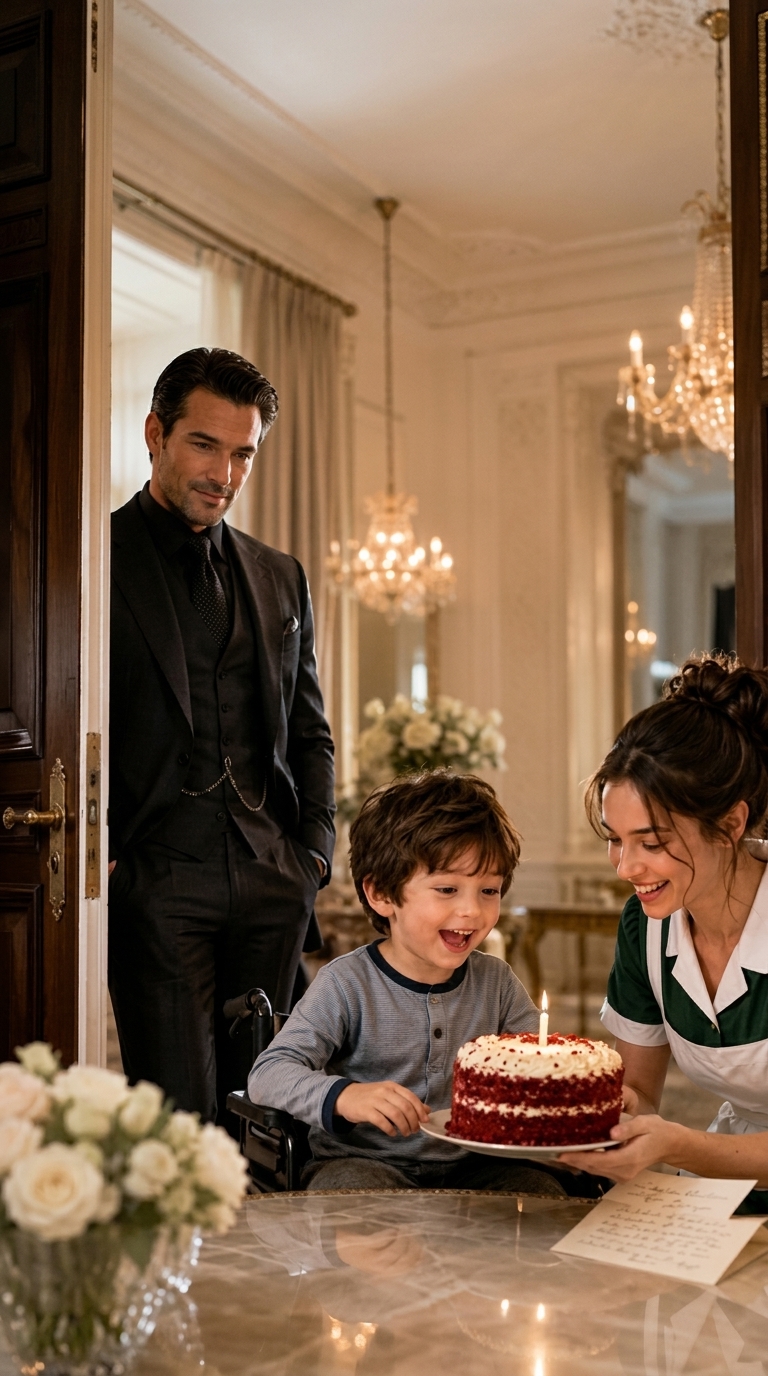
The next day, Lucía came in with a small red velvet cake, lopsided frosting, and a white candle.
Mateo looked at it as if he had seen a ghost.
—Where did you get that?
—from the kitchen.
—My mom used to make that cake.
—I know.
Lucía placed the plate in front of him.
—I found her recipe in a little tin box.
Emilio forgot how to breathe.
No one had touched Renata’s recipes in 10 years.
Mateo picked up the fork with trembling fingers.
He took a bite.
Then another.
And suddenly, tears streamed down his face.
For the first time in months, he asked for more.
Then Lucía pulled a folded envelope from her pocket and placed it next to the plate.
—Your mom wrote this for your 25th birthday —she whispered.
Emilio’s blood ran cold.
Renata had died when Mateo was 15.
Slowly, Mateo lifted his gaze.
And Emilio saw his wife’s handwriting on the envelope, as if the dead had just returned home.
PART 2
Mateo didn’t open the letter immediately.
His fingers trembled so much that the envelope fell onto the bedspread. Lucía tried to pick it up, but Emilio stormed into the room.
—Where did you get that?
His voice was so harsh that Mateo flinched.
Lucía didn’t back down.
—from where Mrs. Renata asked it to be taken out when the time came.
—Don’t play with me, girl.
—I’m not playing.
Emilio snatched the envelope and held it up to the light. The handwriting was Renata’s. Not similar. Not imitated. It was that slanted “M,” that silly little heart above the “i” in “my Mateo.”
His hands shook.
—My wife died 10 years ago.
—Yes —Lucía said—. But she didn’t leave without leaving things undone.
Mateo was breathing heavily.
—Dad… give it to me.
Emilio didn’t want to.
He couldn’t.
For 10 years he had locked Renata in a box, in a closed room, in a part of his memory where nothing hurt. And now a newly hired employee was opening doors he had nailed shut with money, silence, and arrogance.
—First you tell me who you are —Emilio demanded.
Lucía swallowed hard.
—I’m Carmen Márquez’s daughter.
The name dropped like a stone.
Doña Elvira, who had just arrived at the door, crossed herself.
Carmen Márquez had been the nurse who cared for Renata during her last months of migraines, fainting, and pains that everyone mistook for stress.
Emilio fired her three weeks before his wife’s death.
He fired her because Carmen insisted that Renata needed urgent tests, not more painkillers or social obligation parties.
Emilio didn’t want to listen.
He had a meeting in Querétaro, a 300 million project, a signature he couldn’t afford to lose.
Renata died before he agreed to pay attention.
—My mom kept that letter —Lucía continued—. Mrs. Renata wrote several. For Mateo’s birthdays. For when he graduated. For when he fell in love. For when he felt he couldn’t go on anymore.
Mateo started to cry silently.
—Why didn’t they ever give them to me? —he asked.
Lucía looked at Emilio.
—Because Mr. Santillán ordered the closure of the Coyoacán house where my mom’s things were. Everything was seized for a debt that wasn’t even hers.
—that’s not true —Emilio said, but his voice no longer sounded certain.
Doña Elvira lowered her gaze.
—It is true, sir.
Emilio turned to her.
—You knew?
—I knew that Mrs. Renata left envelopes for Carmen. I knew you didn’t want to receive anything that came from that woman. You said they were gossip from employees.
Mateo clenched the cake in his fingers.
—My mom wrote to me for years… and you buried it all?
—I didn’t know about the letters —Emilio said.
—But you did know that Carmen wanted to warn you.
The room fell silent.
Outside, the jacaranda swayed in the wind.
Lucía picked up the envelope and handed it to Mateo, this time without looking at Emilio.
—It’s yours.
Mateo opened it slowly.
The letter smelled faintly of old paper and vanilla, like Renata’s drawers.
“My Mateo,” he read aloud, with a broken breath, “if you’re reading this at 25, I want you to know something: I didn’t come into this world for you to remember me dead, but for you to remember how I loved you alive.”
Emilio leaned against the wall.
The letter didn’t talk about money.
It didn’t talk about treatments.
It didn’t talk about being strong as if pain were a shame.
Renata was telling her son he didn’t have to pretend to be brave. That crying wasn’t losing. That living wasn’t always about healing; sometimes it was about choosing a spoonful, a song, a small laugh, one more day.
Mateo read until the end.
“And if your dad turned to stone, forgive him only when he learns to become human again. Not before.”
Emilio felt something inside him crack.
He didn’t shout.
He didn’t defend himself.
For the first time in 10 years, he cried in front of his son.
Not pretty tears. Not discreet tears.
He cried like a man who had bought half of Mexico and lost the only thing worth taking care of.
—Forgive me, Mateo —he said, dropping to his knees beside the bed—. Forgive me for not being there. Forgive me for leaving you alone with your illness. Forgive me for turning your mom into a forbidden topic.
Mateo didn’t hug him.
Not yet.
—I don’t need you to hire another specialist, Dad —he whispered—. I need you to sit here even if you don’t know what to say.
Emilio nodded, shattered.
That night he canceled three meetings, turned off two cell phones, and sat beside Mateo until dawn.
Lucía brought chicken broth, gelatin, and another piece of cake.
Mateo ate a little.
But he ate.
The next day he agreed to take a shower.
Then he asked to listen to his mom’s old playlist.
On the third day, he accepted respiratory therapy.
The doctor didn’t promise miracles. He was clear: the heart was still serious. The time remained uncertain.
But something had changed.
Mateo was no longer waiting for death with his face turned to the wall.
He was looking at the jacaranda.
And sometimes, when Lucía said something silly, he smiled.
Emilio investigated Carmen Márquez’s story.
The truth was worse than he imagined.
Carmen had died two years after Renata, sick and in debt. Lucía, then a teenager, worked cleaning houses to pay the rent. She kept the box of letters as if it were a foreign treasure.
For years she tried to contact Emilio.
Returned letters.
Blocked calls.
Ignored messages by assistants.
Until she saw an ad seeking staff for the Santillán house and decided to enter through the most humble door: as an employee.
—Did you come for revenge? —Emilio asked her one afternoon in the kitchen.
Lucía was washing the cake mold.
—At first, yes.
Emilio closed his eyes.
—And now?
She looked down the hallway, where Mateo slept with a blanket over his legs.
—Now I came because his son deserved to hear from his mom before leaving… or before deciding to stay.
The phrase left him breathless.
Emilio offered her money.
A lot.
Lucía didn’t accept it.
—Pay off my mom’s debt —she said—. Clean up what you dirtied. And don’t treat me as if my dignity had a price.
For the first time, Emilio obeyed without arguing.
He had the documents checked, paid the debt, reclaimed Carmen’s small house in Coyoacán, and transferred it to Lucía’s name. Then he requested an internal investigation: he discovered that his own administrator had hidden messages, destroyed letters, and blocked visits to avoid “domestic service drama.”
Emilio fired him in front of everyone.
—The drama was believing that money made us superior —he said.
The news spread among employees, family, and partners.
Some called him exaggerated.
Others said a cleaning girl had manipulated him.
But Mateo, from his chair, heard those comments and asked to speak during a family meal.
Uncles, cousins, and people who only appeared when there was an inheritance nearby came.
Mateo was weak, yes.
But his voice came out firm.
—Lucía didn’t manipulate anyone. My mom wrote those letters. My dad chose not to listen for years. And I chose to eat again because someone treated me like a person, not a medical project.
No one knew how to respond.
Then Mateo asked for the box.
There were 11 more letters.
One for when he felt lost.
One for when he hated his father.
One for when he fell in love.
One for when he was afraid of dying.
Mateo didn’t open them all.
—I don’t want to use up my mom in one evening —he said.
Emilio covered his mouth.
That night, father and son looked at old photos. Renata with flour on her nose. Mateo in primary school uniform. Emilio younger, smiling as if he still knew how to do it.
—I miss her too —Emilio admitted.
Mateo looked at him.
—Then stop punishing me for looking like her.
That phrase was the final blow.
Because it was true.
Mateo had Renata’s laugh, Renata’s stubbornness, the eyes that seemed to ask too much. And Emilio, unable to bear the memory, had hidden behind drivers, nurses, and bank accounts.
During the following days, the house changed.
It no longer smelled of bleach and medications.
It smelled of toasted bread, broth, coffee, and red velvet.
Lucía didn’t perform miracles.
She did harder things: staying, listening, not lying.
Mateo had a severe crisis on the tenth day.
Emilio held him while the doctor arrived. This time he didn’t leave the room. He didn’t send anyone in his place. He stayed even when his son vomited, even when he trembled, even when he said:
—I’m scared, Dad.
Emilio kissed his forehead.
—I’m scared too, son. But I’m here.
Mateo survived that night.
And then another.
And then another.
On the fifteenth day, the doctor checked his signs and frowned.
—I’m not going to sell you cheap hope —he said—. But your body is responding better. Eating, sleeping, and accepting therapy changed the landscape. We might be able to try a new evaluation.
Emilio didn’t celebrate like a businessman.
He didn’t talk about “winning.”
He just squeezed Mateo’s hand.
—One more day —he said.
Mateo smiled.
—And tomorrow we’ll see.
Months later, the jacaranda bloomed fully.
Mateo was still sick. He was still in treatment. He still had terrible days.
But he was still alive.
Emilio turned one of his empty towers into a foundation for young patients with terminal illnesses and families who didn’t know how to support them. He didn’t put his last name on it.
He named it “Casa Renata y Carmen.”
When they inaugurated the place, many were expecting an elegant speech.
Emilio climbed the podium, looked at Lucía, Mateo, and the photo of Renata on a simple table.
—For years I thought loving was paying for the best —he said—. But sometimes loving is sitting next to someone and accepting that you can’t save them, only not abandon them.
Mateo asked for the microphone.
His voice was low, but everyone fell silent.
—My mom left me letters. Lucía returned them to me. My dad learned late, but he learned. The question is how many families need a tragedy to understand that a sick person needs not only doctors. They also need not to be treated as if they were already dead.
No one applauded at first.
Because it hurt.
Then Lucía came out with a red velvet cake, crooked like the first one.
Mateo blew out a candle.
He didn’t ask to be cured.
He asked that no one ever hide a love letter out of pride again.
And Emilio, in front of everyone, understood that the true miracle hadn’t been buying more days.
It had been that his son, after feeling abandoned in life, wanted to stay again.





