PART 1
—From today on, not a single dish leaves my hands for you.
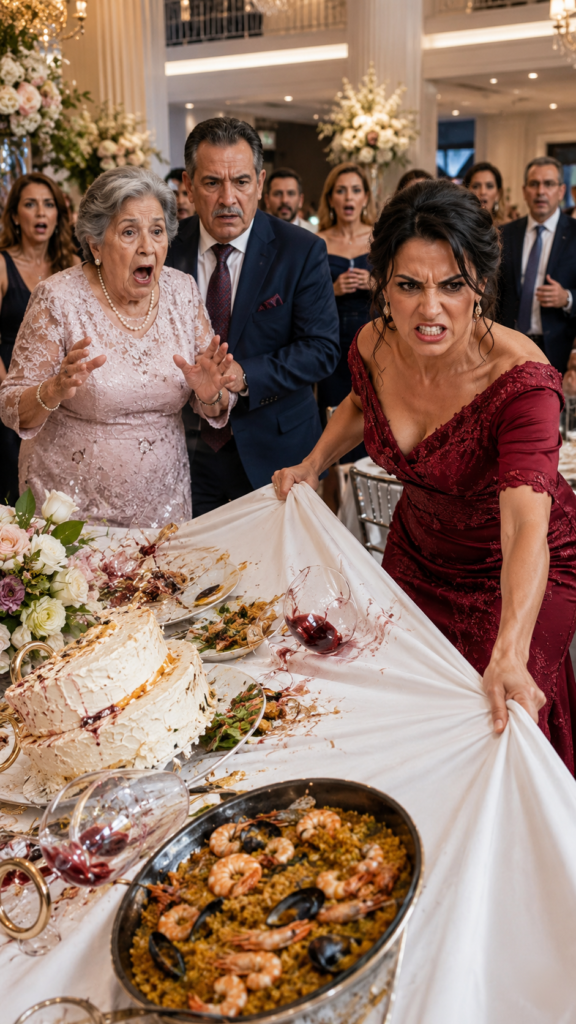
The ivory tablecloth flew off like a furious wave, dragging glasses, cutlery, flowers, candles, and 20 years of accumulated disdain with it.
It all happened in the private dining room of an upscale restaurant in Guadalajara, during the lunch celebrating Don Aurelio Castañeda's 80th birthday. There were 20 guests: children, daughters-in-law, grandchildren, wealthy friends, and people who smiled with expensive teeth but looked on with cold hearts.
The woman who had just provoked that disaster was Carmen Robles, the youngest daughter-in-law.
Until that day, to almost everyone, Carmen was “the one from the stall.”
She was 48, her skin marked by the sun, her hands strong from carrying boxes of chiles, grinding spices, and opening her stall at the Mercado Libertad before dawn. She sold moles, sauces, cheeses, preserves, and artisan bread. Her customers called her Doña Carmen with respect. Her in-laws called her “common” when they thought she couldn't hear.
Her husband, Julián, was Don Aurelio and Doña Imelda's youngest son. He worked as a logistics manager at a food company. He wasn’t wealthy, didn’t flaunt a watch, didn’t speak loudly. Because of this, his mother treated him like he had disappointed the entire Castañeda lineage.
The favored son was Álvaro, a plastic surgeon, married to Mónica, an elegant lawyer who always smelled of expensive perfume and fine disdain.
Carmen never sat down first.
At every family gathering, Doña Imelda told her to help in the kitchen, to clear plates, to check the food, to serve coffee. Carmen endured it for Julián and for Don Aurelio, the only one who looked at her like a person.
That morning she woke up at 3:40. She prepared fish birria, roasted salsa, white rice, and a broth with herbs just like her mother used to make. Don Aurelio loved that broth because, according to him, it tasted like home, not a restaurant.
When Carmen arrived with her thermal pot, Doña Imelda swept her with a glance.
—Good thing you came dressed simply. Go to the kitchen, dear. Here, the guests are fine people.
Mónica let out a soft laugh.
—Oh, Carmen, don’t take offense. Everyone shines where they can. You look natural among pots.
Carmen swallowed hard. She didn’t respond.
She asked the chef for permission, served a deep plate for Don Aurelio, and took it to the main table.
The old man smiled like a child.
—I knew you wouldn’t let me down, Carmencita.
—Never, Don Aurelio. I made it just like my mom used to.
But before he could taste the first spoonful, Doña Imelda took the plate, sniffed it, and wrinkled her nose.
—Is this what you brought? Broth from a stall for an 80th birthday meal?
Carmen stood frozen.
—It’s Don Aurelio's favorite.
—Aurelio is old and settles for anything —Imelda snapped.
Then she tilted the plate and let it fall.
The broth spilled onto the light carpet, staining luxury with the scent of chiles, fish, and home.
No one breathed.
Doña Imelda wasn’t finished yet.
—That’s how your mother was, right? Stuck among grease and pots. Poor woman. Even dead, she never had class.
The blow wasn’t the broth.
It was her mother’s name.
Carmen’s mother had died 9 years before, after selling food her entire life to pay for education, rent, and medicine. She never had jewelry but never humiliated anyone.
Mónica stood up with a glass in her hand.
—Carmen, don’t make a scene. Apologize to my mother-in-law right now. Seriously, how embarrassing for the guests.
Everyone expected tears.
But Carmen lifted her face.
Something in her eyes changed. There was no shame left. There was a dangerous calm.
She took off her white apron, folded it slowly, and left it on the stained table.
Then she yanked the tablecloth.
The room exploded with shouts.
Álvaro stood up in fury.
—Are you crazy? You will apologize to my mother right this minute!
He advanced with his hand raised.
Carmen didn’t back down. She gripped his wrist in midair.
—Doctor, those hands charge a lot for fixing faces. Don’t dirty them by hitting a woman in front of everyone.
Álvaro froze.
Doña Imelda, red with rage, screamed:
—Get out! You are nobody! Don’t even dream of touching a peso from this family!
Carmen opened her bag, took out a sealed envelope with the logo of a law firm, and placed it on the broken table.
—How curious that you speak of money, ma’am.
Mónica took it, read the first page, and lost her color.
Carmen looked at everyone, one by one.
—The house you live in, this restaurant, Álvaro’s clinic, and even the building of Mónica’s law firm are under legal review as of this morning.
Julián stepped toward her, confused.
—Carmen… what did you do?
She took his hand.
—What I should have done years ago.
And while the waiters looked at the broken dishes, Mónica read aloud the name of the owning company.
Maíz Real Inversiones.
Then Don Aurelio smiled just a bit, and everyone understood that the shame was only beginning.
PART 2
Mónica dropped the paper onto the table as if it were on fire.
—This is a threat —she said, trying to sound firm.
But her voice trembled.
Carmen didn’t raise her voice. There was no need. The silence in the room was louder than any scream.
—It’s not a threat, counselor. It’s a notification.
Doña Imelda let out a dry laugh.
—Notification of what? Of your fancy little stall? Look at this, now the market woman thinks she’s a businesswoman.
Several guests looked down. No one dared to laugh.
Don Aurelio stood up slowly, leaning on his cane. For years, they had treated him like the family’s old ornament, a man who needed to be spoken to loudly because he supposedly didn’t understand well anymore.
But that afternoon, his gaze was clear.
—Imelda, enough.
His wife turned to him as if he had slapped her.
—You too? Are you going to defend this woman after what she did?
—I’m going to defend the truth —he replied.
Álvaro tried to approach.
—Dad, sit down. You’re upset.
—The one upset is you, son. I’m more awake than ever.
The phrase left everyone speechless.
Julián looked at Carmen with eyes full of questions. He had seen his wife work like no one else, save penny by penny, review contracts at dawn, and meet with accountants. But he never imagined she was connected to something so big.
Carmen squeezed his hand.
—I’ll explain everything later. But today I won’t hide anymore so they can feel superior.
Mónica read another page from the envelope. There were names of properties, lease contracts, internal audits, and a formal request for a review of business conduct.
—This can’t be valid —she murmured—. Maíz Real Inversiones has nothing to do with you.
Carmen looked at her.
—You said that because you never checked who signs as president.
Mónica swallowed hard.
Doña Imelda stood up so quickly that her chair scraped the floor.
—Aurelio, tell me this is a lie.
Don Aurelio took a deep breath.
—It’s not a lie.
Imelda’s face changed. It was no longer pure rage. It was fear.
The birthday celebration ended without cake. Guests left one by one, pretending to have urgent phone calls, forgotten commitments, sudden headaches. No one wanted to appear in the photo of a powerful family crumbling before a woman in an apron.
That night, they all gathered at the Chapalita mansion, the same one Doña Imelda boasted as “Castañeda property.” Álvaro paced back and forth, talking on the phone with the bank. Mónica reviewed documents on her laptop. Imelda cried out of anger, not sadness.
—That woman cursed us —she said—. I always knew it. Market women are sly.
Don Aurelio was sitting by the window.
—It wasn’t witchcraft. It was work.
Imelda pointed at him.
—You gave her money.
—No —he replied—. I gave her trust. She already had money.
Álvaro hung up the phone with a pale face.
—They suspended the clinic’s line of credit.
—What? —Mónica shouted.
—The bank says the lease contract for the building is under risk evaluation. Without that location, there is no credit.
Mónica opened her email. She had 7 new messages from the firm.
Her most important client was asking to remove her from a real estate case. Another requested a review of her professional conduct. A partner asked for an urgent meeting. The last email had a brutal phrase:
“Counselor, we need to clarify your involvement in an agreement presented to a tenant at Mercado Libertad.”
Mónica felt a hole in her stomach.
Months earlier, she had tried to force Carmen to sign an abusive contract to take over her stall. She had told her that a woman like her should be grateful for any offer.
Carmen didn’t sign.
Mónica thought it was stubbornness.
Now she understood it had been strategy.
The next day, at 11, a message arrived on Julián’s cell.
“Everyone come to the 32nd floor of Torre Andares. Don Aurelio wants to speak.”
Julián showed the message to his family.
Doña Imelda grimaced.
—What is Carmen going to do in Torre Andares? Sell gourmet tamales?
No one answered.
When they arrived, a guard was waiting for them at the reception.
—Mrs. Carmen Robles will receive you upstairs.
The phrase was a slap.
They took the private elevator. Doña Imelda said nothing. Álvaro was sweating. Mónica gripped a folder as if she could hide her fear there.
The doors opened to a huge office, filled with light, with windows overlooking all of Guadalajara.
In the back stood Carmen.
She wore no flashy jewelry or gala dress. She was in a beige suit, simple shoes, and her hair tied up. On the desk was a small photo of her parents in front of a humble eatery.
Next to her was Don Aurelio, in a dark suit with a wooden cane. He no longer looked like a forgotten old man. He looked like the owner of his silence.
—Sit down —Carmen said.
Doña Imelda didn’t move.
—I won’t take orders from you.
Don Aurelio struck the floor with his cane.
—Then take mine.
Imelda sat down.
Carmen opened a thick folder.
—For years you all thought this family’s money came from appearances. Clinics, firms, expensive meals, surnames. But Don Aurelio’s true wealth wasn’t where you flaunted it.
Don Aurelio continued:
—Twenty-five years ago, I bought land in Jalisco, Nayarit, and Querétaro. Everyone called me crazy. Over time, those lands became warehouses, hotels, shopping centers, and industrial parks. When I understood that my family only respected money, I hid what I had.
Álvaro opened his mouth.
—Dad, why didn’t you ever tell us?
—Because when you thought I had nothing, you treated me like a nuisance.
The silence hurt.
Don Aurelio looked at Carmen.
—She was the only one who took me to the cardiologist when no one could. The only one who prepared food for me without charging favors. The only one who reviewed my old papers when you all said I was senile.
Carmen lowered her gaze for a second.
—I didn’t know how much it was all worth at first. I just saw receipts, deeds, and disorganized debts. I told Don Aurelio we needed to protect him.
—And she protected me —he said—. Better than my own children.
Mónica regained some voice.
—That doesn’t give her the right to take family properties.
Carmen slid several documents toward her.
—I didn’t take anything secretly. Don Aurelio established Maíz Real Inversiones with the advice of 4 firms, 2 notaries, and medical reports that certified his full capacity. I entered first as an administrator. Then as an operating partner. Today I am president by legal decision of the board.
Mónica reviewed the signatures.
Each official seal was a stone falling on her pride.
—This is airtight —she whispered.
—Yes —Carmen replied—. Just like the audits.
Álvaro frowned.
—What audits?
Carmen opened another folder.
—The clinic you wanted to open used inflated contracts with suppliers linked to your brother-in-law as collateral. There are duplicate invoices, fake payrolls, and medical equipment quoted three times above its real value.
Álvaro stood up.
—That’s a lie!
Don Aurelio looked at him with sadness.
—Your own accountant provided the information.
Álvaro slumped back into the chair.
Mónica tried to speak, but Carmen placed a contract in front of her.
—And this is yours.
It was the agreement Mónica had brought to the market. It offered Carmen a ridiculous amount for her stall, with a clause threatening to report her for alleged irregularities if she didn’t accept.
—I just negotiated —Mónica said.
—No. You pressured. And you did it because you thought a woman in an apron wouldn’t know how to read.
Mónica lost color.
Doña Imelda gritted her teeth.
—You did all this for revenge.
Carmen looked at her for the first time with open pain.
—No. If it were revenge, I would have responded the first time you called me trash. Or when you seated me at the kids’ table. Or when you told your friends that Julián had lowered himself with me. But today you spoke of my dead mother.
Carmen’s voice broke slightly.
—My mom sold broth outside a factory. She woke up at 4, carried pots heavier than her arms, and still came home to ask me if I had eaten. She had no class according to you, but she had something that was always missing here: heart.
No one said anything.
Doña Imelda opened her mouth, but the usual arrogance didn’t come out.
A small phrase did.
—I… was angry.
Carmen shook her head.
—No, ma’am. You were used to it.
The phrase left her defenseless.
Then Don Aurelio took out a white envelope and placed it in front of Imelda.
—You need to read this too.
She opened it with trembling hands.
Divorce petition.
—Aurelio… we’ve been married for 53 years.
—And I’m 80. I don’t plan to spend the years I have left next to someone who feels great by making others small.
Imelda clutched her chest.
—I’m your wife.
—You were my wife. But you stopped being my partner when you turned this family into a tribunal of appearances.
Álvaro stood up, desperate.
—Dad, please. Don’t destroy everything over Carmen.
Don Aurelio looked at him with a sadness that weighed more than anger.
—I’m not destroying it for Carmen. You all destroyed it by treating Carmen like she was worth nothing.
Julián, who had remained silent, let go of his wife’s hand just to stand in front of everyone.
—I also failed.
Carmen looked at him.
He had red eyes.
—For years I saw how they sent you to the kitchen. I saw how my mom humiliated you. I saw how Mónica mocked you. And I stayed silent because I was taught not to disturb the family.
He breathed heavily.
—But the family that needs your silence to mistreat your wife isn’t a family. It’s cowardice.
Carmen didn’t cry, but her lips trembled.
—Julián…
—I’m sorry —he said—. Not for today. For every previous Sunday.
She looked at him for a long time.
—Forgiveness doesn’t erase what happened.
—I know.
—But it can start with you never letting me feel alone again.
Julián nodded.
—Never again.
Doña Imelda looked at her youngest son, searching for the obedient boy who always lowered his head.
He was no longer there.
Carmen pressed a button on the phone.
Two guards entered.
—Please escort the Castañeda family out.
Mónica wanted to protest, but she knew any word could sink her further. Álvaro walked as if the floor had been pulled out from under him. Imelda passed by Carmen without looking at her.
In the elevator, the mother-in-law saw her reflection in the shiny metal. Perfect hair, pearl necklace, designer bag. For the first time, all of it felt like a disguise.
The following months were a public downfall.
Mónica was suspended from the firm. The abusive contract reached the bar association, and several clients abandoned her. She ended up accepting small cases in an office without a receptionist, charging in three payments what she once spent on dinner.
Álvaro lost the new clinic. Then false invoices, labor lawsuits, and patient complaints surfaced. He sold his truck, his watch, and even the luxury apartment he flaunted on social media. The doctor who spoke of “fine people” ended up doing night shifts at a roadside clinic.
Doña Imelda first left with Álvaro, then with Mónica, then with a niece in Zapopan. She was uncomfortable everywhere. She gave orders where she was invited and cried when no one obeyed.
One day she appeared in front of Mercado Libertad.
She no longer had a driver. She carried an old shopping bag and worn shoes.
Carmen’s stall wasn’t the same either.
It still smelled of chiles, masa, garlic, and hot bread, but now it was part of a huge project called Raíz de Maíz. Carmen had remodeled several stalls, installed cold storage, trained vendors, and created a line of sauces sold in hotels in Puerto Vallarta, Monterrey, Cancún, and Mexico City.
She hadn’t erased the market.
She had lifted it.
At the entrance was a phrase written on wood:
“Honest work doesn’t stain. Arrogance and cruelty do.”
Imelda read it three times.
Through the glass, she saw Carmen tasting a sauce with two young cooks. She laughed, calm and radiant, as if she could finally breathe without asking for permission.
Imelda tried to enter.
Julián appeared at the door.
—Mom.
She clung to his arm.
—Son, I need to talk to Carmen. I’m alone.
Julián closed his eyes for a moment.
—For years, she was also alone at our table. And you made her feel that way.
—I’m your mother.
—And she is my wife.
Imelda began to cry.
—I have nowhere to go.
Julián looked at her with pain, but he didn’t give in.
—We will help you with what is necessary. But you will not enter to ask Carmen for what you never gave her: compassion without respect.
Imelda lowered her head.
Carmen watched the scene from within. She didn’t smile. She didn’t celebrate. She didn’t run out to forgive.
She simply took off her gloves, took a deep breath, and went back to work.
In time, Don Aurelio moved to an apartment near the market, not to the luxury penthouse everyone expected. He wanted to smell bread in the mornings and hear vendors shouting offers. Carmen and Julián had dinner with him every Friday.
There was always broth.
The same one Doña Imelda had spilled.
One night, Don Aurelio took the first spoonful and closed his eyes.
—This tastes like family, Carmencita.
She took his hand.
—Family is also cooked with respect.
A year later, Carmen published a small book titled The Apron Is Not Humiliated. She didn’t expect to sell much, but it went viral. Thousands of women commented that they had cried because they had also been treated like servants by mothers-in-law, sisters-in-law, or families that confused humility with inferiority.
The last page read:
“The apron they used to belittle me was the same one with which I lifted my life. No one should be ashamed of working. Shame should be felt by those who need to humiliate to feel superior.”
The phrase spread across Facebook, women’s groups, entrepreneurship pages, and family chats where more than one mother-in-law fell silent.
One afternoon, Carmen put on the white apron from that day again.
It was no longer stained with broth or disdain. She had washed it, ironed it, and embroidered two names: Rosa and Efraín, her parents.
Julián found her in front of the stall, gazing at the market lights.
—Does it still hurt? —he asked.
Carmen took a moment to respond.
—Yes. But it no longer commands me.
Don Aurelio, sitting nearby with his cane, smiled.
—That’s winning, my dear.
Carmen observed the market's movement: women carrying boxes, men arranging fruit, young people learning recipes, customers lining up for the sauce they used to call common.
She thought of her mother, her tired hands, the plate thrown, the lawyer’s letter, and the 20 guests who that day witnessed an entire family lie fall.
She didn’t feel revenge.
She felt peace.
Because life doesn’t always punish quickly, but sooner or later, it sits each person before the plate they threw.
And Carmen, the woman from the market, no longer needed to ask for a place at anyone’s table.
She had built her own.





