PART 1
Valeria was 20 years old, studying Design in Guadalajara, and she had learned not to ask too many questions about her father.
Her mom, Teresa Morales, always said the same thing: that he died when she was a baby, that he had been a good man, and that some wounds were better left untouched.
Teresa was one of those tough women from Jalisco: hardworking, distrustful, and proud. She had a simple house in Zapopan, a yard full of bougainvilleas, and a hard way of looking at any man who approached her daughter.
That’s why Valeria knew introducing Ricardo Aranda was going to be a huge problem.
Ricardo was 43.
He was not a boastful rich man or a chatterbox. He coordinated a volunteer project where Valeria helped on Saturdays, distributing clothes and supplies in neighborhoods where life felt like an uphill battle.
He was serious, attentive, too careful. He listened to her as if every word mattered. He never pressured her, never wanted to rush anything.
Still, the age difference weighed heavily.
Valeria told herself it had no future, that her mom would be furious, that people would gossip. But Ricardo had a sadness in his eyes that kept her there.
One afternoon, while they were organizing boxes of used uniforms, he said:
—I’ve lost someone once. I don’t want to live in hiding again.
Valeria didn’t know how to respond.
Weeks later she accepted to go out with him. They had quiet coffees, walked through Chapultepec, and had long talks. Ricardo always maintained a strange distance, as if something inside him warned him to be careful.
When he finally asked to meet Teresa, Valeria felt her stomach twist.
On Sunday they arrived at the house in Zapopan.
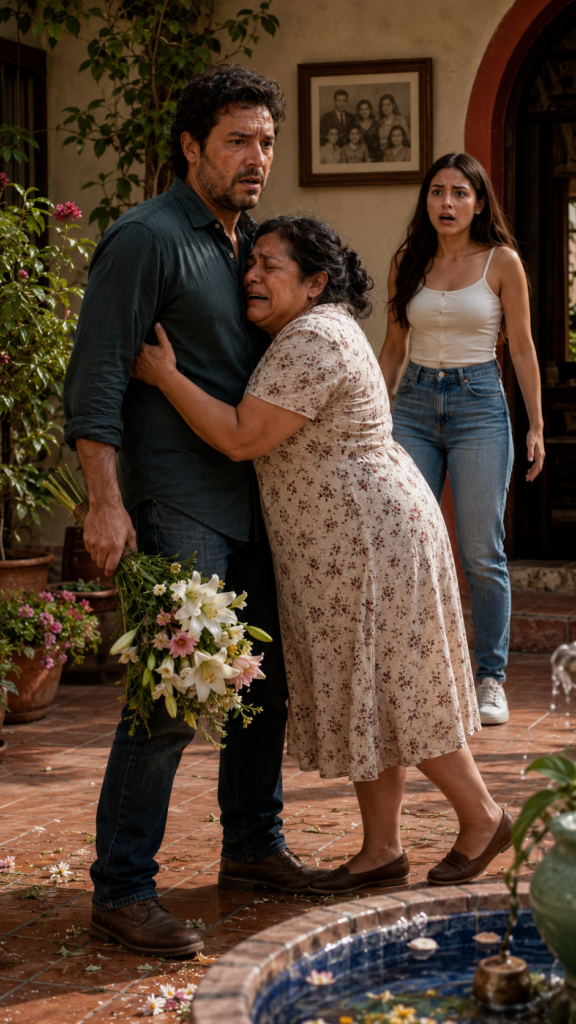
Ricardo brought a bouquet of white daisies.
—How did you know my mom likes these? —Valeria asked.
He smiled nervously.
—I think you told me.
But Valeria didn’t remember saying it.
Teresa was in the yard, watering her plants with a flowery apron and her hair tied up. Upon hearing the door, she first turned to her daughter.
Then she saw Ricardo.
The watering can fell from her hands.
Water began to flow across the floor, but no one moved.
—Mom… he’s Ricardo —Valeria said, trying to sound normal—. My boyfriend.
Teresa turned pale.
Ricardo froze too. The bouquet trembled in his hands.
—Teresa… —he murmured.
Valeria whipped around.
—Do you know her?
Teresa took a step, then another, as if she were seeing a dead man return through her own front door.
Suddenly, she clutched her chest and fell to the ground.
—Mom!
Valeria ran to her. Ricardo dropped the flowers and knelt down too, trembling.
When Teresa opened her eyes, she didn’t look at her daughter.
She looked at Ricardo.
She embraced him with a desperation that froze Valeria’s blood.
—Ricardo! —she screamed, crying—. My God, Ricardo! 20 years thinking you were dead!
Valeria felt the world tilt.
—What’s happening?
Teresa barely released Ricardo but held onto his shirt as if he might disappear.
Ricardo gazed at an old photo on the wall: a young Teresa holding baby Valeria, next to a thin-mustached man.
The man Valeria had called dad her whole life.
Ricardo stepped back.
—No… Teresa, tell me it’s not true.
Tears began to flow from Teresa, tears Valeria had never seen her mother shed.
—Mom, tell me who he is.
Teresa looked at her with a heavy, unbearable guilt.
—Valeria… before you loved him, I had to bury him alive to save you from his own family.
PART 2
The silence was so thick that even the running water in the yard seemed like a scandal.
Valeria looked at her mom, then at Ricardo, then back at the photo on the wall. The man with the mustache smiled from an old frame, as if he had watched over a perfect lie for years.
—Save me from whom? —Valeria asked.
Teresa swallowed hard.
—from the Arandas.
Ricardo closed his eyes upon hearing that surname.
Valeria felt a horrible chill run down her spine.
—Your family? —she asked him.
Ricardo nodded slowly.
—Yes.
Teresa wiped her tears angrily, as if she were ashamed to break down.
—Your dad wasn’t the man in that photo, Valeria.
The girl looked at the portrait again.
She had brought flowers to that man every Day of the Dead. Had cried at his grave. Had written his name in school assignments when asked to talk about her family.
—Then who was he?
Ricardo replied with a broken voice:
—Julián. My brother.
Valeria took a step back.
—No.
Teresa tried to get closer, but Valeria pushed her away.
—Don’t touch me. Tell me the whole truth.
Teresa covered her mouth.
Ricardo looked down.
—Valeria, I didn’t know you existed.
That phrase hit her harder than a slap.
—You didn’t know? Then what am I? Your brother’s daughter? A confusion? A family disgrace?
Teresa closed her eyes.
—You’re Ricardo’s daughter.
Valeria gasped for air.
Father.
The man she had brought home as her boyfriend was her father.
The man who opened the car door for her, who listened to her talk about her designs, who had never wanted to kiss her for more than a few seconds because “something didn’t feel right.”
Now everything took on a repugnant, painful sense.
Valeria ran to the bathroom and vomited.
Teresa cried on the other side of the door.
Ricardo said nothing.
Half an hour later, Valeria came out with a pale face and dry eyes.
—I want everything. No lies. No protecting me. Enough.
They sat in the kitchen.
Teresa made traditional coffee out of habit, although no one touched it. Outside, it began to rain on the flower pots in the yard.
Ricardo spoke first.
The Arandas were a powerful family from Zapopan. They owned land in Tesistán, warehouses, construction companies, and a huge house in Ciudad Bugambilias. Don Eusebio Aranda, Ricardo and Julián’s father, ruled over everyone as if life were a public deed.
Ricardo met Teresa when she was sewing dresses in a workshop in Santa Tere.
He brought a torn jacket.
Then he came back without the jacket, just to see her.
They fell in love quickly, in secret, as people do when they know the world won’t give them permission.
They married in secret.
Then Teresa got pregnant.
—When my family found out, it turned into hell —Ricardo said—. My mother had left a trust. The house in Tlaquepaque, an insurance policy, and several properties would be for my first child.
Valeria clenched her fists.
—So, for me.
—For you —Teresa confirmed—. But Julián was already moving money with fake companies. Don Eusebio covered for him. You were a burden before you were born.
Ricardo recounted that he discovered documents and wanted to report it. That same night he planned to take Teresa far away from Jalisco.
But Teresa went into premature labor.
They were on their way to the Civil Hospital when a truck blocked their path near the road to Chapala.
Then there were blows, blood, lights.
Teresa woke up in a private clinic.
Julián was there.
He told her Ricardo had died.
He also told her that if she opened her mouth, they would take away the baby.
—I was forced to sign papers —Teresa said—. They made Julián your legal father. They told me if I looked for Ricardo, you would disappear.
Ricardo took a deep breath.
—I was sedated. When I woke up, they told me Teresa and the baby had died. They showed me ashes, documents, a grave. I believed them because I was shattered.
Valeria let out a bitter laugh.
—How convenient for everyone.
Teresa lowered her head.
—I chose a lie that would keep you alive.
Valeria hated her.
And at the same time, she understood her.
That mix hurt more than any truth.
The next day, they went to a lawyer in the Americana neighborhood. Her name was Marcela Quiñones, and she was known for not being intimidated by expensive surnames.
Marcela listened to everything without interrupting.
Then she said:
—First, DNA proof with a legal chain. Second, rectification of the birth certificate. Third, protection measures. Fourth, review of the trust, insurances, and properties.
Valeria looked at the table.
—And what about what happened between us?
Ricardo was frozen.
Marcela was firm.
—You didn’t know. But from today, there is no sentimental bond. There is identity, trauma, and a stolen truth. That is worked on with therapy, not public shame.
Valeria didn’t respond.
The DNA test arrived 7 days later.
Ricardo Aranda Cárdenas was her biological father.
There was no embrace.
Valeria left the lab and walked down Avenida Vallarta until her feet hurt. She saw students laughing, fruit stalls, crowded buses, people going on with their lives as if hers hadn’t just shattered.
Ricardo caught up with her near a paint store.
—Valeria.
She didn’t turn around.
—Don’t call me daughter yet.
—Alright.
—And don’t apologize like that would fix things.
—I didn’t come to apologize. I came to tell you I’m not leaving.
That made her stop.
The war began when Julián found out Ricardo was alive.
He arrived at the Zapopan house in a black truck, with 2 lawyers and a smug smile. He was the man from the photo, but older, broader, more expensive.
He looked at Teresa with disdain.
—20 years and you still haven’t learned.
Teresa stood in front of Valeria.
Ricardo stepped out of the yard.
Julián saw him, and his smile twisted.
—Little brother. The dead should stay silent.
Ricardo didn’t raise his voice.
—Tell me where my mother’s documents are.
Julián laughed.
—Did you come back for money?
Valeria stepped forward.
—No. He came back for the truth. I came back for my name.
Julián looked at her as if she were a thing.
—You’re a confused girl because of a resentful seamstress.
Marcela appeared with a folder under her arm.
—Then you won’t have a problem explaining why Ricardo’s death certificate allowed cashing in an insurance policy, moving a house in Tlaquepaque, and erasing Valeria from a trust.
Julián’s face changed.
—This is a family matter.
—No —Marcela said—. This is fraud, forgery, threats, and suppression of identity.
Julián approached Ricardo.
—I let you live, dude. Don’t provoke me.
Ricardo looked at him with a calm that was frightening.
—You didn’t let me live. You left me buried because I was a nuisance to you.
That night the attacks began.
Photos of Valeria and Ricardo at the volunteer project appeared on social media. Fake accounts called her greedy, a gold-digger, a shameless girl. Some university classmates shared gossip without asking.
Valeria stopped going to classes for a week.
Teresa wanted to fight with half of Guadalajara.
Ricardo wanted to report everyone.
Valeria just wanted to disappear.
Therapy came as an obligation and ended up being a lifeline. Her psychologist told her something that stuck with her:
—You are not guilty of a truth that others hid. Shame belongs to the criminals.
Valeria repeated that phrase like a prayer.
Meanwhile, the papers began to speak.
The Civil Registry found inconsistencies in her birth certificate. Teresa’s signature on a supposed waiver of rights didn’t match. The insurance company delivered the file related to the insurance claimed for Ricardo’s “death.”
The bank showed transfers to Julián’s real estate company.
And the house in Tlaquepaque was still there.
Not sold.
Hidden among fake transactions.
The hearing was on a cold morning.
Valeria arrived with Teresa to her left and Ricardo to her right. He didn’t touch her. That was their pact: to accompany her without invading her space.
Julián arrived in a gray suit, smelling of expensive perfume and arrogance.
But Marcela had a last witness.
Doña Lidia, a retired nurse from Tonalá, entered slowly, leaning on a cane. She had worked at the clinic where Teresa woke up after the accident.
For 20 years, she kept a copy of Valeria’s birth wristband and a note written by Ricardo before he was completely sedated.
Marcela read the note aloud:
—“If Teresa lives, don’t let her sign. If my daughter is born, her name will be Valeria. My father and Julián want to take away her rights.”
Valeria broke down.
Not because the truth stopped hurting.
But because her name was not a coincidence.
Her father had named her before his own family tried to erase her.
Julián slammed the table.
—That proves nothing!
Doña Lidia looked at him with tiredness.
—It proves that you arrived that night with money and fear. And that your father said: “The girl must not exist as Ricardo’s daughter.” I was poor, sir, not deaf.
The judge ordered to freeze accounts, suspend any sale of the house in Tlaquepaque, and accept the identity rectification process.
Weeks later, Julián was arrested trying to move money to an account in the United States.
He didn’t apologize.
He just looked at Ricardo and spat:
—I took 20 years from you.
Ricardo replied:
—But you couldn’t take my daughter’s life.
Valeria heard that word.
Daughter.
It still stung, but it no longer disgusted her.
Months later, she entered the house in Tlaquepaque for the first time. It had a spacious patio, old tiles, thick walls, and bougainvilleas climbing as if they had been waiting for her return.
The deed was put in Valeria’s name after the trial.
Her paternal grandmother had left a clear clause:
“The house will be for the first child of Ricardo, regardless of the surname others impose.”
Valeria stood in the patio without speaking.
—It’s yours —Ricardo said.
—No —she replied—. It still feels like evidence of a crime.
Teresa took her hand.
—Then turn it into something that heals.
And that’s what she did.
She didn’t sell the house.
She turned it into a workshop for young women: design, sewing, financial education, and basic legal advice so that no one would sign papers out of fear.
She named it Casa Valeria.
Teresa taught sewing classes on Saturdays.
Ricardo paid for the renovations without imposing a single condition. Everything remained in a trust where Valeria made the decisions.
A year later, an opened safe by court order revealed the last truth.
There was a letter from Don Eusebio Aranda.
It said that he ordered to fake Ricardo’s death.
That he forced Teresa to register Julián as the father.
That he did it because a girl born to a seamstress shouldn’t inherit what, according to him, belonged to “the men of the family.”
At the end was a highlighted phrase:
“A confused daughter doesn’t claim a house, surname, or fortune.”
Valeria folded the letter without crying.
She no longer had tears left for those people.
Days later, she signed her new birth certificate.
Valeria Aranda Morales.
Daughter of Ricardo Aranda Cárdenas and Teresa Morales.
Teresa cried without hiding.
Ricardo did too.
Valeria didn’t cry. She smiled because after 20 years of lies, her name finally felt complete.
That afternoon they walked through Tlaquepaque. They bought ice cream from a scoop, and listened to a mariachi playing far away, in a square full of tourists who didn’t know that a family had just resurrected in pieces.
Ricardo stopped in front of her.
—I don’t know how to be your father.
Valeria took a deep breath.
—I don’t know how to be your daughter either.
—We can learn slowly.
She looked at him closely.
She no longer saw the man she thought she fell in love with. She also didn’t see the dead man from her mother’s story.
She saw a stranger with her blood, broken inside, trying to return without demanding anything from her.
—Start by not leaving —she said.
Ricardo nodded.
—I’m not leaving.
Valeria hugged him.
It was a clumsy, brief, careful hug. But when she rested her head on his chest, she understood that that heartbeat had never been romantic love.
It was something else.
It was the part of her that had been calling from some buried place for 20 years.
Julián ended up in prison, his properties frozen, and his partners pretending they barely knew him. Don Eusebio was already dead, but his punishment was worse than a jail: everything he built to erase her ended up serving to raise her house.
At the entrance of Casa Valeria, they placed a clay plaque made by an artisan from Tonalá.
It said:
“Here no woman loses her name again.”
Valeria took her boyfriend to meet her mom.
But that day the lie that raised her died.
She found her father, reclaimed her surname, and the family that wanted to turn her into a confused daughter discovered too late that a woman with the truth in her hands can claim it all.





