PART 1
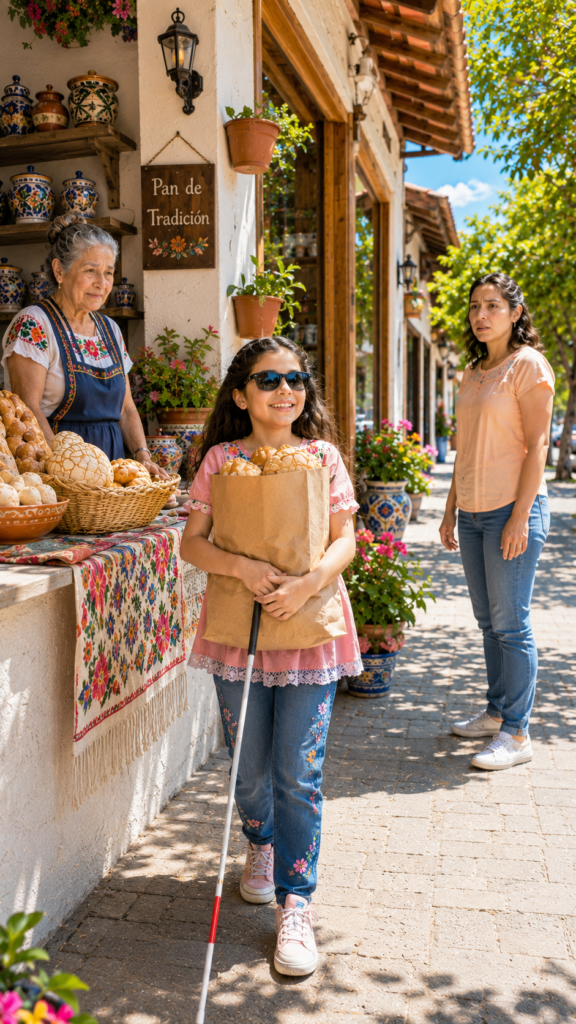
The girl emerged from the bakery, clutching a bag of bread almost larger than her chest, smiling as if she had just touched the sky with her hands.
—Mom, the lady called me "my little sugar lump" —Sofi said, beaming—. Just like my grandma used to in my dreams.
Mariana froze on the sidewalk of an old street in Coyoacán, surrounded by the noise of cars, the scent of freshly baked bread, and the soft tap of her daughter's white cane hitting the ground.
That nickname no one said.
No one.
Only a woman Sofi believed was dead for six years.
A woman Mariana had erased from her home, from her photos, from her prayers, from her life.
Her own mother.
Doña Teresa.
Sofi was seven and blind. But Mariana always said her daughter saw better than anyone. She saw with her fingers, her nose, her ears. She knew when a concha was well-made just by touching the sugary crust.
The two lived in a tiny apartment in the Portales neighborhood. Mariana sold homemade bread on order, washed other people's clothes, and did whatever it took to ensure Sofi lacked for nothing.
That day, she had given Sofi ten pesos and let her go inside alone to buy a piece of bread.
It was an exercise in trust.
Or so she thought.
When Sofi came out, she carried bolillos, conchas, chilindrinas, two ears, and even a cake wrapped in paper.
—Did you really get all that for ten pesos? —Mariana asked, trying to sound calm.
—The lady said it was a gift —Sofi replied—. She let me smell all the breads. She explained which had cinnamon, which had butter, and which sounded crunchy. Isn’t she sweet?
Mariana felt her stomach clench.
—What was her voice like?
Sofi smiled.
—Soft. Like when someone laughs a little. And her hands smelled like anise… just like the conchas you make.
Mariana stared at the storefront.
The bakery hadn’t been there the previous week. She passed that street every day on her way to the market. There used to be a rusty curtain and an empty shop.
Now there was a hand-painted sign: “The House of the Oven.”
That afternoon, she left Sofi with the neighbor, inventing an errand for sugar.
But she returned to the bakery.
She pushed the door.
A bell tinkled.
Behind the counter, a woman with white hair was kneading dough with arms dusted in flour.
Mariana didn’t need to see her face.
She recognized those hands.
—It can’t be —she whispered.
The woman stood still.
Then she spoke without turning around.
—I knew you’d come, dear.
Mariana felt the floor shift beneath her.
—You’re dead.
Doña Teresa turned slowly. She was thinner, older, with deep dark circles and a weary look.
But alive.
—For the girl, yes —she said—. And perhaps it must stay that way.
Mariana clenched her fists.
—Did you dare to touch my daughter?
—I just gave her bread.
—You called her by her nickname.
Doña Teresa lowered her gaze.
—I let it slip.
Mariana let out a broken laugh.
—I told her for six years that her grandmother was in heaven. Six years I made her pray for you as if you were a saint. And now you come to open a bakery three blocks from my house?
Doña Teresa didn’t defend herself.
—I searched for you for years. Not to take her from you. Not to hurt you. I just wanted, before I went, my granddaughter to taste bread made by my hands.
Mariana felt rage, fear, and something worse: guilt.
—You have no right.
Doña Teresa lifted her face.
—No. I have no right to anything. But I do have little time.
Mariana then noticed the tremor in her fingers. The gray color of her skin. The handkerchief hidden beneath her apron.
—Are you sick?
The woman smiled sadly.
—My body is starting to give out.
Mariana swallowed hard, but the hatred came back like a blow.
—I don’t care. After what you did to Sofi, I don’t care.
Doña Teresa closed her eyes.
—Do you still think I did that?
Mariana approached the counter, trembling.
—I saw your hands next to her face. I saw my baby come out of the hospital without eyes. I saw how you took her from me.
The bakery fell silent.
Doña Teresa opened her eyes, filled with tears.
—No, Mariana. You didn’t see everything.
And then she said something that made Mariana feel the world split beneath her feet.
—Sofi wasn’t born blind… and you know perfectly who signed to save her life.
PART 2
Mariana left the bakery without buying anything, her legs weak and her throat tight.
Outside, Sofi waited for her, sitting at the entrance of the neighbor's building, hugging the bag of bread as if it were a treasure.
—Mom, can we go back to see the lady tomorrow? —she asked—. I like her. She smells nice.
Mariana didn’t answer.
That night she couldn’t sleep. She sat in the kitchen, staring at an open bag of flour, while Sofi breathed peacefully in her room.
For six years, Mariana had told the same story.
That Sofi was born blind.
That her grandmother Teresa had made an unforgivable mistake.
That because of those hands, her daughter would never see the light.
But the truth wasn’t so clean.
The truth smelled of hospitals, cold hallways, burnt coffee, and fear.
Sofi wasn’t born blind.
For fourteen months, she saw.
She saw Mariana’s face. She saw her toys. She saw the Christmas lights hanging in the apartment window. She laughed when her mom put a cloth on her head and pretended to be a clown.
Then came that photo.
A birthday photo taken with an old cell phone. In one of Sofi’s eyes, there was a strange white reflection, like a little stone of light.
Mariana thought it was the flash.
Doña Teresa did not.
The next day, they were already at the Federico Gómez Children’s Hospital.
The diagnosis fell like a stone.
Cancer in both eyes.
The doctor explained that if they didn’t operate quickly, the tumor could spread to the brain. It wasn’t a decision between seeing or not seeing. It was a decision between losing her eyes or losing the girl.
Mariana refused.
She screamed. She pleaded. She said they would find another doctor, another treatment, a cleansing, a miracle, whatever it took.
—I’d rather die —she said in that hallway.
But the one who could die was Sofi.
The girl’s father had already left by then. He sent two messages, promised to come to the hospital and never showed up.
So in that room were only Mariana, a sick girl, and Doña Teresa carrying a pain that didn’t fit in her body.
Mariana remembered the pen.
She remembered the document.
She remembered her hand trembling so much she could barely hold it.
And she remembered her mother’s hand on top of hers.
Not pushing her out of malice.
Holding her so she wouldn’t fall.
The next day, she returned to the bakery.
Doña Teresa was placing sweet bread on a tray. Upon seeing her enter, she didn’t ask anything.
—Tell me everything —Mariana ordered—. Don’t hide anything from me.
The woman wiped her hands on her apron and sat on a stool.
—You didn’t sign alone, dear.
Mariana clenched her jaw.
—Don’t call me dear.
Doña Teresa accepted the blow in silence.
—You had the pen in your hand, but you couldn’t. The doctor said there was no time left. If we waited longer, the cancer could spread. You cried and kept repeating no, no, no.
Mariana closed her eyes.
—Then you took my hand.
—Yes.
—And you signed.
Doña Teresa lowered her head.
—with your hand. Because legally it had to be your authorization. I just held it.
Mariana felt nauseous.
—And why did you never tell me?
Doña Teresa let a tear fall.
—Because when Sofi woke up and you saw her bandaged, you looked at me like I was a monster. And in that moment, I understood something very ugly.
—What?
—That if you accepted that you also signed, you would break forever.
Mariana was left speechless.
Doña Teresa continued, her voice small.
—A mother can hate her mother and still stand. But a mother who believes she chose to take her daughter’s eyes… I don’t know if she survives that.
Mariana slammed her palm on the counter.
—You let me hate you for six years!
—Yes.
—I told Sofi you were dead!
—Yes.
—I erased you from everything!
Doña Teresa lifted her gaze, weary.
—And it worked. Sofi had a whole mother. A mother who didn’t drown. A mother who could get up to sell bread, take her to therapy, and teach her to walk with her cane.
Mariana began to cry.
Not like someone who cries beautifully.
She cried with her face twisted, with rage, with shame, with six years stuck in her chest.
—I blamed you for everything.
—I know.
—I called you a murderer.
—I know that too.
—And you… you said nothing.
Doña Teresa smiled faintly.
—It was the only thing I could still do for you.
Then Mariana saw her mother’s hands up close.
Stained, swollen hands, with blue veins and weak nails. Hands that hadn’t taken Sofi’s life. Hands that had signed for her to keep breathing.
—How much time do you have left? —she asked.
Doña Teresa looked toward the oven.
—Little. Maybe weeks. Maybe days. That’s why I put the oven here. I wanted Sofi to hear the bell. To smell the bread. To come in without fear.
—And what if I tell her who you are?
The woman shook her head immediately.
—No.
—She has the right to know.
—She has the right to love without carrying a story she didn’t ask for.
Mariana wiped her face angrily.
—And what do I do with this?
Doña Teresa took her time to respond.
—You carry it. Just as I carried mine.
The next day, Mariana took Sofi to the bakery.
The girl entered excited, touching the counter with her fingers.
—Good morning, pretty lady.
Doña Teresa brought a hand to her mouth.
—Good morning, my… good morning, child.
Mariana noticed how she swallowed the nickname.
But Sofi smiled.
—You can call me sugar lump if you want. I like it.
Doña Teresa closed her eyes.
Mariana had to look away to avoid breaking down.
From that day on, it was every day.
For twenty-three mornings, Sofi entered “The House of the Oven” and learned to recognize breads by their smell.
Doña Teresa described each piece as if it were a painting.
She told her the conchas were clouds in a dress of sugar. That the ears were butterflies crushed by the wind. That the bolillos sang when they came out of the oven.
Sofi laughed heartily.
Mariana watched from a table, never telling the truth.
Sometimes she hated her mother for coming back.
Sometimes she hated her for sacrificing herself.
And sometimes, when she saw her caressing Sofi’s hair with almost religious care, she loved her so much it hurt to breathe.
On the twenty-fourth day, the bakery’s curtain was down.
There was no smell of bread.
The bell didn’t ring.
Mariana understood before they called her.
Doña Teresa died in the early morning, in a hospital bed, without making a sound, as if even in leaving she asked for permission.
A nurse handed her an envelope.
Inside was a napkin from the bakery, folded into fours.
The handwriting trembled, but it was clear.
“Mariana, never tell her I was her grandmother. Let her remember me as the lady who gave her bread. Don’t place a sorrow on her that isn’t hers. I have already carried being the bad one. You carry being her mother. That is more important.”
Mariana sat on a bench in the hospital and cried until she had no strength left.
There was no grand wake.
There were no speeches.
Just a simple box, three neighbors, a rushed priest, and Mariana standing, with a guilt she no longer knew where to place.
Sofi asked about the lady the next day.
Mariana knelt in front of her.
—She went on a trip, my love.
Sofi touched her face.
—Are you crying?
—A little.
—Did you love her?
Mariana couldn’t lie.
—Yes. Very much.
Sofi fell silent.
Then she pulled out a concha wrapped in paper from her backpack.
—She gave it to me on the last day. Said it was for when I missed her.
Mariana hugged her gently, as if her daughter could break.
The concha remained in a shoebox inside Sofi’s closet.
With the months, it hardened. It lost its smell. It cracked a little at the edge.
But Sofi wouldn’t let anyone throw it away.
—It’s from the lady —she would say—. The good lady.
Mariana never told her that the lady was her grandmother.
She never told her that those hands saved her life.
She never told her that for six years she had hated the person who allowed herself to be destroyed so she could continue being a mother without drowning in guilt.
Every morning, before waking Sofi, Mariana would open the closet and look at the box.
And she understood something that haunted her more than any punishment.
Sometimes love doesn’t come clean.
Sometimes it comes disguised as a lie, as warm bread, as a grandmother dead in life, and as a mother who prefers to be hated rather than see her daughter sink.
The most unjust thing wasn’t that Mariana hated Doña Teresa for six years.
The most unjust thing was that when she finally could say "forgive me, Mom," there was no one on the other side of the counter to hear her.





