PART 1
At 9:43 PM, Irene Rivas's phone rang on the bed, right on top of the fuchsia dress she planned to wear by the sea.
There were 11 hours left before she and her husband, Julián, were set to board a flight from Guadalajara to Huatulco.
This wasn’t just any trip.
It was the journey they’d postponed for 5 years, their 35th anniversary, the simple promise of sitting by the ocean without checking watches, without taking care of children, without resolving anyone else's debts, without running after anyone.
Irene was 58, still folding clothes with the speed of a woman who had never allowed herself to be tired.
From the dining room, Julián was carefully reviewing the printed tickets as if they were sacred documents.
When she saw her son’s name on the screen, Irene smiled.
“Surely he wants to wish us a good trip,” she said.
But on the other end, there was no warmth.
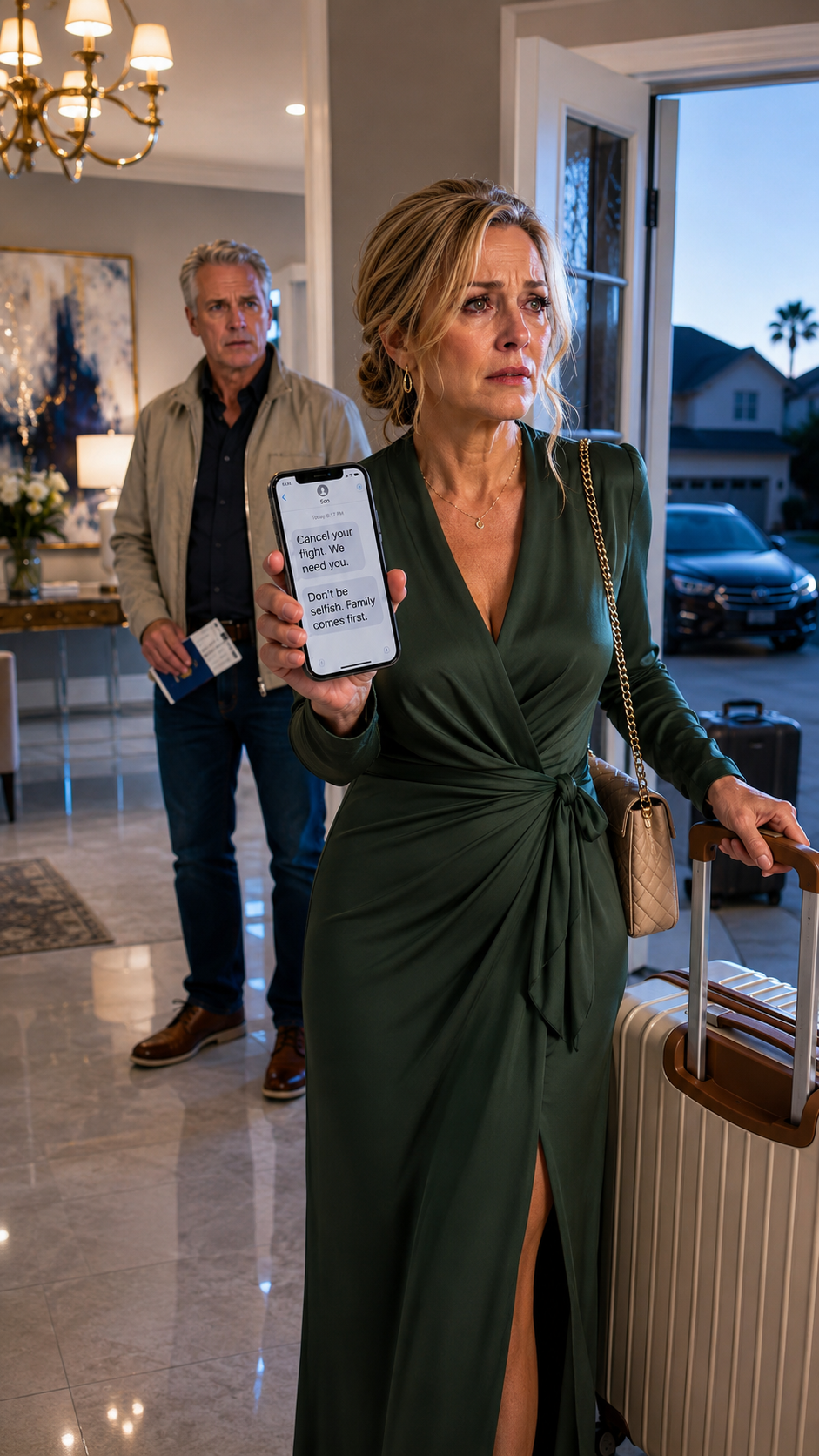
“Mom, cancel your flight.”
Andrés's voice didn’t sound worried.
It sounded like a command.
Irene froze, a blouse in her hand.
“What happened?”
“Mariana starts a training at her company tomorrow. It’s all week. We need you to stay with Valentina and Diego.”
Irene closed her eyes.
Valentina was 6. Diego, 3.
They were her grandchildren, her weakness, her joy, the reason she had often put her own life on pause.
“Andrés, our flight leaves tomorrow at 8:00.”
“I know.”
That sentence hurt more than a scream.
Because he did know.
He had known for months that his parents had paid for the trip. He knew they had saved every peso, selling even an old chair and skipping Sunday dinners out.
He knew Irene had been talking for weeks about that sea as if it were a medicine.
And yet, he waited until the night before.
“Hijo, everything is paid for,” she said.
“Well, see if they can reimburse you. Family comes first.”
Immediately, another message arrived.
“Don’t be selfish. Cancel the trip. We need you.”
Irene read those words twice.
Julián appeared in the bedroom doorway.
“Is everything okay?”
She looked at him.
Saw his new shirt hanging on the back of the chair. Saw his recently bought sandals. Saw the shy glimmer in his eyes, a sparkle she had dimmed for years by saying, “Better later, now Andrés needs something.”
“No,” Irene replied. “But I think I understand now.”
Andrés called again at 10:17.
He spoke non-stop.
That the babysitter was extremely expensive. That Mariana couldn’t miss work. That Valentina’s school was far away. That Diego didn’t sleep with just anyone. That only Irene knew how to heat his milk without him throwing a tantrum.
All of it was true.
And that’s why it hurt so much to say no.
“Andrés,” she said, her throat tight, “I love you, but I’m not canceling my trip.”
On the other end, there was silence.
Then her son’s voice turned cold.
“Then remember this when you need something.”
For 35 years, Irene would have apologized.
Not that night.
“I will remember,” she replied.
And hung up.
At 5:26 AM, while the coffee boiled in the kitchen, the last message arrived.
“If you get on that plane, don’t ever call us again.”
Julián read the screen and lowered his gaze.
“We can still stay, Irene.”
She grabbed her suitcase.
Her hands trembled.
It hurt to be a mother and choose herself at the same time.
“No. We’re going.”
When they closed the door to the house, the phone began to ring again.
For the first time in decades, Irene didn’t answer.
And as the taxi drove towards the airport, she couldn’t imagine what Andrés was willing to do to punish her.
PART 2
The Guadalajara airport was half-empty when Irene and Julián arrived with their two suitcases.
She walked as if she were committing a terrible crime.
It wasn’t a crime, of course.
But for a mother who was used to always being available, getting on a plane while her son was angry felt almost like betrayal.
The phone vibrated inside her bag.
Once.
Again.
One more time.
Irene didn’t take it out.
Julián took her hand before they went through security.
“You don’t have to do this for me,” he said. “If you want to go back, we’ll go back.”
She looked at him.
Her husband had tired eyes. Not from waking up early, but from years of staying silent every time their plans fell through due to an “emergency” from Andrés.
Canceled birthdays.
Postponed medical appointments.
Handed-over weekends.
Money lent that never returned.
Irene had called all that love.
Julián had called it silence.
“I want to go,” she said. “Even if it scares me.”
In the waiting area, she made the mistake of checking her phone.
There were 23 messages.
Andrés wrote:
“Nice. Grandma is going to the beach and her grandkids are stuck wondering who’s taking care of them.”
Mariana wrote:
“I thought I could count on you.”
Then Andrés again:
“Valentina asked why her grandma preferred the hotel.”
Irene felt her chest breaking.
Valentina shouldn’t have to bear that phrase.
Neither should Diego.
No child deserved to be used as a knife in an adults’ fight.
She got up and walked to the bathroom.
There, locked in a stall, she cried silently.
She wanted to record an audio.
Wanted to say that she wasn’t abandoning them, that she had cared for those children since they were born, that she had made soups, helped with homework, stayed up during fevers, bought uniforms, attended festivals, and even paid tuition when Andrés said, “Mom, we’re struggling this month.”
But she sent nothing.
Because she understood something that frightened her.
If she responded from guilt, she returned to the cage.
When boarding was announced, Julián was standing, waiting for her.
“Ready?”
Irene looked at the airplane door.
Then looked at her phone.
And put it on airplane mode.
As they took off, she thought the guilt would leave her breathless.
But it didn’t.
What came was silence.
A strange, uncomfortable silence, like when a house stops hearing screams and doesn’t know what to do with the calm.
They landed in Huatulco under a strong sun and the scent of salt.
Irene turned on her phone as soon as they got off the plane.
She expected more complaints.
There were some.
But among them was a message from Lupita, her lifelong neighbor.
“Irene, sorry to bother you. Andrés and Mariana entered your house about an hour ago. They had keys. They left with a green folder and a bag from your study. Did you know?”
Irene felt her legs go weak.
Julián read the message over her shoulder.
“What green folder?”
She knew.
The bank folder.
The one with account statements, copies of deeds, additional cards, policies, and passwords written down “for any emergency.”
Also inside was the authorization Andrés had on a savings account because Irene had put it there “out of trust” after Julián had a minor operation.
Suddenly, everything that had once sounded normal began to look different.
It wasn’t trust.
It was a door wide open.
They didn’t go to the hotel.
They sat in an airport café with their suitcases beside the table and two untouched coffees.
Julián spoke first.
“Call the bank.”
Irene obeyed, but not as before.
This time she wasn’t obeying her son.
She was obeying herself.
She blocked additional cards. Removed permissions. Changed passwords. Suspended access. Requested alerts on all her accounts.
The bank representative asked her twice if she was sure.
“Yes,” Irene replied. “I’m sure.”
Then she called Lupita.
“Did they force anything?”
“No, comadre. They entered normally. But they were angry. Mariana had a large bag. Andrés said something like ‘so she learns.’”
Irene closed her eyes.
So she learns.
That wasn’t help.
That was punishment.
Lupita lowered her voice.
“Sorry to butt in, but you did the right thing by leaving. Sometimes kids think a mom doesn’t have a lock.”
That phrase struck deep.
A mom doesn’t have a lock.
For years, Irene had lived that way.
Without a lock.
Without a schedule.
Without the right to say “not today.”
Her first impulse was to return immediately.
She wanted to check drawers, demand answers, scream, and insist.
But Julián placed a hand on the table.
“If we go back now, we’ll give him what he wanted. To end the trip.”
Irene looked out the window.
Outside, the palm trees swayed in a gentle breeze, as if the world didn’t know she was being crushed under a lifetime of habit.
“Then let’s go to the hotel,” she said.
The trip wasn’t perfect.
No sea wipes away 35 years of guilt in an instant.
On the first day, Irene barely spoke. She walked along the beach, eyes fixed on the foam, thinking of Valentina, of Diego, of Andrés's furious face.
On the second day, Julián took her to a small place for memelas and coffee from a pot.
She laughed for the first time when a waitress said:
“Ma’am, you look like you needed this trip since before the pandemic.”
Irene let out a laugh so unexpected that she covered her mouth.
Julián looked at her as if he had just found something he had lost.
On the third day, they bought hats at a market. Irene chose one ridiculously large. Julián said it looked like she was a novel’s artist.
She playfully slapped his arm.
“Oh, don’t start, old man.”
And for a brief moment, they were just two married people, not emergency grandparents, not available parents, not anyone's backup.
That night, on the hotel terrace, Irene pulled out a notebook.
She wrote three sentences.
“I’m not a bad mother for resting.”
“My children can solve problems without using me as an automatic solution.”
“To love doesn’t mean to disappear.”
On the fourth day, a message arrived from Mariana.
“We found a lady recommended by my sister. She was expensive, but everything is fine now.”
Irene stared at the screen.
Expensive.
That was all.
The supposed tragedy that demanded her anniversary be destroyed had been resolved with organization and money.
Not with her sacrifice.
Not with her guilt.
Not with her life put on hold again.
She showed the message to Julián.
He sighed.
“How do you feel?”
Irene thought of many words.
Sad.
Angry.
Free.
Guilty.
Light.
“Like I had been carrying a boiling pot and just discovered that it wasn’t even mine.”
Julián smiled.
Upon returning to Guadalajara, they didn’t enter the house as if nothing had happened.
First, they called a locksmith.
They changed the locks.
Then they checked the study.
The green folder had been moved. Copies of account statements, one additional card, and a sheet where Irene had written details of an investment account were missing.
She didn’t want to imagine for what purpose.
That afternoon, she called Andrés.
He answered on the second ring.
“Finally remember you have a son.”
“Tomorrow you’re coming to the house at 6:00,” Irene said. “You and Mariana. Without the kids.”
“Now you’re going to summon me?”
“Yes.”
“Mom, you’re exaggerating a ton.”
“Tomorrow at 6:00.”
And hung up.
Andrés and Mariana arrived at 6:28, late, as if even the clock were a way to challenge her.
Andrés walked in without greeting.
Mariana came with her arms crossed.
Julián sat next to Irene, serious, with a calm heavier than a fight.
On the table were the green folder, the blocked card, the copy of Lupita’s message, and a handwritten note.
Andrés saw everything and swallowed hard.
“What is this show?”
“It’s not a show,” Irene said. “It’s a conversation we should have had years ago.”
Mariana let out a dry laugh.
“All this because you didn’t want to take care of your grandkids for one week.”
Irene looked at her without hatred.
That surprised her.
She felt no hatred.
She felt tired.
“No. This started when you confused help with obligation.”
Andrés slammed his palm on the table.
“We are your family!”
Julián stood up.
“And I am too.”
The room fell into silence.
Andrés looked at his father as if he were seeing him for the first time in a long time.
Julián didn’t shout.
Didn’t insult.
He just spoke with a firm sadness.
“For years, I stayed silent to avoid putting your mother against you. I canceled trips, meals, medical appointments, breaks. But I won’t watch her tremble because you send her messages like a boss.”
Andrés clenched his jaw.
“I went in because I needed to check some papers. I’m her son.”
Irene took a deep breath.
“You’re my son. Not the owner of my house.”
Mariana barely lowered her gaze.
Irene pushed the handwritten note forward.
“From now on, the keys you had no longer work. Andrés is no longer authorized on any account. I canceled cards. Changed beneficiaries, emergency contacts, and passwords. This isn’t revenge. It’s clarity.”
“Are you punishing me?” Andrés asked.
“No. I’m stopping rewarding your threats.”
He opened his mouth but found no clear phrase.
Then Irene said the hardest thing.
“I love you. I love you, Mariana, Valentina, and Diego. I’ll continue to help when I can. But from now on, if you need us to take care of the kids, you’ll ask two weeks in advance. If we can, we’ll say yes. If not, you’ll find another plan. And if you ever use my grandchildren to hurt me again, this conversation ends.”
Mariana was the first to speak.
“We should have asked for this sooner,” she murmured.
Andrés looked at her, annoyed.
But he didn’t contradict her.
Irene still had the final blow.
She pulled out a printout from the bank.
“I also know you tried to use the additional card on Tuesday at a department store.”
Mariana went pale.
Andrés raised his voice.
“It was to buy things for the kids.”
“It was for 14,800 pesos,” Irene replied. “On perfumes and clothes.”
The silence shifted in temperature.
Mariana covered her face with one hand.
Andrés no longer looked furious.
He looked exposed.
“Mom, I…”
“Don’t explain something you can’t justify.”
That phrase dropped like a stone.
There were no hugs.
No immediate forgiveness.
No pretty ending with music and perfect tears.
Real life doesn’t tidy up pain so easily.
Andrés and Mariana left 20 minutes later. Irene closed the door without running after them.
For three weeks, Andrés spoke little.
Irene didn’t chase him either.
Didn’t send long messages. Didn’t beg. Didn’t try to fix in one afternoon what had twisted over years.
She continued with her life.
Went to the market with Julián. Started walking again in the mornings. Scheduled a cardiologist appointment she had postponed for 8 months. Bought herself some red sandals, just because she liked them.
And one Tuesday at 7:12 PM, a message arrived.
“Mom, could you and Dad take care of the kids next Saturday? If you already have plans, it’s no big deal.”
Irene read it three times.
Julián was watering the pots in the yard.
“What happened?”
She smiled slowly.
“He asked.”
That word was small.
But within that house, it sounded enormous.
On Saturday, they arrived with sweet bread.
Valentina rushed to hug Irene. Diego was holding a blue cart in his hand.
Andrés stood at the entrance.
“I brought conchas,” he said, awkwardly.
Julián took the bag.
“Conchas always help, son.”
They ate together.
It wasn’t perfect.
There were odd pauses, looks that still didn’t know where to land, careful phrases to avoid reopening wounds.
But it was different.
After they ate, Valentina sat next to Irene.
“Grandma, can you show me pictures of the sea?”
Irene took out her phone.
Showed her the beach, the terrace, the huge hat, the golden waves at sunset.
“Is that why you didn’t come?” the girl asked.
Andrés tensed.
Irene stroked her granddaughter's hair.
“Yes, my love. Your grandfather and I had a very important trip. But that doesn’t mean I don’t love you.”
Valentina thought for a few seconds.
“My mom says that resting is important too.”
Mariana lowered her eyes.
Andrés said nothing.
But his face changed.
Perhaps he understood late that Irene hadn’t chosen the beach over her family.
She had chosen to continue being a person within herself.
That night, after everyone left, Irene stuck Valentina’s drawing on the refrigerator.
It was two figures holding hands in front of a huge wave.
“Those are you and my grandpa,” the girl had explained to her.
Irene stared at it for a long time.
For years, she believed that a good mother was the one who always answered, always could, always left her suitcase half-closed.
Now she understood something else.
A mother also teaches love when she sets boundaries.
Also cares when she says “not today.”
Also protects her family when she stops allowing herself to be manipulated in the name of blood.
Irene continued helping.
Continued loving.
Continued answering when there was a real emergency.
But she never again confused love with being available for others to live without planning.
Because that plane didn’t wait.
And after 35 years, her life didn’t have to keep waiting either.





