PART 1
Julián Armenta arrived at his home in San Miguel de Allende with a bouquet of white lilies and a heart racing with anticipation.
He had spent three weeks in Monterrey sealing a deal to save the family vineyards. On the way, he imagined Camila waiting for him at the door, one hand resting on her eight-month belly and that smile that always quieted the world.
But no one came out to greet him.
The house was dark.
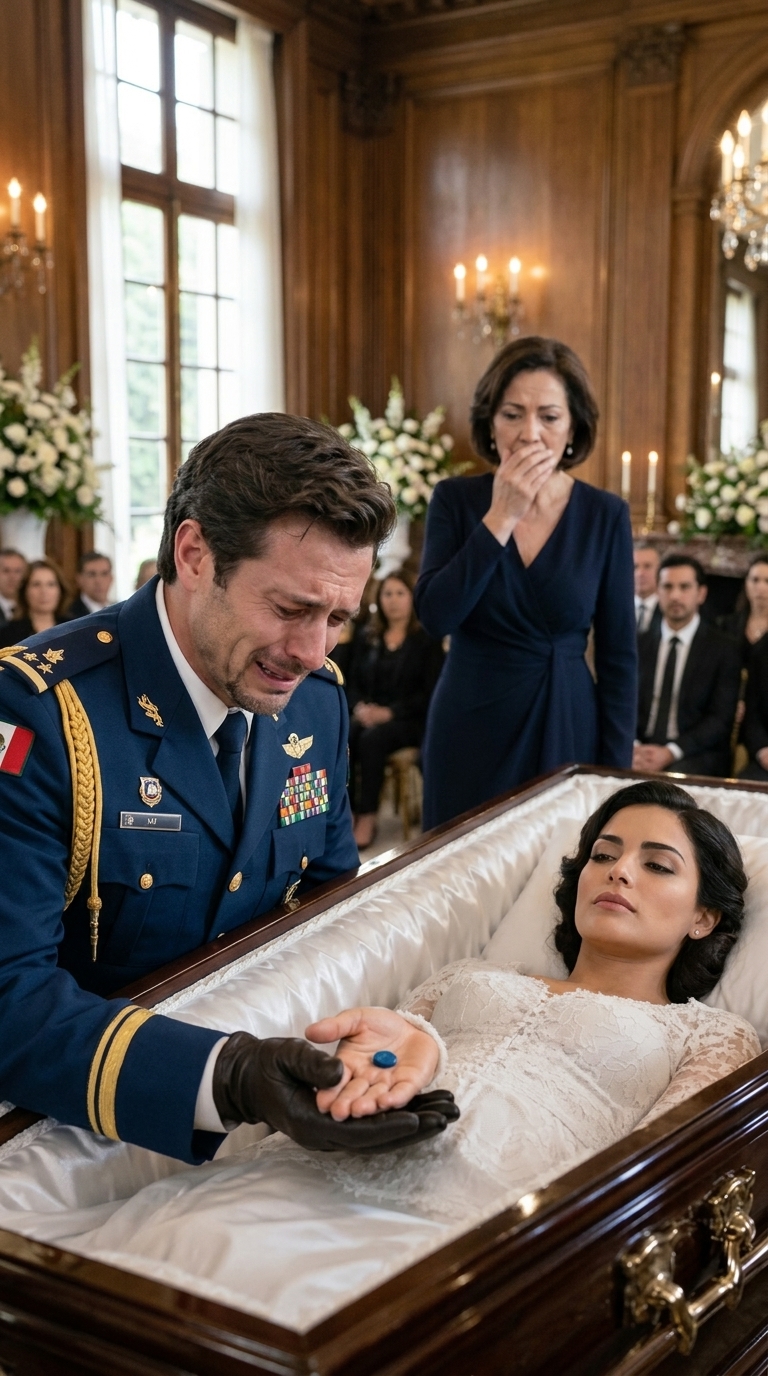
The windows were draped in black curtains. Candles flickered in the living room around an open coffin, placed exactly where Camila used to put fresh flowers every Sunday.
Julián dropped the bouquet.
The lilies fell to the floor as if they too had died.
His mother, Teresa Armenta, stood by the fireplace, dressed in black, immaculate, with red lips and a steely gaze.
“Your wife died giving birth,” she said without a tremor. “And your son didn’t survive either.”
Julián didn’t grasp those words at first. Not because they were difficult, but because they sounded too clean, too rehearsed.
He approached the coffin.
Camila lay there, pale, beautiful, hair meticulously styled. She looked asleep, but something in that scene clenched his chest tighter than death.
Camila despised when the hands of the dead were crossed over their chests.
She always said a person wasn’t a display figure.
And yet, one of her hands rested over her white dress.
The other was clenched.
Tightly.
Too tightly.
Julián leaned down to touch it.
“Don’t disturb her,” Teresa ordered.
He lifted his gaze.
“She’s my wife.”
“You can’t do anything for her now.”
That coldness didn’t sound like mourning. It sounded like fear.
Julián took Camila’s stiff fingers and began to pry them open, one by one, gently. The two housemaids stood frozen against the wall.
Teresa stepped forward.
“I told you to leave her be!”
But Julián did not obey.
Inside Camila’s hand was a navy blue button, yanked free. A thread of dark fabric remained under her nails, as if she had fought back until the last second.
Julián recognized the button immediately.
It belonged to Rodrigo, his older brother’s favorite jacket.
At that moment, Rodrigo appeared from the hallway with a glass of whiskey in hand and sunglasses on indoors.
“Julián, don’t make a scene,” he said. “It’s already sad enough that you arrived late to your own wife’s funeral.”
Julián stared at him.
Rodrigo had a fresh scratch on his neck.
A red line under his jaw.
Teresa turned pale.
“Julián, don’t make ridiculous assumptions,” she whispered.
He tucked the button into his pocket, never taking his eyes off his brother.
“Too late, Mom.”
PART 2
Rodrigo offered a faint smile, as if he still believed Julián was the same calm man he had always been. The brother who avoided conflict. The one who preferred silence to avoid breaking the family.
But Camila had taught him something before she died.
Silence could also be a way to hand over your neck.
“I want to see the medical report,” Julián said.
Teresa let out a dry laugh.
“Medical report? Your wife is dead. Your son is dead. Accept reality and don’t turn this into a circus, please.”
“Which hospital?”
“At Santa Lucía.”
“Then there will be a record.”
Rodrigo slammed the glass down on a table too hard.
“Seriously, brother, are you going to do this today? There are people outside. Priest. Neighbors. Local press. You can’t just destroy the Armenta name.”
Julián felt rage but didn’t let it out.
That was what they wanted.
A scene.
A grieving husband out of control.
A broken man saying foolishness in front of everyone.
That way they could call him crazy.
That way they could close the coffin before dawn and burn the truth with Camila inside.
“I’m not going to make a scene,” he murmured.
Rodrigo breathed a sigh of relief.
So did Teresa.
They thought they had won.
Julián allowed them to continue giving orders. He listened to his mother say that the cremation needed to be done quickly, because “prolonging the pain was cruelty.” He heard Rodrigo receive condolences as if the corpse were his.
When everyone went out to the patio, Julián ascended to his father’s study.
He locked the door.
Behind his grandfather’s portrait was the safe. Teresa thought no one knew the combination. But Camila had discovered it six months earlier when she started reviewing the vineyard accounts.
Inside were copies of false invoices, hidden transfers, and forged signatures.
There was also a power of attorney.
Camila and Julián had signed it in secret. If anything suspicious happened to her, Julián was authorized to investigate her assets, her shares, and any documents related to her death.
Camila had never trusted Teresa.
And she was right.
Julián took the phone and called Dr. Ana Lucía Méndez, a friend of Camila’s and director of Santa Lucía Hospital.
She answered almost immediately.
“Julián,” she said in a low voice. “I’ve been trying to reach you for hours.”
His blood ran cold.
“Tell me the truth.”
There was silence.
Then Ana Lucía whispered:
“Camila didn’t arrive alive at the hospital. They brought her without a wristband, without a record, without identification. Your mother demanded immediate cremation.”
Julián closed his eyes.
“And my son?”
The doctor breathed shakily.
“I can’t say over the phone. Come tomorrow at six through the emergency entrance. Come in the back. And for God’s sake, don’t tell anyone.”
Julián hung up and stared at the dark window.
Until that moment, he had been a widower.
From that moment, he became a witness to a crime.
At 5:40 in the morning, he left the house quietly. He carried the blue button in a small bag, Camila’s documents, and a copy of the transfers Rodrigo had made to an account in Panama.
At the hospital, Ana Lucía waited for him in a coat, dark circles under her eyes, and a red folder pressed to her chest.
“There’s something you need to see,” she said.
She led him to a records room. She closed the door.
On the table, she placed three documents.
The first was Camila’s admission report.
It was signed by Rodrigo.
The second was a request for immediate cremation.
Signed by Teresa.
The third made Julián feel as if the floor were opening beneath his feet.
It was a birth certificate.
A live baby.
Born at 2:17 AM.
“Your son didn’t die,” Ana Lucía said. “They took him away from the hospital before I could report it.”
Julián couldn’t breathe.
“Who took him?”
Ana Lucía swallowed hard.
“A woman hired by your brother. She posed as a nurse. The cameras captured her leaving through the suppliers’ door with a covered stroller.”
Julián slammed his hand on the table.
“Where is my son?”
“I don’t know. But Camila arrived with marks on her arms. Her nails were broken. They found blue fabric fibers in her hand. I saved the samples before your mother could make them disappear.”
Julián pulled out the button.
Ana Lucía looked at it and understood everything.
“Julián… this could send them to jail.”
“I don’t want ‘could.’ I want names.”
The doctor opened another file.
“The woman’s name is Maribel Chávez. She worked for years as a nanny in families’ homes in Querétaro. The address she gave is fake, but she left a number.”
That number led Julián to a tenement in Celaya.
He didn’t go alone. He called Elena Vargas, a criminal lawyer and old friend of Camila. He also called a commander who had investigated frauds involving his family years ago.
At 3 PM, in front of a faded green door, they heard a baby cry.
Julián froze.
It wasn’t just any cry.
It was the sound of life they had stolen from him.
The commander knocked.
No one answered.
He knocked again.
Then a woman appeared with a twisted face. She had dark circles, an old robe, and fear in her eyes.
“I didn’t do anything,” she said before anyone could ask.
Julián pushed the door open with his gaze.
In an improvised crib lay a baby wrapped in a blue blanket.
His son.
Alive.
Small.
With his fists clenched like Camila’s.
Julián approached, but his legs almost didn’t respond. When he picked him up, the baby stopped crying for a few seconds.
As if he recognized something.
As if Camila had saved that moment for him from the other side.
Maribel collapsed into a chair.
“Rodrigo paid me 500,000 pesos,” she confessed. “He said Mrs. Camila was going to die and that the baby had to disappear. That his mother had everything arranged with the funeral home.”
“Why?” Elena asked.
Maribel looked at the ground.
“Because the child inherited Camila’s shares. And if Camila lived, she would report the fraud.”
Julián felt a brutal cold.
It wasn’t just hate.
It was business.
It was ambition.
It was his mother deciding that a pregnant woman was an obstacle.
That night he returned to San Miguel with the police, the lawyer, the doctor, and his son in his arms.
At home, Teresa was in the living room coordinating the cremation. Rodrigo was talking on the phone near the coffin.
When he saw Julián enter with the baby, he lost color.
Rodrigo dropped the phone.
“What is this?”
Julián stepped forward without shouting.
“Your nephew.”
Teresa clutched her chest.
“That child is not—”
“Be careful what you’re about to say, Mom.”
Julián’s voice was so low that everyone fell silent.
The commander showed the search warrant.
“Rodrigo Armenta, Teresa Armenta, you are both under arrest for child abduction, forgery, and probable homicide.”
Rodrigo tried to laugh.
“You have no proof, dude. This is crazy.”
Then Julián pulled out the blue button.
Then Elena showed the hospital video.
Ana Lucía handed over the fabric fibers.
And Maribel, escorted by two police officers, pointed a trembling finger at Rodrigo.
“He paid me. He said Mrs. Camila held onto the jacket when he tried to take the baby away.”
Rodrigo took off his glasses.
The scratch on his neck was still there.
Teresa, however, didn’t look at anyone.
Her mask had shattered, but not out of guilt.
Out of shame.
“I saved this family,” she suddenly said. “Camila was going to destroy everything. She was going to hand the vineyards over to lawyers, banks, rats. Rodrigo did have character. You’ve always been weak, Julián.”
He held his son tighter.
“No, Mom. Weak was Rodrigo when he attacked a pregnant woman. Weak was you when you confused surname with impunity.”
Teresa glared at him with hatred.
“Without me, you are nobody.”
Julián looked at the coffin.
Camila lay there, motionless, but she no longer seemed alone.
“Without Camila, maybe I would have taken longer to understand it,” he said. “But no one will ever touch my son again.”
Rodrigo tried to approach him.
“Brother, listen to me. This got out of control. I didn’t want to kill her. I just wanted to scare her. She got intense, started shouting, scratching me…”
Julián didn’t move.
“Thanks for confessing.”
Rodrigo understood too late.
The commander was already recording on his phone.
Teresa screamed and tried to stop the police, but they ended up handcuffing her in front of the same neighbors she had invited to act out her perfect tragedy.
The news exploded throughout Guanajuato.
The “respectable family” of the Armenta vineyards was exposed for what it truly was: a house full of money, secrets, and cruelty.
Days later, Camila was buried as she wanted.
With her hands unclasped.
Without excessive makeup.
Without lies.
Julián placed one white lily beside her and a photo of his son, whom he named Mateo, just as she had chosen.
In the trial, Rodrigo was sentenced for homicide, child abduction, and fraud. Teresa fell for concealment, forgery, and complicity. The vineyards were placed in a trust in Mateo's name, managed by Julián until he turned 21.
But justice didn’t bring Camila back.
That was the cruelest part.
The truth won, yes.
But it came with a crib in one hand and a grave in the other.
Years later, when Mateo asked why his mom wasn’t there, Julián didn’t tell him a pretty story.
He told him the truth with soft words.
He said Camila had been brave.
That she had protected him even with her last breath.
That in her clenched hand, she hadn’t held hate, but a clue for him to live.
And every time someone in San Miguel said that “family matters are settled at home,” Julián would reply the same:
“No. Crimes are not family. They are crimes.
Because sometimes blood weighs heavily.
But the truth, when it finally comes out, weighs more.





