PART 1
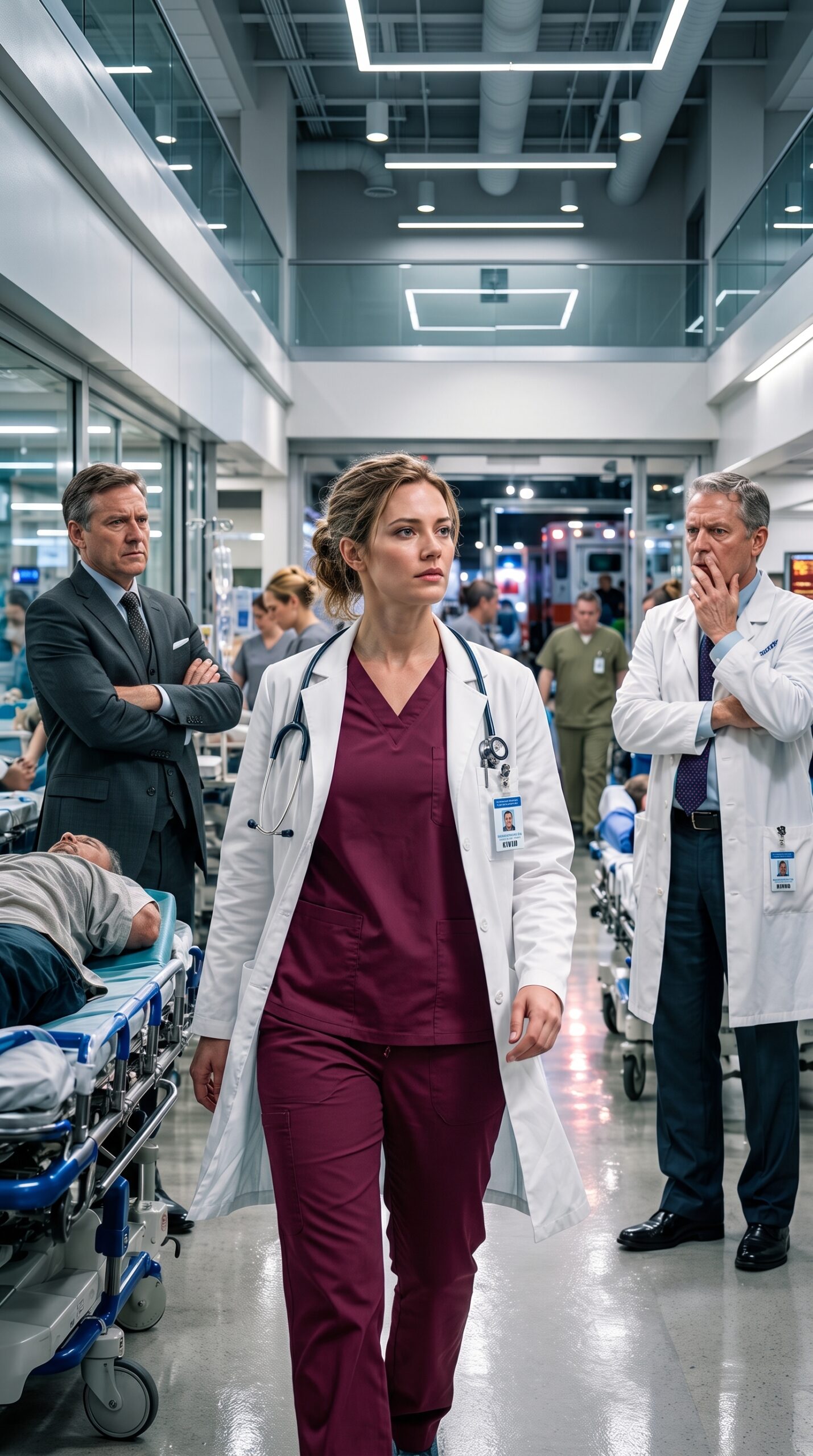
At 10:18 in the morning, at San Gabriel Hospital in Tlalpan, nurse Elena Rivas lost her badge in front of 3 residents, 2 orderlies, and a waiting room full of patients who pretended not to watch.
Doctor Andrés Solórzano ripped it from her uniform with a calm more cruel than a scream.
—You’re suspended, Rivas. No pay and no access to the clinical area until the committee decides what to do with you.
Elena didn’t lower her gaze.
She was 41, her hair pulled back with a black band, and those dark circles that only those who have seen too much death and keep arriving early to work possess.
—Mr. Oscar was bleeding out inside —she said—. If I had waited for your authorization, we’d be calling his family to say goodbye right now.
Solórzano clenched his jaw.
Mr. Oscar Neri, a mechanic from Iztapalapa, had arrived 2 hours earlier with abdominal pain after a minor crash. The doctor said it was anxiety. Elena saw the cold skin, the dropping pressure, that rare silence of patients who no longer have the strength to complain.
She activated the operating room without permission.
The man arrived alive for surgery.
That, for Solórzano, didn’t erase the disobedience.
—We’re not in the Army here —he said, not knowing where he had just stuck his finger—. Here there are hierarchies.
Jaime, a young nurse who had admired Elena since her first shift, wanted to speak.
Elena barely shook her head.
No.
In a hospital, defending someone could cost you more than staying silent.
Security escorted her to the exit as if she were a thief. Outside, the rain fell heavily on Calzada de Tlalpan. Elena packed her belongings into a cardboard box: a dented thermos, some old scissors, a folded photo of a group of soldiers in a dusty northern area, and a holy card of the Virgin of Guadalupe that a patient had given her.
Before getting into her car, she heard the sirens.
First 1.
Then 3.
Then so many that the avenue seemed to open up in pure fear.
Jaime came running through the emergency door, soaked, pale as paper.
—Elena…
—Don’t say that if you’re coming for hospital politics.
—A bus overturned on the Mexico-Cuernavaca highway. Dozens are coming. Doctor Solórzano can’t keep up. There’s no trauma chief. They’re calling everyone.
Elena looked at the badge she no longer had.
—I’m suspended.
Jaime swallowed hard.
—Yes.
Behind her, a paramedic was bringing down a child with a face covered in blood. Another was shouting that a woman wasn’t breathing well. A mother was banging on the ambulance door because she couldn’t find her daughter.
Elena closed the box.
And walked back to the hospital from which she had just been thrown out.
When she crossed the automatic doors, Solórzano saw her from the hallway.
—What are you doing here?
Elena put on gloves.
—What you are not doing.
PART 2
No one moved for 2 seconds.
Just 2.
But in the ER, 2 seconds could become a tomb.
Elena surveyed the room. There was blood on the floor, family members crying, paramedics talking at the same time, doctors just coming out of consultations trying to look calm, and nurses searching for instructions that no one was giving.
Doctor Solórzano’s eyes were lit with rage, but also fear.
That’s what Elena noticed first.
He wasn’t in charge.
He was reacting.
—Red to the left hallway —she ordered—. Yellow to imaging. Green to the cafeteria with 1 nurse, 2 volunteers, and water. If they’re walking, wait. If they’re quiet, it doesn’t mean they’re okay. If they scream, it doesn’t mean they’re dying.
A resident raised his hand like a chastised child.
—But you don’t have authorization.
Elena pointed to a man lying against the wall, his lips gray and a jacket soaked with blood inside.
—He has 5 minutes if we keep asking nonsense.
The resident turned.
His face changed.
—Stretcher! —he shouted.
—Don’t shout —Elena corrected—. Assign. You, you, and you: stretcher. Jaime, 2 large-bore IVs and O negative blood. Raúl, call the OR and tell them unstable abdominal trauma. No drama. With details.
The room started to reorganize around her.
Not because she had a clean uniform.
Not because she had a title.
But because every order sounded like a rope thrown in the middle of a flood.
Elena didn’t run. She walked fast. Running made others follow your panic. She moved as if chaos had corners and she knew them all.
—That child isn’t stable, he’s compensating.
—The woman on stretcher 4 needs a needle now, she has a pneumothorax.
—That gentleman can wait 15 minutes. She can’t wait 5.
—Get the family member out of the red area before they faint and we have patient 58.
After 20 minutes, the same ones who had doubted started to look for her before touching a patient.
After 30, even Solórzano stopped contradicting her.
After 40, no one mentioned suspension again.
Then a young man in National Guard uniform entered, a bandage tight on his thigh and his face pale from bleeding. Two paramedics held him up.
Seeing Elena, he tried to stand straight.
—Sergeant Rivas?
Silence fell like a metal tray.
Jaime turned.
Solórzano froze.
The young man struggled to breathe.
—Sonora, 2018. You pulled my brother out when the tanker exploded. I told him not to sleep. That if he did, I would charge him for the scare.
Elena looked at him for barely 1 second.
—Your brother was named Iván?
The boy let out a broken laugh.
—Yes.
—And he cried for some Cheetos.
—Yes, sergeant.
The word spread through the ER.
Sergeant.
Not a troublesome nurse.
Not a woman who didn’t know how to obey.
Sergeant.
People suddenly understood that Elena’s calm hadn’t come from a motivational course or a quality meeting. She had learned it where dust got into your mouth and screams didn’t always reach to save someone.
Solórzano looked down.
For the first time that day, his authority seemed paper-thin.
Elena didn’t even humiliate him.
—Doctor, the blood bank is making excuses. We need someone with weight to release more O negative.
Everyone waited.
Solórzano could mention the suspension. He could regain his ego. He could wield the regulations as a club.
But he saw the man from the wall entering alive into the OR.
He saw Jaime working without trembling.
He saw the resident following the triage board that Elena had set up with tape and marker.
And perhaps he understood, too late, the difference between being obeyed and being useful.
—I’ll call —he said.
He stepped aside.
It wasn’t an apology.
But it saved time.
The afternoon became a line of impossible decisions.
A mother and her son arrived on separate stretchers, both asking for the other. Elena sent the boy to yellow because fear made him cry, but his body was still fighting. She sent the mother to red because her abdomen was hard under the sheet.
A tamale vendor had burned hands from breaking the bus windows before the firefighters arrived.
—I’m sorry for taking up a bed —he murmured.
Elena bandaged his fingers carefully.
—You already saved lives before you got here. Now shut up for a bit and let someone save yours, okay?
He cried silently.
At 3:27, Jaime broke.
She had an IV in hand, tape stuck to her glove, and a woman screaming in the hallway who couldn’t find her husband.
—I can’t —Jaime sobbed—. Really, I can’t.
Elena stood in front of her.
She didn’t hug her.
Not at that moment.
—Yes, you can.
—No.
—Bed 6 needs that IV.
—I’m sorry.
—You’ll be sorry later.
Jaime looked at her with tear-filled eyes.
Elena lowered her voice.
—When this is over, you sit on the floor, cry, curse, and I’ll sit with you. But right now your hands still work.
Jaime took a deep breath.
—My hands still work.
—Use them.
Jaime placed the IV on the first try.
At 4:18 came the decision no one wanted to carry.
There was 1 ventilator.
2 patients.
A young soldier with a crushed chest, still responding to stimuli.
And an older man, Pedro Langarica, with a brain injury, a pupil starting to fixate and life slipping away in stages.
Elena checked both bodies.
She hated being able to see the difference.
She hated that experience made clearer a choice no human being should have to make.
—The ventilator goes to the soldier —she said.
No one argued.
But 5 minutes later, Pedro’s wife appeared.
Doña Clara came in soaked, with her bag broken against her chest, searching with her eyes for her husband.
She saw the ventilator.
She saw the soldier connected.
She saw Pedro without one.
Wives, mothers, and daughters read a room faster than doctors believe.
—Why him? —she whispered.
Elena walked towards her before anyone else.
—Mrs. Clara…
—You took it away from my husband.
—Yes.
The honesty hit harder than any explanation.
Doña Clara slapped her.
The sound split the hallway.
Jaime took a step. So did Solórzano.
Elena raised a hand to stop them.
Her cheek flushed.
Doña Clara began to tremble, horrified by what she had done, too terrified to apologize.
—I’m sorry —Elena said.
—You’re sorry? Is that all?
—No. But it’s the only thing I can say in the time we have. Your husband is still alive. We are treating him. I made the decision I believed gave both the best chance.
—For both?
—Yes. You can hate me. You can blame me. I’ll stay here and bear it. But afterward, I need you to let my team work.
Doña Clara covered her mouth.
Then she nodded.
And the team moved.
Pedro survived the next hour.
Then another.
At 6:47 in the evening, the last monitor stopped sounding like a threat.
The ER was filled with empty IV bags, red gauze, family members praying, residents sitting on the floor, and nurses with lost gazes.
57 victims.
57 alive.
Not well.
Not whole.
But alive.
The hospital director, Mauricio Olvera, arrived when heroism had already done the dirty work.
He looked at the disaster.
Then he asked:
—Who coordinated this?
No one answered at first.
Jaime, sitting against the wall, her face swollen from crying, raised her hand.
—Elena Rivas —she said—. The nurse who was suspended this morning.
The words didn’t explode.
They fell.
And that was worse.
Olvera turned to Solórzano.
The doctor defended nothing.
He couldn’t.
The silence contained everything: the ripped badge, security escorting her, the patient she had saved before being punished, the 57 alive because she returned even though no one had asked her for forgiveness.
The director approached Elena.
She was next to the supply hallway, with her uniform stiff with blood, a bruise on her arm, and her cheek marked by the slap.
—Why did you come back? —Olvera asked.
Elena looked at the ambulance doors.
She could’ve said: because I was right.
She could’ve said: because you all can’t function without nurses.
She could’ve said: because you needed me.
But she didn’t say that.
—Because the people coming in those ambulances didn’t do anything to me.
Jaime cried again.
Olvera swallowed hard.
—Your suspension is lifted effective immediately.
Elena didn’t smile.
—That’s fine.
—I’m going to open a formal review.
—Against me?
—No. Against how this hospital punishes those who dare to speak up before a patient dies.
Elena looked at Solórzano.
He couldn’t hold her gaze.
The review began on Monday.
And hospitals, like proud families, hate mirrors.
They prefer pretty reports, graphs, speeches about excellence, and photos on social media with clean scrubs. But a mirror shows culture. And culture is what happens in the seconds before someone uses regulations to silence another.
The investigation found what nurses already knew.
Elena hadn’t been the first.
She was just the first they couldn’t ignore because 57 survivors turned her punishment into evidence.
A floor nurse had reported post-operative infections 3 times and was called exaggerated.
Another questioned a dosage and was told not to embarrass the resident.
An orderly reported oxygen failures and was told not to meddle where he didn’t belong.
Each case had been treated as an isolated incident.
Together they formed a pattern.
Solórzano didn’t lose his job.
Many said he should. Others thought that if they didn’t fire him, the hospital hadn’t understood anything.
But Elena said something that made everyone uncomfortable.
—Firing him would be the easiest way to pretend he was the whole problem. He’s part of it. Not all.
Solórzano stayed.
But he changed.
Not like in a movie, not overnight, not enough to erase those he had hurt with his arrogance.
But he changed.
The first time a nurse interrupted him during rounds, the whole hallway stopped breathing.
—Doctor, this patient doesn’t feel right —she said—. He’s more confused than last night.
Solórzano opened his mouth.
The old Solórzano appeared for half a second.
Then he stopped.
He turned to the patient.
—Show me what you’re seeing.
2 words.
Not an apology.
But a door.
Weeks later, Doña Clara returned to the hospital with a bag of sweet bread.
Elena was reviewing files when Jaime touched her shoulder.
—You have a visitor.
Doña Clara approached slowly, as if each step weighed a ton.
—My husband woke up yesterday —she said.
Elena exhaled.
Barely anything.
But Jaime heard it.
—He asked me to come thank the woman who kept him alive long enough to complain about the hospital’s gelatin.
Elena smiled slightly.
—That sounds like a good sign.
Doña Clara cried.
—I slapped you.
—Yes.
—I repeated it 20 times in the car. I thought apologizing here would be easier.
—It’s not.
—No. But I have to say it. Forgive me.
Elena accepted the bag with both hands.
—I forgive you.
Doña Clara shook her head.
—No. That doesn’t take away what I did.
—No —Elena said—. But it doesn’t give your husband back the afternoon you almost lost him. Sometimes an apology doesn’t fix. It just prevents the pain from passing from hand to hand.
Doña Clara cried harder.
And that phrase lingered in Jaime for days.
3 months later, the hospital gathered staff in the auditorium.
No press.
No politicians.
No cameras.
Director Olvera wanted to hold a public event. Elena refused.
—If you turn it into a heroine story, everyone will applaud and tomorrow they’ll silence the next nurse again.
So they spoke only before those who needed to hear.
Olvera admitted that the hospital punished a nurse for having the correct clinical judgment. He said patient safety didn’t depend only on protocols but on trusting those closest to the bed.
Then he called Elena.
She climbed up reluctantly.
She looked at doctors, nurses, residents, janitors, orderlies, administrative staff, and guards.
—When I came back through those doors —she said—, I didn’t come back because I forgave anyone.
The auditorium fell still.
—Nor did I come back to prove a point. I came back because the patients were arriving, and none of them were in the office when they took my badge.
She paused.
—That matters.
Solórzano was in the fourth row, hands clasped.
Elena continued:
—A hospital isn’t safe because everyone obeys the chain of command. It’s safe when the chain of command knows how to distinguish between order and ego. Protocols matter. Titles matter. But no title should make anyone deaf.
No one moved.
—I’ve been in places where doubt costs lives. But in civilian hospitals, I learned something just as dangerous: sometimes people don’t hesitate because they don’t know what to do. They hesitate because they fear being punished for knowing.
Jaime wiped a tear.
—I don’t want you to idolize experience. Experts can be wrong too. I have been wrong and I will be wrong again. But when someone who knows the work says a patient is slipping away, don’t force them to fight first against their pride.
The applause started timidly.
Then grew.
Elena felt uncomfortable, almost annoyed, as if the noise bothered her more than the blood.
As she left, Solórzano caught up with her in the side hallway.
—I reviewed Mr. Oscar’s case again —he said.
Elena waited.
—You saw the hemorrhage before the data.
—Yes.
—I should have listened to you.
—Yes.
It pained him to hear that simple response.
But he didn’t defend himself.
—I’m sorry.
The words came out clumsily, without shine, as if they didn’t know how to live in his mouth.
That’s why they sounded honest.
Elena looked at him.
—Thank you.
—I know it doesn’t fix anything.
—No.
—I’m trying.
She nodded once.
—Then try also when no one is watching.
The next day, Elena arrived before dawn.
The sky over Tlalpan was gray. Her car was still in the same spot where months before she had stored that cardboard box.
She hadn’t thrown the box away.
She carried it folded in the trunk, as a reminder that a life can change shape in just 1 day.
In her locker, she put the photo of her old unit. Next to the mirror, Jaime had taped a yellow note.
Your hands still work.
Elena saw it, shook her head, and didn’t take it down.
At 6:12, the first ambulance arrived.
No headlines.
A man with chest pain. A teenager injured playing soccer. A pregnant woman who swore she wasn’t in labor, though everyone looked at her with a “yeah, right” face.
The ER continued to function as always.
Imperfect.
Tired.
Necessary.
At noon, Don Oscar Neri walked in with his wife.
He moved slowly, one hand on his abdomen, but alive and with enough energy to complain about the parking.
His wife pointed to Elena.
—It’s her.
Don Oscar approached with tears in his eyes.
—You saved my life.
Elena opened her mouth to respond the usual.
I just did my job.
But she stopped.
Maybe because Jaime was watching her from the station.
Maybe because Don Oscar’s wife held her arm tight as if she still feared waking up and not finding him.
Maybe because rejecting gratitude too quickly was also a way of hiding.
So Elena said:
—I’m glad to see you here.
Don Oscar cried unabashedly.
—Me too.
After they left, Jaime appeared with a smile.
—That was growth, sergeant.
—Don’t make it weird.
—It was totally growth.
—Bed 2 needs discharge papers.
—Yes, sergeant.
Elena pointed a pen at her.
—Careful.
Jaime left laughing.
Outside, it started to rain again.
Inside, monitors beeped, phones rang, quick footsteps echoed, and tired voices filled the air. Families continued to arrive with the worst day of their lives in hand, hoping strangers would know what to do with it.
And Elena Rivas stood in the middle of it all.
Not as a heroine.
Not as a headline.
Not as the woman who saved 57 after the hospital humiliated her.
She stayed as a nurse.
A good one.





