PART 1
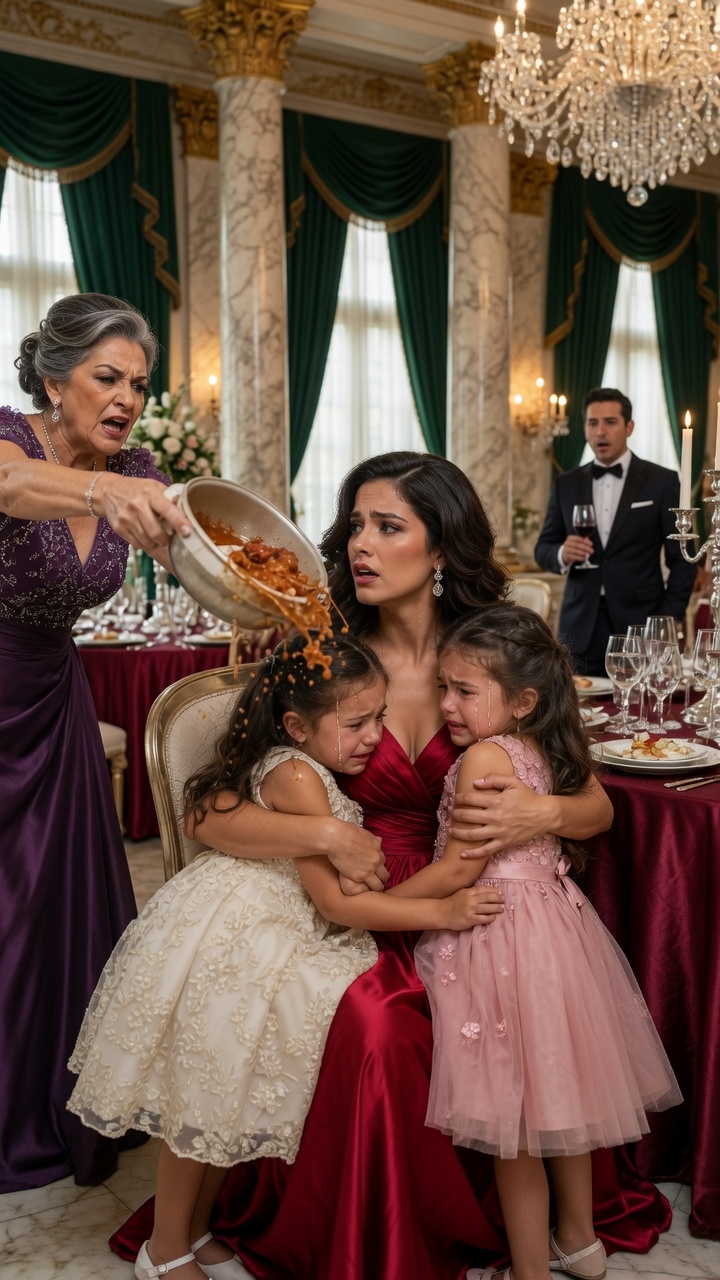
In the illuminated terrace of a so-called mansion in Lomas de Chapultepec, Doña Ofelia lifted an old pot in front of all the guests and emptied it onto the table where her two granddaughters sat.
The lukewarm, greasy broth, filled with shrimp remnants, splattered onto the tablecloth, staining Valeria’s pink dress and smearing Sofía’s cheek, the youngest.
—If you’re hungry, eat this —the mother-in-law said, her smile sharp as a knife—. It’s all that girls who didn’t give this family a son deserve.
The norteño music cut off abruptly.
More than 80 people turned to look.
Cousins, uncles, wealthy neighbors, Leonardo Salazar’s coworkers, and relatives who had come from Morelia to celebrate the “great purchase” of the house.
Fernanda Montes didn’t scream.
She just stared at her daughters.
Valeria, 9, bit her lip to hold back tears. Sofía, 6, had tears welling in her eyes and her hand pressed against her wet dress, as if she couldn’t understand what crime she had committed to deserve this.
From the main table, Leonardo raised his glass.
He wore a navy blue suit, an expensive watch, and a phony smile of an important man.
—Fernanda, don’t start with your drama —he said in front of everyone—. My mom is tired of your delicacies. Today is my party. Sit down and shut up.
Some guests lowered their gaze.
Others pretended to check their phones.
No one defended the girls.
For ten years, Fernanda had endured that family like someone carrying a stone in her chest. To the Salazars, she was just a mere real estate agent, a woman without lineage, without a heavy surname and without the “blessing” of having born a boy.
Doña Ofelia called her useless.
Leonardo corrected her in public.
The aunts whispered that if it weren’t for him, Fernanda would still be eating quesadillas on some corner.
What no one knew was that Fernanda was the true owner of Grupo Montes Alba, one of the strongest real estate agencies in Mexico City.
She owned properties in Santa Fe, Querétaro, Mérida, and Guadalajara.
But everything was protected under her mother’s name and companies created before the marriage.
She had hidden it out of fear.
The first time Leonardo discovered she had earned a huge commission, he slapped her and said:
—A decent wife doesn’t humiliate her husband by earning more than him.
Since then, Fernanda learned to dress simply, to speak little, and to let him believe he was in charge.
But silence doesn’t calm the cruel.
It makes them braver.
Weeks earlier, Doña Ofelia had forced Valeria and Sofía to hand out party favors under the sun because, according to her, “girls must learn to serve.” When Valeria asked why her cousins could play, the grandmother replied:
—Because they carry the name as they should.
That night, Fernanda decided it would all come to an end.
When Leonardo announced that he had bought a mansion for 35 million pesos, she already knew the truth: the house was rented for six months and he was drowning in debt.
She also knew he wanted an absurd party to show off something he didn’t have.
Fernanda didn’t stop him.
On the contrary.
She let him sign a promissory note for $300,000, supposedly lent by his parents. Then, through a friend, she hired the most expensive banquet, with seafood, mole, an open bar, music, and a crystal-clear clause:
Leonardo would pay everything at the end of the event.
And now Doña Ofelia had just dumped leftovers on her two daughters.
Fernanda slowly stood up.
She picked up Sofía in her arms and held Valeria’s trembling hand.
—Enjoy your house, your party, and your lies —she said with an icy calm—. My daughters will never eat anyone’s leftovers again.
She walked toward the exit without looking back.
Leonardo still shouted:
—You’ll come back crawling, Fernanda!
But an hour later, when the $300,000 bill arrived, everyone understood that the one about to crawl wasn’t her.
PART 2
The golden gate closed behind Fernanda, and for the first time in many years, she felt the air didn’t need anyone’s permission to enter her chest.
Valeria walked in silence.
Sofía cried softly, her little face pressed against her mom’s shoulder.
—Mommy —Valeria whispered—, is it bad that we’re girls?
Fernanda squatted down on the sidewalk, even though her blouse was stained and her hair disheveled from the heat.
She cupped Valeria’s face with both hands.
—No, my love. What’s bad is that someone made you believe that. You are not less than anyone. And I swear to you that today was the last time.
She requested a private car and took them to an elegant restaurant in Polanco.
Not to show off.
To dignify a gaping wound in front of everyone.
She ordered tortilla soup, fish, garlic shrimp, fresh water, and chocolate cake. At first, the girls ate with fear, as if expecting someone to come and take their plates away.
Fernanda adjusted their napkins.
—Eat calmly. From now on, no one will throw leftovers at you again.
Meanwhile, in the rented mansion, the party continued pretending to be joyful.
Doña Ofelia walked among the tables like a village queen, greeting with golden jewelry and a strong perfume.
—My son was always different —she said—. A man made and right. Not like other parasites.
Leonardo received pats on the back.
The cousins recorded videos for Facebook.
Aunt Ernestina boasted:
—Look at us, we came out classy from Morelia. The Salazar family has leveled up.
Then the banquet manager appeared.
He carried a red folder under his arm.
Behind him came four guards.
Leonardo smiled, believing it was another moment to shine.
—Did the bill arrive? Bring me the terminal. A man of my level doesn’t count bills.
The manager opened the folder.
—Sure, Mr. Salazar. The total for the event is $300,000. As you signed in the contract, payment must be made right now.
Silence fell heavily.
Leonardo coughed.
—Yes, yes. Come in.
He took out a black card.
The terminal beeped.
Rejected.
Leonardo frowned and let out a nervous chuckle.
—It must be the bank; you know how useless they can be.
He took out another card.
Rejected.
Then another.
Also rejected.
Murmurs began to buzz like flies around rotten food.
Doña Ofelia rushed over.
—There must be a mistake. My son bought this house. He has money.
The manager looked at her blankly.
—Ma’am, you also signed as a joint responsible party.
Doña Ofelia froze.
—Me?
The manager pointed to the paper.
There was her signature, huge and proud, placed when Leonardo told her it was “just a formality for important people.”
Leonardo began to sweat.
—Call my wife. She has money her parents lent her.
The manager closed the folder.
—Your wife is not obligated to pay anything. The contract is in your name and your mother’s.
A cousin stopped recording her video.
An uncle asked loudly:
—So who will pay?
Leonardo called Fernanda once.
Then five.
Then fifteen.
The phone was off.
Doña Ofelia exploded.
—That woman planned this! That ungrateful wretch set a trap for us!
The manager remained unmoved.
—The only trap here is the false signatures of grandeur, ma’am. And before you continue deceiving your guests, you should know something.
Everyone turned.
The manager took a deep breath.
—This house doesn’t belong to Mr. Salazar. It is rented for six months.
The phrase shattered the party.
Aunt Ernestina dropped her glass.
A cousin shot up.
—You brought us from Michoacán to show off a rented house?
Another guest shouted:
—And you still asked us for expensive gifts to inaugurate it?
Leonardo tried to smile, but his mouth trembled.
—It’s a financial strategy, dude. You don’t understand.
No one believed him.
Then the manager ordered to close the gate.
Not to kidnap anyone.
To prevent Leonardo from escaping before legally resolving the fraud of the event.
The party that started with seafood and music ended with screams, accusations, and rejected cards.
Doña Ofelia, the same woman who had thrown leftovers at her granddaughters, had to take off two bracelets, a ring, and hand over the keys to her truck as provisional collateral.
Leonardo signed another document with a trembling hand.
His relatives looked at him as one looks at a false saint when the paint falls off.
That night, Fernanda took her daughters to a house they didn’t know.
It was in Bosques de las Lomas.
It had a garden, huge windows, a library, bright bedrooms, and a terrace from where the city looked like a sea of lights.
Valeria entered slowly.
—Mom… whose house is this?
Fernanda knelt before her two daughters.
—It belongs to our family. To your grandmother Elena and me. And from now on, it also belongs to you.
Sofía opened her mouth.
—Are we not going to sleep at dad’s house anymore?
Fernanda hugged her.
—No, my girl. Never again.
That night, the three of them slept in a huge bed.
The girls held on to some new stuffed animals that the caretaker had bought upon learning what had happened.
Fernanda didn’t sleep.
She thought of every time she said, “it’s not enough,” when it really was.
Of every cheap shoe that hurt their feet.
Of every small plate.
Of every allowed insult.
And she understood something hard:
Sometimes a woman thinks she endures for her children, when in reality her children are learning to endure the same.
The next morning, the guard called on the intercom.
—Mrs. Fernanda, there is a man and a woman at the entrance. They say they are your husband and mother-in-law. They are shouting.
Fernanda looked at the camera.
Leonardo looked finished. The suit was still the one from the party, but wrinkled, stained, and without dignity. Doña Ofelia had smeared makeup and messy hair.
—Let them in —Fernanda ordered—. But with two guards behind.
When they entered the living room, both fell silent.
Leonardo looked at the paintings, the furniture, the staircase, the garden.
Then he looked at Fernanda.
She wore white pants, a silk blouse, and her hair tied back. She no longer looked like the woman who asked for permission to buy milk.
She looked like what she had always been.
The owner of her own life.
—What is this? —he stammered—. With what money did you rent this?
Doña Ofelia regained her poison as soon as she saw luxury.
—She must have stolen her parents’ money. It’s always been clear she’s a climber.
Fernanda took a leather folder and placed it on the table.
—I didn’t steal anything. You just confused my silence with poverty.
Leonardo opened the folder.
First, he saw the deed to the house, in Elena Montes’s name, Fernanda’s mother.
Then he saw documents from Grupo Montes Alba.
Contracts.
Properties.
Financial statements.
Developments in Santa Fe, Mérida, Querétaro, and Guadalajara.
His face changed from anger to fear.
—You… you are Montes Alba?
Fernanda looked at him without blinking.
—Yes. For ten years, you called the woman who could buy the company where you work useless. For ten years, you allowed your daughters to be treated as a burden when they are heirs to something much greater than your surname.
Doña Ofelia sat down as if the ground had been taken from beneath her.
—It cannot be. You sold little houses.
—That’s what they wanted to believe.
Leonardo stepped closer with a broken voice.
—Fer, my love, I didn’t know.
She let out a dry laugh.
—You knew you humiliated me. You knew your daughters cried. You knew your mother despised them for not being boys. What you didn’t know was how much money I had. That’s what hurts you the most.
She pulled out two more documents.
The first was the divorce petition.
The second, the promissory note for $300,000 that Leonardo had signed believing he was using Fernanda’s parents to save his lie.
—Here’s your signature. Here’s your ID. Here you accepted a debt to sustain your circus. My legal team will take care of it.
Leonardo fell to his knees.
—Forgive me. I was an idiot. My mom filled my head. For the girls, Fernanda. Give me another chance.
Fernanda looked at him with quiet sadness.
For years, she had dreamed of seeing him repentant.
But now that she had him on the floor, she felt no love.
Only exhaustion.
—You’re not repentant. You’re ruined.
Doña Ofelia began to cry.
—Daughter, forgive me. Valeria and Sofía are my blood. Let me see them. Let us stay here for a few days. You have plenty. That debt is nothing to you.
Fernanda stood up.
—To me, $300,000 is nothing. But my daughters’ dignity is worth more than all your false houses combined. The day you threw leftovers at them, you lost the right to call them your blood.
The guards approached.
Leonardo wanted to scream, but one of them pointed him to the door.
Doña Ofelia left pleading, promising to change, promising to love her granddaughters, promising to respect Fernanda.
But promises that come after harm sound like counterfeit coins.
The divorce progressed quickly.
Leonardo tried to fight for money, but could touch nothing. The properties were protected before the marriage. Then he tried to fight for custody, but the videos from the party, the audio of insults, and the testimonies from the waiters demonstrated the atmosphere of violence the girls had lived through.
The judge awarded full custody to Fernanda.
Visitation was restricted until Leonardo underwent therapy and proved stability.
He never complied.
His company learned about the scandal because several guests posted the videos on Facebook.
The “successful man” appeared kneeling, with the rejected card, while the manager said that the mansion was rented.
He was fired for using company contacts and seals on personal documents.
He lost the car.
Sold fake watches.
And ended up begging for work from the same relatives who once applauded him.
Doña Ofelia returned to Morelia without jewelry and without pride.
The aunts who once laughed with her now whispered:
—She boasted so much about her rich son and he ended up owing even his dignity.
A year later, Fernanda was preparing garlic shrimp on the terrace of her house while Valeria and Sofía did homework at a large, clean table full of colors.
They no longer ate with fear.
They no longer asked for permission to have dessert.
They no longer lowered their heads when someone mentioned “surname.”
One afternoon, Valeria hugged her mom around the waist.
—Mom, when I grow up, I want to be like you.
Fernanda kissed her forehead.
—No, my love. I want you to be better than me. I want you to never hide your light so that an insecure man doesn’t feel small.
Sofía raised her hand with chocolate in her mouth.
—So can we have more cake?
Fernanda smiled.
—In this house, we don’t beg for love, food, or respect.
The city shone in the background.
And Fernanda understood that she hadn’t destroyed a family by leaving.
She had simply stopped holding up a lie where her daughters were treated like leftovers.
Because a table full of luxury is worth nothing if it’s set for people with rotten souls.
And from that day on, Valeria and Sofía never ate anyone’s leftovers again.





