PART 1
—Your mom doesn’t know what she’s saying anymore, neighbors. She hits herself and then blames others — Clara said with a saintly voice, standing in front of the house in Narvarte.
At that same moment, desperate knocks echoed from the second floor, banging against a door.
—Rafael! Son, don’t leave me here! Open up, please!
Rafael Sandoval had just stepped out of a taxi, military backpack slung over his shoulder, his uniform wrinkled, and his face sunburned after ten months on a security mission in Chiapas.
He had dreamt of returning home, embracing his mother, smelling the rich coffee, and hearing Clara tell him that everything had been fine.
But he found his wife surrounded by neighbors, with perfect tears, a white dress, and an expression of a woman sacrificed.
—I'm sorry, love — Clara said, rushing to hug him —. I didn’t want you to arrive and see this. Your mom has gotten so much worse.
Doña Lidia, the neighbor from across the street, made the sign of the cross.
—Poor Clara. We’ve seen her struggle. Doña Rosario screams, insults, says horrible things.
Rafael lifted his gaze to his mother’s room window.
The curtain moved just slightly.
—Why is she locked in? — he asked.
Clara swallowed hard but recovered quickly.
—for her safety. Yesterday, she tried to go out in her robe. The doctor said it could be advanced dementia.
Rafael's face didn’t change.
In the Army, he had learned that the first bullet is not always the most dangerous. Sometimes, the deadly part is reacting before understanding the battlefield.
—It’s okay — he said —. You did what you could.
Clara let out a sigh of relief.
—I knew you’d understand, love. Honestly, I couldn’t do it alone anymore.
When the neighbors left, Rafael placed his backpack in the living room. Clara went into the kitchen to prepare coffee, talking nonstop about forgetfulness, screams, falls, threats, and supposed violent episodes.
But Rafael wasn’t listening to her words.
He heard the banging above.
The key appeared fifteen minutes later, hidden in a box of Clara's earrings.
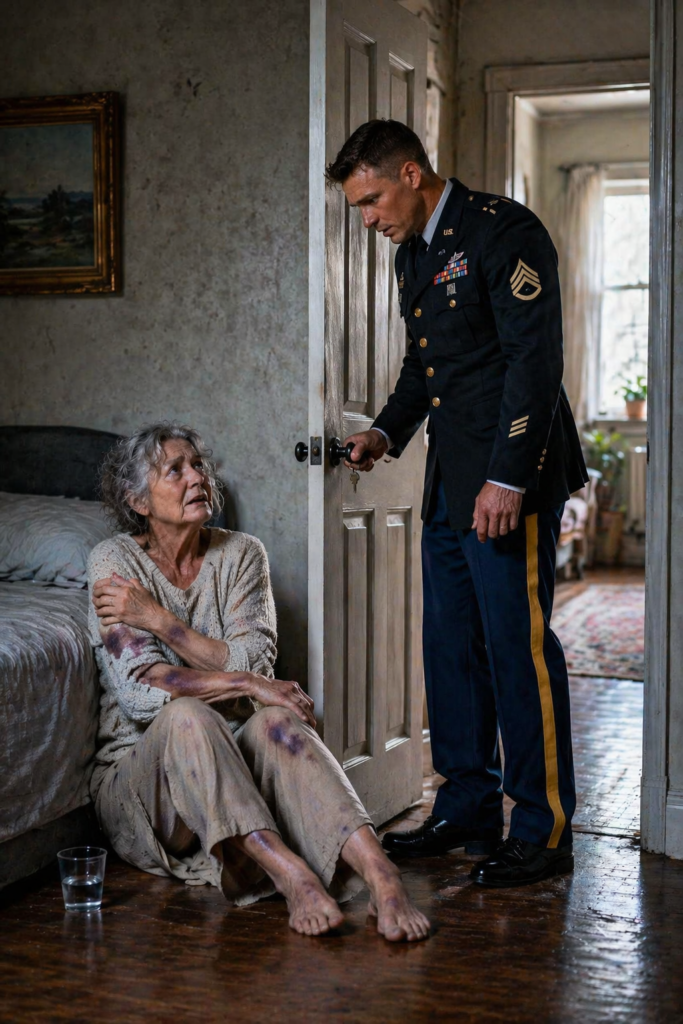
When he opened the door, the stench of confinement hit him like a slap.
There was no lamp. No cell phone. No television. Just an old mattress, a glass of lukewarm water, and his mother sitting on the floor, her back against the wall.
Rosario had bruises on her wrists.
But her eyes were awake.
Clear.
Filled with rage.
—I’m not crazy, son — she whispered.
Rafael knelt before her.
—I know, Mom.
Rosario wanted to speak, but footsteps echoed in the hallway. Her face changed abruptly.
Fear.
—Not yet — she said in a barely audible voice —. That woman listens behind the doors.
Rafael felt something inside him break.
He closed the room again from the outside, even though every turn of the key burned his hand. Before letting go, his mother squeezed his fingers.
At dinner, Clara placed a folder on the table.
—Tomorrow we have a psychiatric evaluation. If they declare her incapable, we can sell her house in Querétaro and put her in a decent home.
Rafael looked up.
—Sell the house?
—It’s for the best for everyone — Clara replied —. You travel, I can’t live looking after a woman who doesn’t even appreciate it.
That night, when Clara fell asleep, Rafael checked cameras, emails, bank accounts, and security accesses.
The videos had been erased.
But the records hadn’t.
At 3:17 in the morning, he found a request to transfer 1,850,000 pesos from Rosario’s account.
The signature was fake.
Before dawn, Rafael entered the room again.
—Mom, tomorrow I need you to act confused.
Rosario looked at her purple wrists and smiled with a chill he had never seen.
—How lost do you want me to look, son?
And Rafael understood that the real war was just beginning.
PART 2
The next morning, Rosario came down to the kitchen with disheveled hair, an old robe, and slow steps.
Clara sat at the table with coffee, impeccable makeup, and the medical folder next to her phone. She smiled like someone who already had an inheritance in the bag.
Rafael stood by the sink, feigning fatigue.
Rosario stared at the stove for several seconds.
—Do they sell tickets to Toluca here? — she asked.
Clara's eyes opened wide with feigned sadness.
—See, Rafael? This is how she wakes up every day. Sometimes she thinks she’s at the bus terminal.
Rosario walked toward the table. Her hands trembled, but not from weakness. They trembled with contained fury.
She grabbed the sugar bowl and let it fall to the floor.
The glass shattered.
Clara jumped up and grabbed her by the wrist.
—Enough, you ridiculous old woman! — she hissed near her ear —. You behave today, or I swear you won’t see the light again.
Rafael lowered his gaze so Clara wouldn’t see his eyes.
Beneath the table, a small recorder was capturing every word.
—Clara — he said calmly —. It’s my mom. Be patient with her.
She released Rosario's wrist and changed her expression in one second.
—I’m sorry, love. I’m just not sleeping. It’s destroying me.
Rosario put her hand on her chest and pretended to look at the ceiling as if she didn’t understand anything.
But when Clara turned around, her eyes sought Rafael’s.
The signal was clear.
There was more.
After breakfast, Clara explained the plan with a confidence that bordered on mockery. The evaluation would be at 11 in the morning with Doctor Estela Montalvo, a specialist in elderly adults. According to Clara, that ruling would serve to initiate a guardianship lawsuit.
—With that, we could legally manage her assets — she said —. No fights, no tantrums, and without the old lady signing nonsense.
—What assets? — Rafael asked.
Clara smiled.
—The house in Querétaro, the investment account, your dad's land in Morelos. Things she no longer understands.
Rafael nodded slowly.
—You’ve thought of everything.
—Someone had to do it — she replied.
That phrase shattered her completely.
During the next hours, Rafael moved each piece as if preparing for an operation. He didn’t shout. He didn’t argue. He didn’t let anger take control.
First, he called an ex-colleague from the Prosecutor’s Office, an expert who owed him a favor for years. He sent the bank documents and Rosario's supposed signature.
The response came quickly.
It was forgery.
Next, he took his mother to a trusted military doctor who examined the bruises on her wrists, arms, and shoulders. The report was clear: the injuries did not match accidental falls, but instead showed signs of forced restraint.
Then a locksmith arrived.
He examined the lock on the room and wrote a brief but devastating report: the door had been modified to open only from the hallway.
Clara had built a prison inside the house.
But the strongest piece came when Rosario, sitting on the bed, asked Rafael to check her father's dresser.
—Bottom drawer, behind the blankets — she murmured.
Rafael found an old camera, hidden inside a smoke detector. His father had installed it after a robbery in the neighborhood, years before he died.
Clara had erased the modern cameras.
She never imagined that this relic was still recording on an internal memory.
Rafael connected the camera to his laptop.
What he saw took his breath away.
Clara taking Rosario’s cell phone.
Clara shoving her toward the room.
Clara practicing in front of the mirror a look of distress before going out with the neighbors.
And then came the real blow.
In the living room, at night, Clara was sitting next to a man in a gray suit. Rafael recognized him instantly: Bruno Alcázar, a real estate agent famous for buying old houses from lonely seniors and reselling them for millions.
—When they declare her incapable, you sign as her guardian — Bruno said in the video —. Your husband trusts you. He’s a good little soldier, isn’t he?
Clara laughed.
—Rafael believes whatever I tell him. He came back tired, guilty, and without wanting to argue.
Bruno placed a contract on the table.
—The house in Querétaro is worth more than 6,000,000. If we sell it for 2,900,000, no one asks questions. You keep your part, and I keep mine.
Clara kissed him.
Rafael closed his eyes.
For ten months, he had slept in camps, thinking his home was the safe place he would return to.
And his home was being plundered by the person who slept next to him.
That afternoon, he prepared four files.
One for Doctor Montalvo.
One for the specialized unit for violence against older adults.
One for the bank.
And another for the lawyer who would handle his divorce.
That night, Clara drank wine in the kitchen. She was in a good mood. Almost celebrating.
—Tomorrow everything is going to change — she said —. You’ll see. We’ll be able to breathe.
—And my mom? — Rafael asked.
Clara grimaced.
—Your mom has already lived. We have the right to start over. We can’t ruin ourselves over a lady who doesn’t even know what day it is.
—Today she knew my name.
—Because you trained her, dude — Clara shot back, forgetting her victim role —. But tomorrow, when the doctor reads everything I documented, it’s over. No one will believe an old lady locked away, hysterical, and filled with strange ideas.
Rafael raised his glass.
—To tomorrow.
Clara clinked hers.
—To our freedom.
Upstairs, Rosario sat with a navy blue dress on her lap. It was the same one she wore on her 35th anniversary with Rafael’s father.
He handed it to her along with comfortable shoes and a new cell phone.
—Ready?
Rosario took a deep breath.
—that woman tried to take my house, my voice, and my memory. Tomorrow, I’m going to show her that the only thing I forgot was to be afraid.
At 10:40, the three of them arrived at the clinic.
Clara walked ahead, wearing dark glasses and holding a thick folder under her arm. She looked like an executive on her way to close a deal.
Rosario walked behind, holding Rafael's arm.
At reception, Clara spoke in a low voice.
—My mother-in-law is delicate. Sometimes she gets aggressive. I ask for understanding.
The receptionist looked at Rosario with pity.
Rosario said nothing.
She just tightened the handbag where she carried a photo of her deceased husband and a copy of the will Clara had never found.
Doctor Estela Montalvo received them in a white, silent, and cold office.
Clara handed over her folder first.
—Here are the episodes: falls, screams, confusion, threats. Also letters from neighbors and a note from Doctor Gómez.
The doctor flipped through the papers.
Then Rafael placed his own file on the desk.
—And here’s what my wife didn’t want you to see.
Clara froze.
—What is that?
Rafael didn’t answer.
The doctor opened the folder. First, she saw the medical photos. Then the locksmith's report. Next, the fake bank request. Finally, she plugged in the USB stick.
Clara’s face lost color before the first audio even played.
—No one will believe an old lady locked away, hysterical, and filled with strange ideas.
Her own voice filled the office.
Clara jumped up.
—That’s edited!
The doctor raised a hand.
—Sit down, Mrs. Clara.
—No! This is a trap!
Rafael placed another file.
The hidden camera video appeared.
Clara yanking Rosario by the arm.
Clara taking her cell phone.
Clara kissing Bruno Alcázar while they discussed selling the house.
Rosario looked at the screen without crying.
That was the detail that destroyed Clara the most.
The lady wasn’t broken.
She was firm.
—Doña Rosario — the doctor said carefully —, I need to ask you some questions.
The evaluation lasted 48 minutes.
Rosario stated the exact date, her complete address, the names of her medications, the deed number of the house, the location of the land in Morelos, the date of her husband’s death, and even Rafael’s birthday.
She also explained, in order, every day she spent locked away.
She said when they took her phone.
When they changed the lock.
When Clara started telling neighbors she had dementia.
And when Bruno entered the house for the first time.
Clara began to tremble.
—She can’t remember all that. She can’t!
The doctor closed her pen.
—What I observe is not advanced dementia. What I observe is a lucid elderly adult, subjected to abuse, isolation, and possible attempts at asset theft.
At that moment, the door opened.
Two agents from the Prosecutor’s Office entered.
Clara backed away.
—Rafael, tell me you didn’t do this.
He looked at her for the first time without affection.
—I did it the moment I understood that you weren’t caring for my mother. You were burying her alive.
One agent pulled out handcuffs.
—Clara Medina, you are under arrest for probable illegal deprivation of liberty, violence against an elderly person, forgery of documents, and attempted asset fraud.
Clara screamed.
She said it was all stress’s fault.
That Rafael had abandoned her for ten months.
That Rosario had always despised her.
That no one understood how difficult it was to care for an old woman.
Then Rosario stood up.
—Caring is not locking up. Getting tired is not stealing. And feeling small doesn’t give you the right to destroy another person.
Clara wanted to respond but couldn’t.
The handcuffs sounded louder than any insult.
That same afternoon, Bruno Alcázar was arrested at a notary in the Del Valle neighborhood, while attempting to submit a purchase contract with a forged signature. The Prosecutor’s Office discovered that he was not his first victim.
There were two more families.
Lonely elderly adults.
Children far away.
Paid-off houses.
Neighbors who heard screams but preferred to say: “It’s probably just the old folks’ business.”
The news exploded in the neighborhood.
The same neighbors who had seen Clara cry on the sidewalk began knocking on the door with flowers, sweet bread, and faces of shame.
Doña Lidia arrived in tears.
—I’m sorry, Rosarito. I believed her.
Rosario looked at her for a long time.
—I’m not hurt that you believed her. I’m hurt that you heard me scream and didn’t come up to knock on the door.
Doña Lidia bowed her head.
No one knew what to say.
The trial wasn’t long. Clara pleaded guilty when her lawyer saw the full videos. She lost her marriage, the house that was never hers, access to accounts, and the little reputation she had left.
Rafael filed for divorce.
There was no discussion.
No public forgiveness.
No final embrace.
Just a signature, twenty minutes of paperwork, and the silence of a woman who thought she could turn a mother into a madwoman to keep what wasn’t hers.
Bruno received a greater sentence when more evidence and more victims appeared.
The house in Querétaro was legally protected. Rosario’s accounts were secured. Rafael installed new cameras, but this time not to spy.
To protect.
Six months later, the room where Rosario had been locked up no longer existed as a prison.
He had the heavy door removed, painted the walls light yellow, and put up white curtains. He placed a rocking chair, a new lamp, recipe books, and a pot of bougainvilleas by the window.
He also left a charged cell phone on the table.
Always.
Rafael returned to service when Rosario asked him to.
—You’re not going to give up your life because of a woman who tried to rob us of ours — she told him while preparing chilaquiles.
He hugged her carefully, as if still afraid of breaking her.
—Are you going to be okay?
Rosario smiled.
—Son, I survived a closed door. I’m not afraid of an open house anymore.
On the morning of their departure, Rafael found her in the kitchen, singing softly and warming coffee.
—Is Mom still confused? — he joked.
Rosario raised an eyebrow.
—Very much so. Sometimes I completely forget why one day I let a liar make me feel small.
Rafael let out a sad laugh.
Outside, the neighbors greeted Rosario respectfully every time she swept the sidewalk.
Some out of affection.
Others out of guilt.
And maybe that was the hardest part to accept: Clara couldn’t have locked up Rosario for so long if the whole neighborhood hadn’t preferred to believe the most comfortable lie.
Because sometimes violence doesn’t start with a blow.
It starts when someone screams behind a door… and everyone decides to turn up the volume on the television.





