PART 1
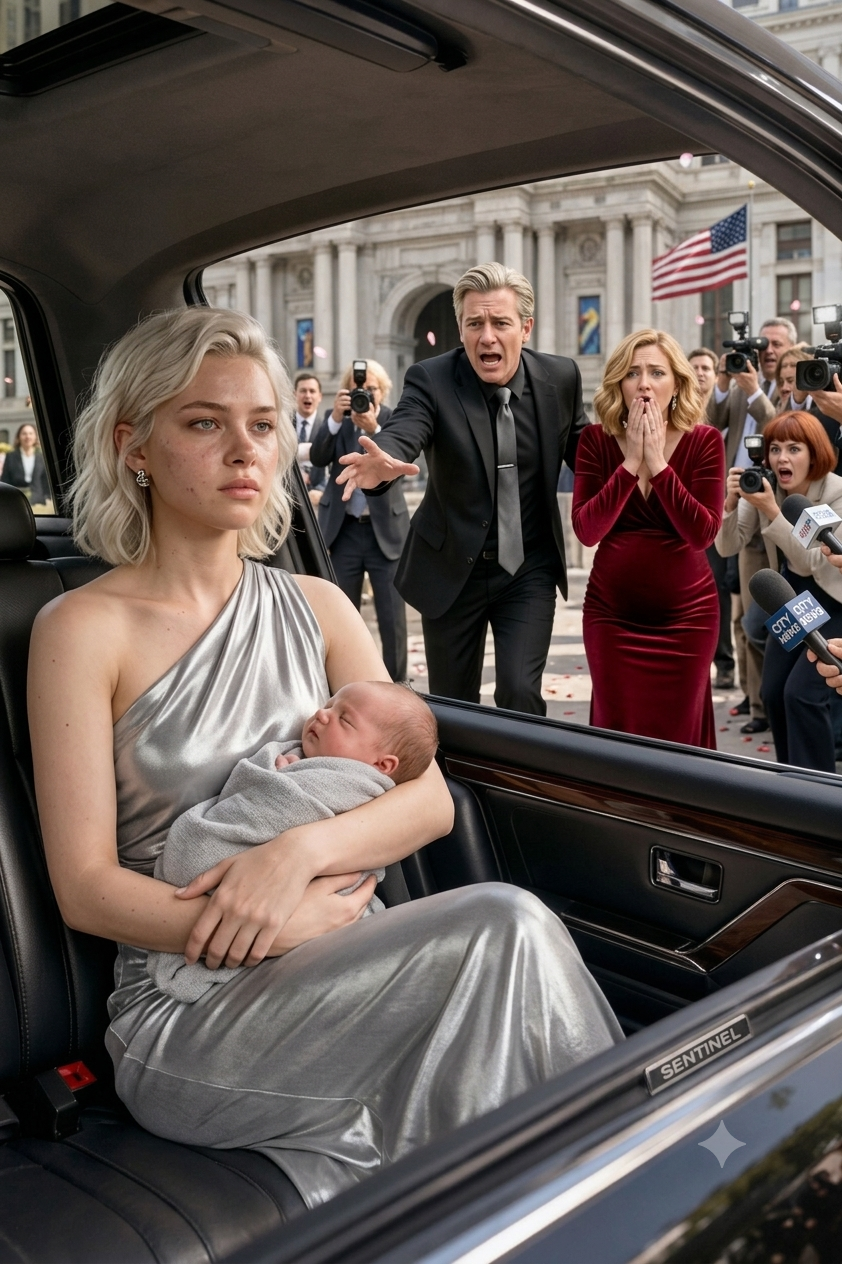
In the most elegant hall of a hacienda in Cuernavaca, in front of nearly 300 guests, Jimena ripped the microphone from the DJ and smiled as if she had just won the lottery.
—I’m pregnant with Fernando’s child —she said.
The mariachi fell silent.
Doña Teresa’s wine glass shattered on the floor, breaking into pieces on the gleaming tiles. Don Ricardo, her father, gripped the tablecloth so tightly that he nearly toppled the centerpieces.
Sofía didn’t move.
She didn’t scream.
She didn’t cry.
She simply stared at her younger sister with a calmness that many deemed icy, but was, in truth, sheer discipline.
Sofía was 38 years old and had served in the Navy. She had learned that a battle doesn’t start with courage but with preparation. And she had been waiting for exactly that moment for four months.
The party was for her 10th anniversary with Fernando.
She had chosen the venue herself, ordered a three-tiered cake, hired the mariachi band, requested embroidered napkins with their initials, and even ironed the blue shirt that Fernando loved so much that very morning.
Jimena arrived wearing a red dress, hugged Sofía, and whispered:
—I love you so much, sister.
She smelled of Fernando’s cologne.
Two months earlier, Sofía had caught that same scent on her husband’s shirt after a supposed urgent meeting on a Saturday. Then came work trips to Querétaro, secret phone calls, and a Valentine’s Day when Fernando left to buy flowers and returned three hours later empty-handed.
Sofía didn’t make a scene.
She called Héctor Salas, a private investigator.
—I just want to know who she is —she told him.
Two weeks later, Héctor summoned her to a café in Del Valle.
—Mrs. Sofía, the woman is from your family.
She thought of a cousin.
A sister-in-law.
Never Jimena.
Until she saw the photos: Fernando and Jimena leaving a hotel in Puebla. She was wearing the blouse Sofía had given her for her birthday.
That night, Sofía realized she had slept next to a stranger and had protected a traitor her whole life.
For four months, she kept silent.
She paid Jimena’s debts, smiled at Christmas, hugged her parents, and listened to Fernando call her “love” as if he didn’t have poison on his lips.
And now there was Jimena, microphone in hand, destroying her in front of everyone.
—Fernando and I love each other —Jimena said—. We’re going to create the family you never could give him.
A murmur swept through the hall.
Sofía stood up slowly.
She walked toward her with her impeccable black dress.
—Put down the microphone, Jimena.
—No. Everyone deserves to know the truth. This time, I won.
Sofía glanced toward a table in the back.
A man in a gray suit stood up, holding a red folder under his arm.
It was Héctor.
Jimena stopped smiling.
—Who’s that guy?
Sofía took the microphone.
—He’s the man who has kept something hidden for four months… something you don’t even know.
Héctor opened the folder on the cake table and pulled out a lab-sealed document.
Sofía lifted it in front of her sister.
—Jimena —she said with a firm voice—, that baby is not Fernando’s.
Color drained from Jimena’s face.
—And the real father is in this room.
Sofía turned her gaze to the third table.
—Only three tables away from you.
PART 2
The third table fell silent.
A dark-haired man stood up so quickly that his chair slammed against the floor. His name was Mauricio, a coworker of Jimena’s at a real estate firm in Polanco.
He didn’t run.
He didn’t deny anything.
He just looked at Jimena with the face of someone who had just been stripped naked in front of the entire world.
That look was enough.
Fernando slumped into a chair and covered his face with both hands. He had destroyed ten years of marriage for a lie that didn’t even belong to him.
Jimena trembled.
—That’s not true —she whispered—. It’s a trap.
Héctor pulled out more documents.
There were messages, photos, hotel receipts, and a non-invasive prenatal DNA test Jimena had taken secretly at a private clinic in Roma Norte.
Mauricio was the father.
Not Fernando.
The hall exploded with murmurs.
—Seriously, how low can you go…
—And she announced it like that?
—That’s just cruel.
Doña Teresa cried, not knowing who to look at. Don Ricardo appeared to age twenty years in five minutes.
But Sofía didn’t celebrate.
She had expected to feel free, victorious, even just a little. However, as Jimena crumbled before everyone, something lodged in her chest.
Because if her sister had been able to lie to her for ten years with Fernando…
What else had she lied about?
That morning, Sofía arrived home alone. Fernando wanted to come in, but she changed the lock that very night and left his bags on the sidewalk.
She didn’t scream.
She didn’t argue.
She just closed the door.
At five in the morning, when the sky was just beginning to turn gray, she opened the bottom drawer of her dresser and pulled out an old bread bag, sealed with a rubber band.
Inside was a hospital bracelet, a blurry photo, and a yellowed piece of paper.
It was all she had left of Diego, the baby they told her had died at birth twelve years ago.
Sofía had had a complicated delivery at a private hospital in Guadalajara. When she woke up, her mother told her that the baby hadn’t survived.
Fernando, then her new husband, cried alongside her.
Jimena had been there too.
She hugged her, brought her tea, told her that God knew why he did things.
For years, Sofía believed that story.
But one phrase from Jimena at the party kept hammering in her head:
“The family you never could give him.”
She hadn’t said, “you didn’t want.”
She hadn’t said, “you couldn’t have.”
She said it as if she knew something.
Sofía called Héctor.
—I need you to investigate the birth of my son.
—Are you sure?
—More than ever.
For three weeks, Héctor traced files, retired nurses, old payments, and modified records. What he found was worse than infidelity.
It was a life stolen.
Sofía’s baby hadn’t died.
He had been born alive.
And someone paid to have him declared dead.
The nurse who signed the false certificate confessed through tears. She said a young woman, desperate for money, came to doña Teresa and asked to “resolve a family problem.”
That woman was Jimena.
But the final blow came later.
Diego, Sofía’s son, was still alive.
He was twelve years old.
And he lived in Toluca with a couple who had raised him without knowing the whole truth. The adoption had been irregular, arranged by a lawyer who was a friend of don Ricardo.
When Sofía heard that, she felt her world shatter once more.
Not only had her sister stolen her husband.
She had also taken her son.
Héctor managed to get a recent photo of the boy: dark eyes, straight hair, a small scar on his left eyebrow.
Sofía sank to the ground upon seeing him.
—He’s mine —she barely whispered—. He’s my son.
The truth reached the family like a wildfire.
Doña Teresa first denied it. Then she locked herself in her room. Don Ricardo confessed that he authorized the paperwork because Jimena had told him that Sofía “was not mentally ready” to be a mother after the delivery.
—I thought it was for the best —he said, crying.
Sofía stared at him without blinking.
—No. You thought you could decide for me.
Jimena, cornered, spilled the truth at a family meeting that ended with police outside the house.
She had hated Sofía since childhood.
She hated that everyone admired her for being strong, responsible, “the good daughter.” She hated that Fernando had fallen in love with Sofía first. She hated seeing her with a stable life while she accumulated debts, failures, and envy.
When Sofía became pregnant, Jimena felt she was losing forever.
—You always had everything —she screamed—. Dad, Mom, Fernando, respect… everything!
Sofía responded with a broken voice:
—And you took my son for that?
Jimena fell silent.
That was her confession.
Months later, the case went to trial. Fernando tried to get close, asked for forgiveness, said he didn’t know about Diego.
But Sofía no longer confused regret with love.
—You didn’t steal my son —she told him—, but you slept with the woman who did. And that also has a price.
The divorce was in Sofía’s favor. Fernando lost the house she had almost entirely paid for and was publicly marked by the betrayal.
Jimena faced charges for forgery, fraud, and involvement in the abduction of a minor. Doña Teresa and Don Ricardo also had to testify. The perfect family they flaunted at gatherings unraveled before records, seals, and signatures.
The hardest part wasn’t the trial.
It was meeting Diego.
Sofía didn’t arrive demanding to be called mom. She came with a dinosaur backpack, new sneakers, and a handwritten letter.
She saw him at a park in Toluca, sitting next to the woman who had raised him.
Diego looked at her with curiosity.
—Are you Mrs. Sofía?
She swallowed hard.
—Yes.
—I was told you searched for me a lot.
Sofía felt her legs weaken.
—I looked for you late, but I looked for you with everything I had.
The boy lowered his gaze.
—Are you going to take me away from my home?
That question tore her apart more than Fernando’s betrayal, more than Jimena’s smile, more than the false documents.
Sofía knelt before him.
—I didn’t come to take you away from anyone. I came so you know I never abandoned you.
Diego didn’t hug her that day.
He only allowed her to sit beside him and share a lemon snow cone.
For Sofía, that was enough.
Over time, the visits became full Saturdays. Then phone calls at night. Then voice messages where Diego would tell her he scored a 9 in math or that he had lost a tooth.
A year later, at another hearing, the judge legally recognized Sofía as Diego’s biological mother, without erasing the family that had cared for him.
Because true love doesn’t need to destroy to exist.
The last time Sofía saw Jimena was in a cold courtroom. Her sister no longer wore the red dress or the triumphant smile. She had a sunken face and trembling hands.
—Forgive me —Jimena said.
Sofía looked at her for a long time.
—I don’t know if I’ll ever be able to. But I’m not going to live hating you. That would just be giving you power.
Jimena cried.
Sofía left without looking back.
Outside, Diego waited for her with a backpack slung over his shoulder.
—Shall we go for tacos? —he asked.
Sofía smiled for the first time in a long while.
—Sure, champ. Al pastor, just like it should be.
As they walked, Diego took her hand. It wasn’t a big hug or a movie scene. It was just a small, timid, almost invisible gesture.
But for Sofía, that hand was justice.
Not the noisy justice of a party ruined in front of 300 people.
Not the bitter justice of watching those who betrayed her fall.
It was something else.
It was proof that, even though someone steals years from you, even if your own blood stabs you in the back, even if everyone tells you it’s too late, the truth always finds a crack to enter.
And when it enters, it doesn’t ask who’s ready.
It just lights everything up.