PART 1
Don Julián Armenta didn't ask Marisol to bring him his pills that night.
He didn’t ask her to heat up the chamomile tea, to adjust the heavy curtains in front of the sea, or to polish the silver tray that he always left by his bed.
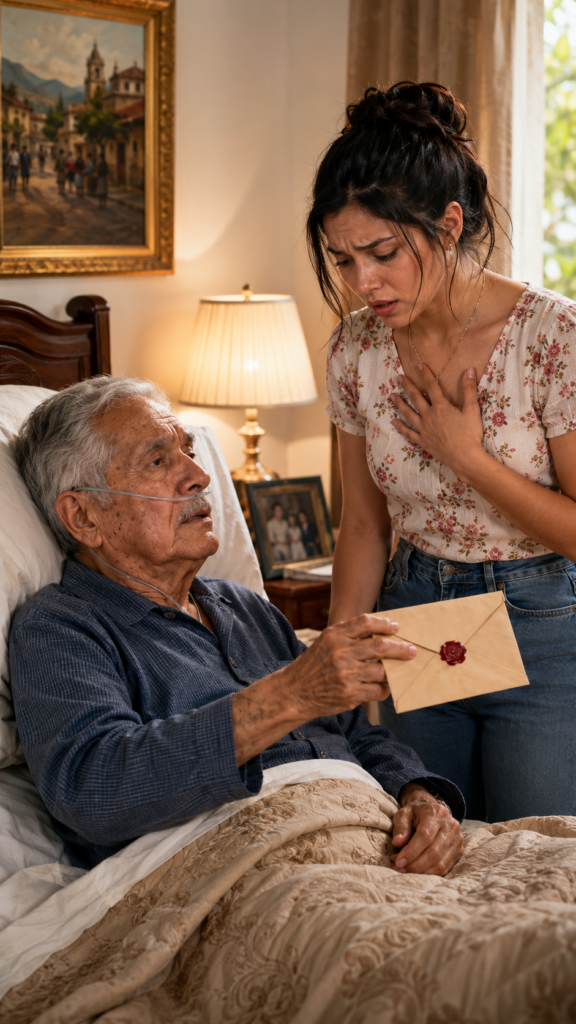
The old businessman, owner of hotels, construction companies, and land in the heart of Baja California Sur, looked at her from his bed, his skin pale and his lips trembling.
—Marisol… would you stay a night with me?
The tray nearly slipped from her hands.
For three years, Marisol Cruz had worked in the Armenta mansion, a huge house perched on a cliff in Los Cabos, where the windows seemed like eyes watching the ocean.
Don Julián was 81 years old and had a fortune that many in Mexico could only dream of in magazine articles.
His children feared him.
His lawyers feared him.
His employees feared him.
But Marisol did not.
She had seen him cry silently in front of old photos. She had watched him send birthday gifts to relatives who never replied. She had seen him play a silver music box and pull his hand away as if the memory burned.
That night, Marisol stood frozen.
—Sir… I think I didn’t understand.
Don Julián smiled sadly.
—You understood, daughter. But it’s not what you think. For God’s sake, no.
Marisol lowered her gaze, embarrassed by her own fear.
—I’m dying —he whispered—. The doctors say I might not make it past this week. My children are downstairs like elegant vultures, fighting over paintings, stocks, and beach houses. No one has asked me what I want before I go.
Marisol remembered the voices from the dining room.
Ricardo, the eldest, demanding to read the will as soon as possible.
Patricia wanting to check their mother’s jewelry.
Mauricio asking again and again about the accounts abroad.
None had come upstairs to sit next to their father.
—I just need someone to stay awake with me —said Don Julián—. Someone who will listen. Someone who doesn’t want my money.
Marisol felt pity, but also confusion.
—And why me?
The old man looked at her as if he were seeing a ghost.
—Because you look like her.
The room fell silent.
—Who?
Don Julián turned toward a photograph on the nightstand.
In it was a young woman in a blue dress, holding a baby.
—My daughter —he said—. The daughter that no one in this house is allowed to mention.
Marisol frowned.
—I thought you only had three children.
—That’s what everyone believes.
Rain began to pound against the windows.
Don Julián struggled to breathe, but his voice gained strength.
—Her name was Elena. She was stubborn, kind, and braver than all my children combined. She fell in love with a boy I thought was nothing. I told her that if she left this house with him, she would never come back.
His eyes filled with tears.
—And she believed me.
Marisol felt a knot in her throat.
—What happened to her?
—She wrote to me when her husband died. She had a little girl. She needed help. I was too proud to respond.
Marisol’s body tensed.
A little girl.
An absent father on all school papers.
A mother working double shifts at a laundromat in Guadalajara.
And a silver music box that she had seen before, many years ago.
Marisol reached for the necklace she hid beneath her uniform.
A silver little bird.
Don Julián saw it.
His face changed.
It didn’t seem like surprise.
It seemed like recognition.
—Marisol… —he murmured, his voice broken—. What was your mother’s name?
She took a step back.
Suddenly, she was afraid of the answer.
But she said it anyway.
—Elena Cruz.
Behind the door, footsteps halted.
Someone was listening.
And then Don Julián Armenta, the millionaire everyone called cold and ruthless, began to cry.
PART 2
The door burst open.
Ricardo entered first, his face hard and his suit immaculate, as if even his anger had been pressed by an expensive tailor.
Behind him came Patricia, smelling of fine perfume and contained rage. Mauricio closed the door with his phone in hand, ready to record, call, or threaten.
—This doesn’t change anything —Ricardo said.
Marisol still held the necklace between her fingers.
Don Julián’s eyes were fixed on her.
—Of course it changes —the old man replied—. It changes everything.
Patricia let out a dry laugh.
—Dad, please. You’re medicated. You’re confused. This girl works here, she’s not family.
Marisol felt the blow of those words.
This girl.
As if she had no history.
As if her mother hadn’t cried for endless nights over overdue bills.
As if poverty were a stain that couldn’t be erased even with years of honest work.
Ricardo approached her with a dangerous calm.
—Marisol, look, we really don’t want to make this bigger. Hand over that necklace, leave the room, and tomorrow we can talk about compensation.
—Compensation? —she asked.
—A fair amount —Patricia said—. For someone like you, it could change your life.
Marisol lifted her gaze.
For years, she had kept her head down because she needed the job. Because rent didn’t wait. Because in Mexico, a young girl alone learns quickly when to stay silent.
But that night, she couldn’t stay silent.
—My mother wasn’t a shame —she said—. And I am not for sale.
Don Julián closed his eyes, as if her words brought him some peace.
Mauricio raised the phone.
—I’m going to call Dr. Salvatierra. He can confirm that Dad isn’t in a mental state to make decisions.
Don Julián opened his eyes.
—Salvatierra is no longer my doctor.
Mauricio froze.
—What?
—You paid him too well —the old man said—. But not enough to buy everything.
Ricardo paled just a little.
Don Julián pointed weakly at the music box.
—Marisol, behind the box.
She walked toward the nightstand.
The box was oval, made of old silver, with a little bird engraved on the lid. The same little bird that hung from her neck.
As she moved it, she found a small black device stuck behind.
Patricia opened her mouth.
—What is that?
Don Julián smiled without joy.
—The truth.
Marisol pressed the button.
First, there was static.
Then Mauricio’s voice filled the room.
—The old man is taking too long to die.
Patricia spoke next, cold as ice.
—If it changes anything, we’ll say the maid manipulated him.
Ricardo added:
—That girl is a problem. My dad trusts her. When this is over, we’ll fire her with a check and a non-disclosure agreement.
The audio ended.
No one breathed.
Don Julián looked at his children, and for the first time, there was no fury on his face.
Only sadness.
—You could have had it all —he said—. I just wanted one of you to have a heart.
Ricardo clenched his jaw.
—People say silly things under pressure.
—No —the old man replied—. People reveal who they are when they think no one important is listening.
Patricia glared at Marisol with contempt.
—Don’t make her feel special.
Don Julián took a breath.
—She is my granddaughter.
The word fell like thunder.
Marisol felt the floor drop out from beneath her.
—I didn’t know… —she whispered.
—I didn’t either at first —said Don Julián—. Until I saw your necklace a year ago.
Marisol looked at him, hurt.
—You knew a year ago?
—I suspected. I had someone investigate. I couldn’t tell you anything without protecting you first.
At that moment, there was a knock at the door.
A woman entered wearing a dark suit, her hair tied back, and carrying a leather briefcase.
It was Licenciada Rebeca Montes, Don Julián’s personal lawyer. The employees had seen her arrive several times at dawn, always through the side entrance.
—Mr. Armenta —she said—, I came as soon as I received your call.
Ricardo exploded.
—You called your lawyer?
Don Julián smiled faintly.
—I called her before dinner.
Rebeca closed the door.
—It’s important that everyone knows the estate documents of Mr. Armenta were modified six months ago, signed before a notary in La Paz, with two independent medical evaluations and full legal validity.
Patricia lost her color.
—That’s impossible.
—Uncomfortable, yes —Rebeca replied—. Impossible, no.
Mauricio scoffed.
—we’ll contest it.
—You can try —said the lawyer—. But Mr. Armenta anticipated it.
She pulled out a folder.
—Marisol Cruz is recognized as the biological granddaughter of Julián Armenta, daughter of Elena Armenta Cruz. The genetic confirmation was conducted with personal samples and medical records preserved by the family.
Marisol felt her eyes burning.
—Did you test me?
Don Julián looked down.
—I had to be sure before putting you at risk.
—Risk from whom?
The old man looked at his children.
The answer was clear.
Ricardo stepped forward.
—Dad, think carefully. You’re handing the Armenta name to a domestic worker.
Marisol smiled faintly.
Not out of mockery.
But because she understood something.
The people who idolize money always betray themselves when they feel they might lose it.
—Yes —said Don Julián—. She cleaned my floors. And still, she has more dignity than all of you together.
Patricia raised her voice.
—You’re punishing us for Elena!
—No —he said—. I’m confronting you with who you are. You never learned to love anything you couldn’t possess.
Rebeca moved closer to Marisol and handed her an envelope.
—Your grandfather asked that this be read with you present.
Marisol wasn’t used to that word.
Grandfather.
It sounded too late.
Too big.
Too painful.
She opened the envelope with trembling hands.
Inside was a yellowed letter.
It wasn’t addressed to her.
It was addressed to Don Julián.
Dad, please read this.
Marisol recognized her mother’s handwriting.
The same handwriting from lunch notes, school permission slips, and the cheap cards that Elena turned into treasures.
She began to read silently, but Don Julián whispered:
—Read it out loud, please.
Marisol took a deep breath.
—“Dad, I know you said not to come back, so I’m not coming back. I’m writing because I have a daughter. Her name is Marisol. She has your eyes, though you might not want to know that.”
Don Julián released a sob.
Marisol continued.
—“Daniel died. I work at night. Sometimes I take the girl with me because I have no one to leave her with. I don’t ask for money for myself. I only ask you to help give Marisol a more secure life than I can give her alone.”
Her voice cracked.
The letter ended with a simple line.
—“If you still remember that I was your daughter before I became your disappointment, please answer me.”
No one spoke.
Don Julián covered his mouth.
—I never answered —he confessed.
Marisol looked at him.
—Nothing?
—Nothing.
That word hurt more than a curse.
Because a cruelty at least arrives.
But nothing leaves a woman checking the mailbox for months. Nothing makes a girl grow up believing that family is a luxury for others.
—My mom never spoke ill of you —Marisol said.
Don Julián looked up.
—No?
—She said your father was a complicated man who had forgotten how to say sorry.
The old man cried silently.
Patricia looked down for the first time.
Ricardo murmured:
—This is pure drama.
Don Julián didn’t look at him.
—No, Ricardo. This is the only real thing that has happened in this house in years.
Rebeca pulled out another document.
—The inheritance comes with a condition. The mansion and a portion of the personal estate go to Marisol. But the main shares of Grupo Armenta can go to her or to a foundation created by Mr. Julián.
Marisol frowned.
—What foundation?
Don Julián looked at her with tired tenderness.
—Casa Elena. A refuge for women with children who have nowhere to go.
Marisol’s throat closed.
—The help my mom asked for.
—Yes —he said—. I couldn’t respond to that letter in time. But perhaps I can respond in other lives.
Patricia let out a bitter laugh.
—How lovely. To give the family business to strangers.
Marisol turned to her.
—Your sister wasn’t a stranger.
Patricia opened her mouth.
Nothing came out.
Maybe for the first time, she remembered Elena not as a scandal, but as a 19-year-old girl walking through a door that no one ever opened again.
Rebeca spoke softly.
—You don’t have to decide tonight.
But Marisol already knew.
She didn’t understand businesses, or trusts, or boards of directors. But she understood exhausted mothers. She understood girls sleeping in borrowed rooms. She understood closed doors.
—I want the foundation —she said.
Ricardo looked at her with hunger disguised as hope.
—Everything for the foundation?
—Not everything —she replied.
He raised an eyebrow.
—The house stays with me until I decide what to do with it. My mother should have been able to return. I won’t allow them to erase her name again.
Don Julián nodded.
—And the business? —Rebeca asked.
—Let it fund the foundation. But with honest people. Not with those who see it as a prize.
Ricardo scoffed.
—you don’t know anything about business.
—True —Marisol said—. That’s why I’ll need people who do know. But not people like you.
A small laugh escaped Don Julián.
Then he took Marisol’s hand.
—I don’t expect you to forgive me.
She watched him.
She saw a man who had built hotels, ports, towers, and fortunes, but had not been able to respond to a single letter from his daughter.
—I don’t know if I can forgive you tonight —she said.
He nodded.
—The truth hurts less than the lie.
—But I can stay.
His cold fingers tightened around hers.
—That is more than I deserve.
His children then understood that they had already lost.
Not just money.
They had lost the right to call themselves family without feeling shame.
Near dawn, the storm ceased.
Marisol opened the curtains.
The sun rose over the sea of Los Cabos, silver and calm after the rain.
Don Julián looked at the light as if searching for someone.
—Elena loved the mornings here —he whispered.
—She would have liked this one too —Marisol said.
He looked at her with the eyes of a remorseful child.
—Do you think she knew I loved her?
Marisol felt that question crack her.
Because love that remains silent for too long resembles abandonment.
—I think she hoped so.
Don Julián closed his eyes.
—Marisol… stay until the sun comes up.
—I’m here.
At 6:12 in the morning, Julián Armenta died holding the hand of the granddaughter he almost lost forever.
By noon, the news was everywhere.
MEXICAN MILLIONAIRE LEAVES FORTUNE TO UNKNOWN GRANDDAUGHTER AND WOMEN'S SHELTER
Reporters filled the entrance of the mansion. Ricardo spoke of "manipulation." Mauricio threatened lawsuits. Patricia disappeared behind dark glasses.
But Marisol did not step out to celebrate.
She sat in the kitchen with Doña Lupita, the cook, who placed a pot of coffee in front of her and cried as if she had lost her own father.
—I knew you were special, mija.
Marisol almost smiled.
—Yesterday I was cleaning bathrooms.
—Special people also clean bathrooms —Doña Lupita replied.
Three days later, they buried Don Julián beside his wife.
And beside Elena.
Marisol brought her mother’s ashes, kept for years in a simple urn, and Rebeca fulfilled the old man’s last wish.
On the white stone, it read:
ELENA ARMENTA CRUZ
BELOVED DAUGHTER
BELOVED MOTHER
AT LAST HOME
Marisol stood in front of that grave for a long time.
Money could not fix the past.
It did not erase hunger, absences, or empty mailboxes.
But the truth, even if it came late, was still better than a buried lie.
A month later, Marisol opened Elena’s old room.
It had been closed for 29 years.
It smelled of wood, dust, and suspended youth.
In a drawer, she found letters.
Some for Julián.
Others for Patricia.
One was addressed to her.
“For Marisol, when she is old enough to ask where we come from.”
She sat on the floor and read it while crying.
Her mother told her that coming from a wealthy family did not mean belonging to it. That the surname should not make her cruel. That closed doors were not symbols of power, but of fear.
The last line read:
“If someday that house finds you, open it for whoever needs it.”
Six months later, the Armenta mansion opened its east wing as Casa Elena.
The room that once held dinners for politicians became a daycare.
The library turned into a legal advisory office.
The main dining room transformed into a communal table where no woman had to justify her hunger.
On the first night, a young woman arrived with a sleeping child in her arms and a plastic bag containing her entire life.
She stood staring at the marble.
—I don’t belong here —she whispered.
Marisol remembered her first day as an employee. She remembered Patricia calling her “someone like you.” She remembered her mother writing a letter to silence.
Then she took the young woman’s bag.
—Yes, you belong —she said—. That’s exactly the point.
The lawsuits came.
Ricardo lost.
Mauricio tried to sell gossip to the press, and soon no one listened to him.
Patricia took almost a year to return. One afternoon she appeared with boxes full of photos, dresses, and Elena’s notebooks.
—I should have brought this earlier —she said.
—Yes —Marisol replied.
Patricia nodded, crying.
—I know.
It wasn’t forgiveness.
Not yet.
But it was a beginning.
And sometimes a beginning is the only honest thing left.
Two years later, Casa Elena had helped 87 women and 112 children.
One morning, Marisol opened the silver music box in the garden.
The melody played while the children ran on the grass that had once only been trodden by wealthy guests.
A boy showed her a paper bird.
—Look, Miss Marisol! It flies!
He launched it into the air.
The bird soared for a second and fell crookedly to the grass.
The boy clapped anyway.
Marisol picked it up and handed it back to him.
—Try again.
He smiled.
And he did.
Then Marisol understood why Don Julián had asked her to spend a night with him.
He wanted not just company.
He wanted a witness.
Someone to hear the truth before money buried it.
Someone to take his regret to a place better than a grave.
Later, people said Marisol was lucky.
That she went from employee to owner of a mansion.
But that was never the real story.
The real story was a mother who wrote one letter.
A daughter who kept a necklace.
An old man who asked for forgiveness almost too late.
And a house that, at last, learned to open the door.





