PART 1
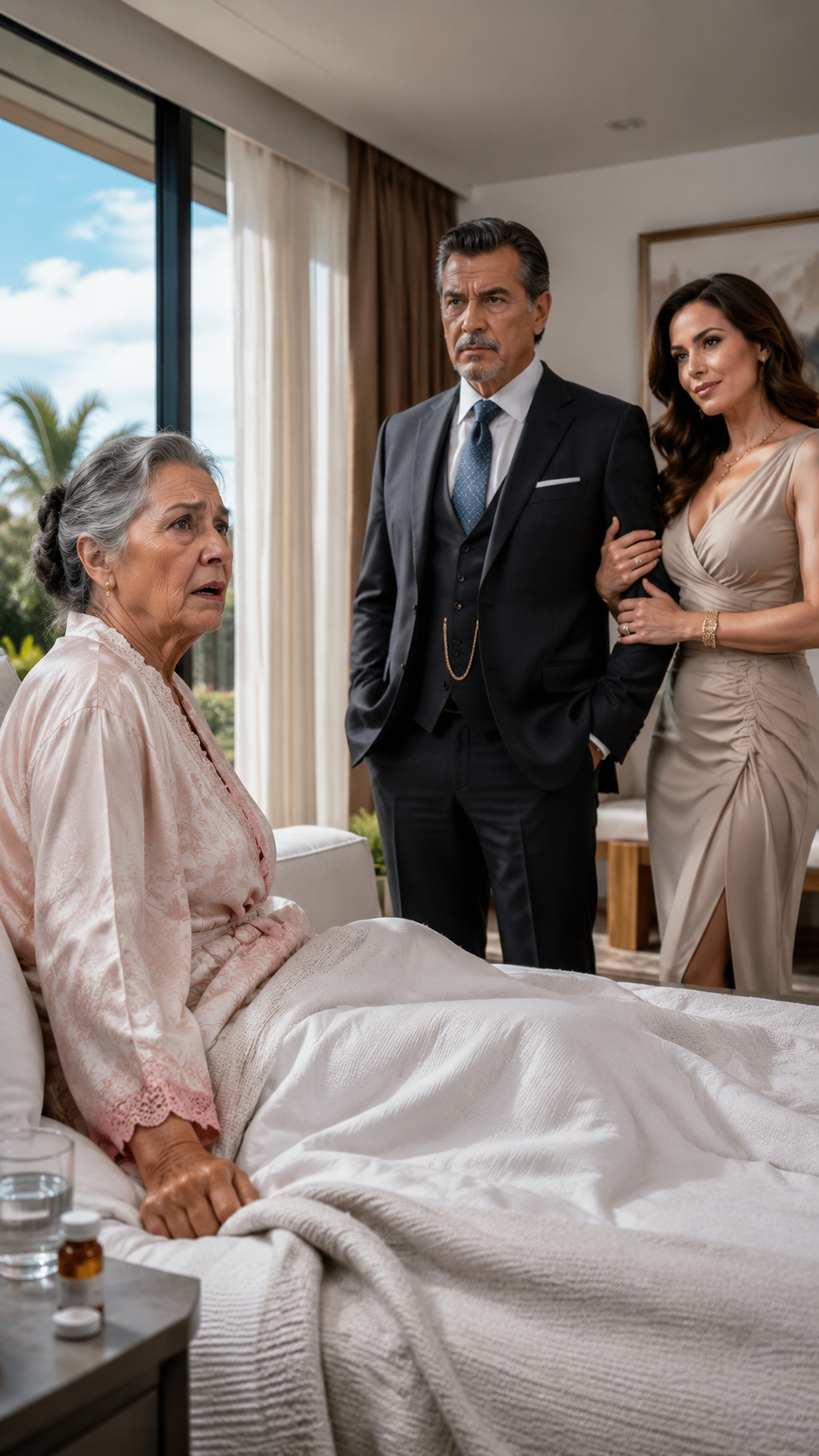
At 73 years old, Elena Robles sat in the living room of her home in Lomas de Chapultepec, a blanket draped over her legs and a fresh scar hidden beneath her blouse, when her husband spoke to her as if she were no longer a person.
Tomás Arriaga, the man she had shared 48 years of marriage with, adjusted his navy blue blazer and said without a hint of shame:
—Elena, there’s no point in pretending anymore. You need care, I need to live. Brenda and I will decide where you’ll stay.
Beside him was Brenda Cárdenas.
35 years old.
Red dress.
Perfect lips.
And on her wrist, a diamond bracelet that didn’t belong to her.
It was Elena’s bracelet.
The same one Tomás had given her decades ago when Grupo Arriaga landed its first big contract with hotels in Cancún. Back then, he would say they had built everything together. Now, he looked at her as if she were an old piece of furniture cluttering the house.
Brenda smiled with that false pity that hurt more than an insult.
—Don’t worry, ma’am. We found a really nice residence in Cuernavaca. Clean air, nurses, a garden… you’ll be at peace.
Elena studied her slowly.
—You’ve already seen it?
Tomás sighed, annoyed.
—Don’t start with the drama. The house is in my name, I run the company, I control the accounts. You’re not in a position to decide. Your children understand that too.
That was what hurt the most.
Not the lover.
Not the stolen bracelet.
Her three children had doubted her.
Mariana said her mother tired easily. Andrés advised her not to get involved in financial matters. Javier asked her not to get upset because “Dad knows what he’s doing.”
For years, Tomás had sown that idea with poisonous patience: Elena was old, Elena forgot things, Elena exaggerated, Elena didn’t understand.
But Elena understood.
She understood perfectly that the betrayal hadn’t started with Brenda.
It had begun much earlier.
—How considerate —she said, with a calmness that unsettled them all.
Brenda let out a little laugh.
Tomás grabbed two leather suitcases, a box of watches, several folders, and a photograph of the house in Valle de Bravo. He didn’t seem like a man leaving with guilt. He looked like a thief selecting trophies.
Before leaving, he leaned toward Elena.
—You have no idea how alone you’re going to be.
Elena barely smiled.
That gesture bewildered him.
When the door closed, the house fell silent. Then Elena reached beneath the couch cushion, pulled out a black cellphone, and dialed a number she had saved two years ago.
—Diana —she said—. He did it.
On the other end, her lawyer responded:
—Then it’s time.
Elena stood up with effort, walked to the library, and opened the safe hidden behind an old painting of her mother.
Inside were contracts, deeds, audits, yellowed letters, and a folder marked with Tomás’s name.
But even she stopped breathing when she found a sealed letter in her mother’s handwriting.
She opened it.
And upon reading the first line, she understood that her husband hadn’t just stolen money from her.
He had stolen 48 years of truth.
PART 2
Diana Montes arrived before 6 a.m.
She didn’t ring the bell. She had had a key for 30 years, because besides being Elena’s lawyer, she was the only friend who had never bought into the myth of the great Tomás Arriaga.
She entered wearing a gray coat, carrying a black leather folder, and a look that didn’t come to console but to fight.
—What did he take? —she asked.
Elena was sitting by the window, the letter from her mother on her lap.
—Watches, documents, the photo of Valle de Bravo… and my bracelet.
Diana grimaced.
—The one the girl had.
—That one.
—What a piece of work.
Elena didn’t respond. She handed over the letter.
Diana read it in silence.
The handwriting was delicate, but the content burned.
Elena’s mother had written that letter shortly before dying. In it, she warned that Tomás had pressured Elena’s father to hand over complete control of the family inheritance. The father refused. He said his daughter’s money should protect her, not turn her into a slave of an ambitious man.
Three days later, Elena’s father died of a heart attack.
Four months later, her mother died.
Tomás took care of everything: funerals, banks, papers, lawyers, signatures.
He told Elena she was too shattered to review documents.
And Elena, broken by grief and pregnant with her third child, trusted him.
—Your mom knew —Diana murmured.
Elena closed her eyes.
—And it took me 48 years to hear her.
The letter also mentioned Víctor Salcedo, the family Robles’ former accountant. According to Elena’s mother, Víctor had kept a special document: a clause in the will that protected Elena’s assets in the event of abandonment, financial manipulation, or forced internment attempts.
Diana looked up.
—If that document exists, Tomás won’t just lose the house. He’ll lose the whole narrative.
Elena let out a dry laugh.
—Tomás has always cared more about the narrative than the truth.
For decades, Grupo Arriaga had been presented in magazines as the masterpiece of a visionary businessman. Tomás spoke of sacrifice, connections, intelligence, and a nose for business. He never mentioned that the first warehouse in Naucalpan was bought with the sale of Elena’s parents’ ranch in Querétaro.
He never mentioned that the first bank loan bore her signature.
He never said that Elena kept the books at dawn while he toasted with investors.
And he especially didn’t say that when the business grew, he began to erase her name from every act, every interview, and every anniversary.
But Elena hadn’t spent the last two years asleep.
After her surgery, when Tomás started to treat her as if she were already half-dead, she did something he never imagined.
She read.
Contracts.
Deeds.
Trusts.
Account statements.
Powers of attorney.
Invoices.
Strange payments.
And she found what she needed.
Brenda wasn’t just a lover.
She had a ghost consulting firm that had received over 80 million pesos from Grupo Arriaga for services that had never existed. With that money, trips, clothes, jewelry, an apartment in Interlomas, and even a truck were paid for.
Tomás signed everything.
With arrogance.
Without fear.
Because he believed Elena could no longer defend herself.
The following Monday, Tomás arrived at the courthouse as if he owned the building. Brenda was on his arm again, wearing the diamond bracelet. Outside, reporters were present because he himself had leaked that he would request guardianship to “protect” his sick wife.
He wanted to humiliate her in public.
But when Elena walked in with a cane, light suit, and her head held high, Tomás’s smile began to fade.
His children were behind him.
Mariana was nervous.
Andrés was serious.
Javier was avoiding eye contact.
Tomás’s lawyer spoke first. He said Elena was fragile, confused, unable to handle complex assets, and that Tomás was acting out of love and responsibility.
Diana listened without blinking.
When it was her turn to speak, she placed a folder on the table.
—Your Honor, Mr. Arriaga is requesting control over assets that do not belong to him.
The judge looked up.
Diana continued:
—The family home was transferred 23 months ago to the Elena Robles Trust. The Valle de Bravo property was legally sold six months ago. The main accounts of Grupo Arriaga require board approval, and Mr. Arriaga was removed as president last Friday for misuse of funds.
Tomás turned pale.
—What did you say?
The judge looked at him.
—Be quiet.
Brenda clenched her jaw.
Diana pulled out another document.
—Additionally, we request the immediate return of a diamond bracelet taken without my client’s consent from her safe. The piece is currently on the wrist of Miss Brenda Cárdenas.
Silence fell like a stone.
All eyes turned to Brenda.
She tried to cover the bracelet.
Tomás whispered to her:
—Take it off.
—You told me it was yours —she murmured.
Elena spoke for the first time.
—Tomás always had a talent for giving away what wasn’t his.
Brenda removed the bracelet with trembling fingers and handed it to the court secretary. She no longer looked like a young queen stepping in to dethrone an old woman. She looked like a trapped accomplice.
But the worst was yet to come.
Diana presented the false invoices, the emails, the payments to Brenda’s consulting firm, and the transfers to personal accounts.
—This is absurd —Tomás said, standing up.
—Sit down —the judge ordered.
And for the first time in 48 years, Tomás obeyed.
That afternoon, Elena’s three children arrived at the house. They no longer came to advise her to stay calm. They came with shame.
Mariana brought a container of soup.
Andrés carried flowers.
Javier stood in the doorway for almost a minute before saying:
—I’m sorry, Mom. We believed him.
Elena looked at them without hardness but without giving them an easy way out.
—You believed because it was more comfortable to think I was exaggerating.
Mariana broke down in tears.
—He told us you were confused.
—And you preferred not to check.
That phrase hurt, but it was true.
Andrés lowered his head.
—Did you move everything?
Elena held her teacup.
—I moved what was mine. What was a lie fell away on its own.
For a few days, it seemed justice had arrived. Tomás lost control of the company, Brenda disappeared from the Interlomas apartment with jewelry, cash, and a truck, and the lawyers began to fight over the remains.
Then the call came.
Tomás called at midnight.
—Elena… Brenda left. She emptied the accounts. I have nowhere to stay.
She heard his broken breath.
There was a time when that voice would have made her run.
But that time no longer existed.
—That problem no longer lives in my house —she replied.
She was about to hang up when Diana entered with a yellow envelope.
Her face was serious.
Too serious.
—Elena, we found Víctor Salcedo.
Elena felt her body grow cold.
The next day, they traveled to a hospice on the outskirts of Toluca. Víctor was 91 years old, his skin clinging to his bones, and his eyes filled with guilt. When he saw Elena, he cried like a child.
—Elenita… I should have found you sooner.
Diana turned on a recorder.
Víctor confessed everything.
Tomás had visited him after Elena’s parents’ funeral. He offered money to conceal the codicil of the will, a clause where Elena’s father made it clear that if Tomás attempted to abandon her, manipulate her, intern her, or take away her assets, all assets originating from the Robles inheritance would immediately pass to Elena and her children.
Víctor accepted the money.
But he didn’t destroy the document.
He kept it for 48 years.
With trembling hands, he pulled out an envelope from his desk drawer.
There it was.
The original codicil.
Signed.
Notarized.
Intact.
Elena didn’t cry.
There are pains that don’t come out through the eyes. They stay inside, waiting for a truth strong enough to wake them.
Víctor also handed over a metal box. Inside were letters from Elena’s mother and a key to a safety deposit box in the Historic Center.
In that box were ancient recordings.
The young voice of Tomás was clear, furious, arrogant.
He admitted to having pressured Víctor.
He admitted to having altered early company records.
He admitted that Elena should not find out because, in his own words, “a woman with her own money becomes ungovernable.”
When Diana turned off the recorder, even she took a moment to speak.
—With this, he can go to prison.
Elena looked at the tape.
For years, she imagined justice as thunder. Something strong, brutal, definite. But upon having the power to completely destroy Tomás, she felt something unexpected.
Peace.
The final hearing was six weeks later.
Tomás arrived without Brenda, without a smile, lacking that air of world ownership. His suit hung loosely on him. His lawyers spoke in low voices. His children were on Elena’s side.
The judge reviewed the codicil, Víctor’s statement, the letters, the audit, and the recordings.
Then he issued the ruling.
Control of the contested assets would remain in the hands of Elena Robles and the family trust. Civil recovery processes would continue. The Public Prosecutor’s Office would also be notified of possible financial crimes, document forgery, and patrimonial violence.
Tomás said nothing.
For the first time, he had no story to tell.
As he left, he caught up with Elena in the hallway.
—Did you ever love me? —he asked.
She looked at him with sadness.
—Yes. That was never the problem.
—Then how can you do this to me?
Elena tightened her grip on the cane.
—I didn’t do this to you, Tomás. I just stopped protecting you from what you did.
He lowered his voice.
—You’re going to die alone.
Elena smiled.
—No. That was your plan for me. Not my ending.
One year later, the mansion in Lomas de Chapultepec reopened under another name: Elena Robles Center for Financial Independence of Older Women.
The room where Elena once served coffee to Tomás’s partners became a free legal clinic. The library filled with workshops on wills, bank accounts, divorce, and patrimonial violence. The visiting room turned into a psychological consulting office.
With the recovery of the Interlomas apartment and other assets, they financed temporary shelters for women over 60 abandoned by husbands, children, or families that treated them like burdens.
On the day of the inauguration, Mariana cut the ribbon. Andrés brought the accounts. Javier arranged chairs until his shirt was soaked with sweat.
Elena appeared in a light blue suit, her white hair loose, and the diamond bracelet back on her wrist.
A reporter asked her:
—Doña Elena, what do you want people to remember about your story?
She looked at the women gathered in front of the house.
Some were afraid.
Others were angry.
Some were just learning not to apologize for existing.
Elena thought of her mother, her father, Víctor, Tomás, Brenda, her children, and all the times they called her exaggerated to avoid listening to her.
Then she looked straight at the camera.
—Being underestimated doesn’t mean you’re defeated. Sometimes it’s the safest place to prepare your comeback.
That phrase was shared thousands of times on Facebook.
But what stirred the most debate wasn’t Tomás’s downfall or Elena’s legal revenge.
It was the question that lingered:
How many women have been called crazy, old, or useless just because someone needed to keep what was theirs?
At 73, Tomás tried to erase Elena from her own home.
At 75, she reclaimed her name.
And at 76, the door he tried to close on her became a refuge for hundreds of women who finally understood something profoundly Mexican and powerfully true:
A quiet lady isn’t always defeated.
Sometimes she’s just gathering evidence.





