PART 1
—Grandpa, please don’t be mad at me… but my dad already found a buyer for your house.
Nicolás, just 9 years old, said this with a broken voice while squeezing a bag of gummy candies that he hadn’t even opened. He was sitting in front of Don Álvaro Méndez, his grandfather, in the garden of a senior citizens' residence in Querétaro.
The afternoon sun fell gently on the bougainvilleas. Other seniors played bingo under a blue tarp, a nurse distributed medications, and from a small speaker in the distance, an old José José song wafted through the air.
Don Álvaro was 74 years old, with wrinkled hands and tired eyes, but he was not lost. He wasn’t “gone,” as his son Ignacio whispered every time he spoke of him.
He was just sad.
Four months ago, Ignacio had taken him to this residence under the pretense of better care.
—Dad, it’s for your safety —he had said then—. The house is too big, you could fall. Here you’ll have company, doctors, hot meals, and people to watch over you.
Don Álvaro didn’t want to leave. His house in the Carretas neighborhood wasn’t just a property. It was the place where he had lived for 45 years with Teresa, his deceased wife. They had raised Ignacio there. The marks of height on the wall, the lemon tree that Teresa had planted when Nicolás was born, and the kitchen where the smell of coffee still seemed to linger.
But Ignacio insisted so much, cried so much, and promised so much, that the old man finally agreed.
—It’ll just be for a while, Dad —he swore—. Your house will remain intact. No one will touch anything.
Don Álvaro believed him because a father usually believes his son, even when something in his chest screams for caution.
At first, Ignacio visited every Sunday. He came with his wife Mariela, their two children, Nicolás and Sofía, and a bag of sweet bread. But little by little, the visits became shorter. Then colder. Then filled with excuses.
—So much work, Dad.
—The kids’ school, Dad.
—The traffic, Dad.
That Saturday, Ignacio didn’t come. He only dropped Nicolás off at the entrance and said he would return in an hour.
The boy couldn’t hold it in any longer.
—I heard him last night —he whispered—. Dad was talking to a man. He said he already had the power of attorney, that you signed without reading it, and that when the house was sold, he’d tell you it was to pay for the residence.
Don Álvaro felt a strange chill, as if someone had splashed cold water on his back.
—Are you sure, son?
Nicolás lowered his head.
—He also said you don’t understand anything anymore… that by the time you complain, everything will be done.
The old man closed his eyes.
That hurt more than the sale.
It wasn’t about the house. It wasn’t about the money. It was knowing that his only son saw him as a burden, like an old piece of furniture that can be moved around without asking permission.
Don Álvaro took Nicolás’s hand.
—Don’t tell anyone that you told me this.
—Not even Mom?
—No one yet.
The boy nodded, though he was scared.
That night, Don Álvaro couldn’t sleep. He stared at the white ceiling of his room, listened to the nurses' footsteps in the hall, and thought of Teresa.
“Old lady,” he murmured through tears, “our son wants to sell us our lives.”
But Ignacio didn’t know something.
The man he believed defenseless still had memory, friends, and one last card up his sleeve.
And when Don Álvaro opened the drawer of his nightstand to take out a yellow folder, he understood that what was coming wouldn’t just be a simple family discussion.
It was going to be a bomb.
PART 2
The next morning, before breakfast was served, Don Álvaro borrowed the reception phone. His hands trembled, but his voice came out firm.
—Attorney Valeria Cortés? This is Álvaro Méndez. I was a friend of your dad’s. I need to see you today. It’s urgent.
The lawyer arrived two hours later, dressed in a dark suit and carrying a leather folder. She wasn’t a woman of many words. She listened to everything without interruption: the residence, the power of attorney, the buyer, Ignacio's phrases, and Nicolás’s fear.
When he finished, Don Álvaro took out from his nightstand a copy of the document his son had made him sign.
—He told me it was to pay for services and medical paperwork —he explained—. I trusted him.
Valeria read each page with a furrowed brow.
—Don Álvaro, this isn’t a small permission. With this power, your son can sell the house, manage accounts, move assets, and sign in your name.
The old man swallowed hard.
—Then he can take everything from me.
—He can try —she replied—. But it’s not too late yet.
Don Álvaro lowered his gaze to his hands. He felt foolish, humiliated, used. But Valeria placed her hand on the table.
—Don’t blame yourself for trusting your son. The blame lies with the one who uses that love to take advantage.
That phrase held him up.
For three days, the attorney moved quickly. She revoked the power, notified the notary, blocked any attempts at sale, and reviewed Don Álvaro’s assets. It was then that the first real blow appeared.
Ignacio was not just after the house.
He had requested information about two commercial properties that Don Álvaro had rented near the La Cruz market and about an investment account that Teresa had left in both their names before she died.
Ignacio believed his father only had an old house.
He didn’t know that Don Álvaro, for years, had been saving quietly. He wasn’t a millionaire showing off trucks or watches, but he had built a sufficient fortune to live comfortably and leave something worthy for his grandchildren.
—I want to protect everything for Nicolás and Sofía —Don Álvaro said—. But Ignacio must not touch a penny.
Valeria explained an option: to create a family trust, where he retained the right to live in his house and manage his resources while he was alive, but where the assets would be protected for his grandchildren.
Don Álvaro signed in pain, not in joy.
Because no one celebrates defending themselves from their own son.
On Friday afternoon, Ignacio showed up at the residence in a pressed shirt, forced smile, and an Americano coffee that his father never drank.
—Dad, I wanted to talk to you about something important.
Don Álvaro looked at him from his chair.
—Go ahead.
Ignacio sat in front of him, adjusting his watch as if he were in a business meeting.
—A colleague wants to buy houses in your area. He said he could offer 2 million 300 thousand pesos for yours. Honestly, it’s a good time. You don’t live there anymore, and maintaining it costs money.
Don Álvaro felt his stomach knotting.
The house was worth almost double.
—What do you think?
—Well… that it would be the best for everyone. With that money, we pay for your residence, your medicines, and you’d even have some left over.
“Left over,” thought the old man.
As if he were doing him a favor.
—Do what you have to do —Don Álvaro replied.
Ignacio smiled, relieved.
—You won’t regret it, Dad.
But the one who was going to regret it was him.
On Monday at 12:40, Ignacio arrived at a notary’s office in downtown Querétaro with the buyer. He carried the power of attorney in a folder, had already received the advance, and walked in with the confidence of someone who believes they have everything under control.
At 12:58, the notary came out with a serious face.
—Mr. Méndez, this transaction cannot take place.
Ignacio frowned.
—What do you mean it can’t?
—The power was revoked. Moreover, the property is protected under a family trust. You don’t have the authority to sell it.
The buyer stood up furious.
—Are you kidding me, Ignacio? I already gave you 150 thousand pesos.
—This must be a mistake —stammered Ignacio.
—It’s not a mistake —said the notary—. It’s a legal protection requested by the owner.
Ignacio left there white-faced, his phone ringing nonstop and his pride in tatters.
That same afternoon, he arrived at the residence like a storm.
He entered Don Álvaro’s room without knocking.
—What did you do with the house?
The old man was sitting by the window, looking at a photo of Teresa.
—Shut the door. I’m not going to argue as if we’re at the market.
—Don’t talk to me like that! —Ignacio shouted—. You made me look like a fool in front of the buyer.
Don Álvaro looked up.
—How curious. You left me looking like a fool when you made me sign a power to rob me.
Ignacio froze.
For the first time, he had no prepared response.
—Dad, I didn’t want to rob you.
—Then what do you call selling my house without telling me anything?
Ignacio breathed heavily. He paced back and forth, like an animal in a cage.
—I’m in debt, okay? The restaurant failed. I owe 800 thousand pesos. I took out loans. Mariela doesn’t know everything. If I didn’t pay this week, they were going to take the place from me.
—You could have asked me for help.
Ignacio let out a bitter laugh.
—Help? Dad, you’re in a home. I thought you had nothing else.
The phrase fell like a stone.
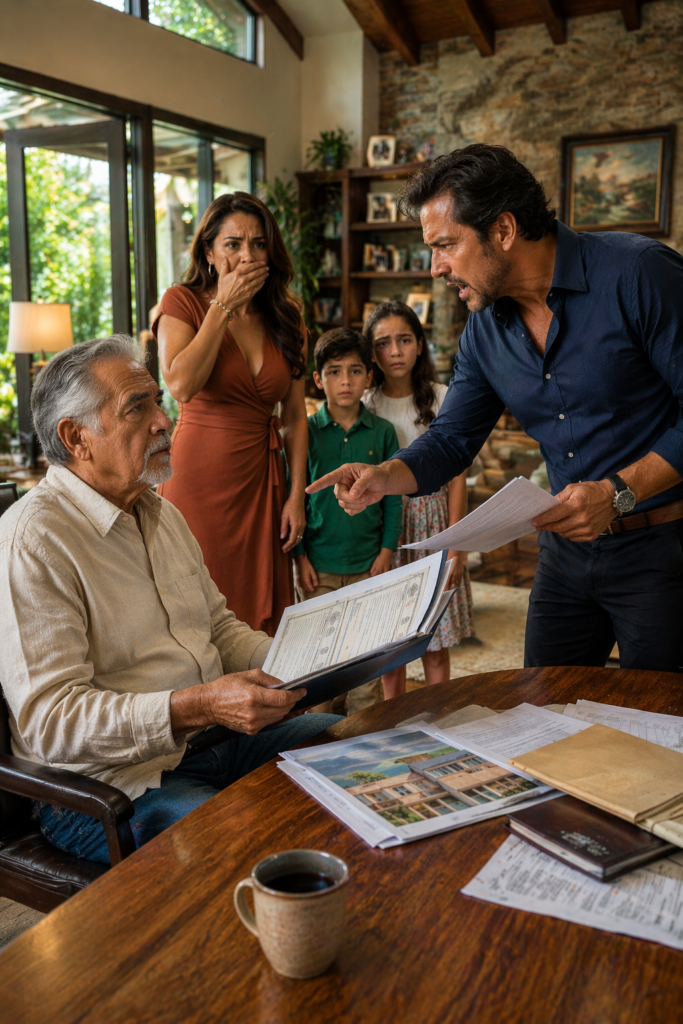
Don Álvaro slowly stood up. His knees ached, but he didn’t feel weak. He pulled out a blue folder and placed it on the table.
—Look.
Ignacio opened the folder with annoyance. Then he fell silent.
First, he saw the deeds to the commercial spaces. Then the rental contracts. Further along, the statements. Finally, the trust where Nicolás and Sofía appeared as beneficiaries.
With each page, his expression changed.
Confusion.
Surprise.
Embarrassment.
—This… this is a lot of money —he murmured.
—It’s my life —Don Álvaro said—. The life you didn’t see because you were too busy calculating how much my house was worth.
Ignacio lowered his gaze.
—Why didn’t you ever tell me?
—Because you never asked. You came here, looked at your watch, said “Everything good, Dad?” and left before I could answer. You never asked if I missed your mother. You never asked if I wanted to go back to my house. But you did have time to look for a buyer.
Ignacio sat down, defeated.
—I messed up.
—No, son. Messing up is forgetting an appointment. You planned this. You brought me here, made me sign, talked to a buyer, and called me an old useless man behind my back.
Ignacio looked up, his eyes wet.
—Who told you that?
Don Álvaro didn’t answer.
Ignacio understood.
—It was Nico.
The silence confirmed what no one had said.
Ignacio covered his face with his hands.
—My son heard me…
—Your son had more shame than you —Don Álvaro said—. And more courage.
That phrase broke him.
Ignacio cried. Not as someone trying to manipulate, but like someone finally seeing the size of his misery. Even so, Don Álvaro didn’t let pity overcome him.
—I will help you with part of the debt —he said.
Ignacio lifted his head, incredulous.
—After everything?
—Don’t confuse help with permission. You’re going to sign an acknowledgment of debt. You will pay me over five years. You will tell Mariela the whole truth. You will take financial and family therapy. And never, ever again will you decide for me as if I were already dead.
Ignacio cried in silence.
—I accept.
—And one more thing. If you make Nicolás feel guilty for telling me the truth, you lose my help and you lose your father.
—I won’t say anything bad to him. I swear.
The next day, Ignacio signed the documents. Then he spoke to Mariela. The argument was tremendous. She arrived at the residence with swollen eyes, but a straight back.
—Don Álvaro, I knew there were debts, but not that Ignacio would do this to you. I’m ashamed to be here.
—The shame belongs to the one who betrays —he replied—. Not to the one who faces the truth.
Nicolás arrived behind her, holding Sofía’s hand. He was scared.
Don Álvaro opened his arms.
—Come here, champ.
The boy ran and hugged him.
—I’m sorry, Grandpa.
—Why?
—For accusing my dad.
Don Álvaro held his face.
—You didn’t accuse him. You told the truth. And sometimes the truth is the only thing that prevents a family from rotting inside.
Ignacio knelt before his son.
—Nico, I was the one who failed. You did the right thing. Forgive me for putting you in the middle of something so ugly.
The boy cried. Sofía did too. Mariela looked away. And Don Álvaro felt something breaking, yes, but also that something was starting to fall into place.
A month later, Don Álvaro returned to his house.
Ignacio made adjustments: handrails in the bathroom, new lights, a small ramp, and a lady who helped him in the mornings. But the decision was the old man’s.
—I want to sleep where I slept with Teresa —he said—. I don’t want to spend my last years in a room that doesn’t know my story.
When he crossed through the green gate, he touched the wall as if greeting an old friend. The lemon tree was still alive. The bougainvilleas were dry in some parts but still bloomed. In the kitchen, Mariela left coffee brewing. Nicolás put sweet bread on a plate. Sofía found a picture of her grandmother and asked if she could put flowers on it.
Ignacio stood still in the yard, unsure of what to do.
—Water the lemon tree —Don Álvaro told him.
And he obeyed.
Over time, Ignacio sold his truck, closed the restaurant, and found a job managing someone else’s business. He paid every month. It wasn’t always easy. There were arguments, uncomfortable silences, and wounds that didn’t heal quickly.
But he started visiting his father without haste.
Sometimes he came with medicines. Sometimes with cream bread. Sometimes he’d just sit next to him and ask about Teresa.
One afternoon, Nicolás asked his grandfather:
—Have you forgiven my dad yet?
Don Álvaro looked at the lemon tree.
—I’m learning.
—Does that mean everything will be like before?
The old man shook his head slowly.
—No, son. There are things that, when they break, don’t return the same. But they can become more honest.
Nicolás pondered this.
—So telling the truth did help.
Don Álvaro stroked his hair.
—It helped save the house. But more than that, it helped your dad see himself in the mirror.
Today, Don Álvaro still lives in that house in Carretas. The trust protects Nicolás and Sofía’s inheritance. Ignacio no longer has power over his assets, and that is not up for discussion.
Some relatives said the old man was too harsh. Others said he was too soft for helping his son.
And maybe that’s why this story is so uncomfortable.
Because in many Mexican families, love is confused with enduring everything. It’s believed that a father must forgive anything just because “he’s blood.” But blood does not entitle anyone to humiliate, steal, or decide for someone who still has a voice.
Don Álvaro loves his son.
But he also learned that loving doesn’t mean allowing oneself to be erased.
And it all started because a 9-year-old boy understood something that many adults prefer to ignore: when a lie threatens to destroy a family, staying silent is also betrayal.





