PART 1
When the fourteenth doctor stepped out of the bedroom and lowered his gaze, Valeria understood that hope had abandoned them.
—We did everything we could —the doctor said, his wrinkled coat and tired eyes telling a story of defeat—. We couldn't find the cause.
Emilio Aranda, owner of developers, restaurants, and a chain of private pharmacies in Monterrey, stood frozen by the door. He was a man used to the world bending to his will. But that night, neither his money, nor his connections, nor his armored trucks could make his son breathe easier.
Mateo was only six months old.
He had been fading away for weeks in a white crib, within a huge residence in San Pedro Garza García. Outside, there were guards, fountains, cameras, and perfectly manicured gardens. Inside, all that remained were dark circles under eyes, whispered prayers, and a growing anguish that already reeked of goodbyes.
Valeria never left the baby’s side. She checked his forehead, adjusted his blanket, and told him stories softly, as if her voice could tether him to life.
But Doña Amalia, Emilio’s mother, never missed an opportunity to tear her down.
—A real mother notices first —she spat in front of the nurses—. That child is dying because you never knew how to care for him.
Valeria looked up, shattered from exhaustion.
—He’s my son.
—Then act like a mother, not like a guest in this house.
Emilio heard it all, but said nothing. His soul was in tatters, and fear had dried up his voice. That silence was what hurt Valeria the most.
That early morning, when Mateo's lips turned purple again, Emilio left the house aimlessly. He asked the driver to take him through empty avenues, under a heavy rain that turned Monterrey into a bright shadow.
Near the Central Bus Station, he saw a boy sitting by an old man. The boy, drenched, was crushing leaves into a can and placing them over the man's old leg wound.
He didn’t seem to be playing.
He seemed to know exactly what he was doing.
Emilio got out of the car.
—Who taught you that?
The boy looked up. He was about twelve. Thin, dirty, with an old backpack and an unsettlingly serious gaze.
—My grandmother. Back in Huasteca.
—My son is dying.
The boy didn’t ask for money. He just looked towards the car and said:
—Then take me to him now.
When Emilio entered the mansion with that boy, Doña Amalia exploded.
—Are you insane? Are you bringing that filthy kid into my grandson’s room?
But the boy had already glanced at the staircase.
He took a deep breath.
And his face changed as if he had smelled death before anyone else.
PART 2
The boy was named Tomás.
He didn’t rush towards Mateo. He didn’t touch the baby. He didn’t even approach the crib immediately.
That made everyone nervous.
Valeria sat next to her son, her fingers intertwined with his cold little hand. There were two nurses in the room, a monitor beeping, an expensive humidifier, linen curtains, imported plush toys, and a fine wooden shelf filled with toys that had never been used.
Tomás stood at the entrance.
He took another breath.
Then he frowned.
—It smells bad in here.
Doña Amalia let out a scornful laugh.
—Of course it smells bad. You walked in.
One nurse lowered her gaze. Valeria closed her eyes, too exhausted to fight. But Emilio, for the first time in days, paid attention.
—What does it smell like?
Tomás walked slowly. He looked at the ceiling, the corners, the carpet, the air conditioning vents. He crouched by the wall, touched the floor with his fingers, and then smelled the wood of the shelf.
—It smells like trapped dampness —he said—. And rotting stuff.
The nurse stepped forward.
—Mr. Aranda, this is not advisable. The boy could contaminate the baby’s space.
Tomás looked at her without fear.
—The space is already contaminated.
Silence fell like a slap.
Doña Amalia turned red.
—Emilio, get him out of here! That little brat is just here for a show to get you money!
But Mateo let out a faint whimper, so small it seemed to come from far away.
Valeria broke down.
—Let him check —she whispered—. We have nothing left.
Tomás approached the wooden shelf. It was enormous, heavy, elegant. It had little trains, teddy bears, fabric books, and animal figurines arranged with absurd perfection, as if the room had been prepared for a magazine photo shoot and not for a child fighting to breathe.
—Move this —Tomás asked.
No one reacted.
Emilio raised his hand.
—Move it.
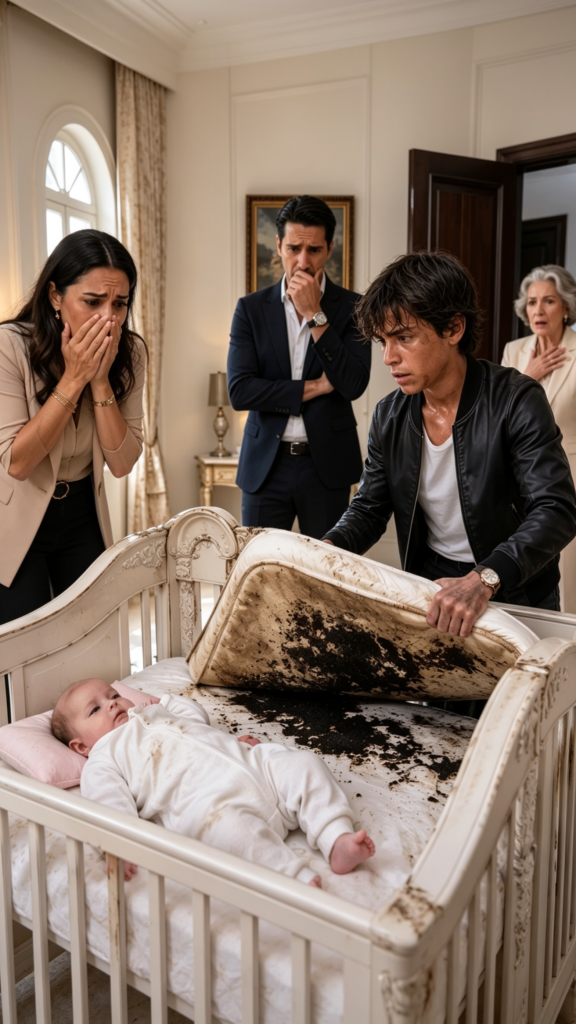
Two employees entered. At first, the shelf barely moved a few inches. Then, when it finally separated from the wall, a sour, damp, thick smell invaded the room.
Valeria covered her mouth.
One of the nurses stepped back.
Doña Amalia stopped talking.
Behind the shelf, the wall was black.
It wasn’t a small stain. It was a dark layer of mold that crept up from the floor to nearly halfway up the wall. The paint was swollen, cracked, like sick skin. There were green and black lines lodged in the crevices, hidden just behind the crib where Mateo slept every night.
Valeria let out a choked scream.
—No… no, please…
Emilio felt his body go numb.
Then he remembered.
Three months prior, a leak from the upstairs bathroom had soaked that wall. The maintenance company said it was dry. Doña Amalia insisted on placing the shelf right there because, according to her, the room looked empty and classless.
Since then, Mateo had been sleeping with the air conditioner on, windows closed, and that rotting wall just steps from his face.
—That’s why he wasn’t getting better —Tomás said—. You were always bringing him back to the same poison.
Valeria started crying with unbearable guilt.
—My baby breathed this every night…
Doña Amalia stepped back.
—No one could have known.
Tomás turned to her.
—Someone did know.
Emilio slowly turned.
—What did you say?
Tomás pointed to the bottom of the shelf. There was new, thick tape stuck behind it, as if someone had wanted to seal the furniture against the wall so no one would move it.
Emilio crouched down.
He ripped off the tape.
And found a small bag hidden between the wood and the wall.
Inside was a dark, damp powder mixed with remnants of something rotten.
Valeria gasped for air.
—What is that?
Tomás didn’t come too close.
—I don’t know what the doctors call it. My grandmother said it comes from rotting wood and fungus. If a baby breathes it, he fades away little by little.
Emilio squeezed the bag between his fingers, as if holding a snake.
—No one leaves this house —he ordered.
Doña Amalia reacted instantly.
—Don’t make a scene, Emilio. Your son is gravely ill. This is not the time to blame anyone.
—My son is gravely ill because someone hid this behind his crib —he replied, with a calm that was frightening—. Of course, it’s the time.
Valeria looked at her mother-in-law.
—You ordered that shelf to be put there.
—Because it matched the room.
—You didn’t let them clean behind it. You said the maids could scratch it.
—It was so expensive!
Emilio looked up.
—Who hired the maintenance crew after the leak?
Doña Amalia swallowed hard.
—I just recommended some acquaintances.
—I didn’t ask that.
Her silence was worse than any confession.
Emilio requested the security footage from the last three months. While they searched for it, Mateo was transferred to another room. They opened windows, removed carpets, turned off diffusers, and called in environmental contamination specialists.
The main pediatrician received photos of the wall by text and requested urgent analysis for mold exposure.
—This changes everything —he admitted over the phone—. We should have checked the environment sooner.
Valeria felt those words shatter her chest.
Because she had bought that crib. She had chosen the curtains. She had sat up next to Mateo believing she was protecting him, not knowing the danger was breathing right next to him.
Tomás didn’t boast about anything.
He stepped into the garden and searched among the wet plants. He recognized eucalyptus leaves, bougainvillea, orange, and gordolobo. He asked for hot water, clean blankets, and a pot.
The nurse looked at him with distrust.
—You’re not giving anything to the baby without authorization.
—I’m not taking away his medicine —Tomás replied—. I’m just going to help the air feel lighter.
He prepared soft steam around the room, without getting too close. He also wrapped warm leaves in clean fabric to place on Mateo’s chest without touching his skin. It wasn’t magic. It was grandmother’s wisdom, that knowledge many ridicule when seen in the hands of the poor.
Throughout the night, the mansion felt like a waiting room before the end.
Valeria softly spoke to the baby.
Emilio stood, his eyes red.
Tomás monitored the rhythm of Mateo’s chest, every pause, every tremor.
At three in the morning, security brought the recordings.
Emilio watched them in his office alongside Valeria, two lawyers, and the head of security. In the first, the workers appeared after the leak. In the second, one pointed to the wall with concern. In the third, Doña Amalia was arguing with them in the hallway.
There was no audio, but the gestures were clear.
The worker was warning something.
She silenced him.
Then came the recording that shattered the family.
Two days later, Doña Amalia entered Mateo’s room alone with a dark bag. She walked to the shelf, still separated from the wall, pulled something from the bag, and shoved it behind. Then she called two employees to push the furniture against the wall.
Valeria brought both hands to her mouth.
—No…
Emilio didn’t blink.
They called for Doña Amalia.
At first, she denied everything. Then she cried. Later, when she saw the paused recording on the screen, her expression changed.
She no longer looked like a worried grandmother.
She looked like a woman caught.
—I didn’t want to kill him —she screamed—. I just wanted him to be sick for a little!
Valeria felt the floor vanish.
—A little?
—You took my son from me —Amalia spat—. Ever since that child was born, Emilio no longer listened to me. It was all Mateo, Valeria, the house, the doctors. I just wanted him to see that you weren’t fit. That he needed his real mother.
Emilio looked at her as if he were facing a stranger.
—You used my son to punish my wife.
—I’m your mother!
—And I am his father.
Doña Amalia tried to approach.
—Emilio, please, I was desperate.
He stepped back.
—No. Desperate was Valeria watching Mateo die while you called her useless.
The police arrived before dawn.
Doña Amalia was taken from the residence amid screams, prayers, and threats. She said it was all an exaggeration, that no one understood the pain of a displaced mother, that Valeria had robbed her place.
But no one defended her.
Not even her son.
Mateo continued to fight.
On the first day outside of that room, his fever barely dropped. His breathing remained weak. The doctors adjusted his treatment. Specialists confirmed that the mold and contaminated dust could have worsened his condition for weeks.
Valeria didn’t leave his side.
On the second day, Mateo squeezed a finger.
It was a minimal movement, almost invisible.
But Valeria felt it as if the entire world had started to beat again.
—Emilio…
He hurried over.
Mateo moved his hand again.
Emilio fell to his knees beside the bed and cried without shame. He cried like a man who finally understood that having it all meant nothing if he couldn't protect what truly mattered.
On the third day, at dawn, Mateo opened his eyes.
It wasn’t like in a movie. There was no music, no perfect miracle. He opened them slowly, tired, as if returning from a dark place.
Valeria leaned in.
—My boy… mommy's here.
Mateo let out a soft sound.
It wasn’t the hoarse cry that had filled the house with terror.
It was a tiny babble.
Alive.
Tomás watched from the corner, silent. He didn’t smile like a hero. He didn’t ask for applause. He just lowered his head, relieved.
Emilio approached him.
—You saved my son’s life.
Tomás shrugged.
—I just smelled the wall.
—No —Emilio said—. You saw what we all ignored.
The case became a scandal throughout Nuevo León. People talked about the mansion, the arrested grandmother, the poisoned baby, the street kid who discovered what fourteen doctors had not.
Many voiced their opinions. Some defended Doña Amalia, saying that a jealous mother suffers too. Others tore Emilio apart for allowing his wife to be humiliated in her own home.
Valeria didn’t grant interviews.
She just cared for Mateo.
Weeks later, the baby began to regain color, strength, and laughter. The bedroom was sealed off, dismantled, and rebuilt from scratch. Emilio ordered every building, clinic, and daycare of his companies to be inspected.
For the first time, he understood that danger doesn’t always enter violently.
Sometimes it hides behind an elegant piece of furniture.
Sometimes it has a family name.
Sometimes it prays with a rosary in hand while it destroys a home from within.
Tomás stayed a few more days.
He slept in a guest room, but always left his shoes by the door, as if still ready to run. Valeria noticed.
—Do you have family? —she asked one afternoon.
Tomás took time to respond.
His grandmother had died in Huasteca. His mother had left years ago. Since then, he had lived between markets, trucks, and sidewalks, healing scrapes or small pains in exchange for food.
Valeria cried in silence.
—A child shouldn’t live like this.
Tomás lowered his gaze.
—One lives as one can, ma'am.
Emilio didn’t offer him a suitcase full of money. He had learned that money, alone, can also be an elegant way to dispose of someone.
He offered school, documents, doctors, a roof, and the chance to study whatever he wanted.
Tomás hesitated.
—I don’t want to be a rich person’s pet.
Valeria stepped closer with Mateo in her arms.
—We don’t want to showcase you. We want you to have a life where no one calls you filthy again for knowing more than they do.
Tomás looked at the baby.
—Can I keep learning about plants?
Emilio nodded.
—And about medicine, if you want.
Years later, Tomás Aranda —because Emilio and Valeria ended up legally adopting him— would study environmental medicine and Mexican herbalism. He never allowed anyone to mock grandmothers, villages, the mountains, or the people who learn to heal without a white coat.
Mateo grew up healthy, knowing he had an older brother who once entered his house soaked and looked where others refused to look.
Emilio was never the same again.
Whenever he saw a child begging for food at a crossroad, he slowed down.
Because he learned late, but he learned.
Wealth can buy doctors, cribs, cameras, and pretty walls.
But it cannot buy humility.
And sometimes, the one who saves a life is not the one who arrives with a title, a suit, and power.
Sometimes it’s the child everyone calls filthy.
The one no one wants to let pass.
The one who learned to survive by smelling the earth after the rain.
The one who looks behind the furniture when everyone is too busy looking at the crib.





