PART 1
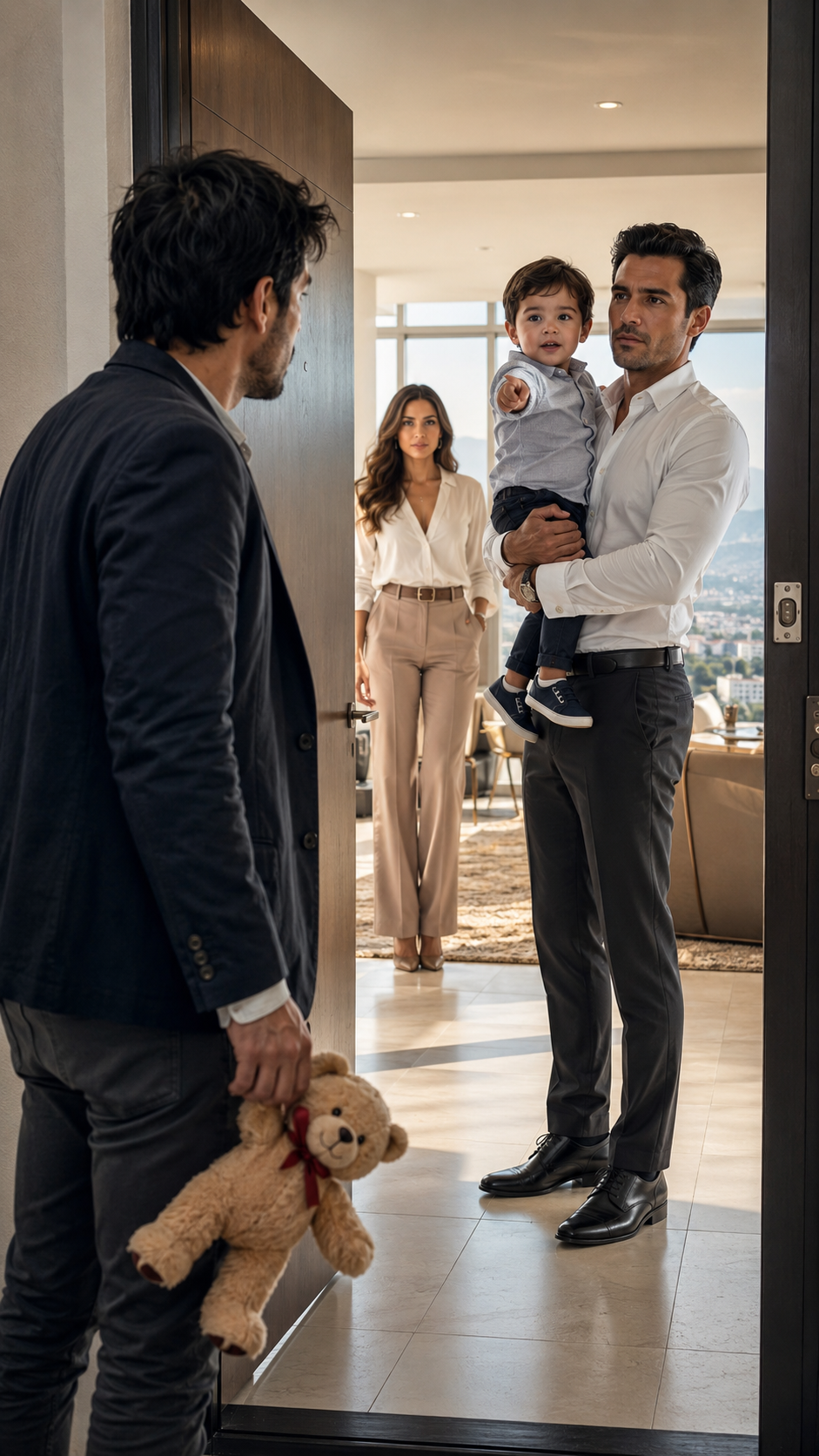
Sergio Ledesma arrived in Lomas de Chapultepec clutching a cheap teddy bear and wearing a grin that seemed too big for his face.
He was convinced he would find Clara Medina scrubbing floors in someone else's house, with the child he had denied running barefoot down some service corridor.
—Let's see if she finally learned her place —he muttered, adjusting his shirt in the mirror of his old car.
Clara had been his wife.
A simple woman, born in a town in Oaxaca, with calloused hands, a soft voice, and clear eyes. When Sergio first met her, he boasted that she was “authentic,” that she cooked like no one else, and that she didn't think she was more than she was.
But when he started making money at a luxury construction firm in Mexico City, that same simplicity filled him with shame.
He said Clara dressed like a market vendor, that she spoke too “country,” that she didn’t know how to navigate dinners with businessmen.
When she was five months pregnant, Sergio was already after Pamela, his assistant: perfect nails, expensive dresses, strong perfume, and a laugh that made him believe he was finally stepping into a fine world.
One night, without a long discussion, he laid an envelope on the table.
—Here’s 30,000 pesos. That should set you up. The kid is your problem. I’m not going to ruin my life over a woman who doesn’t even know how to present herself.
Clara stood frozen, one hand on her belly.
—Are you really going to kick me out like this?
—I already did —he replied—. And don’t come back. Neither you nor that child.
Clara left with a small suitcase, an old sweater, and eyes dry from too much crying.
Sergio thought his elegant life began right there.
But everything fell apart.
Pamela drained his account, piled up debts, and ran off with a real estate developer from Monterrey. Sergio's company went bankrupt, he lost his apartment, and ended up selling luxury finishes, greeting clients who hardly glanced at him.
Two years later, an ex-neighbor told him she had seen Clara in Lomas.
—They say she works for a really rich family. Cleaning, cooking, or something. She’s with her son.
Sergio laughed out loud.
The next day, he bought a cheap stuffed animal at a store in the neighborhood and presented himself at a gated community.
—I’m here to see Clara Medina. I’m family —he said.
The guard spoke on the phone, looked him up and down, and raised the barrier.
—Tower 2. Penthouse.
Sergio rode up in a silent elevator, surrounded by mirrors and smelling of fine wood. He imagined Clara in an apron, nervous, embarrassed to see him.
He rang the bell.
The door opened.
But Clara didn’t appear.
In front of him stood a tall, elegant man in a white shirt, exuding an imposing calm.
Sergio recognized him immediately.
It was Alejandro Santamaría, the owner of the business group where he worked as a mere salesman.
In his arms was a child nearly two years old.
The little boy looked at Sergio, clung to Alejandro's neck, and said:
—Daddy, who is that man?
Sergio felt the floor drop away beneath him.
Then a feminine voice called from inside:
—Alejandro, who just arrived?
And Clara appeared at the end of the hallway.
Elegant. Serene. Unattainable.
She looked him straight in the eye and said:
—Come in, Sergio. I’ve been waiting for this moment for two years, though not in the way you imagined.
PART 2
Sergio stepped inside with heavy legs, as if every step forced him to swallow a humiliation.
The penthouse didn’t look like a place where Clara worked as an employee. It was spacious, bright, with huge windows that offered a view of Mexico City like a sea of lights. There were wooden toys next to a cream-colored rug, fresh flowers on a stone table, and family photographs on the walls.
In one, Clara was holding the newborn baby.
In another, Alejandro was cradling him asleep against his chest.
In the third, the three of them were smiling on a beach in Oaxaca.
Sergio squeezed the stuffed bear against his side.
—So it was true —he said, trying to sound superior—. You really ended up in a rich man's house.
Clara didn’t respond immediately.
She wore a simple dress, her hair up, and an air of tranquility that hurt more than any scream. She didn't seem like the woman he had kicked out with a suitcase. Or maybe she did. Perhaps that dignity had always been there, and he had never wanted to see it.
Alejandro carefully set the child down.
—Mateo, go with Rosita for a moment, champ.
An older woman appeared from the hallway and took the little one by the hand.
Before leaving, Mateo turned to Sergio.
—Is he a friend of Mom’s?
Clara took a deep breath.
—No, my love. He’s someone from the past.
That phrase hit Sergio like a slap.
When the child disappeared, he let out a dry laugh.
—Well, look at that. You did quite well finding a protector, didn’t you?
Alejandro stepped forward, but Clara raised her hand.
—It’s not necessary.
Sergio looked her up and down.
—So you’re not just the cleaning girl.
—I was —Clara replied.
The answer left him uncomfortable.
She walked over to the table and poured water into a glass. She didn’t offer it to him. Just set it down there, as if even courtesy had its limits.
—When you kicked me out, I spent three nights in a boarding house near TAPO. I was five months pregnant, with a suitcase and 30,000 pesos that you called help. I looked for work wherever I could. An older lady from this area hired me to cook for her and help in her home.
Sergio grimaced.
—Well, there you go. Service.
Clara smiled without joy.
—Yes, Sergio. Honest work. Something you always looked down on because you confused value with appearance.
Alejandro remained silent, but his presence filled the room.
Clara continued:
—The lady’s name was Mercedes Santamaría. She was Alejandro’s mother. I made her mole negro, tlayudas, yema bread, regional sweets. One day, she asked me for food for a meeting. Then another. After that, her friends started making requests. When Mateo was born, I was cooking at dawn with him asleep in a cradle next to the oven.
Sergio swallowed hard.
—And then what? Did you marry the boss?
Alejandro spoke with a firm voice:
—First she was a supplier. Then she became a partner. And much later, she became family.
Clara opened a folder on the table. Inside were photos from events, contracts, and clippings with an elegant logo: “Raíces de Clara.”
—Doña Mercedes invested in my first cooking workshop. Alejandro helped me with the legal part. But the recipes, the sleepless nights, the rejected orders, the fairs, the tears, and the months carrying Mateo while working were all mine.
Sergio stared at the documents, refusing to understand.
—Today we have four branches, we provide services to hotels, private events, and we just closed a deal with Grupo Santamaría.
Sergio felt his blood drain from his face.
—What did you say?
Alejandro looked at him without mockery but without pity.
—The internal presentation is tomorrow. Clara will lead the new culinary line for the group. The same company where you work.
Sergio remembered the office rumors. A young businesswoman. A Mexican brand with history. A huge partnership.
He never imagined that woman would be Clara.
—You knew I worked there —he stammered.
Clara nodded.
—I found out three months ago.
—And you didn’t say anything?
—What for? You decided I didn’t deserve explanations when I needed them the most.
Sergio left the teddy bear on a chair. Suddenly, he felt ridiculous, miserable.
—I came to see my son.
Clara held his gaze.
—No. You came to see if I was drowning.
He wanted to deny it but couldn’t.
—You asked Maribel about me —she continued—. She called me afterward. Told me how you laughed and how you said I was probably still serving food to the rich.
Sergio clenched his fists.
—That doesn’t take away my right to know him.
Clara took a few seconds to respond.
—Right. What a big word in your mouth.
She went to a piece of furniture and pulled out another envelope. Inside were copies of messages, screenshots, and a handwritten note.
Sergio recognized his handwriting before reading.
“The child is not my concern. Don’t look for me. I don’t want to know anything about you.”
The air caught in his throat.
—That was a long time ago.
—It was when I needed you the most.
—I was confused.
—No. You were comfortable being cruel.
The silence became heavy.
Clara sat down in front of him.
—When Mateo was born, I thought about calling you. I had a fever, stitches, fear, and a baby crying all night. One morning I dialed your number. I had it on the screen for almost ten minutes.
Sergio lowered his voice.
—Why didn’t you call?
—Because I remembered your face when you kicked me out. And I understood that a tired mother could rise, but an unwilling father could become a wound for a lifetime.
Sergio swallowed hard.
—Clara… I didn’t know you would end up like this.
She looked at him with an old sadness.
—That’s the problem. You don’t come because it pains you to have broken me. You come because you discovered I didn’t stay broken.
For the first time, Sergio lowered his head.
—I’ve made mistakes.
—Yes.
—Pamela cheated on me. I lost everything. I’m in debt. I have no one.
Clara didn’t smile. She didn’t seem to enjoy it either.
—I’m sorry.
That compassion made him feel smaller.
—Is that all? I’m sorry? After everything we were?
Alejandro finally spoke.
—Watch your words.
Sergio pointed at him.
—You stay out of this. That child has my blood.
Alejandro didn’t raise his voice.
—That child carries his mother’s last name, her sleepless nights, her milk, her fear, her work, and her love. Blood doesn’t change diapers at 3 AM.
Sergio stepped toward him.
—You’re not his dad.
Then Clara stood up.
—Mateo calls him dad because Alejandro was there when you chose not to be. Because he took him to the hospital when he had bronchiolitis. Because he learned to sleep sitting up so I could rest two hours. Because he never asked if he was his to love him.
Sergio opened his mouth, but Clara wasn’t finished.
—But I won’t lie to my son. When he’s old enough to understand, he will know who you are. He will know everything. I won’t turn my pain into poison inside him.
That disarmed him.
—So… will you let me see him?
Clara watched him for a long time.
—If you truly want to know Mateo, it will be done right. With a lawyer, mediation, paternity test, financial responsibility, and psychological support. You won’t show up on a Sunday with a hundred peso teddy bear to feel like a good person and disappear on Monday.
Sergio paled.
—Financial responsibility?
—Yes. Being a father isn’t just an emotional visit. It also means taking responsibility for the two years you weren’t there.
He averted his gaze.
Clara understood before he spoke.
—You weren’t coming for Mateo.
Sergio pressed his lips together.
—I have debts, Clara. I’m in over my head. I thought maybe you could help me. A loan. After all, we were husband and wife.
Alejandro closed his eyes, incredulous.
Clara remained frozen.
For a few seconds, only Mateo’s laughter echoed from the hallway. He was playing, unaware that an adult had just revealed his true self in the living room.
Clara took the teddy bear from the chair and returned it to Sergio.
—Don’t use my son as a key to enter my bank account.
—Clara, please.
—No.
—I could lose my job if this gets out.
Clara looked at him firmly.
—You won’t lose it because of me. I don’t need to destroy you. But tomorrow, when I sit in that boardroom and you’re at the back, I want you to remember something: the woman you called a country girl built a company with the hands you despised.
Sergio had red eyes.
—Do you hate me?
Clara shook her head slowly.
—Not anymore. Hating you was still carrying you. Now you just make me feel pity.
That word broke him.
Pity.
Not love. Not rage. Not jealousy.
Pity.
Alejandro accompanied him to the door. Before exiting, Sergio glanced down the hallway.
Mateo appeared with a wooden cart.
—Mom, is the man leaving already?
Clara picked up the child.
—Yes, my love.
Mateo waved.
—Goodbye, sir.
Sergio wanted to say: “I’m your dad.”
But no phrase belonged to him yet.
He simply nodded and left.
The next day, at the Grupo Santamaría headquarters, Sergio sat at the back as Clara entered to present her project.
She wore no large jewelry or scandalous clothing. She didn’t need them.
She spoke of origins, of dignified work, of women from towns, of small suppliers, of recipes inherited from grandmothers, and how a humble kitchen could become a national brand without losing its soul.
No one knew that every word was also a farewell.
Sergio listened with shame lodged in his chest.
When she finished, everyone applauded.
Clara didn’t look at him once.
Months later, Sergio agreed to begin a legal process to recognize Mateo. Not because Clara begged him, but because he finally understood that a child is not claimed: he is earned.
The journey was slow, uncomfortable, and monitored.
Mateo continued to call Alejandro dad.
For a long time, he only called Sergio by his name.
And although it hurt, he did not protest.
Because he understood too late that fatherhood doesn't begin when a man regrets, but when he learns to stay.
Clara never again became the woman who left that night with a suitcase.
Now she was a mother, a businesswoman, and the owner of a peace that no one could take away.
And whenever someone asked her how she managed to rise, she would answer:
—I didn’t rise to prove anything to the man who abandoned me. I rose because my son deserved to see his mother standing.