PART 1
Verónica Salgado returned from the cemetery in her wrinkled black dress, her eyes dry from so much crying and her heart still stuck in her throat.
That afternoon, she had buried Simón Treviño, her husband, the man who had been her home, her calm, and her only true family for seven years.
All she wanted was to enter their apartment in Roma Norte, close the curtains, take off her heels, and sit next to Simón's temporary urn without anyone telling her anything.
But upon opening the door, her grief turned into rage.
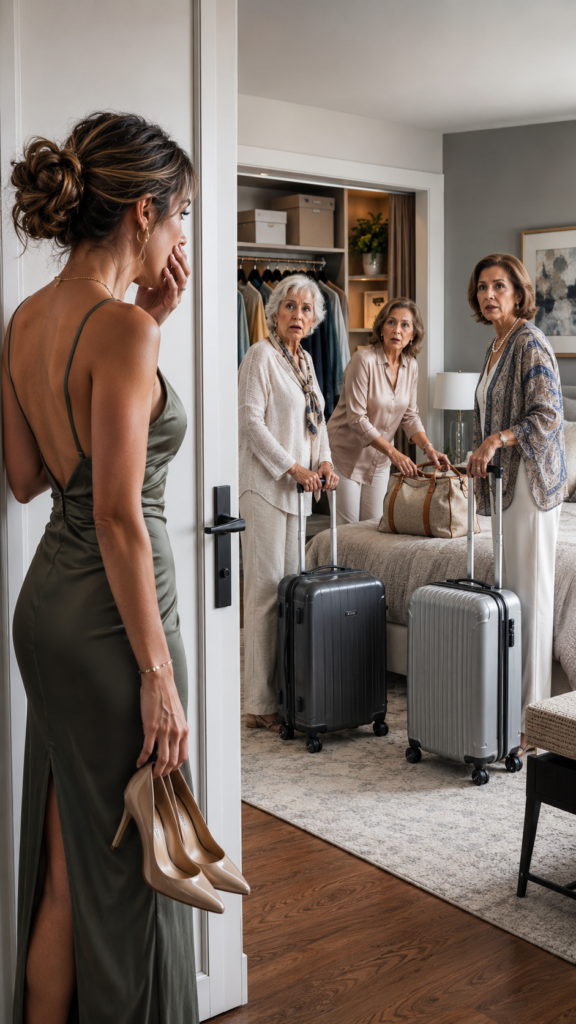
In the living room, eight of Simón's relatives were filling suitcases.
A cousin folded his shirts as if they were old rags. An uncle wrapped a coffee maker in newspaper. Two nephews were taking boxes down to the elevator. And Mariana, the cousin who always asked for favors, was rummaging through the desk where Simón kept his most personal papers.
In the middle of it all was Doña Graciela, her mother-in-law, wearing dark glasses, a designer bag, and a triumphant expression that didn’t match any funeral.
—Don’t even bother to take off your mourning, Verónica —she said without greeting her—. Grab your bag and leave. This apartment is already family property.
Verónica froze.
On the dining table lay a handwritten list: computer, watches, deeds, cards, keys, important documents.
Next to the entrance, Simón's urn was surrounded by wilted flowers. No one looked at it. No one seemed to remember that this man had just died.
—What are you doing in my house? —Verónica asked, her voice so low that even she was surprised.
Doña Graciela let out a dry laugh.
—Your house? No. This was my son's house. You were his wife, not the owner of his life.
—Simón and I lived here.
—You lived here because he allowed you to —Graciela replied—. But that's over. Without a will, blood is worth more than a marriage certificate.
Mariana picked up a folder from the desk.
—Besides, we’ve already searched, comadre. He left nothing. You’d better avoid making a fool of yourself.
Verónica looked at the suitcases, the shirts, the books with Simón's notes, the watches he wore to work even when he was already sick.
Something inside her broke.
But she didn’t cry.
She laughed.
A clean, dry, strange laugh. So unexpected that everyone stopped moving.
—Have you gone crazy? —Graciela spat.
Verónica slowly took off her heels and left them by the door.
—No, Graciela. It’s just that you all just made the same mistake as always.
Óscar, a big cousin, slammed a suitcase shut.
—What mistake, according to you?
Verónica held up her phone. She had just received a message.
“We're downstairs.”
Then she looked at her mother-in-law, at the eight relatives, and at Simón's urn.
—You thought that because he was quiet, he was weak. You thought that because he didn’t show off, he had nothing. And you thought you could loot him on the very day of his funeral.
Doña Graciela pointed to the door.
—You have ten minutes before we call the police.
Verónica smiled without joy.
—Good that you mentioned the police.
At that moment, there was a knock on the door.
And no one in that room could imagine what Simón had signed before he died.
PART 2
When Verónica opened the door, a woman in a navy blue suit entered, hair tied back, and a black folder under her arm.
Behind her came Luis, the building manager, with a clipboard of documents. Next to him walked an auxiliary police officer, one of those who don’t talk much but see everything.
—Good afternoon —the woman said—. I’m Licenciada Adriana Montalvo. I represent the estate interests of Simón Treviño and the trust he established.
The word “trust” dropped like a bucket of cold water.
Doña Graciela crossed her arms.
—Trust? Don’t come to me with nonsense. My son gave consultations; he wasn’t Carlos Slim.
Adriana remained unflustered.
She looked at the open suitcases, the laptop in Óscar's hands, the folders on the couch, the scattered photographs, and the dining table list.
—Precisely because he knew his family very well, Simón organized everything before he died.
Mariana paled.
—There’s no will. We already checked.
—Simón knew that too —Adriana replied—. That’s why he left very little subject to succession.
Luis opened his folder and spoke in a formal voice.
—The apartment is not registered in Simón Treviño’s name as an individual. It belongs to a property society incorporated into a private trust. The primary beneficiary, administrator, and only person with the right to occupy it is Mrs. Verónica Salgado.
The silence was so heavy that the sound of the street could be heard coming through the open window.
Doña Graciela stepped forward.
—That’s a lie. My son would never have left everything to her.
Adriana pulled out a certified copy.
—It’s signed, registered, and valid. If you’d like, you can review it with your lawyer. But for now, what you’re doing here is called burglary and possible theft.
Óscar dropped the laptop on the table as if it burned.
—Simón owed me money.
Verónica looked at him with bitter sadness.
Óscar always showed up when he needed Simón to solve his life. A bad investment, a bank debt, overdue rent. It was all “family,” until it was time to pay.
—Do you have a contract? —Adriana asked.
Óscar swallowed hard.
—It was a verbal agreement.
—Then it wasn’t a debt —the lawyer said—. It was abuse disguised as trust.
Doña Graciela slammed her palm on the table.
—This woman manipulated him. Ever since he married her, my son changed. He didn’t help us as he used to. He wouldn’t answer when we needed him.
Verónica felt the blow to her chest, but she didn’t respond.
She remembered Simón in the hospital, six days earlier, with pale skin and tired eyes, holding her hand with a strength he barely had left.
—They’re going to get the things before the flowers wilt —he had told her—. Don’t fight alone. Call Adriana. And if they tell you I left nothing, laugh.
She had thought he was delirious from the medication.
But Simón wasn’t delirious.
Simón was closing the last door.
Adriana opened another section of the folder.
—Also, before you continue to lie, you should know something. Simón recorded unauthorized accesses to this apartment during his hospitalization.
Mariana clutched the back of a chair.
—What are you saying?
The lawyer placed three photographs on the table.
In the first, Doña Graciela was entering the apartment with an old key.
In the second, Óscar was rummaging through Simón's desk.
In the third, Mariana was photographing personal documents with her phone.
The auxiliary policeman moved a little closer.
—That’s getting more serious.
Doña Graciela lost her color.
—My son wouldn’t have recorded us.
Adriana looked her straight in the eye.
—Your son installed cameras two years ago after documents related to the death of his father went missing.
Verónica closed her eyes.
She didn’t know that.
Simón had carried more secrets than he had wanted to tell her.
Mariana began to cry, but it didn’t seem like sadness. It seemed like fear.
—I was just helping my aunt —she murmured.
—Come on, Mariana —Luis said, for the first time breaking the formal tone—. Helping isn’t coming to take photos of other people's papers.
Doña Graciela glared at Verónica with hatred.
—This is all your fault. Before you, Simón was a good son.
Verónica took a deep breath.
—No. Before me, Simón was an open account.
The phrase hurt more than a scream.
Adriana pulled out a sealed white envelope, closed and signed.
—Simón left specific instructions for this moment.
On the front was written Verónica’s name in his handwriting.
She took it with trembling hands.
Inside was a short note.
“Vero, I’m sorry for leaving you this fight in the middle of the pain. If they are there, don’t negotiate. They didn’t come to say goodbye. They came to collect a life they never respected. Adriana knows what to do. And if my mother asks what I left her, tell her exactly what she earned.”
Verónica covered her mouth.
Doña Graciela pressed her lips together.
—What does that mean?
Adriana pulled out another sheet.
—It means that Simón did leave a minor succession provision.
For a second, Graciela's eyes sparkled.
—Then I’m entitled to something.
—Yes —Adriana replied—. To you, to Óscar, to Mariana, and to other mentioned relatives, Simón left each of you 1 peso.
No one moved.
—1 peso? —Mariana whispered.
—1 peso —Adriana repeated—. And a clause of non-contestation. If you try to contest the trust, a file will be released with evidence of simulated loans, altered documents, unauthorized accesses, and transactions made after Simón's father's death.
Óscar cursed.
Doña Graciela stood frozen.
—He wouldn’t dare destroy his mother.
Verónica pressed the note against her chest.
—You destroyed him first.
Adriana opened Simón's laptop and plugged in a USB drive.
—The video is missing.
Doña Graciela raised her voice.
—I don’t authorize any video.
—You don’t need to authorize it —Adriana replied—. It was recorded by Simón in front of two witnesses and certified before a notary.
The screen took a few seconds to turn on.
Then he appeared.
Simón was sitting on a hospital bed. Thin, pale, with a low voice, but with that calm look Verónica loved. He didn’t seem defeated. He seemed tired of forgiving.
—Vero —he said in the video—, if you’re watching this, it means I couldn’t make it home. I’m sorry. Also, I’m sorry for leaving you one last fight that wasn’t yours.
Verónica began to cry silently.
Simón breathed with difficulty.
—If my family is there, I hope you did what I asked. I hope you laughed.
A broken laugh, mixed with tears, escaped Verónica.
Doña Graciela turned her gaze away.
—For years, I confused being a good son with allowing abuses —Simón continued—. I confused silence with keeping the peace. My mother and some relatives used my guilt, my papers, and my money to solve problems they created themselves.
Óscar hung his head.
Mariana cried without noise.
—I protected them many times —Simón said—. Not because I didn’t know the truth, but because I was ashamed to accept it. It hurt me to understand that the people who were supposed to take care of me only knew how to charge me.
Doña Graciela whispered:
—Lies.
But no one believed her anymore.
Simón looked directly at the camera.
—For the record: my mother, Graciela Treviño, has no authorization over any asset, account, file, property, or decision related to me. Any old key, family promise, or sentimental story they use to enter my home should be treated as an invasion disguised as mourning.
The auxiliary police officer crossed his arms.
Adriana said nothing. It wasn’t needed.
—Everything I built is protected for Verónica Salgado, my wife —Simón continued—. Not because she asked me, but because she was the only person who loved me without asking how much I had, how much I could lend, or what favor I could solve.
Verónica cried harder.
—I leave my family 1 peso —Simón said—. Not as mockery, but as precision. That’s what loyalty is worth that they showed when they thought I could no longer defend myself.
Doña Graciela let out a groan. But it wasn’t pain. It was humiliation.
—And if they try to contest, I authorize my lawyer to present the entire file. I will no longer carry others' secrets.
The video paused.
Then Simón’s voice became gentle.
—Vero, open the windows when you can. Don’t let this house smell like a fight. Fill it with coffee, books, and new flowers. Blood isn’t always family. Sometimes family is who gives you peace when the world comes to take everything from you.
The screen went dark.
For several seconds, no one spoke.
Then the auxiliary police officer pointed at the suitcases.
—You will return everything to its place. Then you will leave the apartment with your personal belongings. Nothing more.
Óscar tried to hold onto his dignity, but when he picked up a watch of Simón’s, the police officer saw him.
—Leave it there.
Óscar obeyed without protest.
The relatives returned shirts, books, cables, folders, and photos. One by one, they exited, no longer as owners but as people trapped in sheer embarrassment.
Luis took the old key Graciela had used and made a record of it. The lock would be changed that same night.
Before leaving, Graciela stopped in front of Verónica.
—He was my son.
Verónica looked at her with red but firm eyes.
—Yes. And you had 38 years to love him well.
Graciela opened her mouth but couldn’t find a phrase that wouldn’t sink her deeper.
She left.
When the door closed, the apartment fell into silence.
It wasn’t peace yet. It was the first minute after a storm when the disaster lies strewn everywhere, but at least no one is breaking more.
Verónica sat next to Simón's urn.
Adriana approached slowly.
—Everything is protected. They won’t be able to take anything from you.
Verónica looked around the living room, the books, the sofa, the lamp where Simón read at night.
—They already took something from me.
The lawyer didn’t respond.
Because no trust, no paper, and no signature could bring back the man she had just lost.
In the following weeks, Graciela didn’t contest. Óscar disappeared from family gatherings. Mariana deleted her social media for a while. No one wanted to take the case to court because Simón had done what he always did: leave the truth ordered, signed, and ready to come to light.
A month later, Verónica bought white calla lilies at the Medellín market.
She arrived at the apartment, opened all the windows, and let the noise of Mexico City in: cars, vendors, distant rain, life.
She placed the flowers next to the urn.
Then she turned on Simón's reading lamp.
For the first time since the funeral, the living room didn’t seem looted.
It seemed like hers.
Theirs.
Verónica touched the sofa where he used to fall asleep with an open book on his chest.
—They never knew who you were —she whispered—. But I do.
Outside, it began to rain.
And inside that apartment, protected until the end by Simón's last act of love, Verónica understood something that many people don’t want to accept:
Sometimes family isn’t who shows up crying at the funeral.
Sometimes true family is who, even while dying, leaves the door closed so that no one can destroy what they loved most.