PART 1
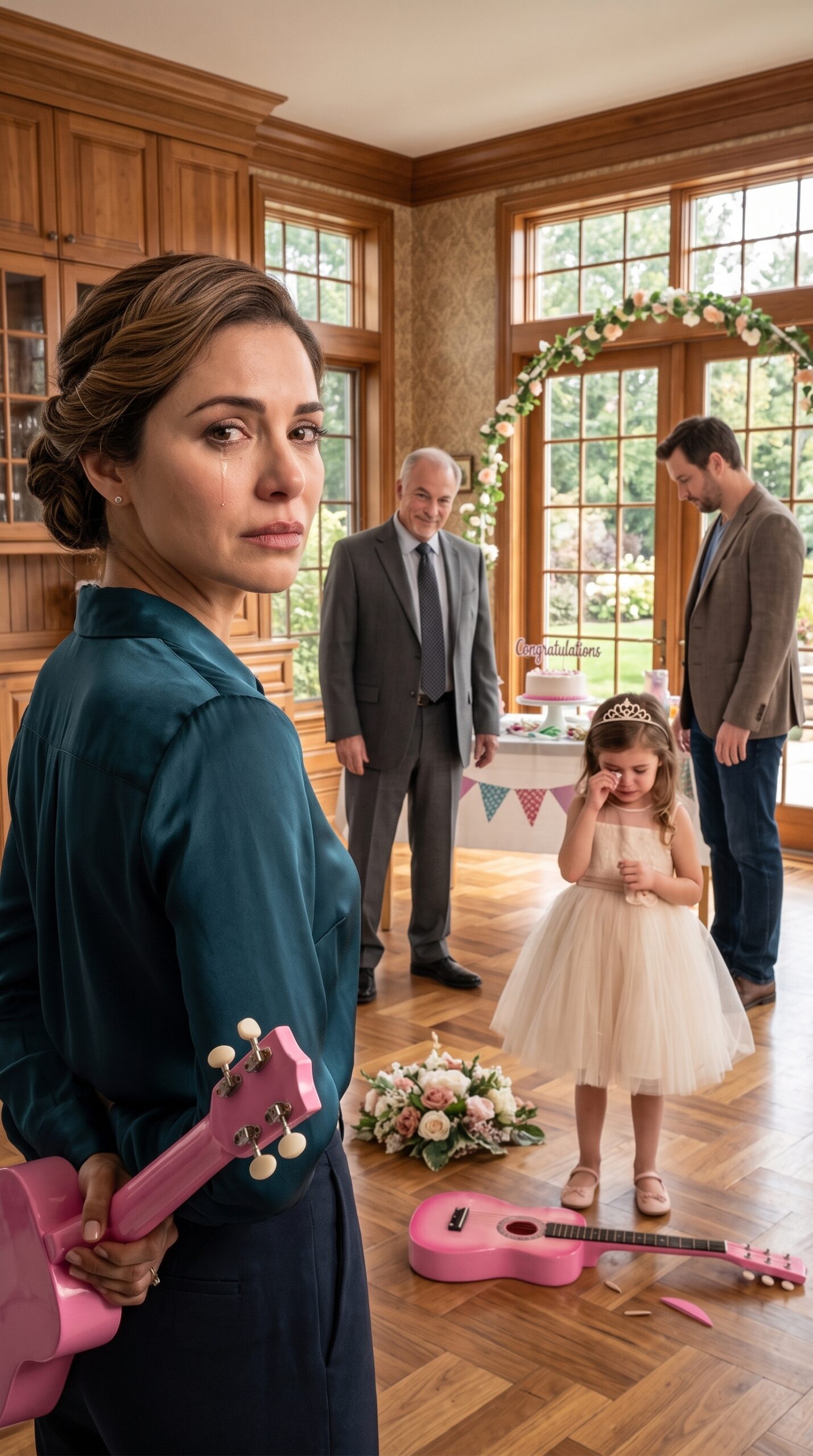
—Mom, look! Dad bought me a guitar! —shouted Valeria, six years old, bursting into the dining room with a huge smile.
The Arriaga house in San Ángel was filled with guests, expensive glasses, and uncomfortable silences.
It was family Sunday, the kind where everyone pretended to love each other while measuring who had more power.
Valeria dashed toward her grandfather, Don Evaristo Arriaga, an old, tough businessman used to having no one oppose him.
The girl carried a small, honey-colored guitar, with a red bow tied at the headstock.
Her dad, Rodrigo, smiled nervously by the door.
Her mom, Mariana, looked at her tenderly, though something in her father-in-law's face froze her blood.
—Grandpa, when I grow up I want to sing at Bellas Artes —Valeria said proudly.
Don Evaristo did not smile.
He didn't even pretend.
He looked at the guitar as if it were trash.
—And who put that nonsense in your head?
The girl blinked, confused.
—My dad said I could learn…
Rodrigo dropped his gaze.
Mariana pressed her lips together.
At the table, Aunt Patricia let out a venomous giggle.
—Oh please. An Arriaga playing in bars. How embarrassing.
Valeria clutched the guitar tighter.
—It’s not a bar. It’s music.
Don Evaristo slowly rose.
At seventy-two, he still instilled fear. Not for being strong, but because he had spent decades buying obedience.
He walked toward the girl and extended his hand.
—Give it to me.
Valeria looked at her mom.
—I don’t want to.
—I said give it to me.
Rodrigo stepped forward.
—Dad, it's just a guitar.
Don Evaristo shot him a withering glance.
—You shut up. You do enough damage filling her head with fantasies.
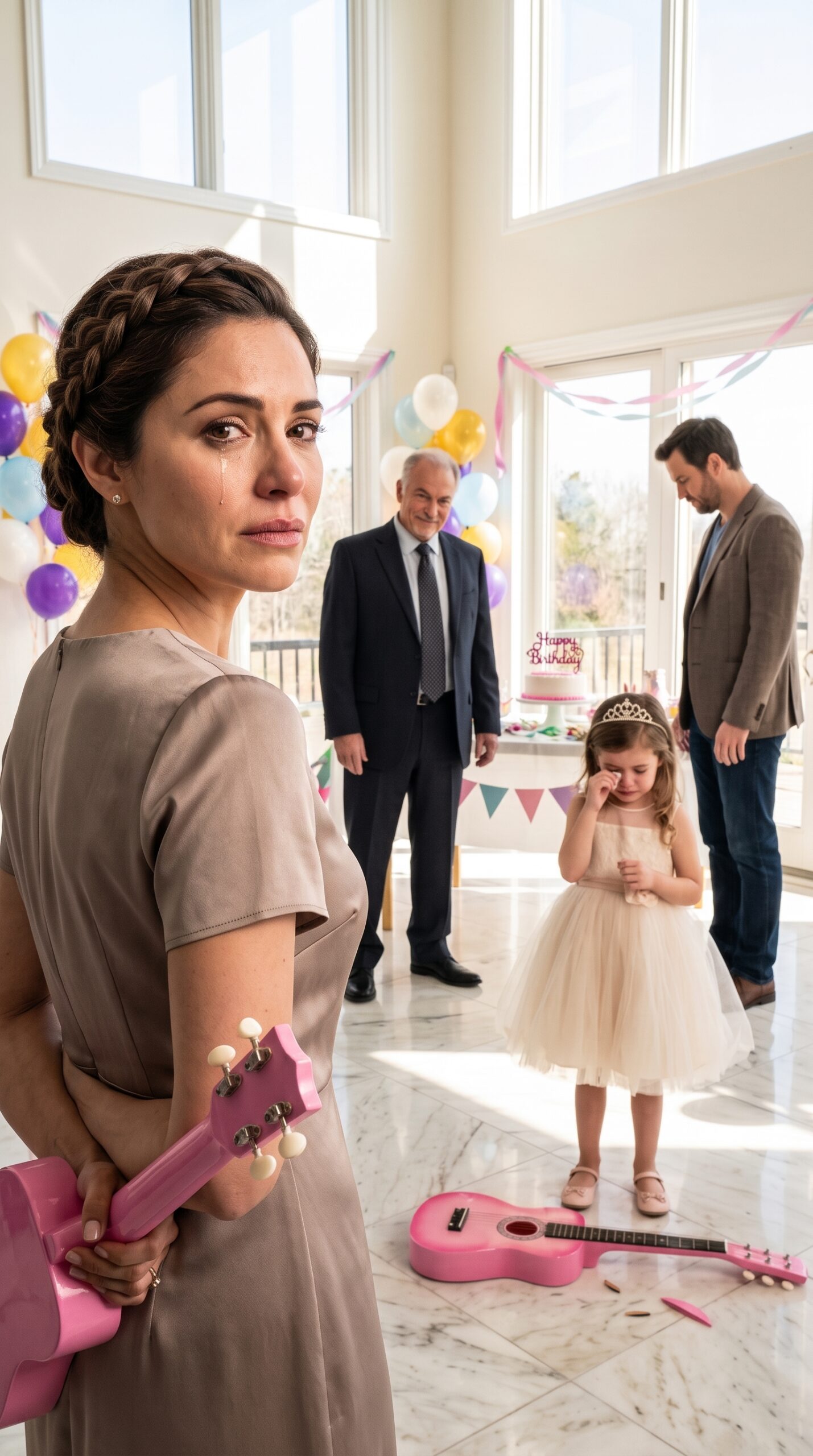
Before Mariana could move, the old man snatched the guitar from Valeria.
The girl let out a scream.
—No, Grandpa!
Don Evaristo raised the instrument and smashed it against the cantera floor.
The sound echoed throughout the house.
The wood splintered.
The strings flew.
The red bow lay discarded next to a broken leg.
Valeria stood frozen, tears filling her eyes, as if something inside her chest had just been shattered.
—Useless girls don't need dreams —said Don Evaristo—. They need to learn their place.
Mariana felt rage rise from her stomach to her throat.
But she didn't scream.
She didn't cry.
She crouched down, picked up a broken string, and tucked it into her bag.
Everyone stared at her.
—Apologize to my daughter —she said, with a calmness that scared more than a scream.
Don Evaristo let out a harsh laugh.
—You’re going to teach me how to educate, Mariana? You, the little choir teacher my son picked up as if she were charity.
Rodrigo said nothing.
That silence was worse than the broken guitar.
Patricia crossed her arms.
—Dad is right. The girl needs discipline. This family wasn’t built on songs.
Mariana held Valeria, who trembled against her neck.
—This family isn’t going to be saved by cruelty either.
Don Evaristo smiled.
—Tomorrow you sign the authorization. Valeria is going to a boarding school in Querétaro. They’ll strip her of those ridiculous ideas.
Rodrigo raised his face, pale.
—Dad, we didn’t agree on that.
—You don’t decide anything anymore —the old man replied.
Then Patricia pulled out a black folder and placed it on the table.
Mariana caught a glimpse of a phrase on the first page: “Assignment of educational custody and asset control.”
The air became heavy.
And Mariana understood that the guitar hadn't been the attack.
It had only been the warning.
PART 2
The next morning, Don Evaristo had breakfast on the terrace as if nothing had happened.
The garden smelled of bougainvillea, coffee from a clay pot, and freshly bought sweet bread.
But there was no warmth at that table.
There was a war served alongside the dishes.
Valeria did not come down.
She remained in her room, hugging the empty guitar case, unwilling to speak to anyone.
Mariana had slept next to her, listening as the girl woke up repeatedly, asking if she had done something wrong.
That question broke her heart.
Rodrigo appeared late, disheveled, with his shirt buttoned wrong.
He had dark circles under his eyes and guilt on his face.
—Mariana, we can fix this —he murmured.
She didn’t look at him.
—Fix what? The guitar or your silence?
He swallowed hard.
—My dad is complicated.
—No, Rodrigo. Your dad is cruel. And you let him be cruel to your daughter.
Don Evaristo set his cup down on the plate.
—Enough with the drama. At 5 PM, the notary is coming. You sign for the boarding school, and this ends.
Mariana lifted her gaze.
—I am not going to sign.
Patricia, immaculate in her white suit, smiled as if talking to a servant.
—Then you're going to get into trouble, sis. Legally, Rodrigo has more weight than you in family decisions.
—Legally? —Mariana asked.
—You don’t want to play lawyer —Patricia said—. You teach music at a secondary school. You’re not in your world.
Mariana barely smiled.
It was a small, cold smile.
—That's what they think.
Rodrigo looked at her, confused.
For seven years, Mariana had endured snubs, classist remarks, and humiliations disguised as advice.
Don Evaristo never accepted her because she didn’t come from a powerful family.
He called her “the little choir girl.”
He sat her far away at meals.
He said Valeria had inherited “her mother's useless sensitivity.”
But Mariana was not just a teacher.
Before marrying, she had worked as a lawyer in a civil association dedicated to protecting cultural trusts.
And very few people knew that information.
One of those people had been Doña Amalia, Rodrigo's mother.
The only Arriaga who had loved Mariana from the very first day.
Doña Amalia died when Valeria was two years old.
Everyone said she left her affairs in order.
But not everyone knew what “in order” meant.
At 5 PM, the notary arrived.
Three partners from Grupo Arriaga also arrived, the family accountant, and two cousins who always showed up when money was involved.
Don Evaristo wanted to do it in the main living room, under the enormous portrait of himself inaugurating a factory.
He needed an audience to humiliate.
Mariana came down with Valeria holding her hand.
The girl had puffy eyes but walked upright.
In her other hand, she carried the red bow from the broken guitar.
—The girl doesn’t need to be here —Rodrigo said.
—Of course she does —Mariana replied—. Yesterday they broke it in front of everyone. Today she will see who really breaks.
Silence fell heavily.
Don Evaristo let out a dry laugh.
—What a drama queen you are.
Patricia pushed the folder toward Mariana.
—Sign and avoid this getting uglier.
Mariana opened the folder.
She read calmly.
They had prepared everything: boarding school, shared tutoring, control of activities, restrictions on artistic classes, and a clause for Rodrigo to temporarily cede his shares to Don Evaristo “for business stability.”
There was the truth.
They didn’t want to correct Valeria.
They wanted to isolate her.
They wanted to break Mariana.
They wanted to force Rodrigo to hand over the last thing Doña Amalia had left him.
—How curious —Mariana said—. They broke a guitar to justify a theft.
Patricia stiffened.
—Watch your words.
—No. You all should watch your evidence.
Mariana took out her cellphone and connected it to the speaker in the living room.
Don Evaristo's voice filled the place.
—If the girl continues with music, Mariana will have influence. Break that illusion for her right now. A scared child obeys better.
Rodrigo paled.
Patricia gritted her teeth.
Don Evaristo slammed his cane against the floor.
—That proves nothing. A recording taken out of context.
Mariana then pulled out another folder.
This one was not theirs.
It was hers.
Inside were notarized copies, printed emails, bank statements, and an old deed signed by Doña Amalia.
The notary picked up the first document.
He read in silence.
Then he lifted his gaze.
His expression changed.
—Don Evaristo… this is an active trust.
The old man’s smile vanished.
Mariana stroked Valeria’s hair.
—Doña Amalia created the Valeria Arriaga Trust to support the artistic education of girls in vulnerable situations. My daughter was a symbolic beneficiary and direct protected party.
Patricia frowned.
—That has nothing to do with the company.
—It does —Mariana said—. Because Doña Amalia left 38% of the family shares within that trust. And she added a very clear clause.
The notary finished the sentence.
—If any administrator endangered the emotional, educational, or asset integrity of the protected minor, they would immediately lose their administrative powers.
Don Evaristo stood up.
—That’s nonsense!
—No —Mariana said—. It’s your wife’s will.
The blow was direct.
Everyone knew that Don Evaristo hated it when someone mentioned Amalia as if she had had her own power.
To him, his wife had been an ornament.
To Mariana, she had been the only decent person in that house.
Patricia tried to snatch the documents.
The notary pushed them away.
—Ma'am, this is registered.
The word “ma'am” made Rodrigo look at Mariana as if he didn’t know her.
—Ma'am? —he whispered.
Mariana looked at him for the first time all day.
—Yes. Before being “the little teacher,” I was a lawyer. And before I stayed silent, I learned to keep every piece of evidence.
Don Evaristo was breathing with fury.
—You don’t know who you’re messing with.
—Yes I do —Mariana replied—. With a man who confused family with property.
But the worst was yet to come.
Mariana pulled out another envelope.
This time she placed it in front of the accountant.
—Review it.
The man hesitated.
Don Evaristo shouted:
—Don’t touch that!
Too late.
The accountant opened the envelope.
His hands began to tremble.
There were false invoices, diverted donations, inflated contracts, and transfers to Patricia's personal account.
For years, Don Evaristo had used Amalia's trust as a slush fund.
Money intended for scholarships for girls had ended up paying for trips, jewelry, and apartments.
Patricia lost her color.
—Dad, you said that was closed.
The whole room heard.
And with that sentence, she sank herself.
Rodrigo collapsed into an armchair.
He covered his face with his hands.
—Oh my God…
Mariana felt no pleasure.
She felt sadness.
Because for years she had hoped he would wake up before it was too late.
But Rodrigo woke up just when it was too late to matter.
Don Evaristo looked at Valeria.
Even at that moment, he wanted to hurt.
—All this for a spoiled girl and a cheap little guitar.
Valeria tightened the red bow.
Mariana leaned toward her.
—Don’t believe a word.
Then she looked at the old man.
—It wasn’t about a guitar. It was because you dared to call a girl useless who is worth more than your entire surname.
The notary closed the folder.
—With this evidence, the immediate removal of Don Evaristo as administrator is activated. The provisional representation will be handed over to Mariana Salcedo, according to the alternate designation of Doña Amalia.
Patricia let out a scream.
—She’s not an Arriaga!
—No —Mariana said—. That’s why I didn’t learn to obey like you.
At that moment, the doorbell rang.
The employee opened the door and two agents from the Prosecutor's Office entered, accompanied by a court clerk.
Don Evaristo looked around, seeking support.
No one moved.
Not his partners.
Not his nephews.
Not Rodrigo.
The court clerk read an order related to fraud, disloyal administration, and diversion of resources.
Patricia began to cry.
But she didn’t cry for Valeria.
She didn’t cry for the girls who were left without scholarships.
She cried because her cards were going to stop working.
Don Evaristo pointed a trembling finger at Mariana.
—You destroyed this family.
Mariana held Valeria.
—No. I just turned the light on. What was rotten was already there.
Rodrigo approached, crying.
—Mariana, forgive me. I swear I didn’t know everything.
She looked at him without hatred.
That was the hardest part.
Because when a woman stops hating, she often stops hoping.
—Maybe you didn’t know everything —she said—, but you saw enough. And yet, you stayed silent.
Rodrigo tried to take Valeria's hand.
The girl hid in her mom's neck.
That gesture was his sentence.
Six months later, the mansion in San Ángel was no longer a museum of arrogance.
Half of it transformed into a free music school for girls from underserved communities.
The other half was sold to recover the money stolen from the trust.
At the entrance, a simple plaque read:
“Amalia Arriaga Cultural Center. For the girls who should never have had to ask for permission to dream.”
Don Evaristo awaited trial.
Patricia lost her position, her accounts, and almost all the friends who only wanted her for her benefits.
Rodrigo saw Valeria on Saturdays, under a clear rule: absolute respect or the visit ended.
It wasn’t punishment.
It was protection.
One afternoon, at the City Theater, Valeria stepped onto a small stage.
She carried a new guitar, made by a luthier from Paracho.
It wasn’t the most expensive.
But it sounded beautiful, as if each note knew how to heal.
Mariana sat in the front row.
Rodrigo, a few seats back, cried silently.
Before playing, Valeria approached the microphone.
Her hands trembled a little, but she didn’t lower her head.
—This song is for my grandma Amalia —she said—. And for all the girls to whom someone told their dreams didn’t matter.
The theater fell silent.
Then the first note came out clean.
Firm.
Brave.
Mariana closed her eyes.
She remembered the broken guitar, the cantera floor, Don Evaristo's laughter, and her daughter’s face believing dreaming was a mistake.
And she understood that justice doesn’t always come as one imagines.
Sometimes it doesn’t come with shouts.
Sometimes it comes with a six-year-old girl playing in front of everyone who tried to silence her.
Because there are adults who break guitars thinking they break dreams.
But there are mothers who gather the broken strings…
and with them, they end up binding the fall of those who believed themselves untouchable.