PART 1
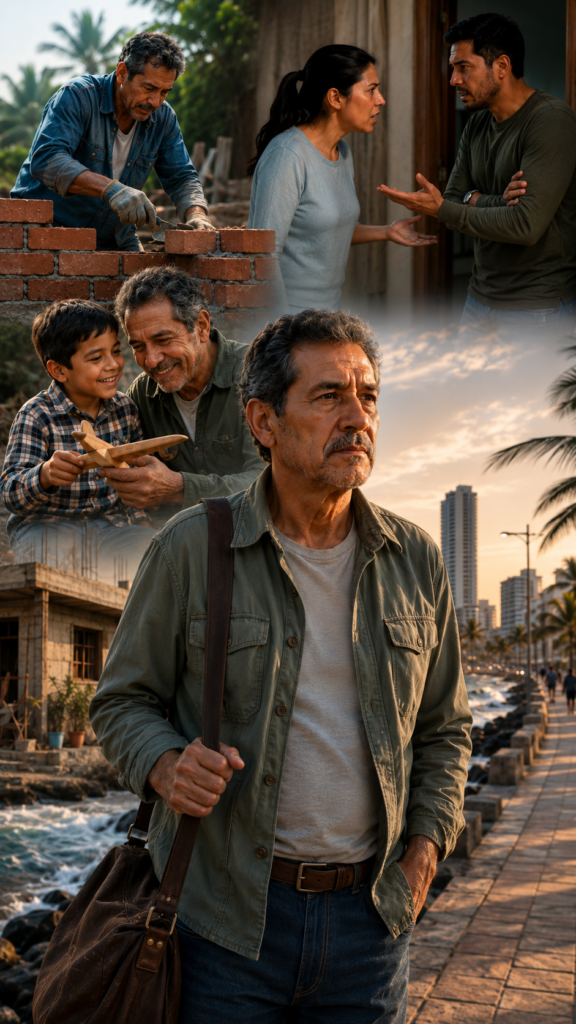
Don Arturo Salinas was 52 years old when he walked out of the bank with a notebook in his hands and his heart knotted.
It wasn’t fear.
It was that rare excitement that comes when life, after so many setbacks, finally seems to give you a bit of justice.
His older brother, Don Eusebio, an old fisherman from La Cruz de Huanacaxtle, had died without children. In his will, he left Arturo an amount of money he had never seen together in his life.
Arturo didn’t think about buying a truck.
He didn’t think about going on a trip.
He didn’t even think about resting.
The first thing that came to his mind was his family.
His son Iván.
His daughter-in-law Brenda.
His two grandchildren, Mateo and Sofía, who ran through the house in Tonalá as if the world were still good.
He wanted to fix the roof that leaked every rainy season, change the old kitchen, build a nice room for the kids, and maybe start a small family business so Iván wouldn’t be drowning in debt anymore.
That house had been built by Arturo with his own hands.
Brick by brick.
Shift by shift.
Back pain upon back pain.
Since he became a widower, when Iván was just 3 years old, there hadn’t been a day he hadn’t worked thinking of giving his son a decent roof.
He had been a mason, a night watchman, a laborer at the wholesale market, and even an assistant in a mechanic's shop.
He never complained.
Because for him, being a dad was this: swallowing the exhaustion so his son wouldn’t have to know hunger.
That afternoon he returned with a bag of sweet bread to celebrate.
Before entering Iván’s room, he heard voices.
He was going to knock on the door, but he froze upon hearing his name.
“Your dad is already in the way, Iván,” Brenda said softly, but with poison. “Honestly, the house feels heavy with him here. He comments on everything, he watches everything. He’s too old. What are we going to do when he gets sicker?”
Iván sighed.
“He’s my dad, Brenda. I can’t just kick him out.”
“Don’t be dramatic. No one said to kick him out. Find him a cheap room downtown or put him with some guy who rents. You give him 1,500 a month, and that’s it. We need space. The kids need their room. And you need to understand that this house is our life now.”
Arturo felt the bag of bread slipping from his fingers.
But the worst came when Iván replied:
“Give me a chance. After the end of the month, I’ll talk to him. Let’s see how I tell him he doesn’t fit here anymore.”
Don Arturo made no noise.
He didn’t cry.
He didn’t shout.
He simply took a step back with his soul shattered.
And no one in that house imagined what was about to happen next.
PART 2
Don Arturo walked to the service patio, that corner where he had his twin bed, an old dresser, and a photo of his wife, Lupita, taped to the wall with clear tape.
That was where the owner of the house lived.
That was where the man who built it slept.
In a little room that barely fit his shoes and his dignity.
He sat on the edge of the mattress and looked at his hands.
They were marked by cement, paint, metal, old cuts, and broken nails. Those hands had carried Iván when he had a fever. They had made sandwiches. They had paid tuition. They had buried Lupita and, still trembling with pain, kept working the next day because the boy needed to eat.
That night Arturo didn’t have dinner.
He didn’t open the bank notebook either.
He put the inheritance document in a black backpack, along with three changes of clothes, his ID, the house deeds, and a photo of Iván when he was 7 years old, smiling without his front teeth.
At 5:20 in the morning, he left without waking anyone.
He only left a note on the table:
“I’m leaving for a few days. Don’t worry.”
Nothing more.
No reproaches.
No explanations.
No drama.
Because sometimes silence hurts more than any scream.
He took a bus headed for Nayarit. Along the way, as the sun rose behind the hills, Arturo wondered when a father’s love became invisible.
He remembered when Iván got bronchitis at 5 years old and he sold his bicycle to pay for medicine.
He remembered when he refused to buy himself new boots because his son wanted a Spider-Man backpack.
He remembered the Christmases when he said he didn’t need a gift, just so Iván could have new shoes.
And now that son was looking for a place to put him so he wouldn’t be an inconvenience.
When he arrived in La Cruz de Huanacaxtle, Don Julián, a friend of his brother Eusebio, was waiting for him.
He was a skinny, dark man, wearing a straw hat and a calm voice.
When he saw Arturo get off the bus, he hugged him as if he had been waiting for him for years.
“Eusebio always said you were too good for this world, brother.”
Arturo looked down.
“Maybe that’s why the world gets used to stepping on you.”
Julián didn’t ask more.
He offered him a room in a little house near the dock. From there, the waves and the seagulls’ cries could be heard at dawn.
In the first days, Arturo didn’t know what to do with so much calm.
He was used to waking up before everyone else, making coffee, sweeping the patio, fixing any leaks, taking the grandchildren to school, and then making himself small so as not to bother.
In Nayarit, no one asked him to make himself small.
On the contrary.
A fisherman asked for his help to repair a bench.
A woman brought him coffee.
A young man asked if he could teach him how to patch a wall.
In less than a month, Arturo was already known at the dock.
Not for his money.
But for the way he looked at people.
For his habit of helping without humiliating.
For speaking little and fulfilling much.
One day, Julián took him to a lawyer in Tepic to review the inheritance papers.
Arturo thought it was just about the deposited money.
But the lawyer showed him a blue folder with plans, deeds, and property tax receipts.
“Don Arturo, your brother didn’t just leave you money. He also left you a plot of land by the sea. It’s neglected, but it’s worth quite a bit.”
Arturo stood still.
“By the sea?”
“Yes. And not just any land. It has direct beach access and a permit for residential construction.”
Julián smiled.
“Eusebio knew what he was doing.”
The lawyer asked if he wanted to sell it.
Arturo looked at the plans for several seconds.
In his mind appeared the face of a lady he had met at the dock. Doña Chela. She was 78 years old, and her children lived in the United States. They sent her money every two months, but no one visited her.
Then he thought of Don Hilario, a retired teacher who ate alone every day at a little eatery, talking to the empty chair where his wife used to sit.
And he thought of himself.
The owner of a house sleeping in the patio.
The father turned into a burden.
Then he took a deep breath.
“I’m not going to sell it.”
“What do you want to do?” asked the lawyer.
Arturo raised his gaze.
“I want to build a house for the elderly who no longer have a place in their own family. But not a sad nursing home. A real house. With a garden, kitchen, music, workshops… a place where no one ever feels like a burden again.”
Julián crossed himself slowly.
“That’s really something, Arturo.”
Meanwhile, in Tonalá, the absence of Don Arturo began to feel like dampness in the walls.
At first, Brenda said it was better.
“Finally, we have space.”
But after a few days, things fell apart.
The bathroom leak returned.
The water heater stopped igniting.
Mateo cried because his grandfather no longer took him for corn at the park.
Sofía asked every night if grandpa was mad at her.
Iván said no, but each question pierced something in his chest.
Brenda, on the other hand, began to get upset.
“Well, if you miss him so much, call him. But don’t go begging. Remember that he left on his own.”
Iván didn’t respond.
Until one night, looking for a warranty for the water heater, he opened an old drawer in his father’s room.
There he found a metal box.
Inside were yellowed receipts, notes, photographs, and a brown-covered notebook.
Iván opened it expecting nothing.
But on the first page, he recognized his dad’s handwriting.
“Today Iván turned 8 years old. I didn’t have enough to buy him a cake from the bakery, but Lupita would have worked magic with sweet bread and candles. I watched him blow out the candles and thought: as long as I live, this boy will not lack a home.”
Iván swallowed hard.
He continued reading.
“Today I was offered to work double shifts. My back hurts, but Iván needs new glasses.”
“Today I sold my watch. It was the only keepsake from my dad, but the secondary school inscription doesn’t wait.”
“Today Iván told me that one day he would buy me a big house. He doesn’t know that this one has been his since he was born.”
His hands began to tremble.
At the bottom of the box, he found the original deeds.
And that’s when the blow came.
The house had never been in Iván’s name.
It was still legally in Don Arturo Salinas’s name.
His father had never taken it from him.
He had never flaunted it.
He had never used it to control him.
He simply allowed him to live there as if it were his own.
Iván felt shame.
But still, something worse was yet to come.
On the last page of the notebook was a recent note.
“Today I received a blessing from my brother Eusebio. I wanted to tell Iván to fix the house and help him with his debts. But I heard that I no longer have a place here. It doesn’t hurt me to leave. It hurts me to have stayed so long where I was already seen as a burden.”
Iván collapsed sitting on the floor.
Brenda entered and saw him crying.
“What do you have now?”
Iván showed her the notebook.
She looked at it with no emotion.
“Oh, come on. Old people always write things to gain pity.”
That phrase opened his eyes completely.
For the first time, Iván didn’t defend Brenda.
He didn’t stay silent.
He didn’t look at the floor.
“My dad didn’t gain pity. My dad held us all up.”
Brenda crossed her arms.
“Well then, go find him. Let’s see if you also get something from that inheritance.”
Iván froze.
“What inheritance?”
Brenda paled.
That twist broke the house apart.
Iván understood that she already knew.
He checked messages, papers, and even a receipt that Arturo had left folded by accident. Brenda had seen the deposit before everyone. That’s why she was in a hurry. That’s why she wanted him gone. She didn’t want to take care of a father-in-law. She wanted to push him away before he decided what to do with his money.
Iván took his cellphone and went out to the patio.
He called every family contact.
No one knew where Arturo was.
Weeks passed.
Then he got Don Julián’s number.
When he called, the man’s voice was dry.
“Don Arturo is fine.”
“I need to talk to him. I’m his son.”
Julián fell silent.
“Look, kid, I’m going to ask you something very clear. Are you looking for your dad because you love him or because you found out what he inherited?”
Iván couldn’t respond immediately.
The question was cruel.
But it was fair.
“I’m looking for him because I was an idiot,” he finally said, “And because if he still allows me to see him, even if it’s to ask me to leave, I need to apologize.”
Three months later, Iván arrived in Nayarit with Mateo and Sofía.
Brenda didn’t come.
By then, Iván had already started the separation. Not for a single phrase, but for years of contempt that he was just now learning to face.
When he arrived at the plot of land by the sea, he found a beautiful single-story building, painted in white and blue.
At the entrance, there was a wooden sign:
“Casa Marea Clara.”
It didn’t look like a nursing home.
It looked like a home.
There were bougainvilleas, tables in the shade, a carpentry workshop, a huge kitchen, and several elderly adults sitting and chatting as if someone had finally returned their names.
Don Arturo was teaching a man how to sand a chair.
When he saw Iván, he didn’t smile immediately.
He stood still.
The grandchildren ran to him.
“Grandpa!”
Arturo embraced them with a force that broke his voice.
Iván waited.
He didn’t want to interrupt that moment.
When the kids stepped back, he walked toward his father.
“Forgive me, Dad.”
Arturo looked at him without harshness, but with a sadness that doesn’t easily fade.
“Why are you here, Iván?”
“Because I read your notebook. Because I understood what you did for me. Because I heard Brenda say things I should have stopped from day one. And because I’m ashamed that the man who gave me a roof had to leave to regain his dignity.”
Arturo took a deep breath.
“I forgive you.”
Iván closed his eyes, as if those three words hurt him more than a reproach.
But Arturo raised a hand.
“I forgive you, but I’m not coming back.”
Iván nodded, crying.
“I know.”
“And the house in Tonalá is still mine. I’m not telling you this to humiliate you. I’m telling you because I want you to understand something: a son doesn’t inherit what he doesn’t know how to respect.”
Iván lowered his head.
“You’re right.”
Arturo looked at his grandchildren playing near the garden.
“I’m not going to leave Mateo and Sofía without a roof. But that house won’t be a reward for ingratitude. I’m going to put everything in legal order. When they’re older, I’ll decide what’s fair. In the meantime, you’re going to learn to hold your life without stepping on anyone else’s.”
Iván didn’t argue.
For the first time, he accepted a lesson without feeling offended.
Over time, he began to visit his father every two weeks. He helped at Casa Marea Clara, painted walls, fixed furniture, served food, and listened to the stories of elderly adults who had been forgotten by children very much like him.
Every story filled him with shame.
And it was also changing him.
Don Arturo was never the same quiet man in the service patio again.
Now he walked through his house by the sea in a clean shirt, wearing a straw hat, and with the calm gaze of someone who no longer asks for permission to exist.
When local journalists asked him why he had invested his inheritance in other elderly people, he replied:
“Because no one who gave their life for a family deserves to end up feeling like a burden.”
That phrase was shared all over Facebook.
Some defended Iván because he returned repentant.
Others said that a single apology does not erase a betrayal.
But almost everyone agreed on one thing:
Sometimes children discover too late that the real treasure wasn’t the inheritance, the house, or the money.
It was that father who was still alive, waiting for a sincere hug before pride left everything in silence.